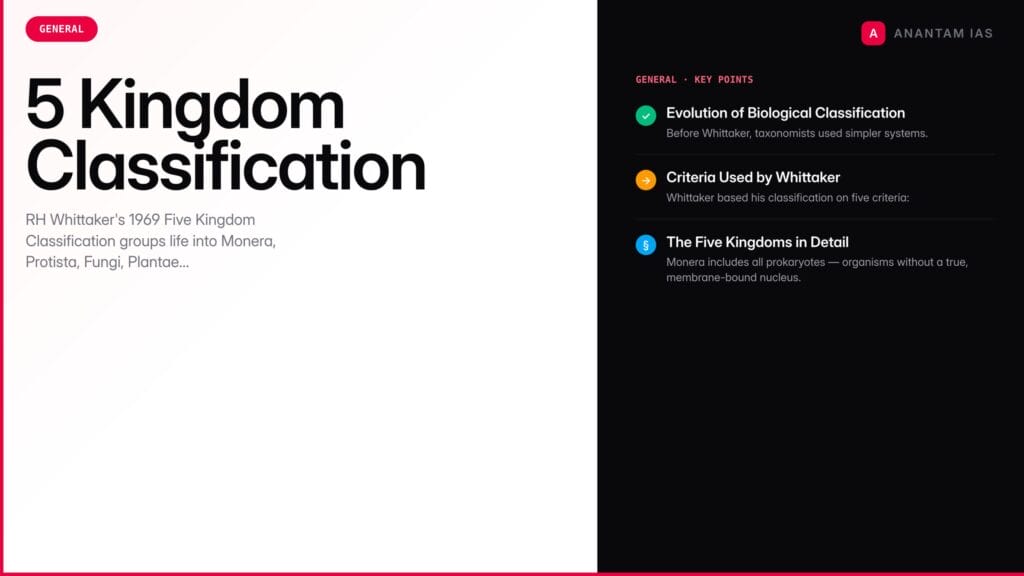
The Five Kingdom Classification proposed by American ecologist Robert Harding Whittaker in 1969 groups all living organisms into five large categories: Monera, Protista, Fungi, Plantae, and Animalia. It replaced the older two- and three-kingdom schemes and became the dominant framework in school and competitive-exam biology because it combined cell structure, body organisation, mode of nutrition, reproduction, and phylogenetic relationships into one coherent system. For UPSC aspirants, Whittaker's scheme is a recurring Prelims Science and Ecology topic and also appears in GS Paper III contexts on biodiversity, microbial diversity, and emerging classification debates.
Evolution of Biological Classification
Before Whittaker, taxonomists used simpler systems.
| System | Proposed by | Year | Kingdoms |
|---|---|---|---|
| Two Kingdom | Carl Linnaeus | 1735 | Plantae, Animalia |
| Three Kingdom | Ernst Haeckel | 1866 | Protista, Plantae, Animalia |
| Four Kingdom | Copeland | 1956 | Monera, Protista, Plantae, Animalia |
| Five Kingdom | R. H. Whittaker | 1969 | Monera, Protista, Fungi, Plantae, Animalia |
| Six Kingdom | Carl Woese | 1977/1990 | Archaebacteria, Eubacteria, Protista, Fungi, Plantae, Animalia |
| Three Domain | Carl Woese | 1990 | Archaea, Bacteria, Eukarya |
Linnaeus's two kingdoms worked while biologists knew only macroscopic life. Microscopy revealed organisms that fit neither. Haeckel added Protista for single-celled organisms. Copeland separated prokaryotes into Monera. Whittaker's major contribution was separating Fungi from plants based on nutrition.
Criteria Used by Whittaker
Whittaker based his classification on five criteria:
- Cell structure — prokaryotic or eukaryotic.
- Body organisation — unicellular or multicellular; tissue-level or organ-level.
- Mode of nutrition — autotrophic (photosynthesis), heterotrophic (ingestion or absorption).
- Mode of reproduction — asexual, sexual, spores.
- Phylogenetic relationships — evolutionary lineage inferred from morphology and life cycles.
The Five Kingdoms in Detail

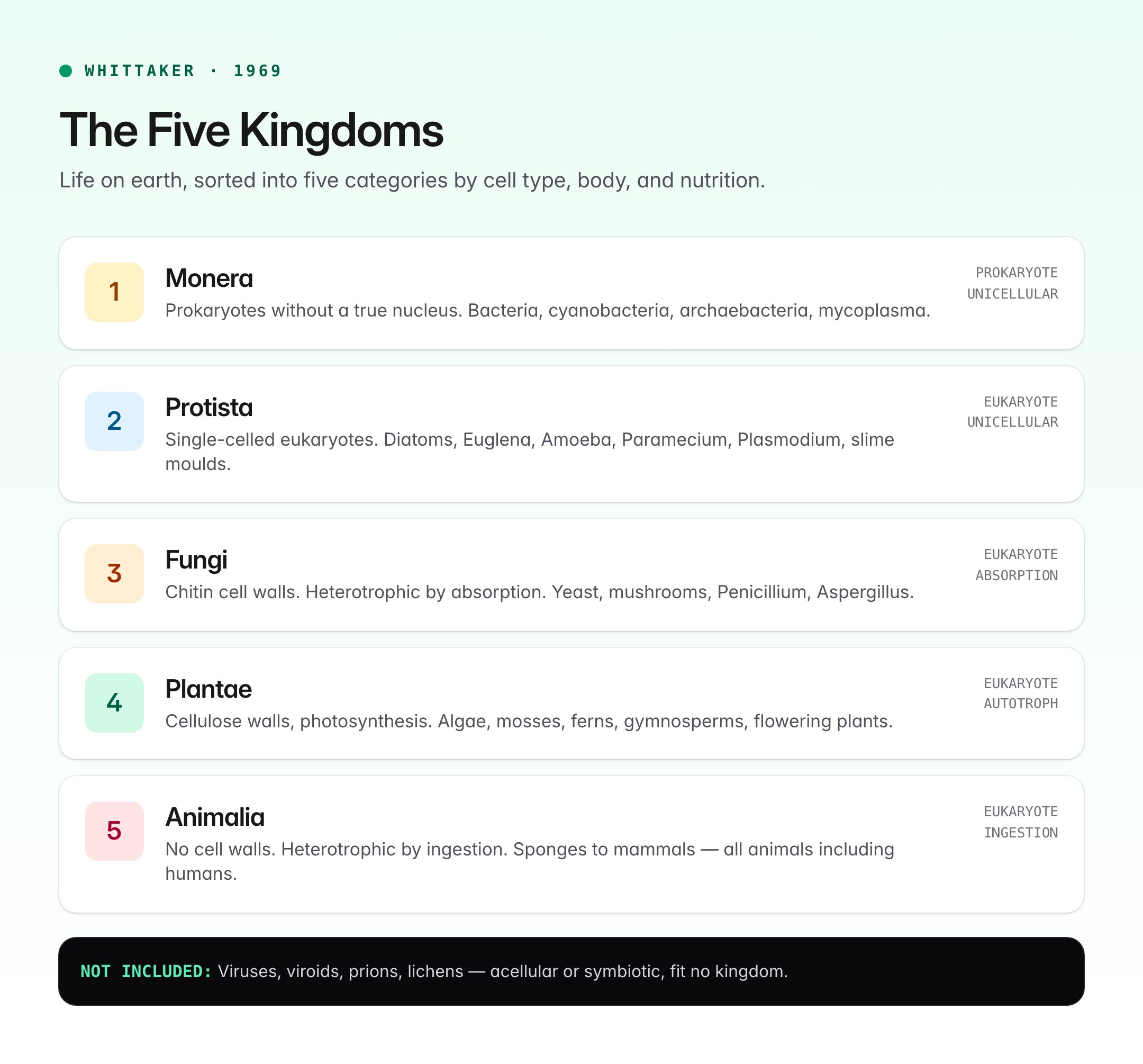
1. Kingdom Monera
Monera includes all prokaryotes — organisms without a true, membrane-bound nucleus.
| Feature | Detail |
|---|---|
| Cell type | Prokaryotic |
| Cell wall | Present (peptidoglycan in bacteria) |
| Body | Unicellular |
| Nucleus | Absent (nucleoid region) |
| Organelles | No membrane-bound organelles |
| Nutrition | Autotrophic (photosynthetic, chemosynthetic) or heterotrophic (saprophytic, parasitic) |
| Reproduction | Mostly binary fission; also conjugation, transduction |
| Examples | Bacteria, Cyanobacteria (blue-green algae), Archaebacteria, Mycoplasma |
Archaebacteria (methanogens, halophiles, thermoacidophiles) are extremophiles and were later separated into their own domain by Woese.
2. Kingdom Protista
Protista contains single-celled eukaryotes, representing the evolutionary link between simple Monera and complex higher kingdoms.
| Feature | Detail |
|---|---|
| Cell type | Eukaryotic |
| Body | Mostly unicellular |
| Nucleus | Present |
| Organelles | Membrane-bound organelles present |
| Nutrition | Autotrophic or heterotrophic |
| Reproduction | Asexual (binary fission) and sexual (syngamy) |
| Examples | Chrysophytes (diatoms, desmids), Dinoflagellates, Euglenoids (Euglena), Slime moulds, Protozoans (Amoeba, Paramecium, Plasmodium) |
Euglena is famous for being both autotrophic (in sunlight) and heterotrophic (in darkness) — a bridge between plant and animal traits.
3. Kingdom Fungi
Whittaker's most important innovation was separating Fungi from plants.
| Feature | Detail |
|---|---|
| Cell type | Eukaryotic |
| Cell wall | Chitin (not cellulose) |
| Body | Mostly multicellular (except yeast); filamentous structure of hyphae forming mycelium |
| Nucleus | Present |
| Nutrition | Heterotrophic by absorption — saprophytes, parasites, symbionts |
| Reproduction | Vegetative (fragmentation, budding), asexual (spores like conidia), sexual (ascospores, basidiospores) |
| Examples | Yeast (Saccharomyces), Mushrooms (Agaricus), Penicillium, Aspergillus, Rhizopus (bread mould) |
Symbiotic associations include lichens (fungi + algae/cyanobacteria) and mycorrhizae (fungi + plant roots), central to soil ecology.
4. Kingdom Plantae
Plantae contains multicellular, photosynthetic eukaryotes.
| Feature | Detail |
|---|---|
| Cell type | Eukaryotic |
| Cell wall | Cellulose |
| Body | Multicellular |
| Nucleus | Present |
| Plastids | Chloroplasts with chlorophyll |
| Nutrition | Autotrophic by photosynthesis (a few parasitic, insectivorous) |
| Reproduction | Alternation of generations (gametophyte and sporophyte) |
| Examples | Algae, Bryophytes (mosses, liverworts), Pteridophytes (ferns), Gymnosperms (pines, cycads), Angiosperms (flowering plants) |
5. Kingdom Animalia
Animalia contains multicellular, heterotrophic eukaryotes without cell walls.
| Feature | Detail |
|---|---|
| Cell type | Eukaryotic |
| Cell wall | Absent |
| Body | Multicellular with tissue, organ, or organ-system level organisation |
| Nucleus | Present |
| Nutrition | Heterotrophic by ingestion (holozoic) |
| Locomotion | Mostly motile |
| Reproduction | Sexual in most; internal embryonic development |
| Examples | Porifera (sponges), Cnidaria, Arthropoda, Mollusca, Echinodermata, Chordata (including mammals) |
Summary Comparison Table
| Feature | Monera | Protista | Fungi | Plantae | Animalia |
|---|---|---|---|---|---|
| Cell type | Prokaryote | Eukaryote | Eukaryote | Eukaryote | Eukaryote |
| Cell wall | Peptidoglycan | Variable | Chitin | Cellulose | Absent |
| Body | Unicellular | Mostly unicellular | Multicellular (mostly) | Multicellular | Multicellular |
| Nutrition | Both auto and hetero | Both | Heterotrophic (absorption) | Autotrophic (photosynthesis) | Heterotrophic (ingestion) |
| Nucleus | Absent | Present | Present | Present | Present |
| Chlorophyll | Some (cyanobacteria) | Some | Absent | Present | Absent |
| Reproduction | Binary fission mainly | Both | Spores, budding, sexual | Alternation of generations | Sexual mainly |
Advantages of the Five Kingdom System
- Separated Fungi from Plantae based on nutrition (absorption vs photosynthesis) and cell wall composition (chitin vs cellulose).
- Grouped prokaryotes in a single kingdom (Monera) recognising their fundamentally different cell structure.
- Accommodated unicellular eukaryotes in Protista, distinct from multicellular life.
- Reflected evolutionary relationships better than previous schemes.
- Combined multiple criteria rather than relying only on morphology.
Limitations of the Five Kingdom System
- Monera is too heterogeneous — lumps archaebacteria with eubacteria despite huge biochemical differences.
- Protista is a grab-bag of diverse, only distantly related unicellular eukaryotes.
- Viruses, viroids, prions, and lichens are not included. They are acellular or symbiotic and do not fit any kingdom.
- Autotroph/heterotroph distinction becomes blurred in mixotrophic organisms such as Euglena.
- Cyanobacteria (photosynthetic prokaryotes) sit oddly in Monera alongside non-photosynthetic bacteria.
Later Modifications
| Year | Scientist | Change |
|---|---|---|
| 1977/1990 | Carl Woese | Six-kingdom system: split Monera into Archaebacteria and Eubacteria. |
| 1990 | Carl Woese | Three-domain system: Archaea, Bacteria, Eukarya, based on ribosomal RNA sequencing. |
| 1998 | T. Cavalier-Smith | Proposed six kingdoms (Bacteria, Protozoa, Chromista, Plantae, Fungi, Animalia). |
Modern molecular phylogenetics increasingly favours domain-based frameworks, but Whittaker's five-kingdom system remains the most widely taught and tested.
Quick Revision Table
| Point | Fact |
|---|---|
| Proposed by | R. H. Whittaker |
| Year | 1969 |
| Kingdoms | Monera, Protista, Fungi, Plantae, Animalia |
| Criteria | Cell type, body organisation, nutrition, reproduction, phylogeny |
| First to separate | Fungi from Plantae |
| Excluded | Viruses, viroids, lichens, prions |
| Replaced | Two and three kingdom systems |
| Succeeded by | Six kingdom (Woese 1977) and Three Domain (Woese 1990) |
UPSC Relevance
The Five Kingdom Classification is a high-frequency Prelims topic, usually through matching questions on kingdom–example pairs, cell wall composition, or nutrition type. Remember that Whittaker proposed it in 1969, that Fungi have chitin cell walls, that cyanobacteria belong to Monera, and that viruses are not included. For Mains GS Paper III, the topic connects to biodiversity, taxonomy, conservation of microbial diversity, and emerging fields like metagenomics. Current events link the system to extremophile research, gut microbiome studies, and the role of fungi in carbon cycles. In GS Paper I (Physical Geography / Ecology), kingdom-level understanding supports questions on food webs, decomposers, nitrogen fixation by Monera, and primary production by photosynthetic protists and plants. For Science and Technology, aspirants should also track the three-domain system, CRISPR applications in prokaryotes, and debates around reclassifying Protista using genomic data — all rooted in Whittaker's foundational framework.
Tell Google you want more of this.
Add Anantam IAS as a preferred sourceOne tap, and this site shows up more often in your own Top Stories, AI Overviews and AI Mode. Remove it any time.