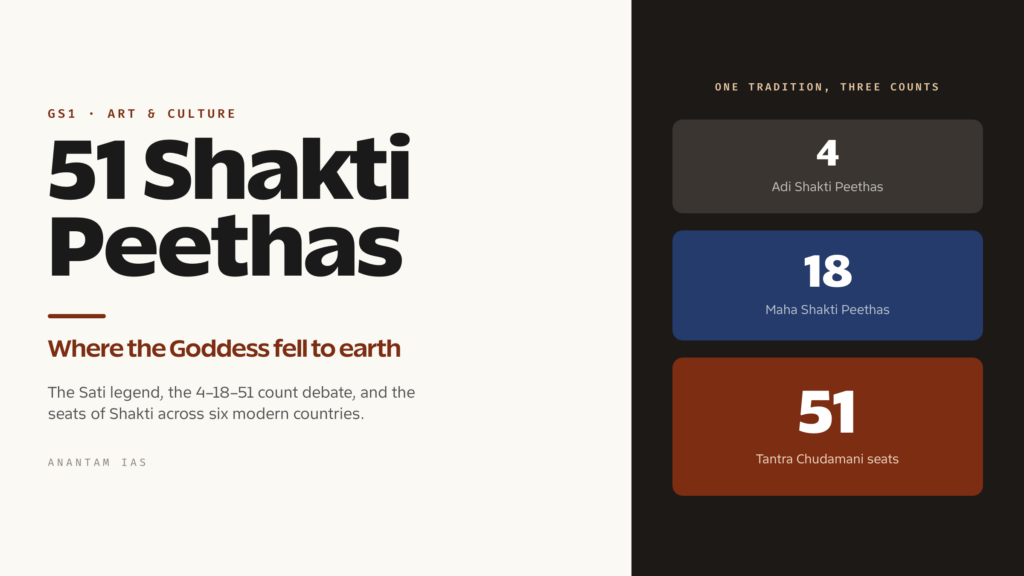
Ask three people how many Shakti Peethas there are and you’ll get three numbers: 4, 18, 51. None of them is wrong, and that’s exactly what trips up most aspirants. The Shakti Peethas are not a fixed government list. They’re a layered tradition that grew over centuries, and different sacred texts count them differently.
A Shakti Peetha (literally “seat of the Goddess”) is a place where, by tradition, a part of the goddess Sati’s body is said to have fallen to earth. Each site became a shrine where the divine feminine, Shakti, is worshipped alongside a guardian form of Shiva called the Bhairava. For UPSC, this sits squarely in GS1 Art and Culture, and individual peethas like Kamakhya in Assam keep surfacing as places in news. Get the structure right once and you never have to re-learn it.
The Legend Behind the Shakti Peethas
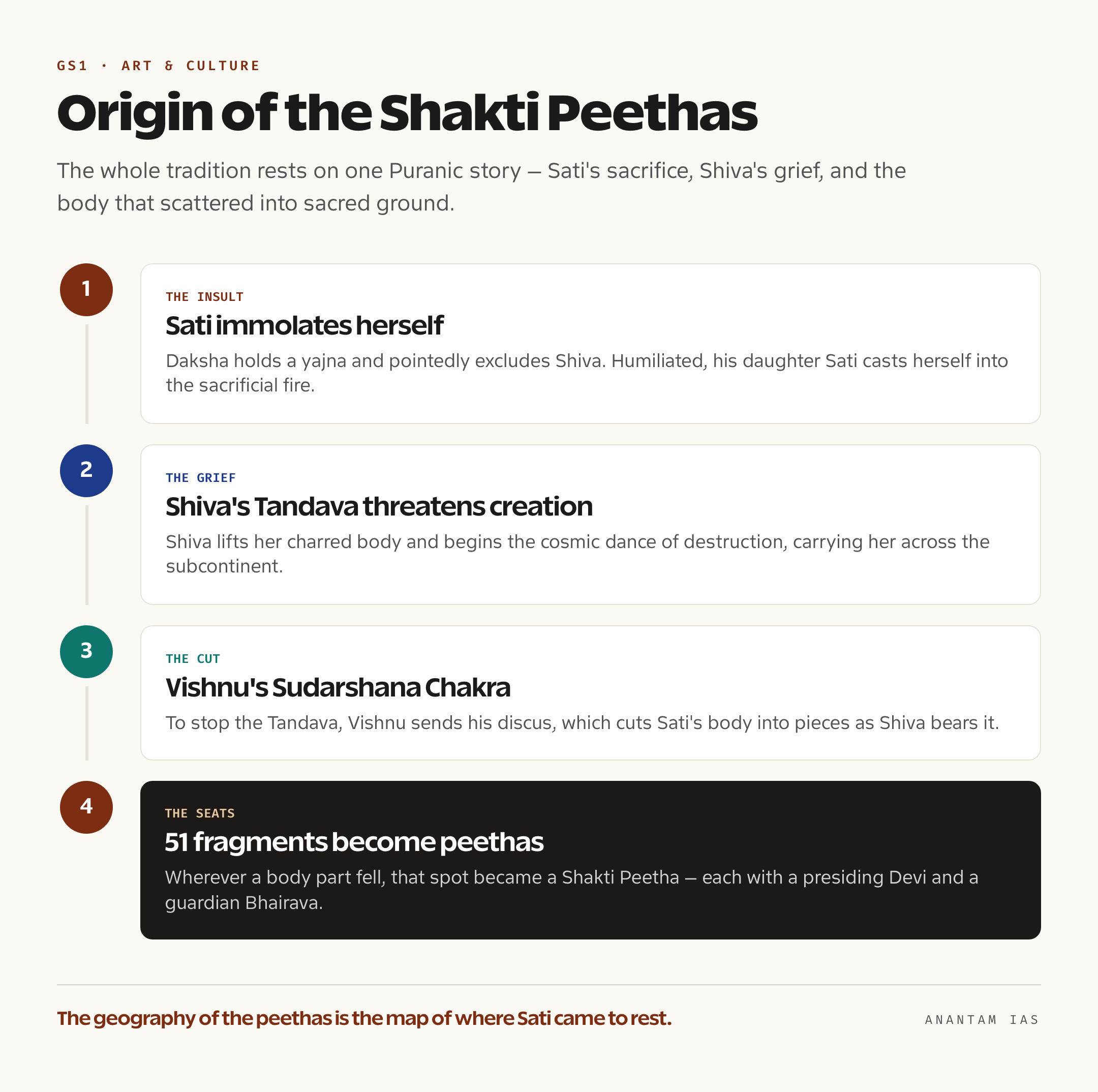
The whole tradition rests on one story from the Puranas, told here as the mythology it is. Sati, the daughter of King Daksha, married Shiva against her father’s wishes. When Daksha held a great fire sacrifice, a yajna, he deliberately did not invite Shiva. Sati attended anyway, was publicly insulted, and in her grief and humiliation she immolated herself in the sacrificial fire. That self-sacrifice is what gives her the name Sati.
Shiva, devastated, lifted her charred body and began the Tandava, the cosmic dance of destruction, threatening to unmake creation itself. To stop him, Vishnu sent his discus, the Sudarshana Chakra, which cut Sati’s body into pieces as Shiva carried it across the subcontinent. Wherever a body part fell, that spot became sacred ground, a Shakti Peetha. So the geography of the peethas is, in the tradition’s own logic, the map of where Sati’s body came to rest.
Two things make this story do real work. First, the Shakti and Bhairava pairing: each peetha has a presiding goddess (the Shakti) and a guardian form of Shiva (the Bhairava), so the site holds both the feminine power and its protector. Second, the body-part association: every peetha is identified with a specific part of Sati, from her tongue at Jwalamukhi to her toes at Kalighat. This is the detail examiners love, because it forces you to remember the peetha, the place, and the part together. If you want to see how this kind of devotional geography connects to the wider story of Indian sacred space, our explainer on temple architecture in India pairs naturally with this topic.
Why the Count Varies: 4, 18 and 51
Here’s the direct answer to the question everyone asks: the number changes because different texts and traditions drew the boundary in different places. There is no single canonical count, and that’s the whole secret to not getting confused.
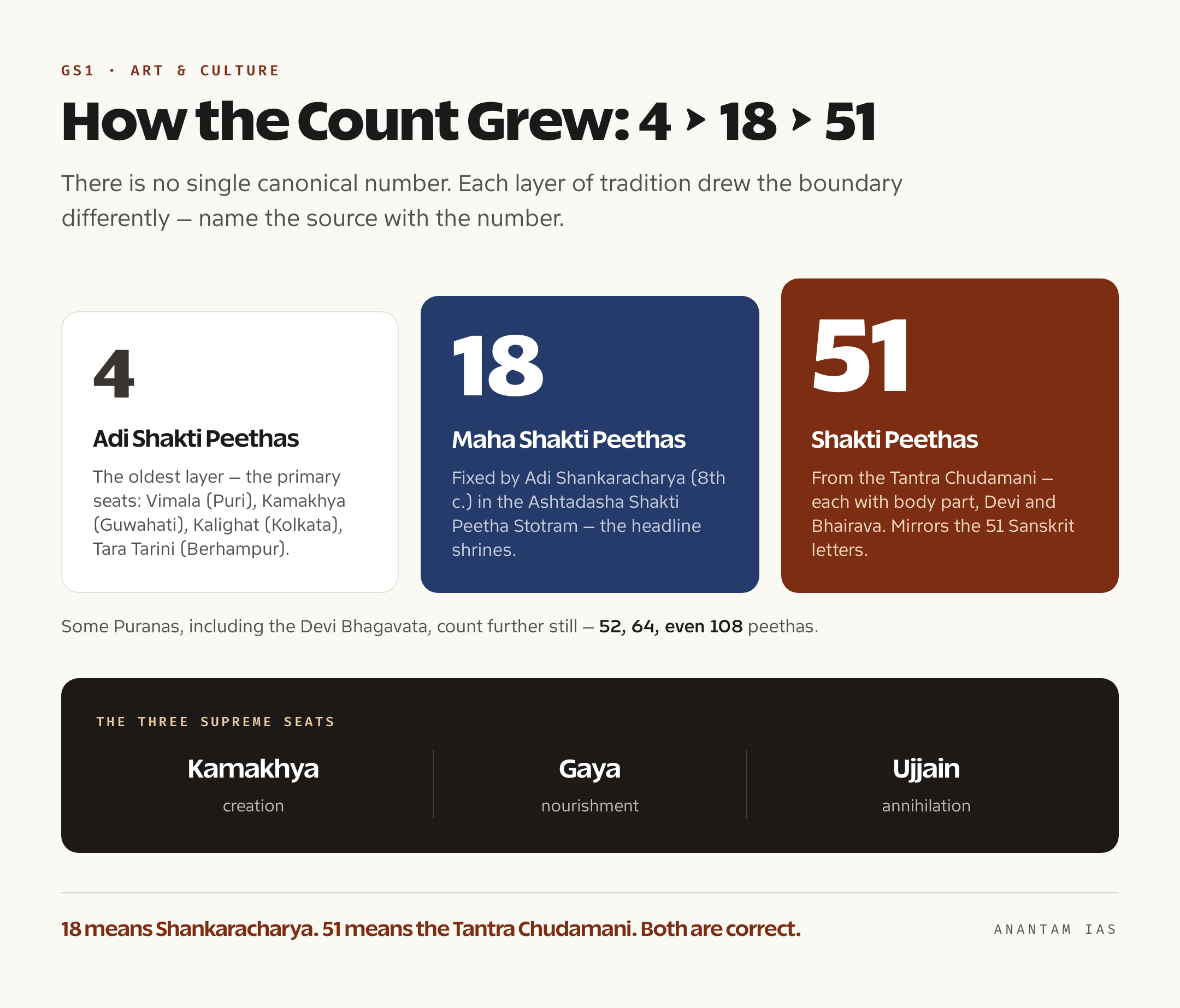
The smallest and oldest layer is the 4 Adi Shakti Peethas, the primary seats. The most widely cited four are Vimala at Puri (Odisha), Kamakhya at Guwahati (Assam), Kalighat at Kolkata (West Bengal), and Tara Tarini near Berhampur (Odisha). These are treated as the original power centres from which the tradition expanded.
The next layer is the 18 Maha Shakti Peethas, fixed for posterity by Adi Shankaracharya in the 8th century in his short hymn, the Ashtadasha Shakti Peetha Stotram (“ashtadasha” simply means eighteen). In just a handful of verses he names eighteen goddesses and their seats, from Shankari in Sri Lanka and Kamakshi at Kanchipuram in the south to Vishalakshi at Varanasi and Sharada in Kashmir in the north. Three of these are singled out as supreme because they symbolise the Goddess’s three core functions: Kamakhya (creation), Gaya (nourishment), and Ujjain (annihilation).
The broadest commonly used layer is the 51 Shakti Peethas, drawn mainly from the Tantra Chudamani (also called the Pithanirnaya or Mahapithanirupana), a Shakta tantric text that lists fifty-one seats, each with its body part, Shakti and Bhairava. And it doesn’t stop there: some Puranas, including the Devi Bhagavata, mention 52, 64 or even 108 peethas. The 51 figure caught on partly because it mirrors the 51 letters of the Sanskrit alphabet, each treated as a syllable of the Goddess. So when a source says 51, it usually means the Tantra Chudamani set; when it says 18, it means Shankaracharya’s list. Both are correct, just different maps.
The Most Important Shakti Peethas to Know
If you only memorise a handful, make them these, because they show up most often in current affairs, in the Ashtadasha list, or both. The pattern to hold onto is simple: peetha, place, body part, deity.
Kamakhya (Guwahati, Assam) is the most famous of all, associated with Sati’s yoni (womb), making it the seat of creative and menstrual energy. Its annual Ambubachi Mela regularly makes the news. Kalighat (Kolkata) marks the toes of Sati’s right foot and is the source of the name Kolkata; its goddess is Dakshina Kali with Bhairava Nakuleshwar. Vishalakshi (Varanasi) sits beside the Ganga and is tied to Sati’s earring, with Kala Bhairav as guardian.
In the hills, Jwala Ji or Jwalamukhi (Kangra, Himachal Pradesh) is unique: there’s no idol, only natural flames burning from the rock, marking where Sati’s tongue fell. Across the borders the tradition stretches further. Hinglaj Mata (Balochistan, Pakistan) marks the Brahmarandhra (crown of the head) and is the largest Hindu pilgrimage site in Pakistan, drawing huge crowds for the annual Hinglaj Yatra. Sharada Peeth in Pakistan-administered Kashmir marks the right hand and lies in ruins near the Line of Control; a new Sharada temple was consecrated in Kupwara, Jammu and Kashmir, in 2023. To see how border geography keeps shaping these places-in-news, our note on places in the news for UPSC is a useful companion.
| Peetha | Location | Body part of Sati | Shakti (Devi) | Bhairava |
|---|---|---|---|---|
| Kottari (Hinglaj Mata) | Hinglaj, Balochistan, Pakistan | Crown of head (Brahmarandhra) | Hinglaj / Kottari | Bhimalochana |
| Sharada | Pakistan-administered Kashmir | Right hand | Sharada (Saraswati) | Sharada Bhairava |
| Mahamaya | Amarnath, Jammu & Kashmir | Throat | Mahamaya | Trisandhyeshwar |
| Jwala Ji (Jwalamukhi) | Kangra, Himachal Pradesh | Tongue | Jwalamukhi (flame form) | Unmatta |
| Brajeshwari | Kangra, Himachal Pradesh | Left breast | Brajeshwari | Lal Bhairav |
| Chhinnamastika | Chintpurni, Himachal Pradesh | Feet | Chhinnamastika | Rudra Mahadev |
| Bhadrakali | Kurukshetra, Haryana | Ankle | Bhadrakali | Sthanu |
| Tripuramalini | Jalandhar, Punjab | Left breast | Tripuramalini | Bhishan |
| Vishalakshi | Varanasi, Uttar Pradesh | Earring | Vishalakshi | Kala Bhairav |
| Panchasagar (Varahi) | Varanasi region, Uttar Pradesh | Lower teeth | Varahi | Vigneshwar |
| Lalita / Madhaveshwari | Prayagraj, Uttar Pradesh | Fingers | Lalita / Madhaveshwari | Bhava |
| Katyayani | Vrindavan, Uttar Pradesh | Hair | Katyayani | Bhutesh |
| Shivani | Ramgiri, Uttar Pradesh | Right breast | Shivani | Chanda |
| Avanti | Ujjain, Madhya Pradesh | Upper lip | Avanti / Mahakali | Lambakarna |
| Mangal Chandika | Ujjain, Madhya Pradesh | Elbow | Mangal Chandika | Kapilambar |
| Sharada (Maihar) | Maihar, Madhya Pradesh | Necklace | Sharada | Kala Bhairav |
| Kaalmadhav | Amarkantak, Madhya Pradesh | Left hip | Kali | Asitanga |
| Narmada (Shona) | Amarkantak, Madhya Pradesh | Right hip | Shona / Narmada | Bhadrasen |
| Danteshwari | Bastar (Dantewada), Chhattisgarh | Tooth | Danteshwari | Kapal Bhairav |
| Tripura Sundari | Udaipur, Tripura | Right foot | Tripura Sundari | Tripuresh |
| Kamakhya | Guwahati, Assam | Yoni (womb) | Kamakhya | Umananda |
| Jayanti | Nartiang, Meghalaya | Left thigh | Jayanteshwari | Kramadishwar |
| Tara Tarini | Ganjam, Odisha | Both breasts | Tara and Tarini | Someshwar / Udayeshwar |
| Vimala (Bimla) | Puri, Odisha | Feet | Vimala | Jagannath |
| Kalighat | Kolkata, West Bengal | Toes of right foot | Dakshina Kali | Nakuleshwar |
| Yogadya | Khirgram, West Bengal | Right big toe | Yogadya | Ksheerkhandak |
| Bahula | Ketugram, West Bengal | Left arm | Bahula | Bhiruk |
| Kankalitala | Bolpur, West Bengal | Waist (pelvic bone) | Devgarbha / Kankaleshwari | Ruru |
| Phullara | Attahas, West Bengal | Lips | Phullara | Vishwesh |
| Ratnavali | Hooghly, West Bengal | Right shoulder | Kumari | Ghanteshwar |
| Mahishasuramardini | Bakreshwar, Birbhum, West Bengal | Between the eyebrows | Mahishasuramardini | Vakranath |
| Nandikeshwari | Sainthia, Birbhum, West Bengal | Necklace | Nandini / Nandikeshwari | Nandikeshwar |
| Kiriteshwari | Murshidabad, West Bengal | Crown | Kiriteshwari / Vimala | Samvarta |
| Bargabhima | Tamluk, Purba Medinipur, West Bengal | Left ankle | Bhimarupa / Bhimkali | Sarvananda |
| Bhramari (Saptashrungi) | Nashik, Maharashtra | Chin | Bhramari / Saptashrungi | Vikritaksha |
| Mahakali (Kalika) | Pavagadh, Gujarat | Right toe | Kalika | Lakulish |
| Chandrabhaga | Prabhas (Veraval), Gujarat | Stomach | Chandrabhaga | Vakratunda |
| Bhramaramba | Srisailam, Andhra Pradesh | Neck | Bhramaramba | Samvaranand |
| Vishweshwari (Godavari) | Rajahmundry, Andhra Pradesh | Both cheeks | Vishweshwari / Rakini | Dandapani / Vatsanabh |
| Chamundeshwari | Mysuru, Karnataka | Hair | Chamundeshwari | Mahabaleshwar |
| Devgarbha (Kamakshi) | Kanchipuram, Tamil Nadu | Navel / skeleton | Kamakshi | Ruru |
| Sarvani (Kanyashram) | Kanyakumari, Tamil Nadu | Spine / back | Sarvani | Nimish |
| Gandaki Chandi | Muktinath, Nepal | Right cheek | Gandaki Chandi | Chakrapani |
| Guhyeshwari | Kathmandu, Nepal | Both knees | Guhyeshwari / Mahamaya | Kapali |
| Dakshayani | Manasarovar, Tibet | Right hand | Dakshayani / Manasa | Amar |
| Bhavanipur | Karatoya (Bogra), Bangladesh | Left anklet | Aparna | Vaman |
| Jeshoreshwari | Jessore, Bangladesh | Palms and soles | Jeshoreshwari | Chanda |
| Sugandha | Shikarpur (Barisal), Bangladesh | Nose | Sugandha / Sunanda | Tryambak |
| Shivaharkaray | Karachi, Pakistan | Third eye | Mahishasuramardini | Krodhish |
| Chattal Bhavani | Chittagong, Bangladesh | Right arm | Bhavani | Chandrashekhar |
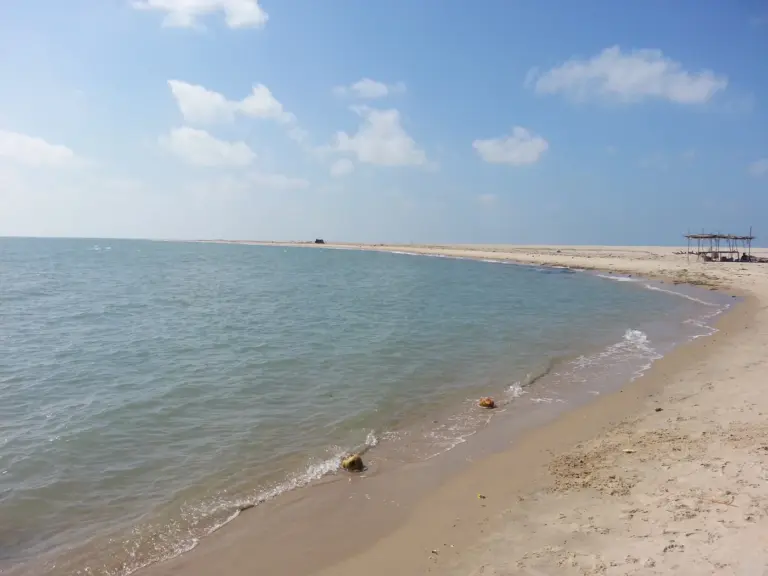
| Indrakshi | Nainativu, Sri Lanka | Anklet | Indrakshi / Nagapooshani | Rakshaseshwar |
A few entries are genuinely contested: regional traditions in Bengal sometimes count 52 by splitting or duplicating sites, and texts disagree on whether the Sri Lanka seat is at Nainativu or Trincomalee. Where a peetha is debated, note it rather than treating one version as final, because examiners reward precision over false certainty. For the broader culture context this fits into, our Indian classical dances explainer covers another high-yield GS1 art and culture topic.
The Spread Across the Subcontinent
The peethas map the cultural sphere of the goddess across six modern countries, and that geographic spread is itself the exam point. The body of Sati, in the tradition, did not fall within one nation’s borders, because those borders didn’t exist; it scattered across what is now India, Nepal, Bangladesh, Pakistan, Sri Lanka and Tibet (China).
Most peethas lie in India, with a heavy cluster in West Bengal and the eastern region, reflecting Bengal’s strong Shakta tradition. Beyond India you get Hinglaj and Shivaharkaray in Pakistan, Sharada in Pakistan-administered Kashmir, Sugandha, Bhavanipur, Jeshoreshwari and Chattal Bhavani in Bangladesh, Gandaki and Guhyeshwari in Nepal, Dakshayani at Manasarovar in Tibet, and Indrakshi in Sri Lanka. This transnational footprint is why the Shakti Peethas come up not just in art and culture but in questions about shared cultural heritage and cross-border pilgrimage diplomacy, as with the reopening of the Sharada corridor.
How to Study This for UPSC
Treat this as a high-yield Prelims topic first and a Mains garnish second. The single most tested fact is the count debate, so lock in 4 (Adi), 18 (Ashtadasha, by Adi Shankaracharya), and 51 (Tantra Chudamani) before anything else.
For Prelims, focus your memory on the outliers and the famous ones, not all 51. Know the peethas outside India (Hinglaj, Sharada, Sugandha, Dakshayani, Indrakshi) cold, because foreign-location matches are the easiest questions to set. Learn the signature body-part pairings that get reused: tongue at Jwalamukhi, yoni at Kamakhya, toes at Kalighat, head at Hinglaj. And remember the creation-nourishment-annihilation trio of Kamakhya, Gaya and Ujjain. Skip rote-learning the full Bhairava column; it’s rarely asked at that depth.
For Mains, you almost never need the list itself. What you need is the theme: Shakti Peethas as evidence of a pan-Indian Shakta tradition, of tantra’s influence, and of cultural continuity across modern political borders. One or two well-placed examples in an art-and-culture or heritage answer is plenty. If you’re building a system for retaining this kind of factual culture content, our UPSC preparation strategy guide shows how to slot it into revision cycles instead of cramming.
Frequently Asked Questions
How many Shakti Peethas are there, 51 or 52? Both numbers appear in tradition. The Tantra Chudamani lists 51, while some Bengali and Puranic traditions count 52 by splitting or adding sites. The Devi Bhagavata even mentions 64 and 108. There is no single official count, so always name the source along with the number.
What is the difference between the 18 and 51 Shakti Peethas? The 18 Maha Shakti Peethas come from Adi Shankaracharya’s Ashtadasha Shakti Peetha Stotram and are the most revered subset. The 51 come mainly from the Tantra Chudamani and form a broader list. The 18 are essentially the headline shrines within the larger network.
Which is the most important Shakti Peetha? Kamakhya in Assam is the most prominent, associated with the goddess’s womb and creative power, and counted among both the 4 Adi and the 18 Maha Peethas. Kamakhya, Gaya and Ujjain together are treated as supreme.
Are all Shakti Peethas in India? No. They span six modern countries: India, Nepal, Bangladesh, Pakistan, Sri Lanka and Tibet (China). Examples outside India include Hinglaj and Shivaharkaray in Pakistan, Sugandha in Bangladesh, and Dakshayani at Manasarovar in Tibet.
Who fixed the list of 18 Shakti Peethas? Adi Shankaracharya, the 8th-century philosopher, named the eighteen in his Ashtadasha Shakti Peetha Stotram, a short hymn that lists each goddess and her seat.
Practice Questions
Prelims MCQs
- The legend of the Shakti Peethas is associated with the body of which figure? (a) Parvati (b) Sati (c) Lakshmi (d) Saraswati. Answer: (b) Sati, daughter of Daksha, whose body parts are said to have fallen at the peethas after Vishnu’s chakra cut it.
- The 18 Maha Shakti Peethas were fixed in a stotram composed by whom? (a) Tulsidas (b) Ramanuja (c) Adi Shankaracharya (d) Madhvacharya. Answer: (c) Adi Shankaracharya composed the Ashtadasha Shakti Peetha Stotram in the 8th century.
- Which Shakti Peetha is located in Balochistan, Pakistan, and marks the crown of Sati’s head? (a) Sharada (b) Shivaharkaray (c) Hinglaj Mata (d) Sugandha. Answer: (c) Hinglaj Mata, the largest Hindu pilgrimage site in Pakistan.
- The Jwala Ji (Jwalamukhi) Shakti Peetha in Himachal Pradesh is unique because it: (a) has no idol, only natural flames (b) is underwater (c) lies in Nepal (d) marks Sati’s heart. Answer: (a) It is worshipped as natural flames marking where Sati’s tongue fell.
- Consider the trio of Kamakhya, Gaya and Ujjain. They are regarded as supreme because they symbolise: (a) the three Vedas (b) creation, nourishment and annihilation (c) the three gunas (d) past, present and future. Answer: (b) Kamakhya (creation), Gaya (nourishment) and Ujjain (annihilation).
Mains Practice Questions
- The Shakti Peethas reflect both the spread of the Shakta tradition and the cultural unity of the Indian subcontinent. Discuss. (15 marks, 250 words)
- Examine how the legend and geography of the Shakti Peethas illustrate the assimilative character of Hindu sacred traditions. (15 marks, 250 words)
- “The Shakti Peethas are a map of shared heritage across modern political borders.” Evaluate this statement with examples. (10 marks, 150 words)
- Trace the role of Adi Shankaracharya in consolidating devotional traditions, with reference to the Ashtadasha Shakti Peetha Stotram. (10 marks, 150 words)
- Discuss the significance of tantric texts such as the Tantra Chudamani in shaping the sacred geography of the Shakti Peethas. (15 marks, 250 words)
The trap with this topic is trying to memorise all fifty-one peethas in one sitting; nobody retains that, and the exam doesn’t reward it. Anchor yourself to the 4-18-51 logic, the famous shrines, and the foreign-location outliers, and revisit the table only to sharpen recall before Prelims. Do that, and a topic that looks like an overwhelming list of names becomes a clean, scoring piece of your art and culture preparation.
Tell Google you want more of this.
Add Anantam IAS as a preferred sourceOne tap, and this site shows up more often in your own Top Stories, AI Overviews and AI Mode. Remove it any time.