You just decided to attempt the UPSC Civil Services Exam, and the first thing the internet did was overwhelm you. Booklists with forty titles, toppers swearing by opposite strategies, coaching ads promising a rank if you start today. The truth is simpler and harder: the UPSC Civil Services Exam (CSE) is not a difficult exam in the sense of needing genius. It’s a long exam that rewards a small set of right habits repeated for a year or more. Most people who fail don’t lack intelligence. They lack a clear sequence and the patience to stick with it.
This guide is the map, not the whole journey. It tells you what the exam actually is, the order in which to start, which books to read and which to skip, and how to build a weekly rhythm you can sustain. It’s written for someone at day zero. Where a topic deserves its own deep dive, this page points you to one, so you can go as deep as you need without drowning on day one.
Understand the Exam Before You Buy a Single Book
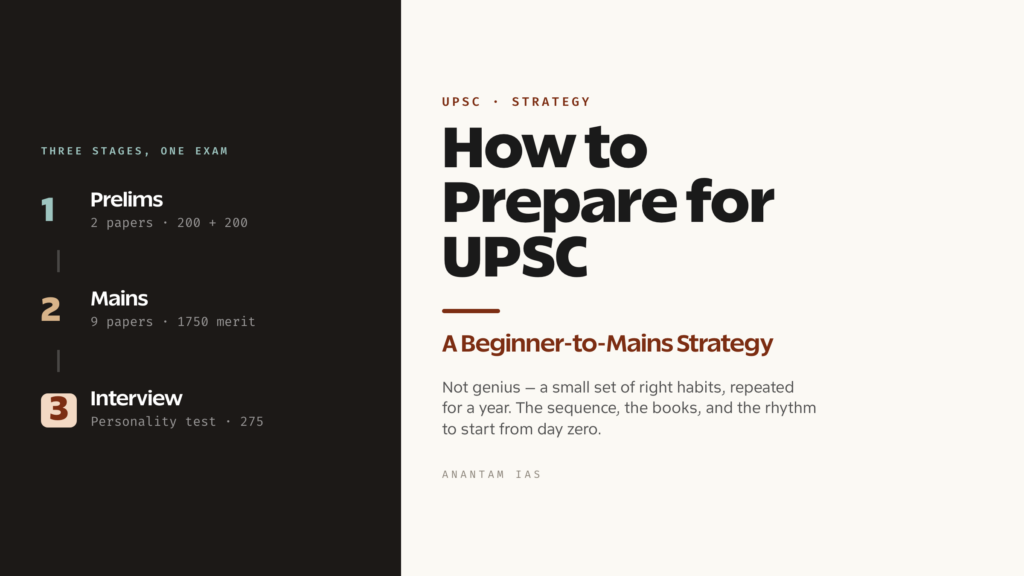
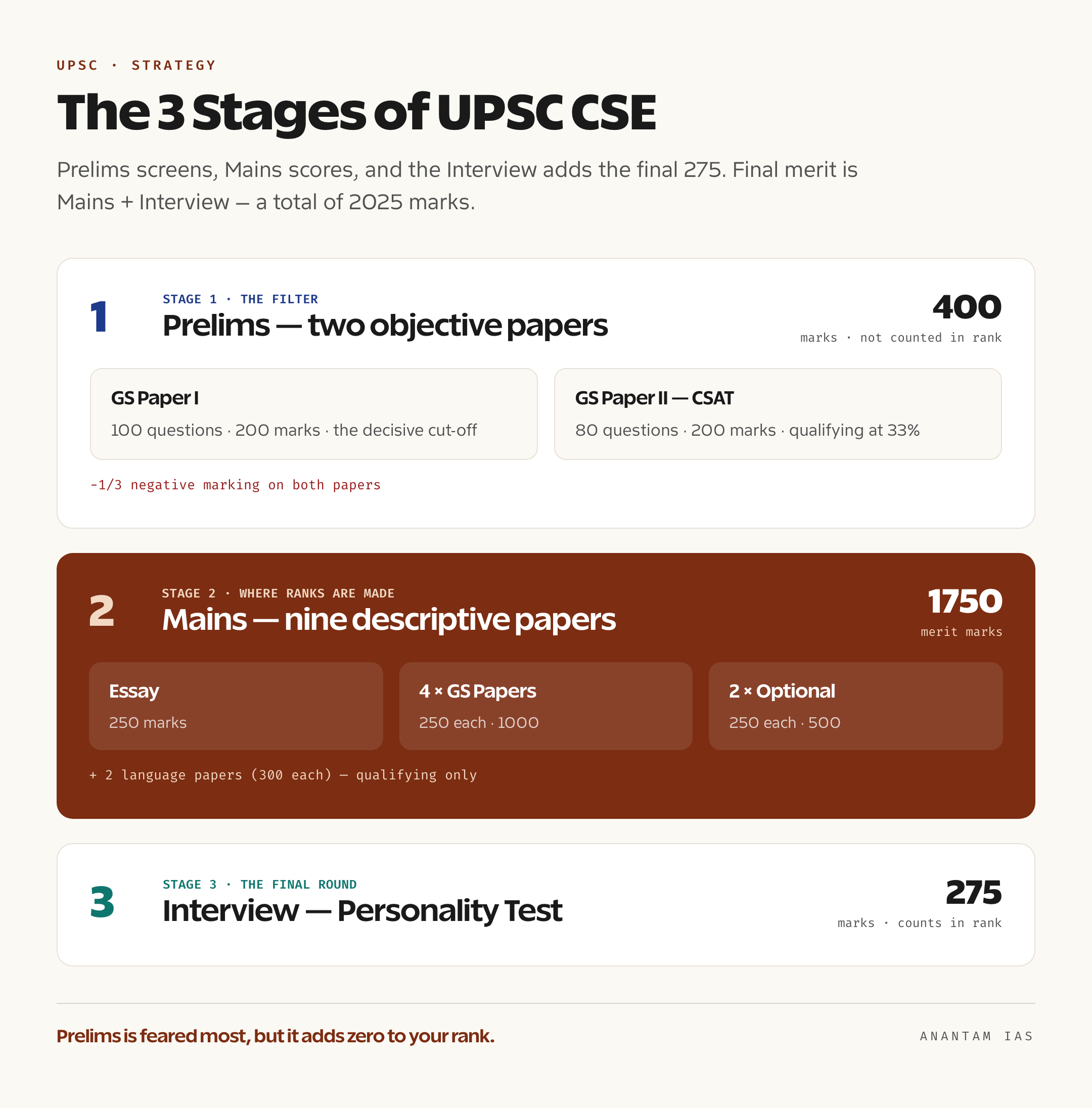
The UPSC CSE has three stages, and you cannot reach the next without clearing the one before it. Prelims is a filter, Mains is where you actually score, and the Interview is the final 275 marks. Beginners waste months because they study for “UPSC” as a vague blob instead of studying for these three very different tests.
Prelims is two objective papers held on one day. GS Paper I has 100 questions for 200 marks and decides your fate, its cut-off is what you must cross. GS Paper II, the CSAT, has 80 questions for 200 marks but is only qualifying: you just need 33 percent (about 66 marks) to pass it. Both papers carry a one-third negative marking penalty, so reckless guessing hurts. Prelims marks do not count toward your final rank. It is purely a gate.
Mains is where ranks are made. It is nine descriptive papers. Two are language papers (one English, one in a listed Indian language), each 300 marks and only qualifying, so they don’t add to your merit, but if you fail them the rest of your papers aren’t even evaluated. The seven that count are the Essay (250), four General Studies papers (250 each), and two Optional subject papers (250 each). That’s 1750 marks of written exam. The Interview, or Personality Test, is 275 marks, and your final merit is Mains plus Interview, a total of 2025 marks. Notice what this means: the GS papers and the optional together carry more weight than anything else, and Prelims, the stage everyone fears most, contributes zero to your rank.
The four GS papers map to clear territory. GS-I is history, art and culture, geography, and society. GS-II is polity, the Constitution, governance, social justice, and international relations. GS-III is economy, agriculture, science and technology, environment, internal security, and disaster management. GS-IV is ethics, integrity, and aptitude, a paper of theory plus case studies that trips up everyone the first time. The Essay paper asks you to write two essays from given topics. The optional is one subject you choose and study in real depth.
A realistic first attempt takes 12 to 18 months of honest preparation. You also need to clear the eligibility bar: a graduate degree, age 21 to 32 for the general category on the cut-off date (with relaxations for reserved categories and persons with disabilities), and a cap of six attempts for the general category (nine for OBC, unlimited up to the age limit for SC/ST). For the full marks structure, durations, and qualifying rules, our UPSC exam pattern and syllabus guide lays it all out paper by paper.
Start With NCERTs, in the Right Order
Before any standard book, read the NCERT school textbooks. This is the single most repeated piece of advice from toppers, and it’s right. NCERTs are written in plain language, cover the basics the entire syllabus assumes you already know, and quietly answer a surprising number of Prelims questions on their own. If you skip them and jump straight to thick reference books, you’ll keep hitting concepts you half-understand, and that gap shows up in both Prelims accuracy and Mains depth.
The order matters because subjects build on each other. A sensible sequence is below. Read each book once, fast, for understanding rather than memorisation.
| Subject | NCERT classes to read | Why first |
|---|---|---|
| Geography | Class 6 to 12 | Builds the spatial vocabulary every other subject borrows |
| History | Class 6 to 12 (Themes in Indian History for seniors) | Ancient, medieval, modern, in narrative form |
| Polity | Class 9 to 12 (Political Science) | Plain-English base before Laxmikanth |
| Economics | Class 9 to 12 | Defines GDP, inflation, banking before the heavy books |
| Science | Class 6 to 10 | Covers the everyday science Prelims loves |
Don’t make notes on the NCERTs the first time. Just read, underline lightly, and move on. The goal at this stage is to feel comfortable with the language of each subject, not to capture every fact. That’s the whole secret of the foundation phase: speed and coverage over perfection. You’ll return with standard books and the second pass will stick far better because the scaffolding is already there.
Build the Core With Standard Books, One Subject at a Time
Once NCERTs are done, you move to the standard books, the ones that actually carry you through Prelims and most of Mains GS. The mistake here is buying everything at once and reading nothing fully. Pick one book per subject, finish it, revise it, then add the next. Resist the urge to hoard. A shelf of unread books is not preparation, it’s anxiety with a spine.
Here is a tight, defensible starter set. For each subject I’ve named one pick and why, because beginners need a decision, not a menu.
| Subject | The one book to start with | Why this pick |
|---|---|---|
| Polity | Indian Polity by M. Laxmikanth | The undisputed standard; structured exactly like the syllabus |
| Modern History | A Brief History of Modern India by Spectrum | Concise, fact-dense, perfect for Prelims and GS-I |
| Geography | NCERTs plus Certificate Physical and Human Geography by G.C. Leong | Leong fills the physical geography that NCERTs leave thin |
| Economy | NCERTs plus Indian Economy by Ramesh Singh or Sanjeev Verma | Sanjeev Verma is gentler for beginners; Ramesh Singh is the deeper reference |
| Environment | Shankar IAS Environment | The default; covers ecology, biodiversity, and climate compactly |
| Current Affairs | One monthly magazine plus a daily newspaper | Your living textbook for the next year |
On the two big choices people agonise over: for Polity, read Laxmikanth, full stop, it’s the rare book where there’s genuine consensus, and our deep guide to Indian Polity by Laxmikanth shows you how to read it chapter by chapter rather than cover to cover. For Economy, if numbers and theory intimidate you, start with Sanjeev Verma and graduate to Ramesh Singh later; if you’re comfortable, go straight to Ramesh Singh. For the polity decision specifically, our best book for Indian Polity comparison settles the debate with reading order.
Read each standard book at least twice before the exam. The first read is to understand. The second, closer to Prelims, is to retain. A book read once and never revisited is mostly forgotten by exam day, and that’s not a failure of intelligence, it’s how memory works.
Make the Newspaper and Notes Your Daily Engine
Current affairs is not a subject you finish, it’s a habit you keep for the whole journey, and it bleeds into every GS paper, the Essay, and the Interview. Beginners get this wrong in two ways: they either ignore the newspaper for months and panic later, or they read it for three hours and copy out everything, which is just slow transcription. The right way sits in the middle.
Read one good newspaper daily, The Hindu or The Indian Express, and spend 60 to 90 minutes on it, not three hours. You’re not reading it like a news junkie. You’re scanning for material that connects to the syllabus: government schemes, Supreme Court judgments, economic policy, international agreements, environment, science with a policy angle. Skip the sports pages, the city crime, the celebrity news, and most political mudslinging. The filter is simple: would this help me answer a GS or Essay question? If not, move on. Our guide to reading The Hindu for UPSC breaks down exactly which sections to read and which to skip.
Notes are where most aspirants quietly sabotage themselves. Make notes that are concise and revisable, not comprehensive and pretty. A good note is something you can scan in two minutes a month before the exam and recall the whole topic. That means bullet points, not paragraphs; one page per theme, not five; and a system you’ll actually reopen. Whether you go digital or paper is genuinely a personal choice, our UPSC note-making strategy walks through both and what’s actually worth noting. The deeper question of how to start current affairs without burning out is covered in our beginner’s guide to current affairs, and once you’re rolling, the current affairs strategy on sources and how much is enough keeps you from over-reading.
A word on the trap of “I’ll start current affairs later.” Later never comes cleanly, and a year’s backlog is genuinely demoralising. Start the newspaper in week one, even at fifteen minutes a day. Consistency beats intensity here more than anywhere else in this exam.
Start Answer-Writing Early and Choose the Optional Calmly
Two decisions separate serious aspirants from perpetual ones: writing answers from early on, and choosing an optional you can live with for two years.
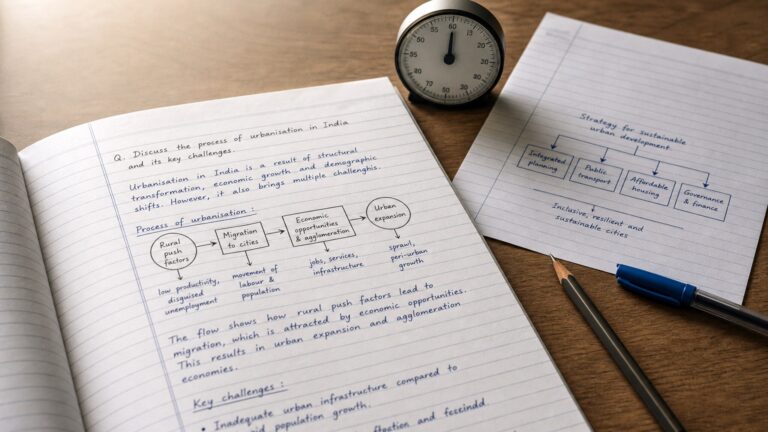
On answer-writing: the most common, most expensive mistake is treating Mains as something to worry about “after Prelims.” Mains is 1750 marks of writing under time pressure, and writing is a motor skill, you get better only by doing it. Start writing answers in your first few months, even if they’re bad. One or two questions a day, or a handful a week, builds the muscle of structuring an answer in seven minutes: a crisp intro, a body with points and maybe a diagram, a forward-looking conclusion. You don’t need to have finished the syllabus to start, you need to start so that by the time the syllabus is done, writing feels natural. Our Mains answer-writing tips cover structure and presentation, and if you want a concrete kickstart, the 30-day answer-writing practice plan gives you a daily schedule.
On the optional: this is one paper-pair worth 500 marks, and your choice can swing your rank. There’s no single “best” optional, anyone who tells you otherwise is selling something. Here’s a clean framework to decide, in priority order:
| Decision factor | What to ask yourself |
|---|---|
| Genuine interest | Can I read this subject for two years without resenting it? |
| Background | Did I study something close to it in college, so the ramp-up is shorter? |
| Overlap with GS | Does it cover GS ground too (like Geography, PSIR, History, Sociology)? |
| Material and guidance | Are good books, notes, and mentors easily available? |
| Scoring record | Has it produced consistent top ranks recently? |
Weight interest and overlap most heavily, scoring trends least, because a “high-scoring” optional you hate will quietly bleed your motivation dry. Our guide to choosing a UPSC optional applies this framework across subjects, and if you’re leaning toward the popular GS-overlapping ones, we have detailed strategies for PSIR and Geography. Decide within your first couple of months and commit. Switching optionals mid-preparation is one of the costliest things you can do.
How to Build a Realistic Weekly Rhythm
The honest answer is that there’s no universal timetable, only a structure you adapt and a few non-negotiables. A working day for a full-time aspirant might hold 7 to 9 focused hours; a working professional might manage 3 to 4 on weekdays and more on weekends, and that’s enough if it’s consistent. The number of hours matters less than whether the same blocks happen every day.
A sane weekly shape looks like this. Each day: newspaper plus current-affairs notes in the morning, two or three deep blocks on standard books or your optional, and a short answer-writing or revision slot. Once a week: a longer revision session of everything you covered, and a test or a batch of MCQs. The revision and the test are the parts beginners skip, and they’re the parts that actually move scores.
| Block | Roughly how long | What happens |
|---|---|---|
| Morning | 60 to 90 minutes | Newspaper, current-affairs notes |
| Mid-day deep work | 2 to 3 hours | Standard book or optional, one subject |
| Afternoon deep work | 2 to 3 hours | Another subject, or revision |
| Evening | 45 to 60 minutes | Answer-writing or MCQ practice |
| Weekly | One half-day | Consolidated revision plus a mock test |
Three things make or break this rhythm. Revision is not optional, schedule it weekly and monthly or you’ll relearn the same things forever. Previous-year questions (PYQs) are your syllabus decoder, working through them tells you exactly what depth UPSC wants and stops you from over-reading; our Prelims PYQ analysis shows the patterns. And mock tests matter because they train exam temperament, the real skill of Prelims is deciding which questions to attempt and which to leave under pressure, and you only learn that by simulating it. A test series is worth the money for the mocks and the discipline of a fixed schedule, not for the static notes. If you’re balancing a job, our realistic strategy for working professionals restructures all of this around a 9-to-6.
How to Study This for UPSC
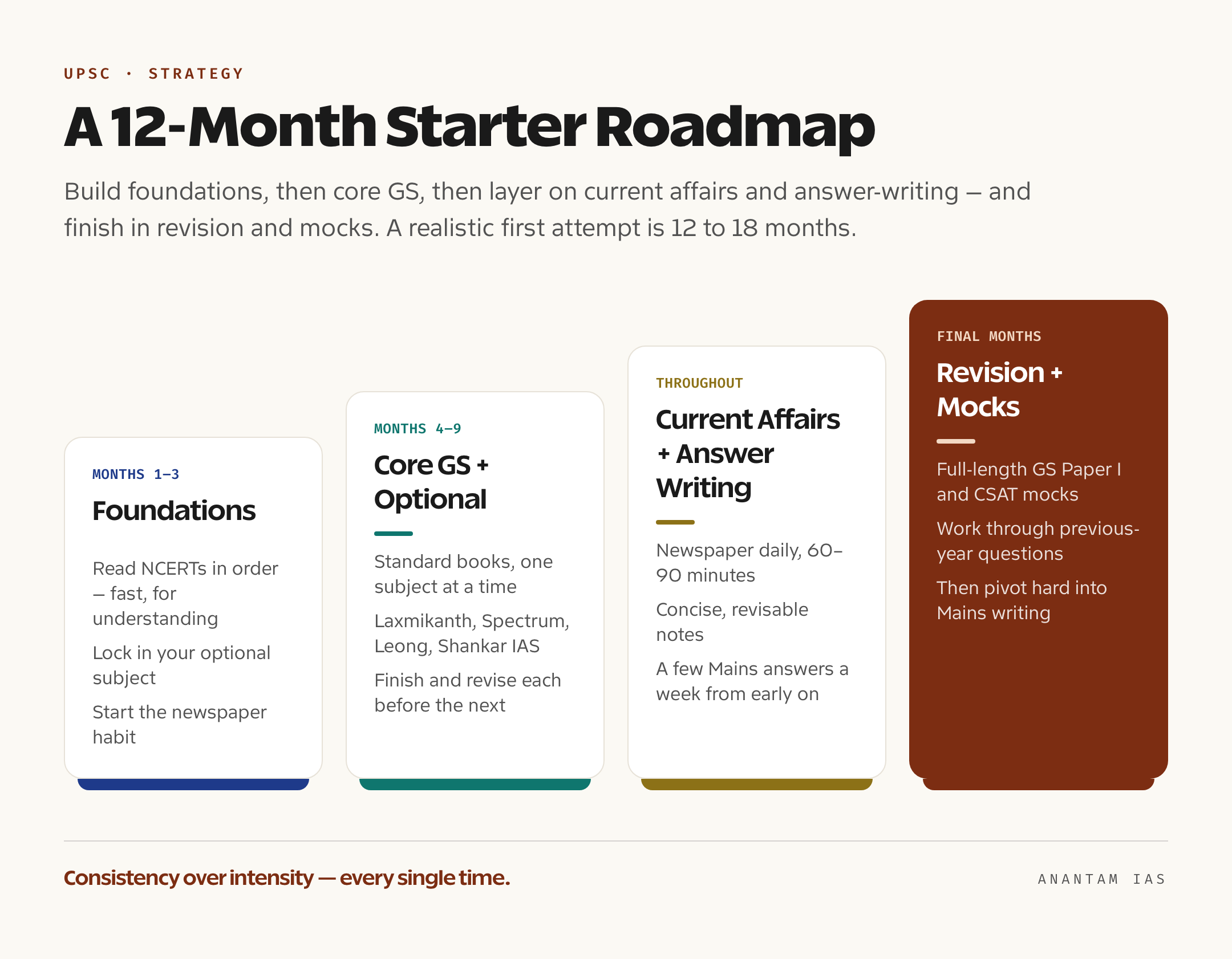
Turn the strategy above into a sequence. In your first two to three months, finish the NCERTs and lock in your optional, no answer-writing yet, just building the base and the newspaper habit. In months four to nine, move through the standard books one subject at a time, start writing a few answers a week, and keep the daily current-affairs engine running. In the final months before Prelims, switch into revision and full-length mock tests, GS Paper I mocks and CSAT mocks both, and treat the CSAT seriously enough to clear 33 percent if you’re not from a maths background. After Prelims, pivot hard into Mains answer-writing and the optional.
What to skip: don’t watch every free lecture on the internet, don’t collect PDFs you’ll never open, don’t read four newspapers, and don’t keep buying alternate books for the same subject. More resources is the enemy. One source per subject, revised twice, beats five sources read once.
On how it’s tested: Prelims rewards breadth and accuracy under negative marking, so it favours wide reading plus heavy MCQ practice. Mains rewards depth, structure, and the ability to write balanced, current-aware answers, so it favours note-making, answer-writing, and connecting static topics to current events. The Interview rewards clarity, honesty, and a calm personality, not encyclopedic knowledge. Build all three muscles, but in that order over time. For the big-picture roadmap, our 12-month UPSC study plan and the broader how to become an IAS officer guide tie the whole journey together, and our personalized study-plan framework helps you build a timetable around your own life. If you’d rather have structure and accountability from day one, the Anantam IAS GS Foundation and mentorship programmes are built around exactly this beginner-to-Mains arc.
A last word on staying sane, because it’s not a footnote. This is a long preparation, and burnout fails more aspirants than any subject does. Take one day off a week without guilt, sleep properly, and protect a small life outside books. The aspirants who clear this exam are rarely the ones who studied the most hours in a burst, they’re the ones who kept showing up, calmly, for a year or more. You will have bad weeks where nothing sticks. That’s normal, not a sign you’re not cut out for this. Consistency over intensity, every single time.
Frequently Asked Questions
How long does it take to prepare for UPSC from scratch? A realistic first attempt needs 12 to 18 months of honest, near-daily preparation. People who clear it faster usually had a relevant background or studied very intensively full-time. Don’t let “two-month crash course” promises set your expectations.
Do I need coaching to clear the UPSC exam? No, coaching is not mandatory, and many candidates clear the exam through self-study using standard books, PYQs, and a good test series. Coaching or structured mentorship helps mainly with discipline, answer evaluation, and guidance. The deciding factor is the quality and consistency of your own study, not where you study.
Which books should a beginner buy first? Start with NCERTs (classes 6 to 12), then add one standard book per subject: Laxmikanth for Polity, Spectrum for modern history, G.C. Leong plus NCERTs for Geography, Sanjeev Verma or Ramesh Singh for Economy, and Shankar IAS for Environment. Finish and revise each before adding the next.
When should I start answer-writing for Mains? Early, in your first few months, even before you finish the syllabus. Answer-writing is a skill built by practice, not by reading about it. A few answers a week from the start makes Mains feel natural by the time you reach it, instead of a panic in the final months.
How do I choose my optional subject? Weigh genuine interest and any college background most heavily, then overlap with GS, availability of good material, and finally scoring trends. Pick a subject you can study for two years without resenting it, and commit to it within your first couple of months. Avoid switching optionals once you’ve started.
Practice Questions
Prelims MCQs
- How many papers does the UPSC Civil Services (Preliminary) Examination consist of, and what is the maximum marks of each? (a) Two papers of 200 marks each (b) Two papers of 250 marks each (c) Four papers of 200 marks each (d) One paper of 400 marks. Answer: (a) Prelims has GS Paper I and GS Paper II (CSAT), each carrying 200 marks.
- The CSAT (GS Paper II) in Prelims is: (a) a merit-counting paper (b) qualifying in nature, requiring 33 percent (c) optional to attempt (d) worth 300 marks. Answer: (b) CSAT is only qualifying; a candidate must secure at least 33 percent in it.
- What is the total marks of the UPSC Mains written examination (the merit-counting papers)? (a) 1750 (b) 2025 (c) 2000 (d) 1500. Answer: (a) The seven counting papers, Essay, four GS, and two optional, total 1750 marks.
- Which Mains paper deals with Ethics, Integrity and Aptitude? (a) GS Paper I (b) GS Paper II (c) GS Paper III (d) GS Paper IV. Answer: (d) GS Paper IV covers ethics, integrity, aptitude, and case studies.
- What is the penalty for a wrong answer in the Prelims objective papers? (a) No penalty (b) Full marks of the question (c) One-third of the marks assigned to that question (d) One-half of the marks. Answer: (c) Each incorrect answer carries a penalty of one-third of that question’s marks.
Mains Practice Questions
- “Consistency over intensity wins the UPSC exam.” Critically examine why sustainable study habits matter more than short bursts of high-effort preparation. (15 marks, 250 words)
- Discuss the role of NCERT textbooks as the foundation of UPSC preparation. Why is sequencing and a single careful reading more effective than jumping directly to standard reference books? (15 marks, 250 words)
- Evaluate the importance of starting Mains answer-writing early in the preparation cycle rather than after Prelims. (10 marks, 150 words)
- “The optional subject is a strategic choice, not merely an academic one.” Examine the factors a candidate should weigh while selecting an optional for the UPSC Mains. (15 marks, 250 words)
- Explain how previous-year questions and mock tests function as tools to decode the syllabus and build exam temperament. (10 marks, 150 words)
So where does this leave you on day one? Not with forty books and a panic, but with a sequence: understand the three stages, read NCERTs, build the core one subject at a time, keep the newspaper running daily, write answers early, choose an optional you can live with, and revise on a schedule. None of it requires brilliance. It requires showing up for a year or more and trusting the process on the days it feels slow. Bookmark the deeper guides linked above, work through them as each phase arrives, and start today with the smallest possible step, the newspaper and the first NCERT. The aspirants who make it are simply the ones who began, and then kept going.
Tell Google you want more of this.
Add Anantam IAS as a preferred sourceOne tap, and this site shows up more often in your own Top Stories, AI Overviews and AI Mode. Remove it any time.