The 7th Pay Commission Matrix is the level-based salary table introduced under the 7th Central Pay Commission (7th CPC) recommendations, effective from 1 January 2016. It replaced the old Pay Band + Grade Pay system with 18 clearly defined levels and a fitment factor of 2.57. The minimum basic pay starts at ₹18,000 (Level 1) and the maximum reaches ₹2,50,000 (Level 18). For UPSC, this topic falls under GS II (Governance) and GS III (Fiscal Policy).
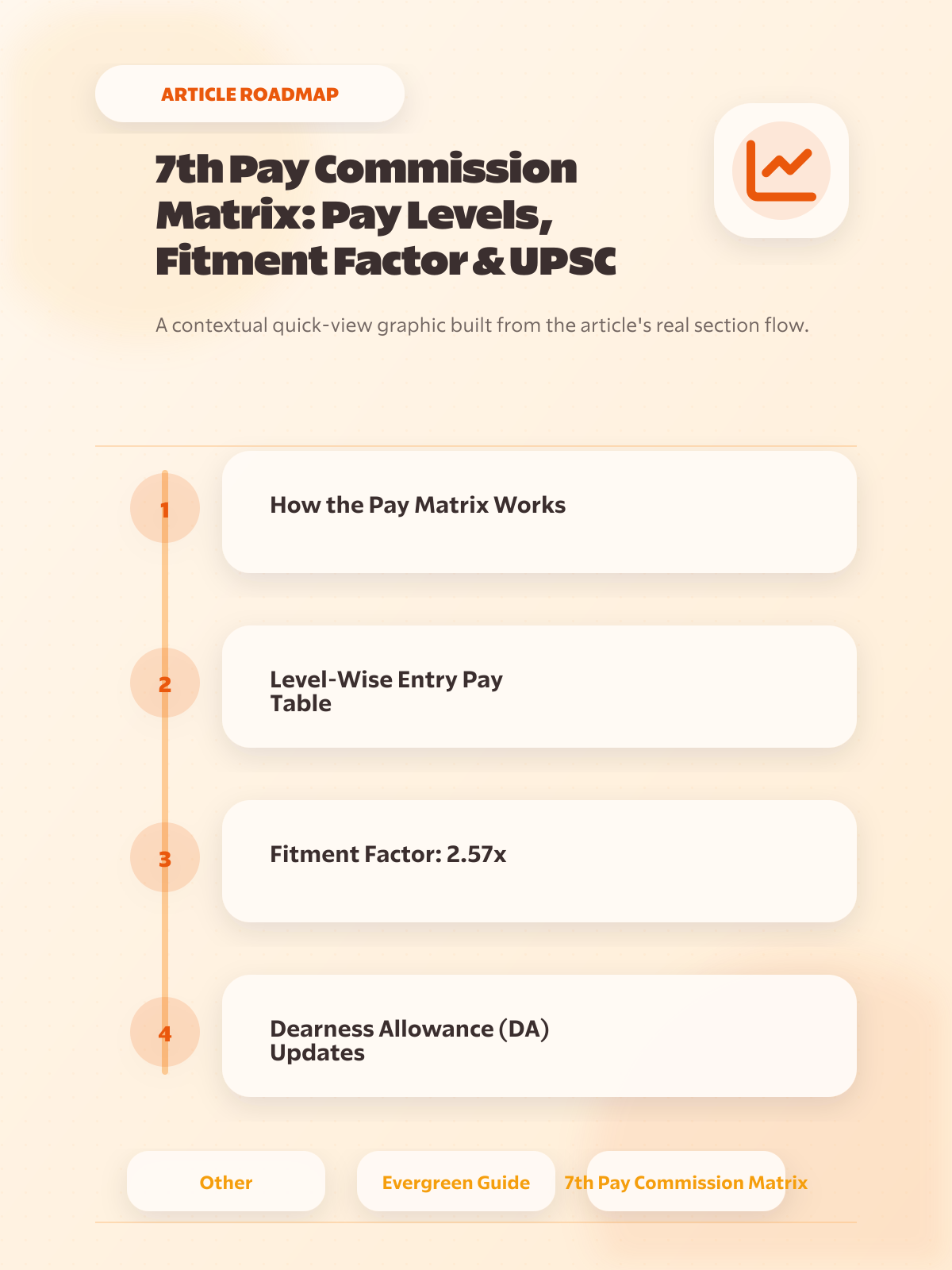
How the Pay Matrix Works
The 7th CPC Pay Matrix is a structured table where:
- Rows represent years of service (annual increments)
- Columns represent pay levels (Level 1 through Level 18)
- Each cell shows the basic pay for that level and year of service
- Annual increment is 3% of basic pay, rounded to the nearest ₹100
| Feature | Detail |
|---|---|
| Old system replaced | Pay Band + Grade Pay |
| New structure | Pay Matrix with 18 levels |
| Fitment factor | 2.57 |
| Effective date | 1 January 2016 |
| Legal basis | Central Civil Services (Revised Pay) Rules, 2016 |
Level-Wise Entry Pay Table
| Level | Entry Basic Pay | Equivalent Old Grade Pay | Typical Posts |
|---|---|---|---|
| Level 1 | ₹18,000 | ₹1,800 | MTS, Peon |
| Level 2 | ₹19,900 | ₹1,900 | Lower Division Clerk |
| Level 3 | ₹21,700 | ₹2,000 | Upper Division Clerk |
| Level 4 | ₹25,500 | ₹2,400 | Stenographer Grade-D |
| Level 5 | ₹29,200 | ₹2,800 | Senior Clerk |
| Level 6 | ₹35,400 | ₹4,200 | Section Officer, ASO |
| Level 7 | ₹44,900 | ₹4,600 | Assistant Section Officer (CSS) |
| Level 8 | ₹47,600 | ₹4,800 | Section Officer (CSS) |
| Level 9 | ₹53,100 | ₹5,400 | Under Secretary equivalent |
| Level 10 | ₹56,100 | ₹5,400 (PB-3) | IAS/IPS probationer, Group A entry |
| Level 11 | ₹67,700 | ₹6,600 | Deputy Secretary equivalent |
| Level 12 | ₹78,800 | ₹7,600 | Director |
| Level 13 | ₹1,23,100 | ₹8,700 | Joint Secretary |
| Level 14 | ₹1,44,200 | ₹10,000 | Additional Secretary |
| Level 15 | ₹1,82,200 | — | Secretary to GoI |
| Level 16 | ₹2,05,400 | — | Secretary (higher) |
| Level 17 | ₹2,25,000 | — | Apex Scale |
| Level 18 | ₹2,50,000 | — | Cabinet Secretary |
Note: Level 10 is significant because most UPSC civil services (IAS, IPS, IFS, etc.) join at this level.
Fitment Factor: 2.57x
The fitment factor of 2.57 was the multiplier used to convert the old basic pay (Pay Band + Grade Pay) into the new matrix basic pay.
Example calculation:
- Old basic pay (Pay Band pay + Grade Pay): ₹7,000
- Revised basic pay: ₹7,000 x 2.57 = ₹18,000 (Level 1 entry)
This single number explains the entire pay revision arithmetic. It is the most quoted figure from the 7th CPC.
Dearness Allowance (DA) Updates
DA is revised twice a year (January and July) based on the All India Consumer Price Index (AICPI) for industrial workers.
| DA Revision | Effective Date | DA Percentage |
|---|---|---|
| January 2024 | 1 January 2024 | 50% |
| July 2024 | 1 July 2024 | 53% |
| January 2025 | 1 January 2025 | 55% |
| July 2025 | 1 July 2025 | 58% |
Key point: When DA crosses 50%, the government typically considers DA merger with basic pay. The January 2024 milestone of 50% DA triggered discussions about a potential merger, which often precedes a new Pay Commission.
Basic Pay vs Gross Salary vs In-Hand Salary
| Term | Meaning |
|---|---|
| Basic Pay | Fixed matrix-based pay before any allowances |
| DA | Dearness Allowance — inflation adjustment on basic pay |
| HRA | House Rent Allowance — location-based (X, Y, Z cities) |
| Gross Salary | Basic + DA + HRA + all other allowances |
| In-hand salary | Gross salary minus deductions (NPS, tax, CGHS, etc.) |
Example for Level 10 (IAS entry):
- Basic Pay: ₹56,100
- DA at 55%: ₹30,855
- HRA (X city, 27%): ₹15,147
- Gross: ~₹1,02,102 (plus other allowances)
- In-hand: ~₹85,000-90,000 after deductions
Impact on Government Employees
- 48 lakh central government employees and 65 lakh pensioners directly affected
- Total fiscal impact estimated at ₹1.02 lakh crore annually at implementation
- Pension: Revised under the old pension scheme; NPS employees affected differently
- Allowance restructuring: HRA, transport, and children's education allowances revised
- One-rank-one-pension (OROP): Separately implemented for defence personnel
8th Pay Commission: What to Expect
The 8th Pay Commission has been announced and is expected to submit its report by 2026, with implementation likely from 1 January 2026.
| Parameter | 7th CPC | Expected 8th CPC |
|---|---|---|
| Fitment factor | 2.57 | Estimated 2.28-2.86 (various projections) |
| Minimum basic pay | ₹18,000 | Estimated ₹34,560-₹51,480 |
| Implementation | 1 January 2016 | Expected 1 January 2026 |
| DA merger | Not done | Likely before implementation |
Important: Until the 8th CPC report is finalised, the 7th CPC matrix remains the operational salary framework. The 8th CPC discussion is future reform context.
Why the Pay Matrix Replaced Grade Pay
The old Pay Band + Grade Pay system was criticised for:
- Complexity: Multiple pay bands with overlapping grade pays
- Opaque progression: Difficult to compare posts across groups
- Pay fixation disputes: Frequent anomalies in pay determination
The Pay Matrix solved these by providing:
- Transparency: Clear level-wise salary visible in one table
- Easier pay fixation: Direct look-up instead of calculations
- Clear hierarchy: 18 levels from MTS to Cabinet Secretary
- Simpler comparison: Any post's pay identifiable by its level number
Common Mistakes About the Pay Matrix
| Mistake | Correction |
|---|---|
| Matrix value is in-hand salary | It is basic pay only; add DA, HRA, and other allowances |
| Grade pay still applies | Replaced entirely by matrix levels since 2016 |
| DA is fixed | DA changes twice a year based on AICPI |
| All government employees get same pay | Levels, posting location, and years of service vary pay |
| 7th CPC is outdated | It remains the current operational framework until 8th CPC implementation |
UPSC Relevance of 7th Pay Commission Matrix
| Exam Stage | How It Appears |
|---|---|
| Prelims | Pay Commission history, fitment factor, governance current affairs |
| Mains GS II | Administrative reform, civil service compensation, governance |
| Mains GS III | Fiscal implications of pay revisions, public expenditure |
| Interview | IAS salary structure, administrative efficiency |
Key concepts for UPSC answers:
- Pay Commissions are constituted every 10 years (1st in 1946, 7th in 2014)
- They cover pay, allowances, and pension for central government employees
- Fiscal impact analysis links to government expenditure and fiscal deficit
- State governments typically follow with their own pay revision, amplifying fiscal impact
Frequently Asked Questions
What is the 7th Pay Commission Matrix?
It is the 18-level salary table introduced after the 7th Central Pay Commission, replacing the old Pay Band + Grade Pay structure. Effective from 1 January 2016.
What is the fitment factor in the 7th CPC?
The fitment factor is 2.57. Old basic pay multiplied by 2.57 gives the revised basic pay under the matrix.
What is the minimum and maximum basic pay?
Minimum basic pay is ₹18,000 (Level 1) and maximum is ₹2,50,000 (Level 18, Cabinet Secretary).
What is the current DA percentage?
DA stands at 55% of basic pay as of January 2025, revised twice yearly based on the Consumer Price Index.
When will the 8th Pay Commission be implemented?
The 8th Pay Commission has been constituted and is expected to submit its report by 2026, with implementation likely from 1 January 2026.
Tell Google you want more of this.
Add Anantam IAS as a preferred sourceOne tap, and this site shows up more often in your own Top Stories, AI Overviews and AI Mode. Remove it any time.