8th Pay Commission: Expected Salary Hike & Timeline
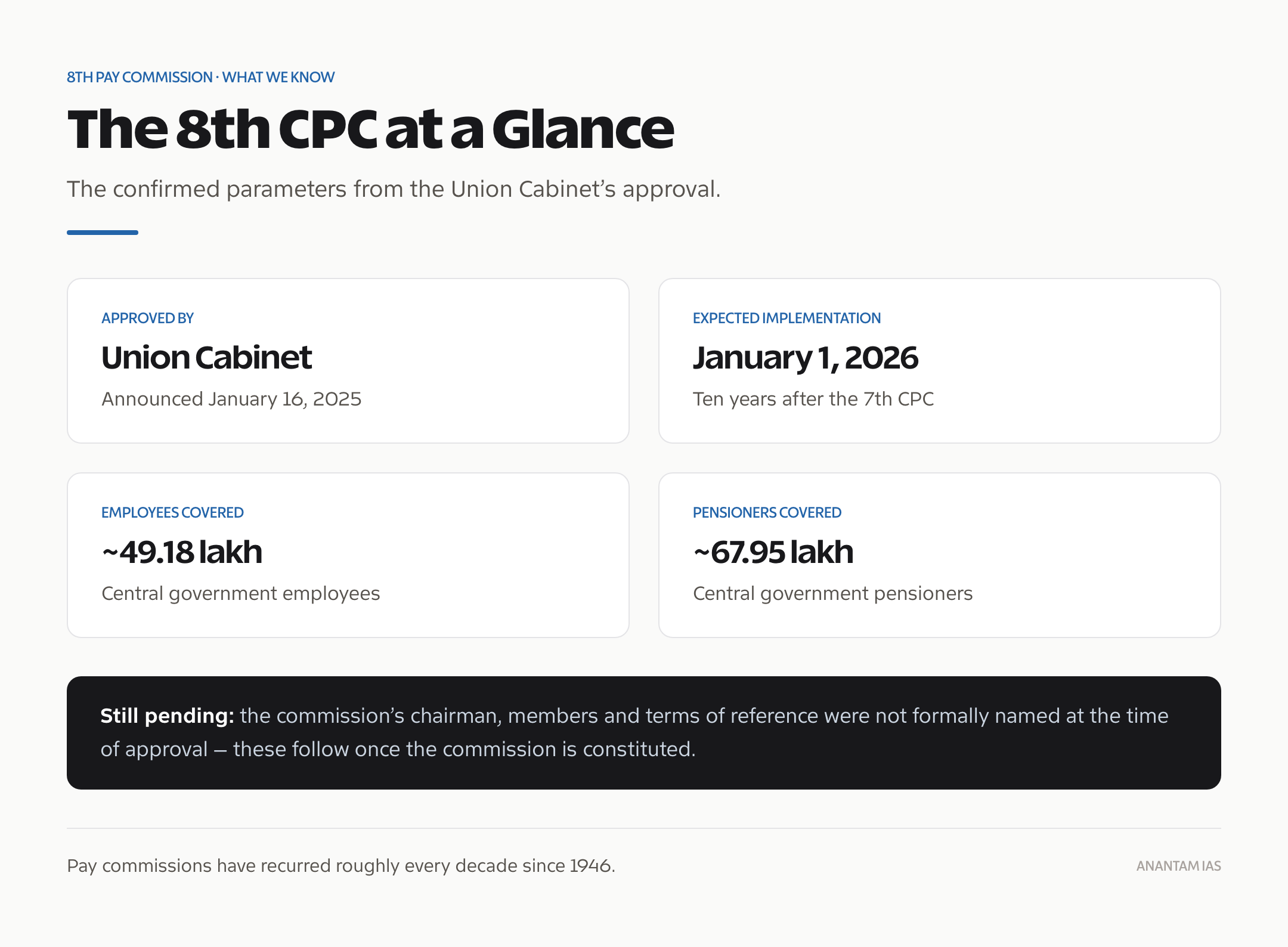
The 8th Pay Commission was approved by the Union Cabinet on January 16, 2025. It will review the pay structure of central government employees and pensioners, with recommendations expected to take effect from January 1, 2026. Approximately 49.18 lakh central government employees and 67.95 lakh pensioners will be directly affected.
Pay commission recommendations are among the most-watched government decisions in India — not just by affected employees but by economists, because revisions cascade into consumption patterns, real estate demand, and state government pay revisions.
8th Pay Commission: What We Know
Cabinet Approval
The Union Cabinet chaired by PM Narendra Modi approved the constitution of the 8th Central Pay Commission on January 16, 2025. The announcement came ahead of the Union Budget 2025-26, signalling the government’s intent to address salary revision for the pre-election period.
Key Details
| Parameter | Detail |
|---|---|
| Approved by | Union Cabinet |
| Date of approval | January 16, 2025 |
| Implementation date | Expected January 1, 2026 |
| Employees covered | ~49.18 lakh central govt employees |
| Pensioners covered | ~67.95 lakh |
| Previous commission | 7th Pay Commission (effective Jan 1, 2016) |
| Terms of reference | To be announced by the government |
The commission’s chairman and members had not been formally named as of early 2025. The terms of reference — the specific aspects the commission must examine — are typically announced separately after the commission is constituted.
Expected Fitment Factor and Salary Hike
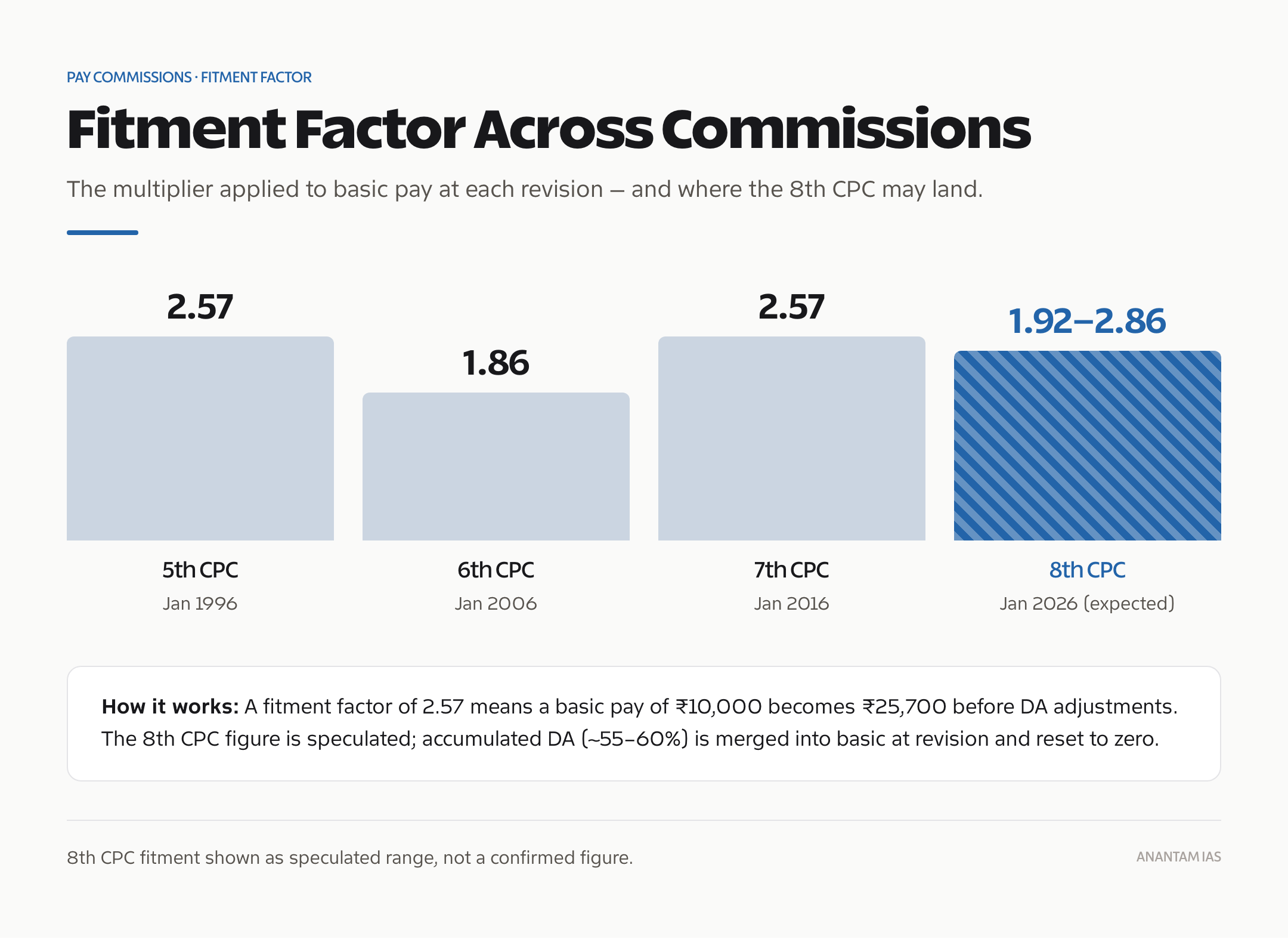
The fitment factor is the multiplier applied to the existing basic pay to arrive at the revised basic pay. It’s the single most-watched number when any pay commission is being discussed.
Historical Fitment Factors
| Pay Commission | Fitment Factor | Effective Date |
|---|---|---|
| 5th Pay Commission | 2.57 | Jan 1, 1996 |
| 6th Pay Commission | 1.86 | Jan 1, 2006 |
| 7th Pay Commission | 2.57 | Jan 1, 2016 |
| 8th Pay Commission (expected) | 1.92 – 2.86 (speculated) | Jan 1, 2026 |
For the 7th Pay Commission, the 2.57 fitment factor meant an employee drawing a basic pay of ₹10,000 moved to ₹25,700 before DA adjustments. The actual salary increase also includes Dearness Allowance (DA) merger — a crucial concept.
What Does Fitment Factor Mean Practically?
Suppose your current basic pay is ₹20,000 (as per 7th CPC scale). With a fitment factor of 2.5:
“ New basic = 20,000 × 2.5 = ₹50,000 “
DA (which may be around 50%+ by 2025) is typically merged into basic pay at the time of revision — that’s the “DA merger.”
Current Speculation
Various employee unions and financial analysts have projected fitment factors ranging from 1.92 to 2.86. A fitment factor of 2.0–2.5 is commonly discussed as realistic. The actual factor depends on:
- Accumulated DA as of the reference date
- Inflation between 2016 and 2026
- Government’s fiscal headroom
- Recommendations on pay matrix structure
A higher fitment factor increases government’s wage bill significantly — affecting the fiscal deficit. This is the political economy tension every pay commission navigates.
History of Pay Commissions in India
Pay commissions have been constituted roughly every decade since independence. Here’s the complete picture:
| Commission | Year Constituted | Effective From | Key Recommendations |
|---|---|---|---|
| 1st Pay Commission | 1946 | 1947 | Basic salary structure for post-independence govt |
| 2nd Pay Commission | 1957 | 1960 | Revised pay scales; merged dearness allowance partially |
| 3rd Pay Commission | 1970 | 1973 | Pay revision post-1971 war; significant anomaly resolution |
| 4th Pay Commission | 1983 | 1986 | Merit pay concept introduced; pay bands explored |
| 5th Pay Commission | 1994 | 1996 | 2.57 fitment factor; recommended merger of DA; downsizing |
| 6th Pay Commission | 2006 | 2008 | Pay band system (PB-1 to PB-4 + HAG); Grade Pay; 1.86 fitment |
| 7th Pay Commission | 2013 | 2016 | Pay matrix (Levels 1–18); 2.57 fitment; abolished Grade Pay |
| 8th Pay Commission | 2025 | 2026 | Under process |
From Grade Pay to Pay Matrix: The 7th CPC Innovation
The 7th Pay Commission replaced the confusing pay band + grade pay system with a clean pay matrix. The matrix has:
- 18 levels (Level 1 for Group D to Level 18 for Cabinet Secretary)
- Each level has defined cells; annual increment moves employee one cell up
- DA is calculated as a percentage of basic pay (cell value in the matrix)
The 8th Pay Commission will likely revise this matrix — either by creating new levels or by restructuring existing ones.
DA Merger and Its Importance
One of the most significant aspects of any pay commission cycle is Dearness Allowance (DA) merger.
DA is revised twice a year (January and July) based on the All India Consumer Price Index for Industrial Workers (AICPI-IW). It compensates for inflation.
How DA Accumulates
After the 7th CPC took effect on January 1, 2016, DA was reset to 0%. By 2025, DA had accumulated to approximately 53% of basic pay. This means a central employee’s effective total was basic + 53% DA + other allowances.
When the 8th CPC takes effect on January 1, 2026, accumulated DA (expected to be around 55–60% by then) will be merged into basic pay and reset to 0%. The fitment factor calculation accounts for this accumulated DA.
This is why comparing fitment factors across commissions requires careful reading — the 6th CPC’s “lower” fitment of 1.86 was partly because less DA had accumulated compared to the 7th CPC’s 2.57.
Impact on Central Government Employees
Pay Revision by Employee Category
Without knowing the exact fitment factor, we can illustrate the potential impact:
| Level | Current Basic (7th CPC) | At 2.0 Fitment | At 2.5 Fitment |
|---|---|---|---|
| Level 1 (MTS) | ₹18,000 | ₹36,000 | ₹45,000 |
| Level 6 (Jr Officer) | ₹35,400 | ₹70,800 | ₹88,500 |
| Level 10 (Asst Commr.) | ₹56,100 | ₹1,12,200 | ₹1,40,250 |
| Level 13 (Joint Secy) | ₹1,23,100 | ₹2,46,200 | ₹3,07,750 |
| Level 18 (Cabinet Secy) | ₹2,50,000 | ₹5,00,000 | ₹6,25,000 |
Pensioners
Pension revision follows the same fitment factor. The government has about 67.95 lakh pensioners — this is a significant fiscal obligation. Family pensioners (widows, disabled dependents) also get revised pension at the same factor.
State Governments
State governments are not bound by central pay commission recommendations but typically follow them with a lag of 1–3 years. Some states like Maharashtra and Karnataka adopt recommendations swiftly; others take longer. This creates a multiplier effect on total public sector wage bill across India.
Fiscal Impact of 8th Pay Commission
The 7th Pay Commission’s implementation in 2016 increased the government’s pay and allowances bill by roughly ₹1.02 lakh crore in the first year. The 8th CPC is likely to have a larger absolute impact given:
- A larger government workforce
- Higher base salaries to multiply
- Arrears payment from January 2026 (if implementation is delayed beyond 2026)
The pension liability will also rise significantly. Rating agencies and fiscal hawks watch pay commission implementations carefully — they typically pressure the government to contain the fiscal deficit through offsetting measures.
UPSC Relevance
GS Paper II / III
- Public administration: Pay structures, incentive design for government employees
- Indian economy: Fiscal impact of pay revisions, inflation transmission
- Social justice: Disparity between organised and unorganised sector wages
Important Facts to Memorise
- Date approved: January 16, 2025
- Expected effective date: January 1, 2026
- Employees covered: ~49.18 lakh central employees + ~67.95 lakh pensioners
- Administered by: Department of Expenditure, Ministry of Finance
- 7th CPC fitment: 2.57 (effective Jan 1, 2016)
- DA reset: DA is merged into basic pay on CPC implementation; resets to 0%
NITI Aayog: Functions, Composition & Role GDP of India 2026: Growth Rate & Key Indicators
Frequently Asked Questions
When will the 8th Pay Commission be implemented?
The 8th Pay Commission was approved on January 16, 2025, with recommendations expected to take effect from January 1, 2026. This follows the established pattern of 10-year intervals between pay commissions.
What is the expected fitment factor for the 8th Pay Commission?
No official figure has been announced. Speculation ranges from 1.92 to 2.86. A factor of 2.0–2.5 is commonly cited as realistic, subject to accumulated DA and government fiscal position.
How many employees will benefit from the 8th Pay Commission?
Approximately 49.18 lakh central government employees and 67.95 lakh pensioners will directly benefit. State government employees typically adopt revised scales within 1–3 years.
What is DA merger in a pay commission context?
DA (Dearness Allowance), which accumulates to compensate for inflation between revisions, is merged into basic pay when a new pay commission takes effect. DA then resets to 0%, and the cycle begins again.
What was the fitment factor under the 7th Pay Commission?
The 7th Pay Commission used a fitment factor of 2.57, effective from January 1, 2016. An employee with a basic pay of ₹10,000 moved to ₹25,700 under the revised pay matrix.
Tell Google you want more of this.
Add Anantam IAS as a preferred sourceOne tap, and this site shows up more often in your own Top Stories, AI Overviews and AI Mode. Remove it any time.