
The AI Action Summit, held in Paris on 10–11 February 2025, was the third in a rapidly evolving series of global summits on artificial intelligence, following Bletchley Park (UK, November 2023) and Seoul (May 2024). Hosted by President Emmanuel Macron and co-chaired by Prime Minister Narendra Modi, it brought together over 100 countries and more than 1,000 participants from government, industry, academia and civil society. The Paris summit marked a deliberate pivot: from the UK's earlier "AI safety" focus to a broader "AI action" agenda emphasising opportunity, inclusion, sustainability and public-interest AI.
Background: Three Summits, Three Framings
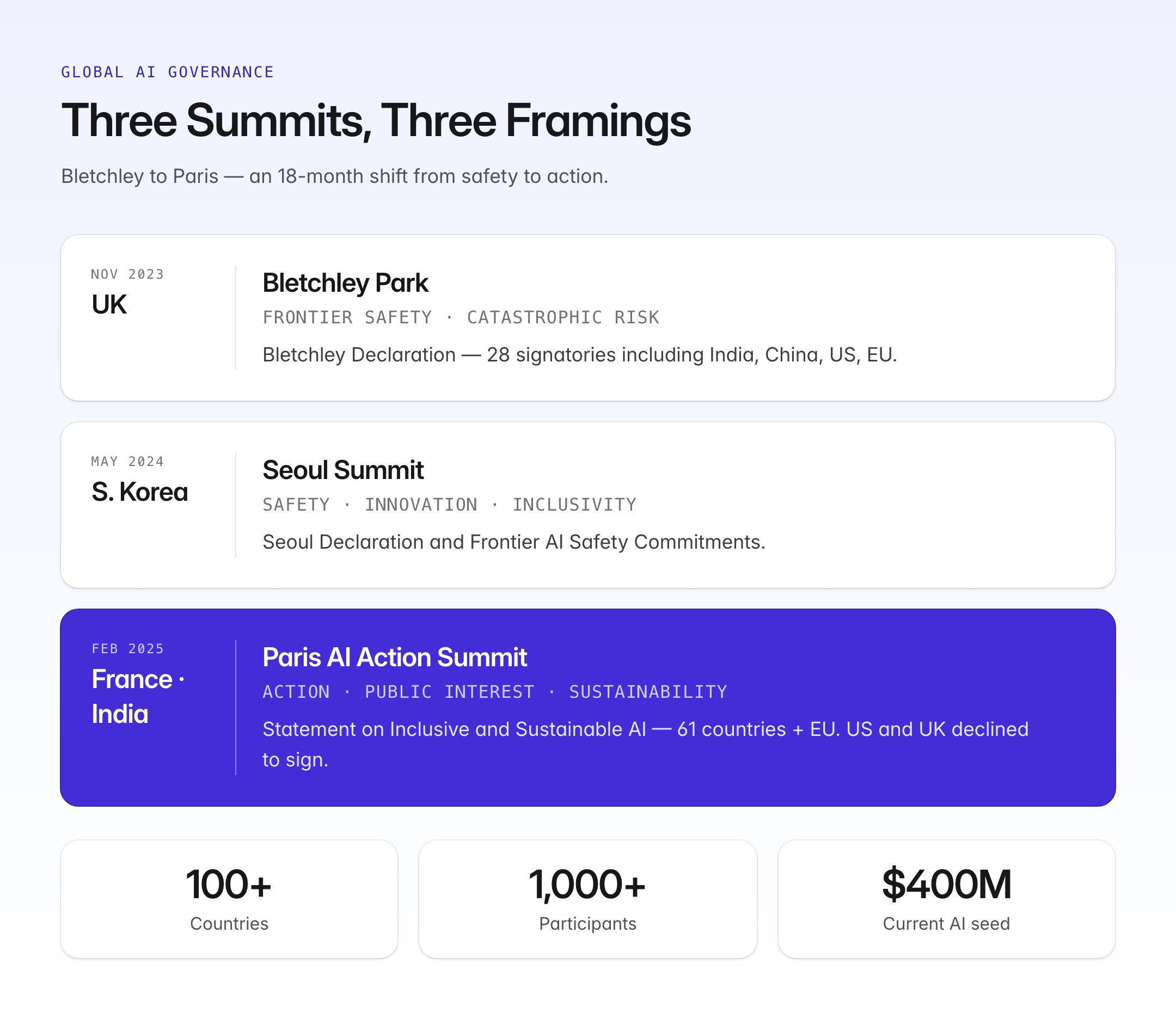
| Summit | Host | Year | Framing | Key Document |
|---|---|---|---|---|
| Bletchley Park | United Kingdom | November 2023 | Frontier AI safety; catastrophic risk | Bletchley Declaration (28 signatories including India, China, US, EU) |
| Seoul Summit | South Korea + UK (virtual co-host) | May 2024 | Safety, innovation, inclusivity | Seoul Declaration; commitments on Frontier AI Safety |
| Paris AI Action Summit | France + India (co-chair) | February 2025 | Action: public interest AI, labour, environment, governance | Statement on Inclusive and Sustainable AI |
The Paris summit was explicitly positioned as a correction: critics of Bletchley argued it over-indexed on speculative existential risk and excluded Global South concerns about access, jobs and development.
India's Role as Co-Chair
India's co-chairing of the Paris summit was the most significant moment for Indian AI diplomacy to date.
- Prime Minister Narendra Modi delivered the co-chair address emphasising AI for public good, the Global South, and the UN Sustainable Development Goals.
- India announced hosting the next AI summit (expected 2026), extending the multilateral track.
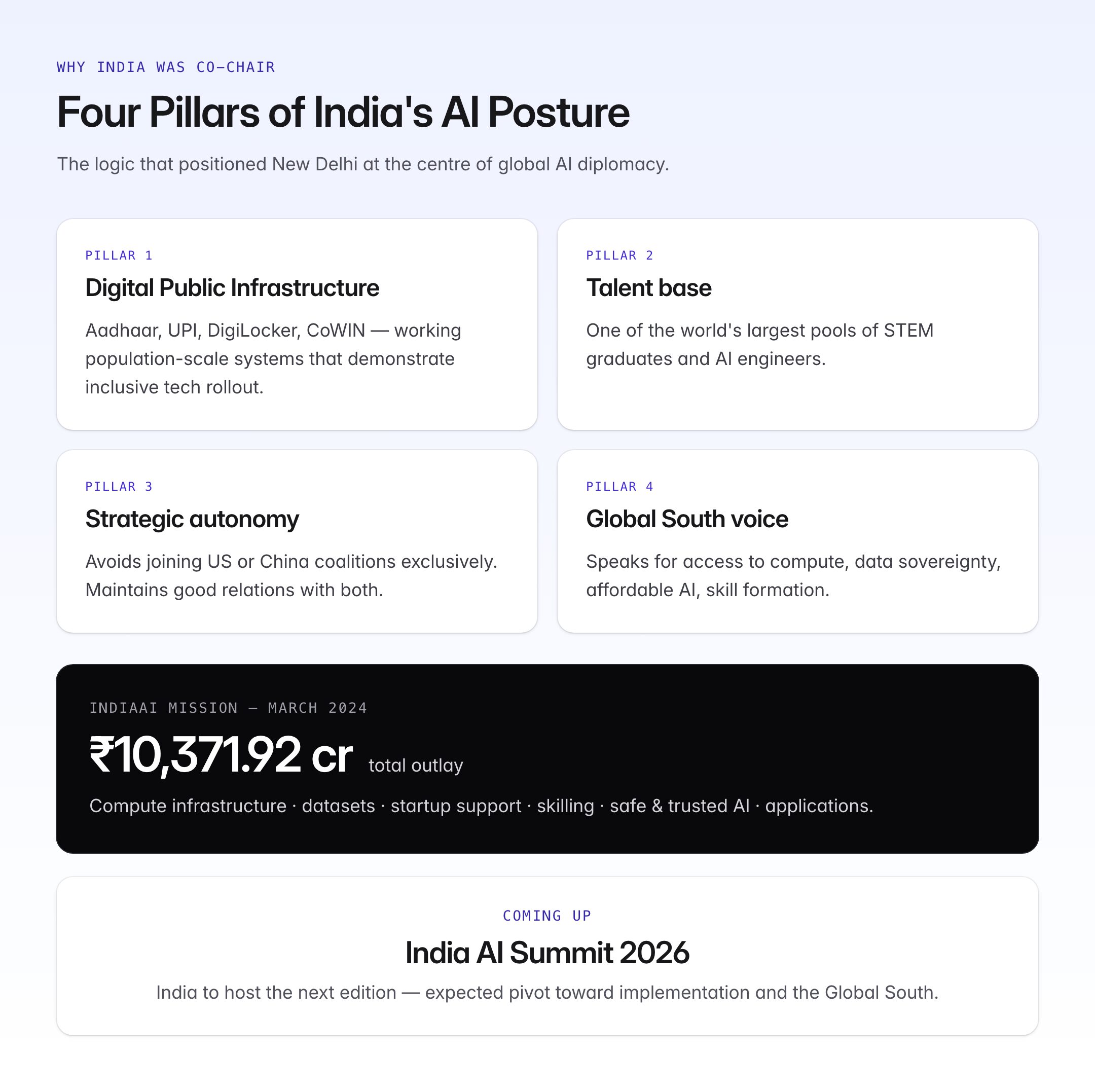
- India's positions aligned closely with the IndiaAI Mission (approved March 2024, Rs 10,371.92 crore outlay) — compute infrastructure, datasets, startup support, skilling, safe and trusted AI, and application development.
- India reiterated its call for a UN-based global AI governance architecture and avoidance of fragmented, club-style regimes.
Modi's speech framed AI as a tool to bridge rather than widen inequalities, citing India's Digital Public Infrastructure (Aadhaar, UPI, DigiLocker, CoWIN) as a model for inclusive technology rollout.
Key Outcomes
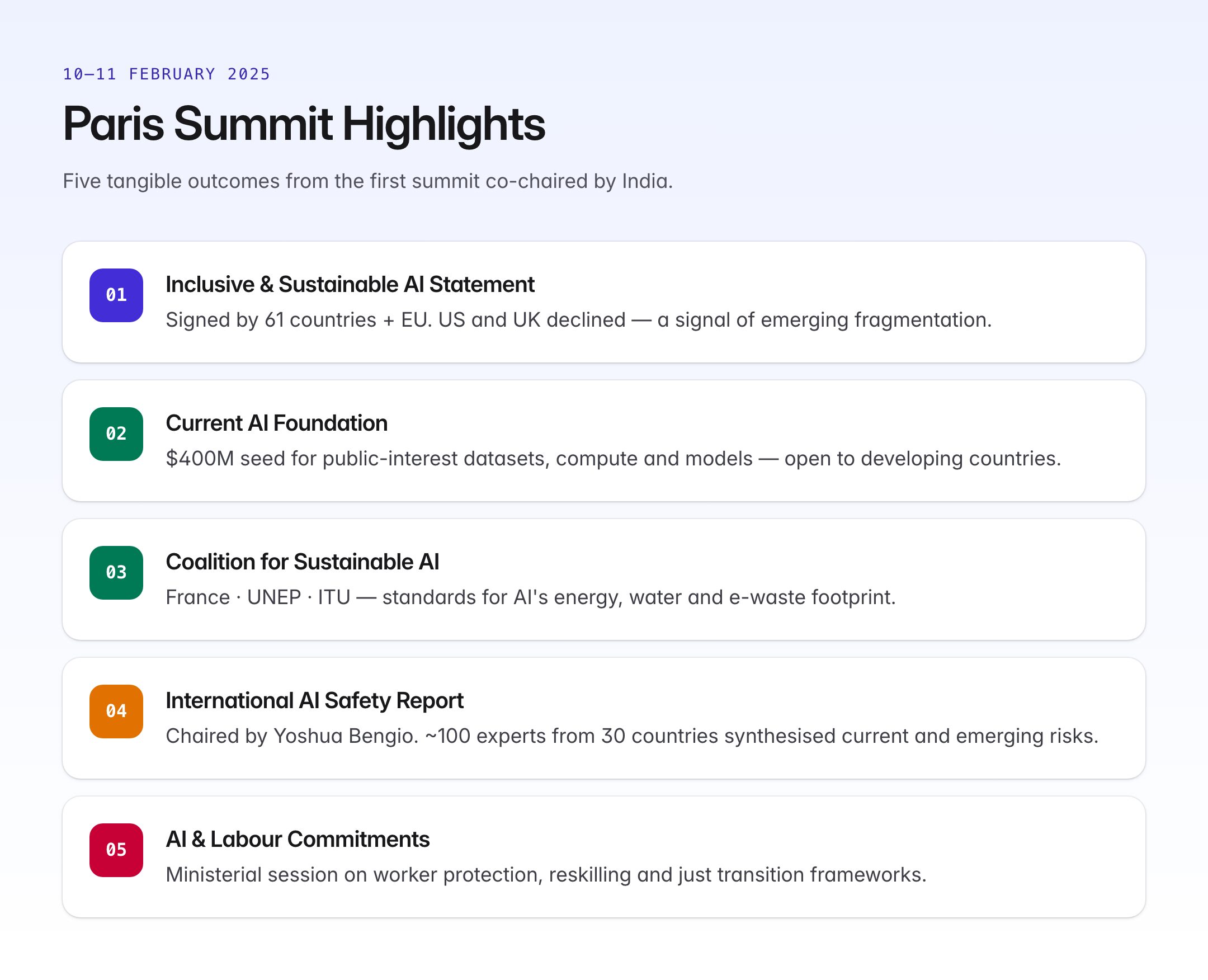
1. Statement on Inclusive and Sustainable AI
The principal outcome document was signed by 61 countries and the EU. Its main commitments:
- AI must be open, inclusive, transparent, ethical, safe, secure and trustworthy.
- AI should support people and the planet, including the SDGs.
- Focus on avoiding market concentrations.
- Support for sustainable AI — reducing the energy and carbon footprint of AI.
- Strengthening international governance of AI.
Notably, the United States and United Kingdom did not sign the declaration, citing concerns over ambiguous language and lack of detail on national security. This was read as an early signal of the new US administration's turn toward a deregulatory, America-first AI stance, later reinforced by the January 2025 executive order revoking the Biden-era AI executive order.
2. Current AI Foundation
A new public-interest foundation launched with about $400 million of seed funding from governments, philanthropies and companies, to build public goods — datasets, compute, models — freely available to developing countries, researchers and public-sector bodies.
3. Coalition for Sustainable AI
An initiative to develop standards and indicators for AI's environmental footprint, led by France's Ministry of Ecology, UNEP, ITU, and partners. It addresses energy consumption of training and inference, water use for cooling, rare-earth mineral supply chains and e-waste.
4. International AI Safety Report
A first-of-its-kind scientific synthesis, chaired by Turing Award laureate Yoshua Bengio, produced by around 100 experts from 30 countries plus OECD, UN and EU. It consolidates evidence on current and anticipated risks of general-purpose AI and became a reference document for future summits.
5. Commitments on AI and Labour
A dedicated ministerial session on AI, work and skills produced commitments on worker protections, re-skilling and just transition frameworks.
Thematic Tracks
The summit organised work around five tracks:
| Track | Focus |
|---|---|
| Public Interest AI | Open science, public goods, access for developing countries |
| Future of Work | Labour markets, skills, just transition |
| Innovation and Culture | Startups, creative industries, scientific research |
| Trust in AI | Safety, security, transparency, evaluations |
| Global AI Governance | International institutions, standards, interoperability |
Why India Matters in Global AI Governance
India's AI posture rests on four pillars:
- Digital Public Infrastructure (DPI) — working, population-scale systems that demonstrate inclusive technology rollout.
- Talent base — one of the world's largest pools of STEM graduates and AI engineers.
- Strategic autonomy — India avoids joining either the US-led or China-led AI coalitions exclusively, while maintaining good relations with both.
- Global South voice — India speaks for developing-country concerns: access to compute, data sovereignty, affordable AI, skill formation.
India's Global Partnership on AI (GPAI) chairmanship (2024–25) and the G20 New Delhi Leaders' Declaration 2023 — which included substantial AI language — positioned it for the Paris co-chair role.
Comparison: Bletchley, Seoul, Paris
| Dimension | Bletchley 2023 | Seoul 2024 | Paris 2025 |
|---|---|---|---|
| Host | UK | South Korea + UK | France + India (co-chair) |
| Focus | Frontier safety, catastrophic risk | Safety, innovation, inclusivity | Action, public interest, sustainability |
| Outcome | Bletchley Declaration | Seoul Declaration, Frontier AI Safety Commitments | Inclusive and Sustainable AI Statement |
| Signatories | 28 | 27+ | 61 + EU |
| US/UK position | Supportive | Supportive | Declined to sign Paris statement |
| Global South presence | Limited | Moderate | Strong — India co-chair |
| Key absence from declaration | — | — | US, UK |
Responsible AI Frameworks Referenced
The Paris summit drew on and reinforced several existing frameworks:
- OECD AI Principles (2019, updated 2024) — trustworthy AI, human-centred values.
- UNESCO Recommendation on the Ethics of AI (2021) — adopted by 193 states.
- EU AI Act (2024) — first comprehensive legal framework, risk-tiered.
- US NIST AI Risk Management Framework (2023).
- ISO/IEC 42001 — AI management system standard.
- UN Advisory Body on AI report "Governing AI for Humanity" (2024).
- NITI Aayog #AIForAll strategy (2018) and IndiaAI Mission (2024).
Critiques of the Paris Summit
- Weakening of safety focus: some researchers argued the "action" framing diluted the earlier commitment to evaluate frontier models for dangerous capabilities.
- US/UK opt-out: highlighted emerging fragmentation in AI governance, with G7-style regimes, plurilateral coalitions, and UN-track discussions running in parallel.
- Industry capture concerns: large tech firms were central to the Current AI foundation and other initiatives.
- Limited binding commitments: the declaration is aspirational, lacking enforcement or accountability mechanisms.
What Comes Next
- India AI Summit 2026 — India expected to host the next edition, potentially pivoting toward implementation and the Global South.
- UN AI processes — the Global Digital Compact (September 2024) and the UN Secretary-General's AI advisory body outputs feed toward a possible international AI governance body.
- EU AI Act implementation — most provisions roll in between 2025 and 2027.
- National AI laws — countries including India, UK and US are expected to finalise domestic frameworks.
- Compute diplomacy — access to advanced chips, export controls, sovereign clouds will increasingly drive international AI politics.
UPSC Relevance
Prelims: Dates (10–11 February 2025), host (France), co-chair (India/PM Modi), principal document (Statement on Inclusive and Sustainable AI), non-signatories (US, UK), key outcomes (Current AI Foundation, Coalition for Sustainable AI, International AI Safety Report), chair of safety report (Yoshua Bengio), previous summits (Bletchley 2023, Seoul 2024).
GS-II (International Relations): India’s role in global governance, multilateralism, and tech diplomacy. Question: “Analyse India’s emerging role in global AI governance with reference to the Paris AI Action Summit 2025.”
GS-III (Science and Technology): AI's impact on economy, jobs, defence, healthcare; IndiaAI Mission; regulatory frameworks.
Essay: Topics like "technology and humanity," "global commons in the digital age," "science and sovereignty."
Interview: Expect questions on whether India should push for a UN AI body, the trade-off between regulation and innovation, and the US withdrawal from the Paris statement.
Track the AI Action Summit not as a one-off news item but as a node in an emerging international regime — where India's voice, for the first time, is at the centre of shaping the rules.
Tell Google you want more of this.
Add Anantam IAS as a preferred sourceOne tap, and this site shows up more often in your own Top Stories, AI Overviews and AI Mode. Remove it any time.