Amur Falcons at Doyang Lake in Nagaland are the subject of one of the most cited conservation success stories in India. Every year between October and early November, tens of thousands of these small migratory raptors — sometimes more than a million in peak years — converge on the Doyang reservoir in Wokha district, Nagaland, to roost for a few weeks before continuing one of the most demanding journeys in the avian world: a non-stop, multi-day flight across the Arabian Sea to southern and eastern Africa. Up to 2012, this roost was also one of the world’s largest unrecorded raptor slaughters. The transformation since then — led primarily by the village of Pangti, with support from the Nagaland Forest Department, the Bombay Natural History Society and the Wildlife Institute of India — is now used as a textbook case of community-led conservation.
For UPSC, the Amur Falcons Doyang Nagaland story features in (migratory birds, conservation), (north-east climate and seasonal migration routes), and current affairs (the annual Amur Falcon festival, IUCN status, and the CMS — Convention on Migratory Species). Aspirants should be careful with two common traps: the conservation success was driven by community action, not by tracking technology; and the falcons are passage migrants, not permanent residents.
Who the Amur Falcon Is
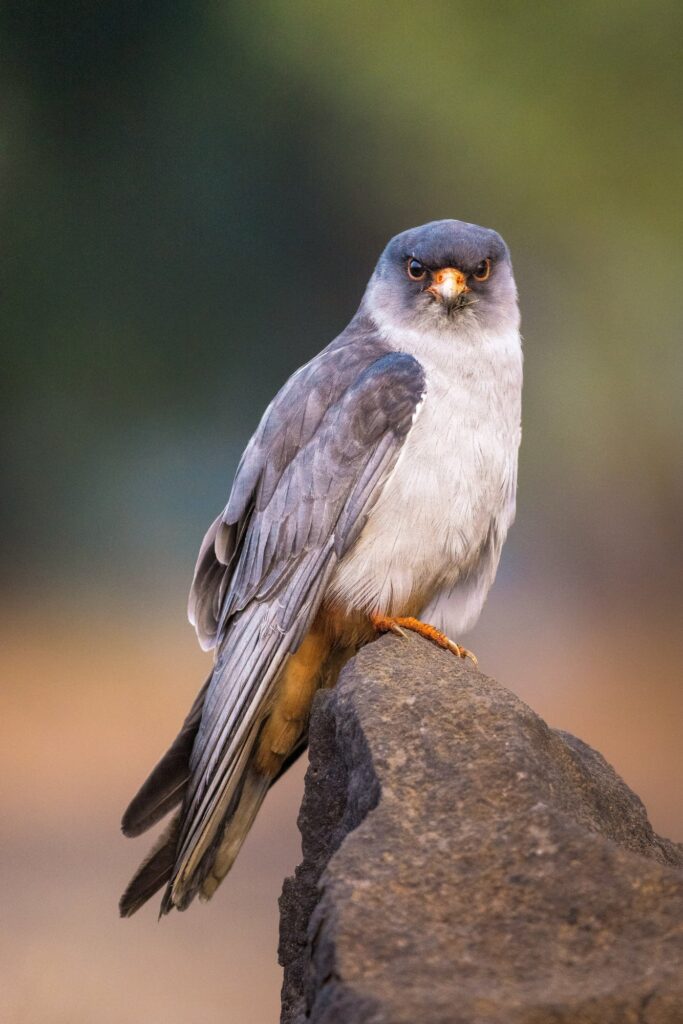
The Amur Falcon (Falco amurensis) is a small raptor about 28 to 31 centimetres long, named after the Amur River basin in Russia and China where it breeds. Adult males are slate-grey with chestnut leg feathers and white underwings spotted with black; females are barred. They eat large flying insects, particularly termite alates and dragonflies, and are highly social — they roost in spectacular communal aggregations during migration.
A migration of staggering scale
Amur Falcons follow one of the longest known migrations of any raptor in the world. From breeding grounds in northeast China, the Russian Far East and Mongolia, they travel southwest across the Tibetan plateau and northeast India, stop at roost sites in Nagaland, Manipur, Assam and adjoining areas to refuel on termite swarms during the post-monsoon period, and then make a non-stop flight of around 5,600 to 6,000 kilometres across the Arabian Sea to southern Africa. The single sea crossing — completed in roughly three or four days without stopping — is the longest known regular over-water crossing by any raptor.
Why Doyang Lake?
Doyang reservoir, on the Doyang river, was created by the dam built by the Northeast Electric Power Corporation (NEEPCO) in the 1990s. The reservoir formed a vast water surface, a thinly populated shoreline, and importantly an abundance of post-monsoon termite alates rising from the surrounding forests at exactly the period when the falcons need to refuel. By the late 1990s the lake had become the largest known stopover of the species anywhere on the migration route.
The villages around the reservoir — Pangti, Asha and Sungro in Wokha district — found that the dense, exhausted roosting flocks were easy to net at night.
The Slaughter: 2011–2012
In 2012, a Conservation India team documented mass-scale netting at Doyang. Estimates suggested 12,000 to 14,000 birds were being killed every day during the peak roost weeks, with carcasses smoked, salted and sold in local markets. The total annual take ran into hundreds of thousands of birds. Photographs of the scale of the slaughter triggered national and international outrage. The Nagaland Forest Department, BNHS, WWF-India, WTI and other organisations moved quickly into the area.
The Conservation Turn
The pivotal element was not technology. It was a partnership with the village councils of Pangti and neighbouring villages.
Within two seasons, the village councils declared the falcons protected, prohibited netting, and turned the lake’s banks into a community-managed roost reserve. Local youth were trained as guides and guardians. The Nagaland Forest Department designated the area as a stopover reserve. An annual Amur Falcon Festival was started in Pangti.
The shift produced near-zero hunting from 2013 onwards. The roost size returned to normal, the birds began to be tracked by scientists, and the village earned national and international recognition. Nagaland was nicknamed the “Falcon Capital of the World” in some media accounts.
A common common confusion is to credit GPS tracking with this turnaround. The truth is the other way round: community action made the area safe, and afterwards a small number of birds were satellite-tagged by BNHS-Wildlife Institute of India teams to map the migration route. Tracking technology documented and amplified the story; it did not drive the conservation success.
Passage Migrant, Not Permanent Resident
The Amur Falcon’s relationship with India is temporary. The birds stop at Doyang and adjoining roosts for only a few weeks each year and then continue to Africa. They do not nest in India; their breeding grounds are in the Russian Far East, northeast China and Mongolia. After wintering in southern and east Africa from December to March, they return through the same flyway in April and May, although the spring passage is more dispersed and less spectacular than the autumn roost.
Statements that describe the Amur Falcon as a permanent or breeding resident of Nagaland are therefore wrong.
Conservation Status and International Protection
- IUCN Red List: Least Concern, but with a stable-to-declining population trend and concerns about cumulative mortality at key roosts.
- Wildlife (Protection) Act, 1972: Schedule II in India.
- CMS Appendix II: the Convention on the Conservation of Migratory Species of Wild Animals lists the Amur Falcon, requiring range states (including India) to cooperate on conservation.
- CITES: Appendix II.
India has been a strong partner in the Raptors MoU under CMS.
Why the Story Matters
The Amur Falcons Doyang Nagaland turnaround is widely cited because it demonstrates several principles relevant to UPSC environmental governance answers.
- Community ownership beats command-and-control in remote landscapes where the state cannot police every roost.
- Recognition and pride are strong conservation incentives — the rebranding of villages as the falcon’s protectors mattered.
- Livelihood substitution through eco-tourism and the Falcon Festival created alternative incomes.
- Transnational migration requires transnational cooperation under instruments such as CMS.
Open Issues
Conservation gains at Doyang are real but not irreversible. Open issues include:
- the risk of resumed hunting in years of poor economic conditions,
- limited monitoring at other northeastern roosts (Tamenglong in Manipur, Pheonsai in Assam),
- climate-driven changes in termite swarm timing and reservoir conditions,
- and the continuing need for community payments, capacity-building and eco-tourism infrastructure to sustain incentives.
Frequently Asked Questions
Where do Amur Falcons stop in India?
Mainly at Doyang Lake in Wokha district, Nagaland, with smaller roosts in Manipur, Assam, Meghalaya and Arunachal Pradesh. Doyang is the largest known stopover site for the species anywhere in the world.
Why is Pangti village famous?
Because Pangti village led the turnaround from large-scale falcon hunting in 2012 to a community-managed conservation regime within two seasons, supported by the Nagaland Forest Department and the Bombay Natural History Society.
What is the Amur Falcon migration route?
From breeding grounds in northeast China, the Russian Far East and Mongolia, the birds travel southwest across the Tibetan plateau and northeast India, refuel in Nagaland and adjoining areas in October-November, and fly non-stop across the Arabian Sea to southern and east Africa.
Are Amur Falcons permanent residents of India?
No. They are passage migrants that use India only as a stopover for a few weeks each autumn and again on the return passage. They do not breed in India.
What is the IUCN status of the Amur Falcon?
Least Concern globally, although cumulative threats at major roost sites and climate-driven changes have raised concern for the species.
Did satellite tracking save the Amur Falcons?
No. Community-led action by the villages around Doyang Lake ended the hunting. A few birds were later satellite-tagged to map the migration; that helped document the success but did not cause it.
Which international treaty protects migratory birds like the Amur Falcon?
The Convention on the Conservation of Migratory Species of Wild Animals (CMS) and the Raptors MoU under it. India is a Party, and the Amur Falcon is on CMS Appendix II.
When does the Doyang roost peak?
In October and the first half of November. The annual Amur Falcon Festival in Pangti is timed to coincide with the peak roost.
Tell Google you want more of this.
Add Anantam IAS as a preferred sourceOne tap, and this site shows up more often in your own Top Stories, AI Overviews and AI Mode. Remove it any time.