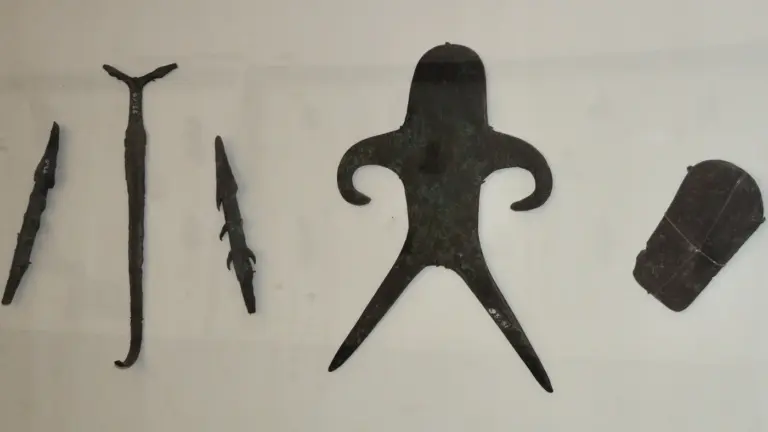
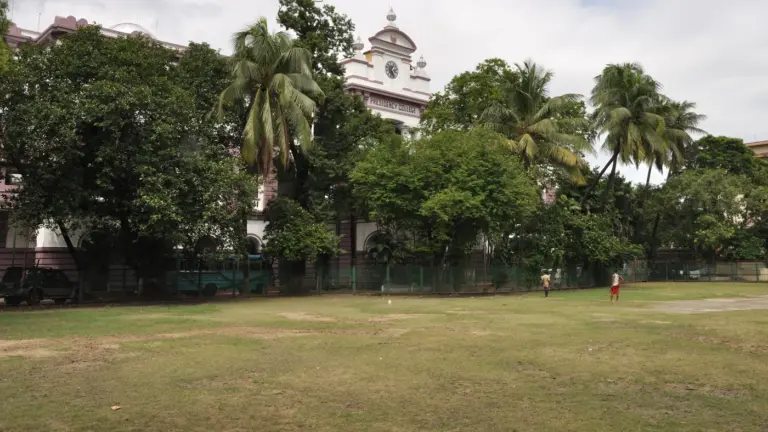
The Appiko Movement was a non-violent forest conservation movement launched in September 1983 in the Salkani village of Sirsi taluka, Uttara Kannada district, Karnataka. Led by social activist Pandurang Hegde, Appiko drew direct inspiration from the Himalayan Chipko Movement of the 1970s and carried its philosophy of hugging trees to the southern Western Ghats. The word “Appiko” in Kannada means “to hug” or “to embrace”, just as “Chipko” means in Hindi. It is one of the most important environmental movements of post-Independence India and a recurring topic in UPSC environment and ethics syllabi.
Background and Context
By the early 1980s, the evergreen and semi-evergreen forests of the Western Ghats in Uttara Kannada had been severely depleted. Commercial felling for plywood, paper and plantation industries, combined with monoculture eucalyptus plantations encouraged by state forest policy, had reduced native forest cover from over 81 percent in 1950 to less than 25 percent by 1980.
Local villagers, dependent on forests for fuelwood, fodder, non-timber forest produce, soil stability and perennial streams, began to experience acute shortages. Landslides, drying springs and loss of biodiversity were reported across the district. The situation was made worse by the clear-felling policy of the Karnataka Forest Department.
Launch of the Movement
On 8 September 1983, inspired by a visit to the Chipko activists in Uttarakhand, Pandurang Hegde mobilised the villagers of Salkani, Husri and Bilegal in Sirsi taluka. Men, women and children walked eight kilometres into the forest of Kalase and hugged the trees that contractors had marked for felling, refusing to let the axe fall. The non-violent protest continued for 38 days until the felling order was withdrawn.
The movement soon spread to neighbouring Sirsi, Siddapur and Yellapur taluks, and later to districts like Shimoga, Dakshina Kannada and Chikmagalur.
Key Leaders and Supporters
| Figure | Role |
|---|---|
| Pandurang Hegde | Founder and chief coordinator, inspired by Chipko |
| Sunderlal Bahuguna | Chipko leader who mentored and visited Appiko sites |
| Chandi Prasad Bhatt | Chipko pioneer whose ideas shaped Appiko's method |
| Anant Hegde Ashisara | Local activist, later an MP who carried conservation politics forward |
| Shivaram Karanth | Jnanpith laureate who lent intellectual support |
Three Objectives of Appiko
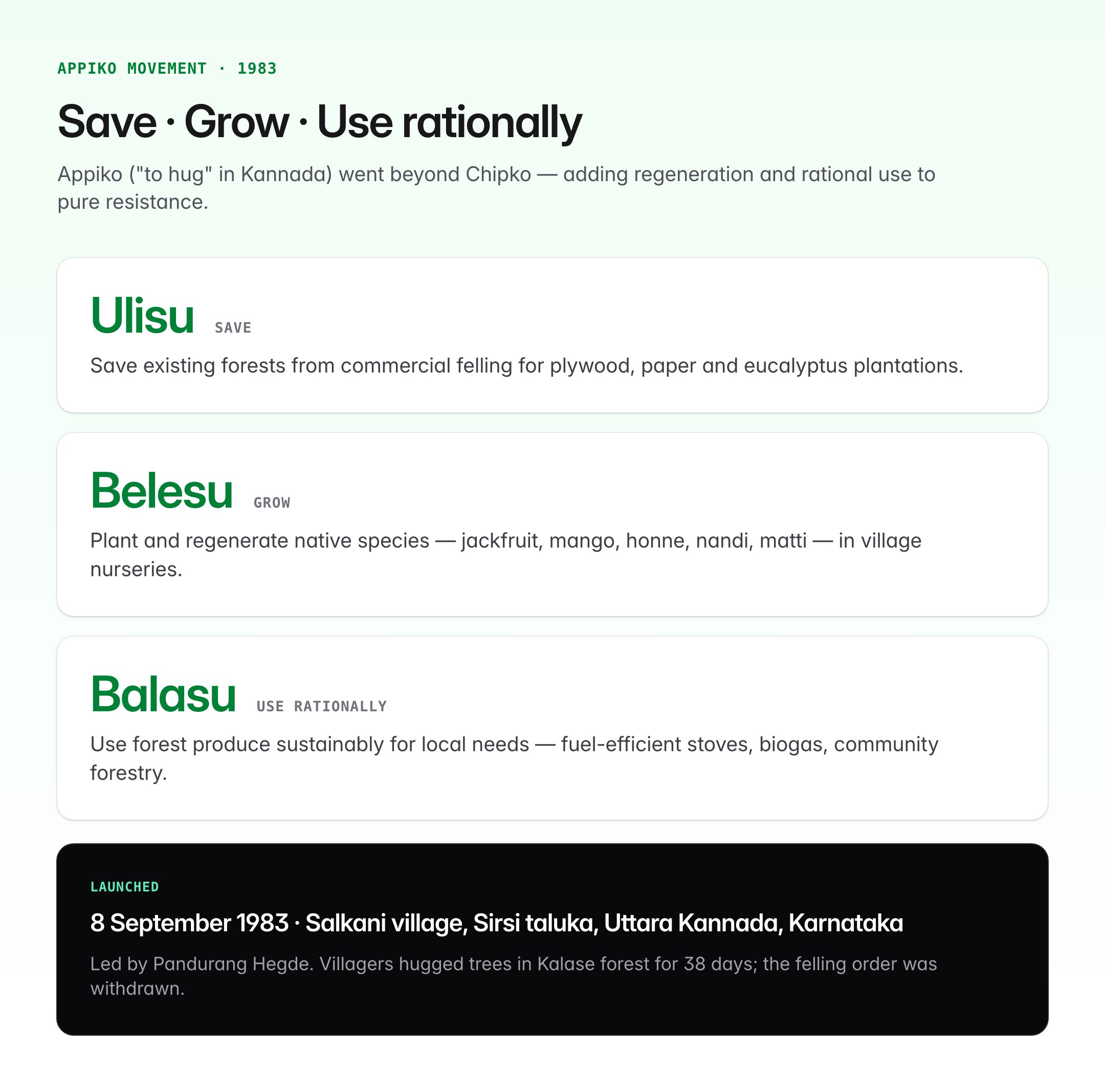
Unlike Chipko, which was predominantly a protest against felling, Appiko articulated a positive conservation programme built on three verbs in Kannada.
| Kannada Slogan | English | Meaning |
|---|---|---|
| Ulisu | Save | Save existing forests from commercial felling |
| Belesu | Grow | Plant native species and regenerate degraded forests |
| Balasu | Use rationally | Use forest produce sustainably for local needs |
This "Save, Grow, Use rationally" triad made Appiko a more holistic ecological movement than pure preservationism. It combined resistance with restoration and rational consumption.
Methods of Protest
Appiko activists used a variety of Gandhian satyagraha techniques.
- Tree-hugging to physically prevent felling
- Padayatras (foot marches) through villages to build awareness
- Slide shows and folk theatre in local languages
- Seedling distribution and community nurseries of native species such as jackfruit, mango, honne, nandi and matti
- Fasts and sit-ins outside forest offices
- Alternative energy campaigns promoting biogas and fuel-efficient stoves to reduce pressure on forests
Impact and Outcomes
The Appiko Movement produced tangible results.
| Outcome | Description |
|---|---|
| Logging halt | Karnataka government banned felling of green trees above 1,000 metres altitude in 1983-84 |
| Policy pressure | Contributed to the spirit of the National Forest Policy 1988, which emphasised forests for ecology over revenue |
| Western Ghats focus | Laid groundwork for later movements and for the Gadgil (2011) and Kasturirangan (2013) committees on the Western Ghats |
| Grassroots networks | Generated village-level Vriksha Laksha Andolan (plant a million trees) and Parisara Samrakshana Kendra |
| Sustainable alternatives | Promoted horticulture, areca and spice gardens as alternatives to timber-based income |
More importantly, Appiko created a generation of community-based forest protection committees in Karnataka that continue to function today.
Link with the Chipko Movement
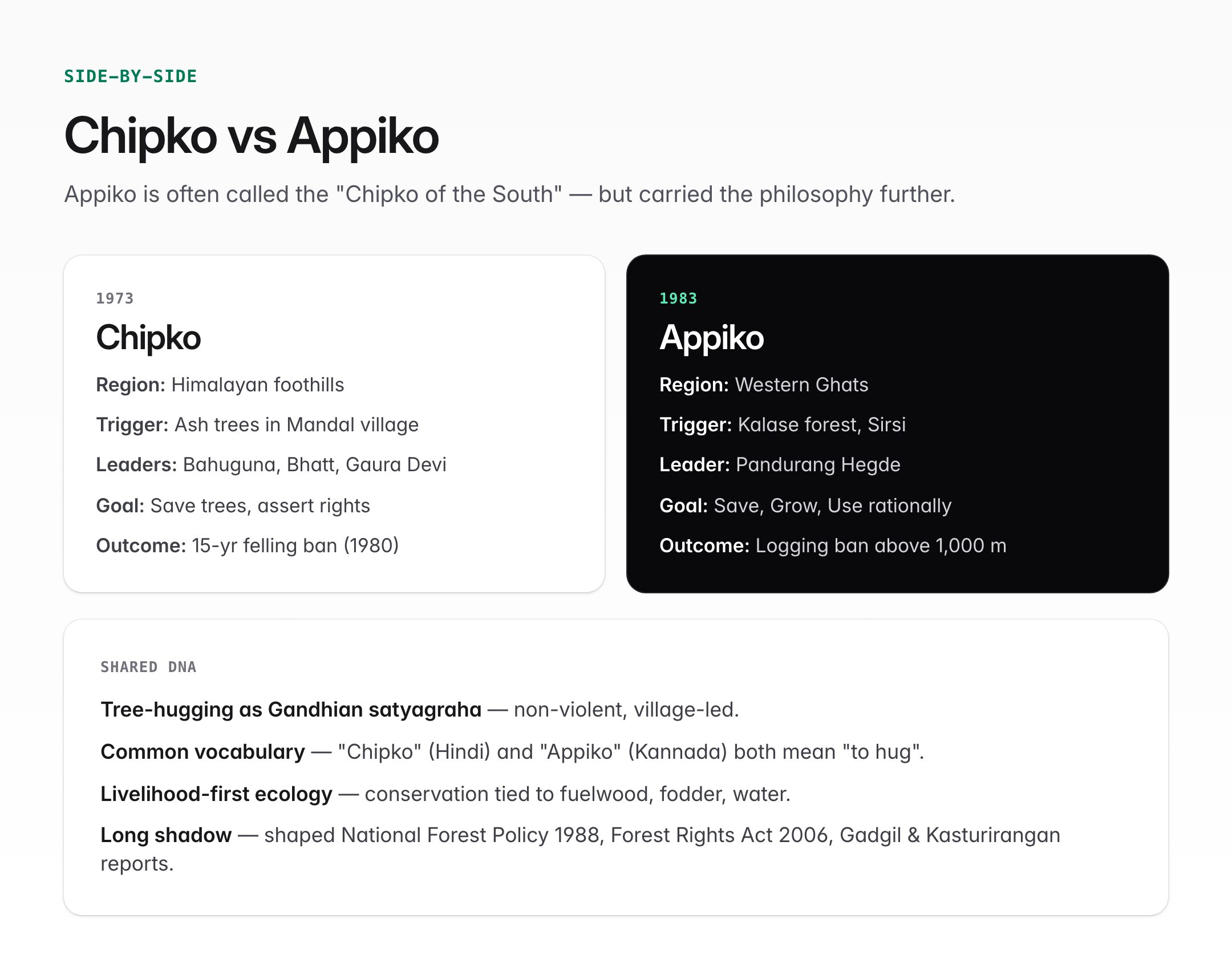
| Feature | Chipko (1973, Uttarakhand) | Appiko (1983, Karnataka) |
|---|---|---|
| Region | Himalayan foothills | Western Ghats |
| Leader | Sunderlal Bahuguna, Chandi Prasad Bhatt, Gaura Devi | Pandurang Hegde |
| Trigger | Felling of ash trees in Mandal village | Felling of native evergreen trees in Kalase forest |
| Method | Tree-hugging, Gandhian satyagraha | Tree-hugging, satyagraha |
| Objective | Save trees, assert community rights | Save, grow, use rationally |
| Outcome | 15-year felling ban in Himalayas (1980) | Logging restrictions in Western Ghats |
Appiko is often called the "Chipko of the South", but it went further by adding regeneration and rational use to the original template.
Significance for Environmental Movements
Appiko reinforced several principles that now define Indian environmentalism.
- Ecology of the poor – Ramachandra Guha and Madhav Gadgil cite Appiko as a prime example of "environmentalism of the poor", where conservation is tied to livelihood, not aesthetics.
- Community forest rights – It foreshadowed legal recognition under the Forest Rights Act, 2006.
- Bioregionalism – It highlighted the uniqueness of the Western Ghats, now a UNESCO World Heritage site and one of the world's eight "hottest" biodiversity hotspots.
- Non-violent mobilisation – It kept Gandhian satyagraha alive as an ecological tool.
Criticisms and Limitations
- Some critics argue Appiko remained regionally limited to north Karnataka and did not scale up as Chipko did.
- The movement's insistence on native species was sometimes in tension with cash-crop demands from the same communities.
- Commercial felling has since shifted to encroachment, mining leases and linear infrastructure like power lines and highways, which Appiko's original toolkit addresses less effectively.
Present Status
Pandurang Hegde continues to write and advocate for the Western Ghats. The Parisara Samrakshana Kendra at Sirsi trains youth, and annual Appiko anniversaries and World Environment Day events see tree-planting drives. The movement's spirit informs current campaigns against mining in Kudremukh, the Hubli-Ankola railway line and projects threatening the Sharavathi Lion-tailed Macaque Sanctuary.
UPSC Relevance
Prelims: Expect direct factual questions on the year (1983), location (Uttara Kannada, Karnataka), leader (Pandurang Hegde), the three slogans (Ulisu, Belesu, Balasu) and the link to Chipko. Pair with Chipko, Silent Valley, Narmada Bachao and Jungle Bachao for environmental movement MCQs.
Mains GS-1 (Society): Use Appiko in answers on social movements in modern India, tribal and peasant mobilisation, and role of women and youth in environmental action.
Mains GS-3 (Environment): Appiko is a live example for conservation of biodiversity, Western Ghats ecology (Gadgil and Kasturirangan reports), community forest management, National Forest Policy 1988 and the Forest Rights Act 2006.
Essay and Ethics (GS-4): Appiko illustrates ethical dimensions of intergenerational equity, sustainable development, non-violent resistance and responsibility towards nature. Pandurang Hegde's leadership offers a case study on ecological ethics, courage and community service.
Candidates should remember Appiko not as an imitation of Chipko but as its philosophical maturation, moving from protest to regeneration and offering a replicable model for forest conservation across India's biodiversity hotspots.
Tell Google you want more of this.
Add Anantam IAS as a preferred sourceOne tap, and this site shows up more often in your own Top Stories, AI Overviews and AI Mode. Remove it any time.