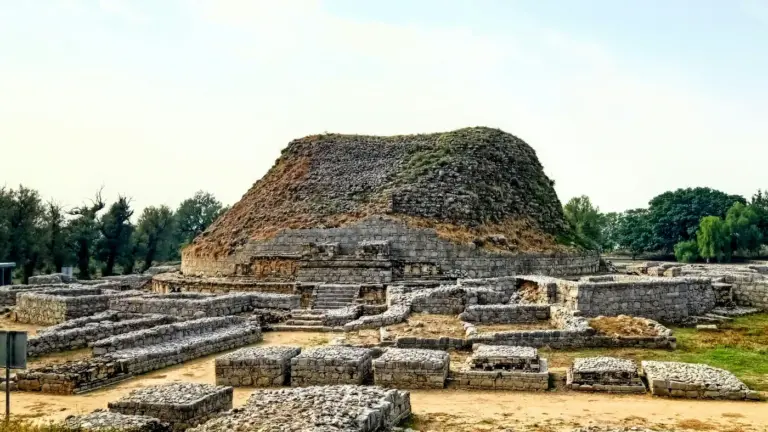
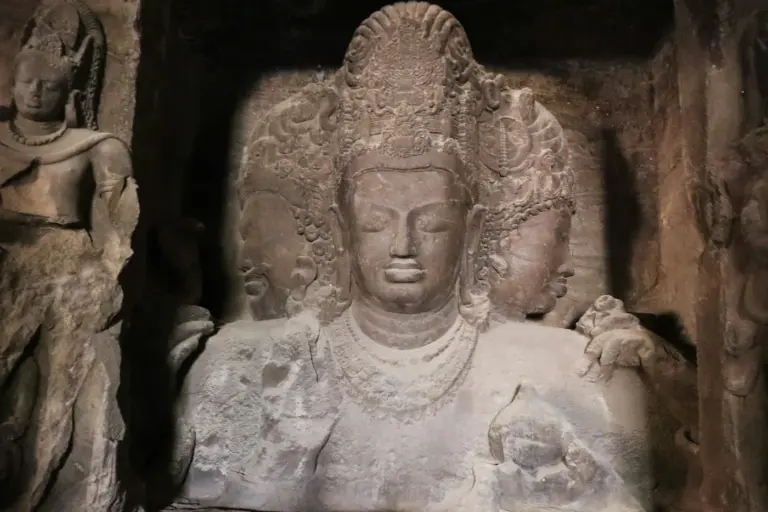
The Ashoka Pillar refers to a series of monumental stone columns erected by the Mauryan emperor Ashoka the Great (268–232 BCE) across the Indian subcontinent, often crowned with animal capitals and inscribed with edicts proclaiming his Dhamma. Among them, the Lion Capital at Sarnath stands out as India's national emblem, and the wheel on its abacus — the Dharma Chakra — appears at the centre of the Indian national flag. This guide covers the design, major sites, edicts, and significance of Ashoka Pillars for UPSC Art & Culture and Ancient History.
Who Was Ashoka
Ashoka Maurya, grandson of Chandragupta Maurya and son of Bindusara, ruled the Mauryan Empire from about 268 to 232 BCE.
- The Kalinga War (c. 261 BCE) caused mass casualties and led to Ashoka's turn toward Buddhism and non-violence (ahimsa).
- He propagated the policy of Dhamma — ethical conduct, tolerance, and welfare.
- Ashoka sent Buddhist missions abroad, including his son Mahendra and daughter Sanghamitra to Sri Lanka.
The pillars and edicts are central physical evidence of his reign and the earliest surviving royal inscriptions in India.
Structure of an Ashoka Pillar
Ashoka Pillars share a distinct architectural grammar:
- Single monolithic shaft of stone, tall (typically 12–15 m) and polished smooth.
- Tapering cylindrical shaft, never segmented.
- Capital at the top consisting of:
- Inverted lotus (bell)
- Abacus (square or circular platform)
- Crowning animal sculpture — lion, bull, elephant, or horse
Material:
- Predominantly Chunar sandstone (near Varanasi), a fine buff-coloured sandstone.
- Some shafts quarried from the Mathura region.
Signature polish:
- The Mauryan polish is a glass-like finish unique to the period, achieved through techniques not fully reconstructed.
Major Ashoka Pillars
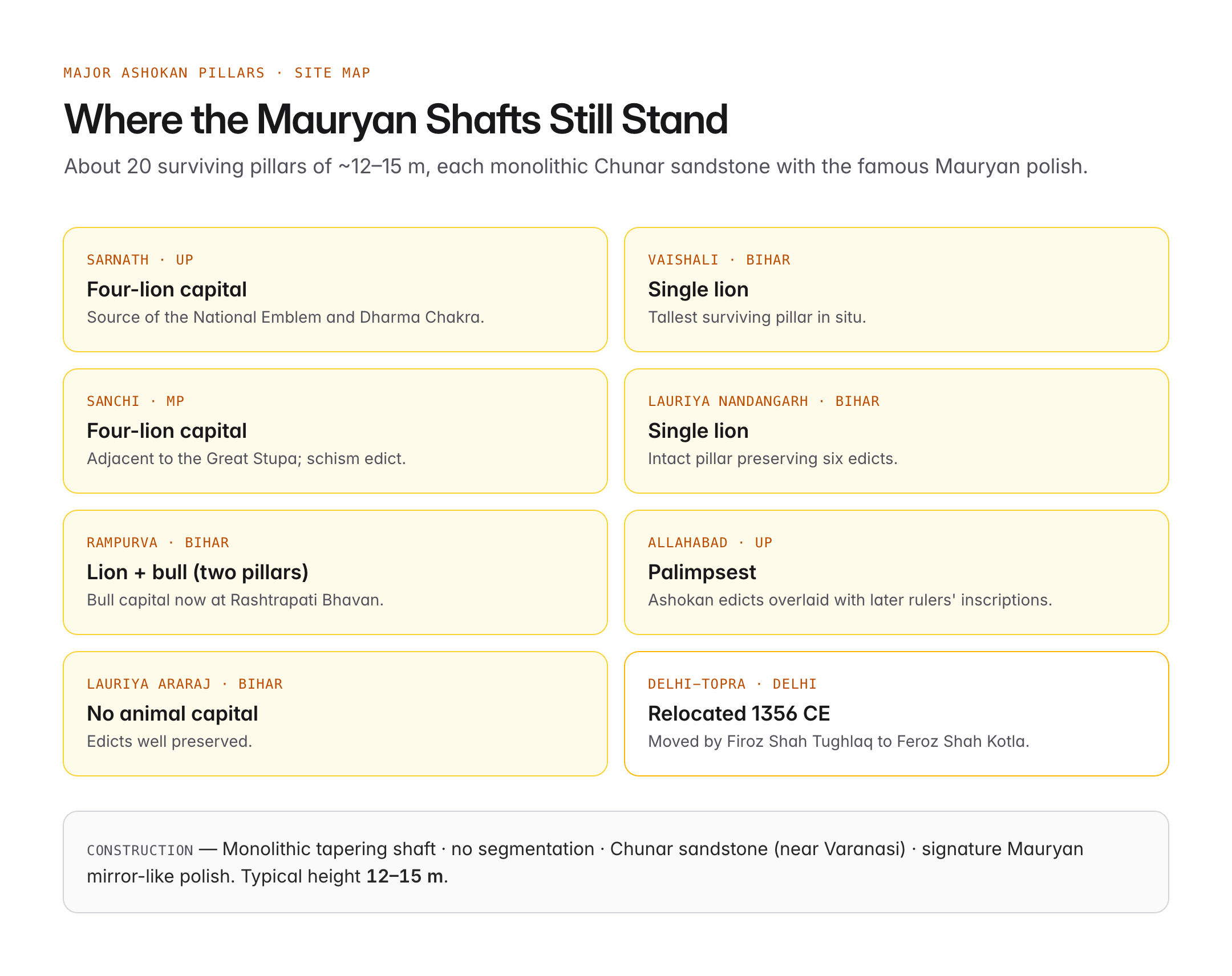
Approximately 20 surviving pillars have been identified, though many are fragmentary or shifted from their original sites.
| Site | Capital | Notable feature |
|---|---|---|
| Sarnath (UP) | Four-lion capital | National emblem; Dharma Chakra |
| Vaishali (Bihar) | Single lion | Tallest surviving pillar in situ |
| Sanchi (MP) | Four-lion capital | Near the Great Stupa |
| Lauriya Nandangarh (Bihar) | Single lion | Intact pillar with six edicts |
| Lauriya Araraj (Bihar) | No animal capital | Edicts preserved |
| Rampurva (Bihar) | Lion and bull capitals (two pillars) | Bull capital now in Rashtrapati Bhavan |
| Topra and Meerut | Relocated to Delhi | By Firoz Shah Tughlaq in 14th century |
| Allahabad (Prayagraj) | Contains edicts of Ashoka and later rulers | Palimpsest inscription |
The Delhi-Topra pillar, moved by Firoz Shah Tughlaq in 1356 CE, stands in the grounds of the Feroz Shah Kotla in Delhi.
The Lion Capital of Sarnath
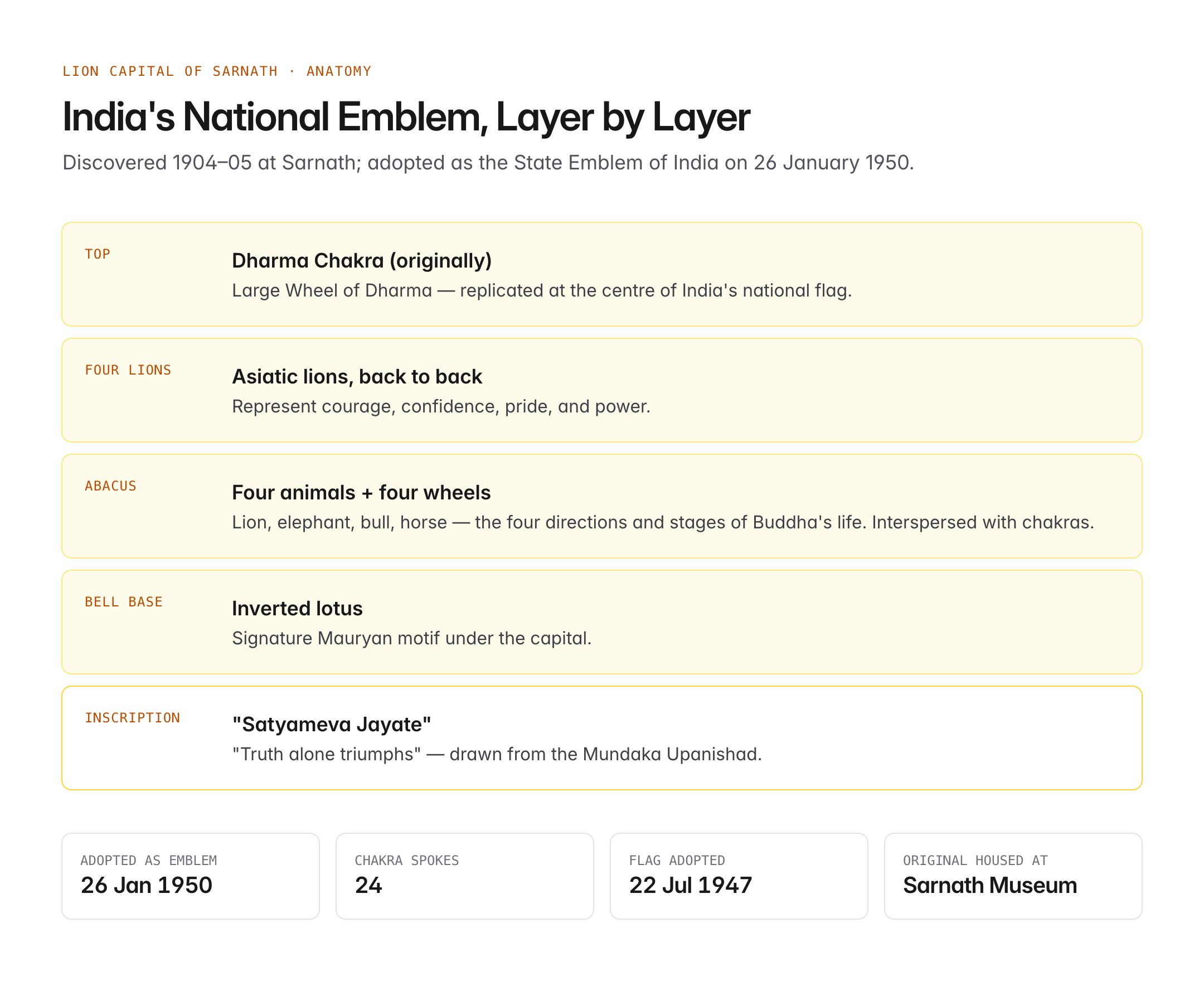
Discovered in 1904–05 at Sarnath near Varanasi, the Lion Capital is the most famous Mauryan sculpture.
- Four Asiatic lions seated back to back, originally surmounted by a large Wheel of Dharma (Dharma Chakra).
- Abacus carved with four animals (lion, elephant, bull, horse) alternating with four wheels (chakras).
- The animals are thought to represent the four directions and stages of the Buddha's life.
- The capital rests on an inverted lotus (bell).
National symbols:
- Adopted as the State Emblem of India on 26 January 1950.
- The motto "Satyameva Jayate" ("Truth alone triumphs"), from the Mundaka Upanishad, is inscribed below.
- The Dharma Chakra from the abacus appears at the centre of the Indian national flag.
- The original capital is preserved in the Sarnath Museum.
Ashokan Edicts
The pillars carry Ashoka's edicts, proclamations of state policy written in the first person.
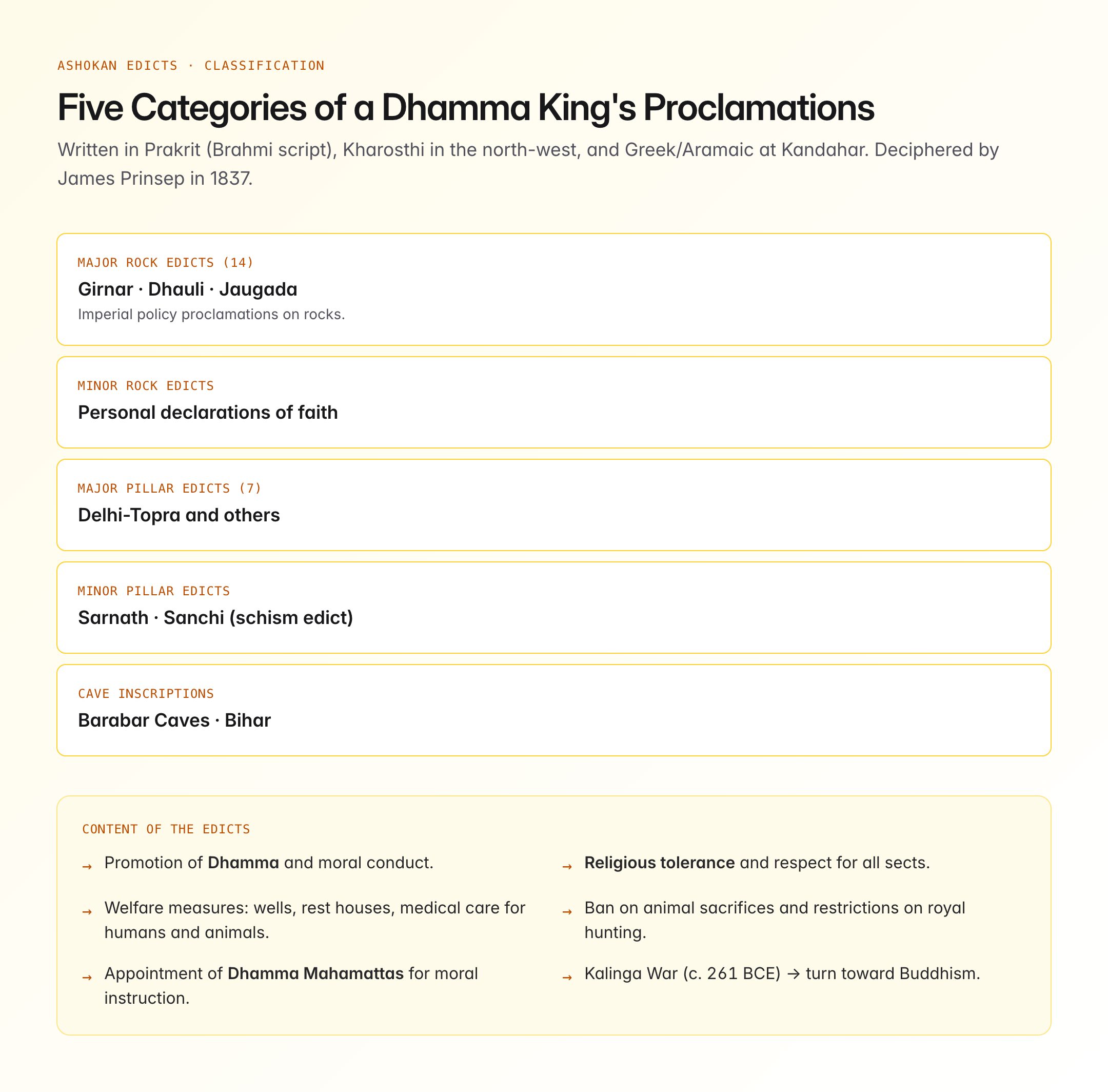
- Composed mostly in Prakrit, inscribed in the Brahmi script (north India), Kharosthi (north-west), Greek and Aramaic (Kandahar bilingual edict).
- Deciphered by James Prinsep in 1837.
- Edicts are classified into:
| Type | Features |
|---|---|
| Major Rock Edicts (14) | On rocks; e.g., Girnar, Dhauli, Jaugada |
| Minor Rock Edicts | Personal declarations of faith |
| Major Pillar Edicts (7) | On pillars; e.g., Delhi-Topra |
| Minor Pillar Edicts | E.g., Sarnath, Sanchi (schism edict) |
| Cave inscriptions | Barabar caves, Bihar |
Content of the edicts includes:
- Promotion of Dhamma and moral conduct.
- Religious tolerance and respect for all sects.
- Welfare measures – wells, rest houses, medical care for humans and animals.
- Ban on animal sacrifices and certain forms of hunting.
- Appointment of Dhamma Mahamattas (officials for moral instruction).
The Ashoka Chakra
- The Dharma Chakra / Ashoka Chakra has 24 spokes.
- Symbolises the Wheel of Law and continuous motion.
- Appears at the centre of the Indian national flag (adopted 22 July 1947).
- Represents the ideals of dharma, righteousness, and progress.
Artistic and Technical Significance
Ashokan pillars mark a watershed in Indian art:
- First major free-standing stone sculpture in the subcontinent.
- Influences suggested from Achaemenid Persian columns (e.g., Persepolis), though the realism of animal sculpture is distinctly Mauryan.
- The Mauryan polish, precise carving, and anatomical realism of the animals are unmatched in contemporary South Asian art.
Art historian Ananda Coomaraswamy and others have emphasised the uniqueness of Mauryan imperial art compared to later folk art traditions such as the yakshas and yakshis.
Protection and Preservation
- Most surviving pillars are protected as Centrally Protected Monuments under the Archaeological Survey of India (ASI).
- Lauriya Nandangarh pillar remains standing in its original location.
- The Allahabad pillar stands in the Akbar Fort, Prayagraj.
- Sarnath's Lion Capital is preserved in a museum with strict environmental controls.
UPSC Relevance
Prelims focus:
- Lion Capital of Sarnath – State Emblem of India (adopted 26 January 1950).
- Ashoka Chakra – 24 spokes, at the centre of national flag.
- Material: Chunar sandstone; unique Mauryan polish.
- Major sites: Sarnath, Vaishali, Sanchi, Lauriya Nandangarh, Rampurva, Allahabad, Delhi-Topra, Delhi-Meerut.
- Brahmi script deciphered by James Prinsep (1837).
- Satyameva Jayate – from Mundaka Upanishad.
Mains GS angle (GS Paper I – Ancient History, Art & Culture):
- Significance of Ashokan inscriptions as political and moral documents.
- Mauryan art: imperial patronage, craftsmanship, and foreign influences.
- Use of Dhamma as a tool of statecraft.
- Continuity of Mauryan symbols (lion capital, chakra) in modern Indian identity.
Sample PYQ angle: UPSC has asked about the Lion Capital, content of Ashokan edicts, and Mauryan administration. Expect questions on material and technique, edict classification, and symbolism of the Ashoka Chakra.
Tell Google you want more of this.
Add Anantam IAS as a preferred sourceOne tap, and this site shows up more often in your own Top Stories, AI Overviews and AI Mode. Remove it any time.