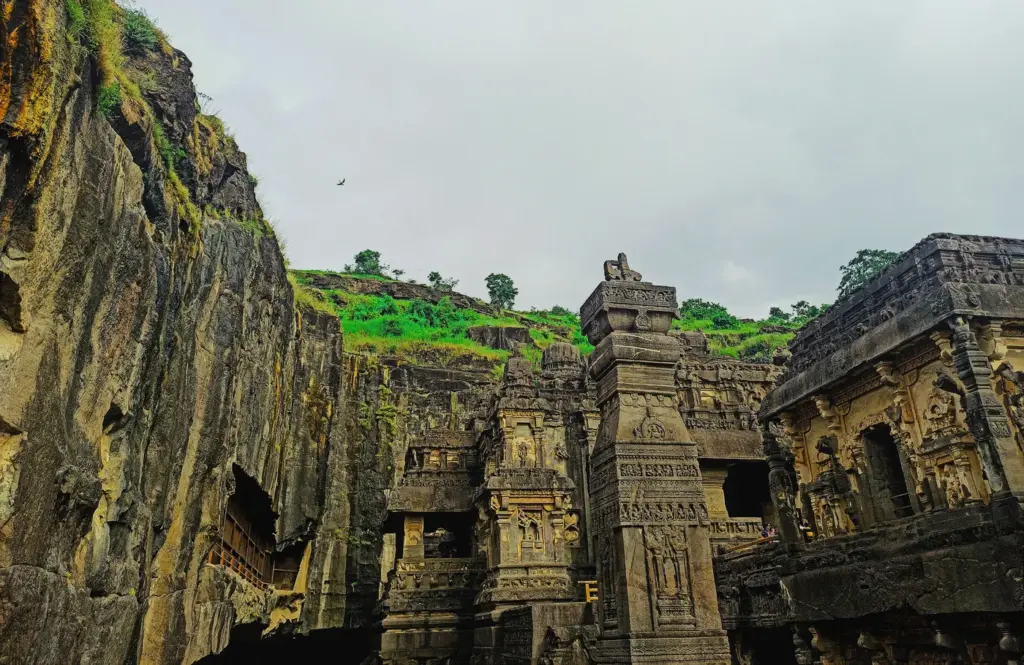
The Ellora Caves are 34 rock-cut monasteries and temples cut side by side into a high basalt cliff in the Charanandri hills at Verul, about 30 km north-northwest of Aurangabad, now Chhatrapati Sambhajinagar, in Maharashtra. UNESCO’s brief description dates the main sequence from AD 600 to 1000. The Archaeological Survey of India stretches the work from the 6th-7th century to the 11th-12th. Cave 16, the Kailasa temple, is the monument everyone photographs, and it is only one excavation on a cliff that also holds Buddhist and Jain sanctuaries, inscribed as a World Heritage Site in 1983.
Most notes collapse the whole place into that one temple and one Rashtrakuta king. That is the trap. The numbered caves run 1 to 34 from south to north along more than 2 km of scarp, the numbering is spatial not chronological, and the early Buddhist halls and Cave 21 were already being cut before the Rashtrakutas took the Deccan. Get the three-faith sequence and the two inscriptions that actually survive, and the rest of the site falls into order.
What the Ellora Caves are and where they stand
Ellora is a monastic-temple cliff, not a lost gorge. The ASI’s local name is Verul Leni. UNESCO still files the property as Verul Village, Khulatabad Taluk, Aurangabad District. The caves face west, hewn from Deccan Trap basalt in the Sahyadri, on an old trade road that ran from Paithan toward Nasik.
| Fact | Detail |
|---|---|
| Location | Verul (Ellora), Khuldabad taluka, Chhatrapati Sambhajinagar district, Maharashtra; UNESCO still lists Aurangabad District |
| Distance | About 30 km north-northwest of Aurangabad, on the Aurangabad-Chalisgaon road (ASI) |
| Setting | Charanandri hills; a west-facing basalt scarp running north-south for nearly 2 km |
| Caves | Nearly 100 excavations in the hill; 34 numbered caves are the ones visitors and the World Heritage file count |
| Groups | Caves 1-12 Buddhist, 13-29 Brahmanical (Hindu), 30-34 Jaina (ASI and UNESCO) |
| Date | UNESCO: 6th to 12th century CE, with a brief description of AD 600 to 1000; ASI: circa 6th-7th to 11th-12th century |
| Signature monument | Cave 16, the Kailasa temple, called the largest single monolithic excavation in the world by the ASI |
| Status | Protected by the ASI; UNESCO World Heritage Site since 1983, criteria (i), (iii) and (vi) |
The rock itself did some of the work. The ASI notes that the builders followed the horizontal and vertical joints in the lava flows, and that Deccan Trap is soft when first cut and hardens on exposure. That is why a cliff here could take halls, a three-storey monastery and a temple cut free of the hill.
There are other excavations on the Elaganga and on an upper terrace, the Ganesh Leni and Jogeshwari Leni. They are not part of the numbered 34.
Who built the Ellora Caves, and when
No single dynasty built the Ellora caves. The cliff was a shared workshop for several centuries, and the inscriptions that would have named most patrons were never cut, or have not survived. The ASI is blunt: apart from two records, Ellora lacks the donor walls you meet at Ajanta, Nasik or Kanheri.
UNESCO’s Outstanding Universal Value statement gives the working chronology in three overlapping phases:
- Caves 1-12, Buddhist, 5th to 8th centuries CE, Mahayana in outlook and, in the later halls, Vajrayana deities.
- Caves 13-29, Brahmanical, 7th to 10th centuries, including Kailasa.
- Caves 30-34, Jaina, 9th to 12th centuries, Digambara.
The ASI’s range is close: from about the 6th-7th century to the 11th-12th. ICOMOS in 1983 had used a tighter band of about 600 to 1000 CE. When a question asks for a date, give the range and the source, not a fake year of foundation.
The early work is generally given to the Kalachuris of Mahishmati and, for a shorter hold, the Chalukyas of Badami. The ASI assigns Caves 1 to 10 and Cave 21, the Ramesvara, to this pre-Rashtrakuta horizon. Excavation here picks up as the great campaign at the Ajanta caves is ending, which is why Ellora’s Buddhist halls already show a seated Buddha on the stupa, not the aniconic shrines of Ajanta’s first phase.
The only royal inscription still on the rock is on the back wall of the front mandapa of Cave 15, the Dasavatara. It names Dantidurga (c. 753-57 CE), the first imperial Rashtrakuta, who overthrew the last Badami Chalukya. That record dates a visit and a genealogy. It does not, by itself, date every Hindu cave.
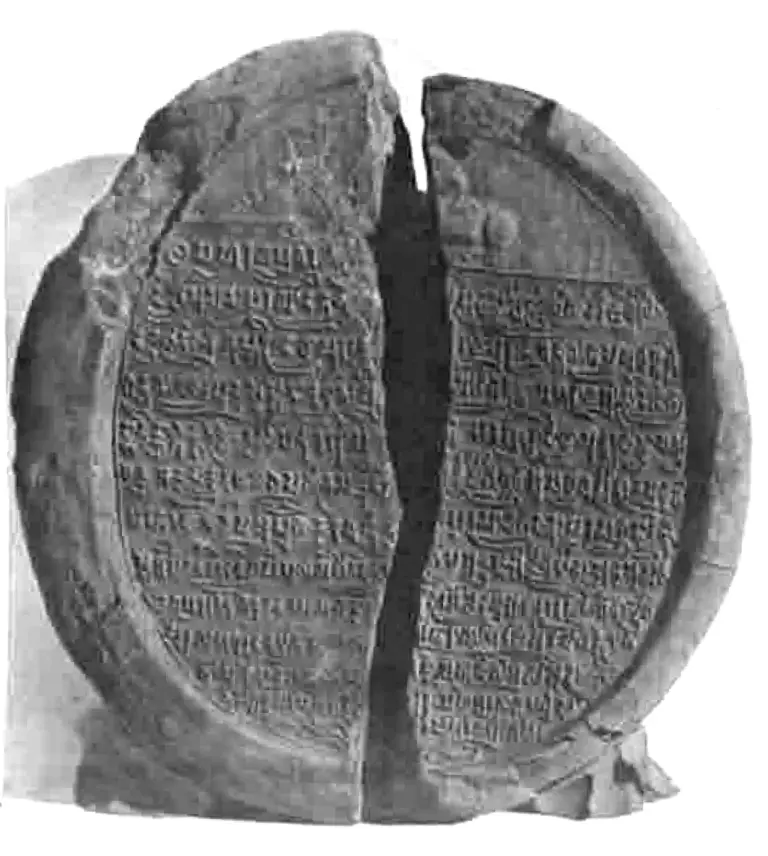
Cave 16 is attributed to his successor and uncle, Krishna I (c. 757-83 CE). The proof is not on the temple. It is a copper plate issued about 30 years later, the Baroda grant of Karka II (c. 812-13 CE), which praises a Shiva temple that Krishnaraja caused to be built on the hill at Elapura, so astonishing that the gods took it for self-existent and the architect wondered how he had done it. Most historians, and the ASI, read that as Kailasa. The political history of the house, from Manyakheta to the Kannauj struggle, belongs in the note on the Rashtrakuta dynasty, not here.
The Jain caves are later still. The ASI places them after the Rashtrakutas, in the time of the Kalyani Chalukyas and the Yadavas of Deogiri (Daulatabad), and notes fragmentary inscriptions plus Jaina sculpture from Daulatabad as the local context.
So the honest answer to “who built Ellora” is a sequence, not a name. Kalachuri and Chalukya beginnings, Rashtrakuta Hindu climax, later Jain work. Krishna I owns Kailasa on the best reading of one later plate. He does not own the cliff.
The 34 caves in the order you meet them
Numbering at Ellora follows the path along the scarp from south to north. Cave 1 is not the oldest cave. It is the first cave you reach on the southern arc. It is wise to learn the three groups before the cave numbers.
The ASI’s own short list, if time is tight, is Cave 10, Cave 16, Cave 21 and the Jain pair 32 and 34. That is a better revision set than a complete catalogue.
The Buddhist group, Caves 1 to 12
These are mostly viharas, monastery halls with cells, cut when Mahayana Buddhism was current in the western Deccan. UNESCO flags three of them.
Cave 10, Visvakarma, also called Sutar-ki-jhopari, the Carpenter’s Cave, is the only large chaitya, a prayer hall, in the group. The barrel-vaulted ceiling is cut to look like timber ribs, which is where the carpenter’s name comes from. At the apsidal end a rock-cut stupa carries a seated Buddha in the teaching pose, flanked by attendants. This is the late Deccan chaitya: the stupa is still there, but the Buddha is now on it, as at Ajanta’s later halls, not only implied by an empty mound as at the Sanchi Stupa.
Cave 12, Teen Tal, is the three-storeyed monastery UNESCO calls the largest in this category. Cave 11 sits with it as a multi-storey vihara. Both, with Cave 10, mark the move into Vajrayana imagery: rows of Buddhas, bodhisattvas and goddesses arranged as a carved mandala rather than a single shrine image.
Caves 1 to 9 are the quieter residential halls. They matter as the monastic campus. They are not the halls you need to name.
The Hindu group, Caves 13 to 29
The Brahmanical caves occupy the centre of the cliff, and they are the ones that stop looking like caves. Several open into courtyards. A few are almost free-standing temples that happen to have been subtracted from the hill.
Cave 15, the Dasavatara, the Cave of Ten Incarnations, is the political key. Large panels of Vishnu’s avatars fill the upper hall, and Dantidurga’s inscription is on the front mandapa. The plan, with a court and a two-storey hall, already points toward Kailasa next door.
Cave 21, Ramesvara, is the ASI’s pick from the earlier Hindu work, the Shiva cave it puts on the short list beside Kailasa. Cave 29, Dumar Lena, is the other early landmark. Its plan is the one UNESCO and the ASI compare with the Great Cave at the Elephanta Caves. In the monsoon the Elaganga comes over the scarp near this cave as the fall the ASI calls Sita-ki-nahani. That is geography doing the teaching: Ellora was cut into a living hillside, not a dry museum face.
Cave 16 needs its own section. Around it, Cave 14 and the lesser Shaiva halls fill the centre of the scarp.
The Jain group, Caves 30 to 34
The five Jain caves sit on the northern arc. They are smaller than Kailasa and finer in the cutting. UNESCO assigns them to the Digambara tradition and notes the paintings that still cling to ceilings and walls.
Cave 32, Indra Sabha, is the one later conservation reports name. ICOMOS already pointed out that this cave recalls dispositions of the Kailasa temple: a court, a small monolithic shrine, then a two-storey hall. Cave 30 is a reduced monolith on the same idea. The Jain sculptors were not inventing a new architecture. They were finishing the Ellora language in another register, with Tirthankara images in place of Shiva and the Buddha.
The paintings here are the ones that still have colour, unlike the faded patches in Kailasa’s front mandapa. They belong in the same family as the western Indian mural tradition treated in the note on mural painting, only later and on a Jain programme.
Cave 16, the Kailasa temple
Kailasa is a built Dravida temple that was never assembled. It was released from the hill by cutting a trench around a block of basalt and carving the temple out of what remained, from the top down. UNESCO’s phrase is that it “transposes models from constructed architecture.” The masons already knew the gateway, the Nandi pavilion, the pillared hall, the linga shrine and the tower of a structural Shiva temple. At Ellora they subtracted the same parts from living rock.
Britannica measures the complex at some 50 m long, 33 m wide and 30 m high. Treat those as one published set of figures, not a survey you can quote to the centimetre. The ASI does not print a size. It prints a rank: the largest single monolithic excavation in the world.
A walk through it follows the plan of a courtyard temple, not a cave:
- A screen wall and gateway, the gopura, open into a court cut down from the plateau.
- A Nandi mandapa stands in the court, facing the main shrine, with large elephant sculptures along the lower walls.
- The main temple, two storeys, holds the garbhagriha and a Shiva linga, with a vimana above, the tower standing for Mount Kailasa, Shiva’s Himalayan seat.
- Side galleries carry narrative panels from the Ramayana and the Mahabharata.
- The panel UNESCO names is Ravana trying to lift Mount Kailasa, Shiva pressing the mountain down with his foot.
The front mandapa still holds traces of painting from more than one period. They are easy to miss because the sculpture is louder.
The nearest built cousin is the Virupaksha temple at Pattadakal, the Chalukya workshop from which Rashtrakuta masons inherited a southern vimana. M.K. Dhavalikar read Kailasa as that temple enlarged and turned into a monolith. You do not need to settle the copy debate. You do need the architectural point: Kailasa is temple architecture executed by excavation.
One correction is worth planting here. Kailasa is Cave 16, a Hindu monument of the 8th century on the best evidence. It is not a stand-in for the other 33 caves, and it is not proof that the Rashtrakutas cut the Buddhist halls.
Ellora Caves today: UNESCO status and conservation
The Ellora caves have been a UNESCO World Heritage Site since 1983, inscribed at the 7th session of the World Heritage Committee in Florence, 5 to 9 December 1983, under dossier 243. The Committee listed them under three cultural criteria, and the later Outstanding Universal Value text still uses that wording:
- Criterion (i), a masterpiece of human creative genius: the ensemble, and above all the technological exploit of cutting Kailasa, plus its sculpted and painted programme.
- Criterion (iii), a unique testimony: the uninterrupted sequence of monuments from AD 600 to 1000.
- Criterion (vi), an association with living traditions: not only three religions, but the fact that Buddhist, Brahmanical and Jain communities set their sanctuaries on one cliff.
Ajanta, inscribed at the same session, carries an extra criterion, (ii), for its influence on later art. Ellora’s distinctive citation is (vi), the tolerance argument. The Committee also asked India for a protection zone around the landscape and the cliff. The Archaeological Survey of India now manages the property. The buffer is shared with the Forest Department and the Government of Maharashtra, under the Ancient Monuments and Archaeological Sites and Remains Act, 1958, its 1959 Rules and the 2010 amendment, plus forest and state planning law.
Unlike Ajanta, Ellora was never lost in jungle. The ASI traces visitors from the Arab geographer Al-Masudi in the 10th century through Sultan Hasan Gangu Bahmani in 1352, Firishta and early modern European travellers. In the 19th century the Holkars of Indore leased worship rights. The Nizams of Hyderabad then maintained the caves with ASI guidance, and the site passed to the ASI after the princely state merged into Maharashtra. The caves are closed on Tuesday.
The live conservation problem is water. UNESCO’s own management note lists seepage and cracking, visitor pressure and staff capacity, and says a Comprehensive Conservation Management Plan is underway. In August 2025 the ASI began desilting a concrete drain above the complex and repairing minor cracks after seepage near the 9th-century frescoes in Cave 32, Indra Sabha. A PTI report carried on 8 August 2025 quoted an official saying the damp was then away from the paintings. That is a maintenance story, not a collapse story, and it is exactly the threat the World Heritage file already named.
The wider Indian list, and how Ellora sits on it, is in the note on UNESCO World Heritage Sites in India.
How to study the Ellora Caves for exams
Ellora sits in the Indian culture part of GS Paper I, under art and architecture, and it is the standard example of rock-cut work after Ajanta. Art and Culture accounts for 94 of the 1,403 questions from 2013 to 2026 in the site’s Prelims question bank. The theme is tested as rock-cut architecture and as a three-faith site, not as a tourist brochure for one temple.
Mains 2020 GS Paper I asked “The rock-cut architecture represents one of the most important sources of our knowledge of early Indian art and history. Discuss.” Ellora answers both halves: the art is in the chaitya, the monolith and the Jain courts, and the history is in Dantidurga’s inscription and the Baroda plate. History Optional 2015 Paper I asked, verbatim, “Kailasa temple built at Ellora marks the culmination of rock-cut architecture in India. Elucidate.” That sentence is the frame. Culmination means the end of a line that begins with the Mauryan rock-cut halls and runs through Ajanta and Elephanta, not a monument with no past.
Revise these until they are automatic:
- Place: Verul (Ellora), Charanandri hills, about 30 km NNW of Aurangabad; local name Verul Leni.
- Count: 34 numbered caves of nearly 100; 1-12 Buddhist, 13-29 Hindu, 30-34 Jain.
- Date: about 6th to 12th century CE; UNESCO also uses AD 600 to 1000 for the main sequence.
- Inscriptions: Dantidurga on Cave 15; Krishna I for Kailasa via the Baroda plate of Karka II, not via a dedication on the temple.
- Kailasa: Cave 16, top-down monolith, Shiva as Mount Kailasa, Ravana panel, paintings in the front mandapa.
- Buddhist keys: Cave 10 Visvakarma chaitya; Cave 12 Teen Tal; Vajrayana imagery.
- UNESCO: 1983, 7th session, Florence; criteria (i), (iii) and (vi); ASI protection under the AMASR Act.
Three confusions cost marks:
- Ellora and Ajanta. Both are UNESCO cave sites near Aurangabad, both inscribed in 1983. Ajanta is Buddhist only, famous for paintings, and was lost until 1819. Ellora is three faiths, famous for a monolith, and was never lost.
- Kailasa and the site. Cave 16 is the signature. It is not the site. An answer that names only Krishna I has missed the Buddhist and Jain thirds.
- Numbering and date. Cave 1 is south, not first. Cave 29 can be earlier in style than Cave 16.
Set it beside its two Maharashtra siblings:
| Site | Faith | Main period | Signature | UNESCO |
|---|---|---|---|---|
| Ajanta | Buddhist | 2nd to 1st century BCE, then 5th to 6th century CE | 30 caves; paintings; chaityas and viharas | 1983; (i), (ii), (iii), (vi) |
| Ellora | Buddhist, Hindu and Jain | 6th to 12th century CE | 34 caves; Kailasa (Cave 16) | 1983; (i), (iii), (vi) |
| Elephanta | Shaiva, with Buddhist remains | Mid-5th to 6th century CE | Great Cave and the Maheshmurti | 1987; (i), (iii) |
Ellora rewards the aspirant who can hold a sequence without flattening it. The cliff is three religions, two hard inscriptions and one temple that looks like a building. An answer that says so, and then describes Kailasa as constructed architecture cut from the rock, reads as more authoritative than one that recites a single king’s name and a superlative.
Frequently Asked Questions
Who built the Ellora Caves?
No one dynasty built all 34. The ASI assigns the early Buddhist caves and Cave 21 to the Kalachuris of Mahishmati and the Chalukyas of Badami, the great Hindu work including Kailasa to the Rashtrakutas, and the Jain caves to later Kalyani Chalukya and Yadava times. Krishna I is the usual patron of the Kailasa temple on the evidence of the Baroda copper plate of Karka II.
How many caves are there at Ellora?
The World Heritage property and the visitor circuit count 34 numbered caves. The ASI notes nearly 100 excavations in the hill range, plus smaller groups called Ganesh Leni and Jogeshwari Leni, which are not in that 34. Of the numbered set, 12 are Buddhist, 17 Hindu and 5 Jain.
What is the Kailasa temple at Ellora?
It is Cave 16, a monolithic Shiva temple cut top-down from the basalt so that a full courtyard temple stands free of the cliff. The ASI calls it the largest single monolithic excavation in the world. Its programme includes a Nandi pavilion, a linga shrine, narrative galleries and the relief of Ravana trying to lift Mount Kailasa.
When were the Ellora Caves declared a UNESCO World Heritage Site?
UNESCO inscribed the Ellora Caves in 1983 at the 7th session of the World Heritage Committee, held in Florence from 5 to 9 December. They were listed under criteria (i), (iii) and (vi), for the artistic and technical achievement, the long sequence of monuments and the three religions sharing one cliff.
What is the difference between the Ajanta Caves and the Ellora Caves?
Ajanta is a Buddhist-only site in a horseshoe gorge, known for its murals, with two phases and a long abandonment until 1819. Ellora is a west-facing cliff of Buddhist, Hindu and Jain caves, known for the Kailasa monolith, and it remained in living memory. Both were inscribed in 1983, but Ajanta carries criterion (ii) as well, and Ellora carries (vi).
Are the Ellora Caves Buddhist or Hindu?
They are both, and Jain as well. Caves 1 to 12 are Buddhist, 13 to 29 Hindu and 30 to 34 Jain. UNESCO cited that mix as evidence of religious tolerance, not as a claim that every cave was in use at the same moment.
Where are the Ellora Caves located?
They stand at Verul village, locally Verul Leni, about 30 km north-northwest of Aurangabad, now Chhatrapati Sambhajinagar, in Maharashtra. UNESCO still records the property as Aurangabad District, Khulatabad Taluk, Verul Village, in the Charanandri hills.
Practice Questions
Prelims
1. Consider the following statements about the Ellora Caves:
1. UNESCO inscribed them as a World Heritage Site in 1983.
2. They were inscribed under criteria (i), (iii) and (vi).
3. Caves 1 to 12 are Buddhist, 13 to 29 Brahmanical and 30 to 34 Jaina.
Which of the statements given above is/are correct?
- (a) 1 and 2 only
- (b) 2 and 3 only
- (c) 1 and 3 only
- (d) 1, 2 and 3
Answer: (d) The World Heritage file and the ASI both give this grouping, the 1983 date and the three criteria.
2. Consider the following statements:
1. The Kailasa temple at Ellora is Cave 16.
2. A dedicatory inscription of Krishna I is carved on the temple itself.
Which of the statements given above is/are correct?
- (a) 1 only
- (b) 2 only
- (c) Both 1 and 2
- (d) Neither 1 nor 2
Answer: (a) Cave 16 is Kailasa, but the link to Krishna I comes from the later Baroda copper plate of Karka II, not from an inscription on the monument.
3. The only large Buddhist chaitya among the numbered Ellora caves is:
- (a) Cave 10, Visvakarma
- (b) Cave 12, Teen Tal
- (c) Cave 15, Dasavatara
- (d) Cave 29, Dumar Lena
Answer: (a) UNESCO and the ASI identify Cave 10 as Visvakarma, the Carpenter’s Cave; Cave 12 is a three-storey vihara.
4. Match the following Ellora caves with their identifications:
1. Cave 15 : Dasavatara
2. Cave 21 : Ramesvara
3. Cave 29 : Dumar Lena
Which of the pairs given above is/are correctly matched?
- (a) 1 and 2 only
- (b) 2 and 3 only
- (c) 1 and 3 only
- (d) 1, 2 and 3
Answer: (d) All three names are those used in the UNESCO Outstanding Universal Value statement and the ASI account.
5. Consider the following statements about rock-cut sites in Maharashtra:
1. The plan of Ellora’s Dumar Lena closely resembles the Great Cave at Elephanta.
2. Ajanta and Ellora were both inscribed on the World Heritage List in 1983.
Which of the statements given above is/are correct?
- (a) 1 only
- (b) 2 only
- (c) Both 1 and 2
- (d) Neither 1 nor 2
Answer: (c) UNESCO compares Elephanta’s Great Cave with Dumar Lena (Cave 29), and both Ajanta (242) and Ellora (243) were inscribed at the 7th session in 1983.
Mains
- The rock-cut architecture represents one of the most important sources of our knowledge of early Indian art and history. Discuss. (10 marks, 150 words) Previous year: Mains 2020, GS Paper I.
- The Ellora Caves are often described as a monument of religious tolerance. Examine that claim with reference to the sequence of Buddhist, Hindu and Jain excavations and to UNESCO criterion (vi). (15 marks, 250 words)
- ‘Kailasa temple built at Ellora marks the culmination of rock-cut architecture in India.’ Elucidate, with attention to how Cave 16 transposes the plan of a constructed temple. (15 marks, 250 words)
- Distinguish the evidence for Rashtrakuta patronage at Ellora from the evidence for earlier and later work on the same cliff. (10 marks, 150 words)
- Safeguarding the Indian art heritage is the need of the moment. Discuss. (10 marks, 150 words) Previous year: Mains 2018, GS Paper I.
Tell Google you want more of this.
Add Anantam IAS as a preferred sourceOne tap, and this site shows up more often in your own Top Stories, AI Overviews and AI Mode. Remove it any time.