The Pala Empire was the kingdom of the Pala dynasty, which ruled Bengal and Bihar from the middle of the 8th century to the 12th. Its founder, Gopala, took power after a spell of anarchy, and his son Dharmapala and grandson Devapala briefly made the Palas the strongest kings in north India. The dynasty matters because it fought the long war for Kannauj and was the last great royal patron of Buddhism in India, sending Buddhist art to Tibet and Southeast Asia.
Two ideas trip up most readers. The first is that Gopala was “elected” in something like a vote; the copper plate behind that story says his prakritis made him king, and historians still argue over who they were. The second is that the Palas founded Nalanda. They didn’t. Nalanda was already centuries old, and the Palas were its patrons, not its builders. This note settles both from the inscriptions themselves.
What was the Pala Empire?
The Pala Empire was a Bengal and Bihar kingdom whose kings, at their height, claimed overlordship over much of north India. NCERT’s Class XII art textbook treats 750 CE to the mid-12th century as the Pala period. Reign dates move by a decade or more between standard works; the table gives its sources’ ranges.
| Fact | Detail |
|---|---|
| Dynasty | The Palas of Bengal and Bihar, 8th to 12th century |
| Founder | Gopala, a local chief who rose in the mid-8th century; the IGNOU unit places his death about 780 |
| Founding record | Khalimpur copper plate of Dharmapala, issued in his 32nd regnal year |
| Peak | Dharmapala (c. 770-810) and Devapala (c. 810-850), by Britannica’s dates |
| Main seat | Mudgagiri, modern Munger in Bihar, with other centers on the Ganga such as Pataliputra |
| Revivals | Mahipala I (c. 988-1038) and Ramapala (c. 1077-1120), the last important Pala king |
| Religion | Buddhist kings who also granted land to Brahmanas and Hindu temples |
| Monasteries | Founded Vikramashila and Somapura; endowed the older Nalanda |
| Successors | The Senas in Bengal; Pala kings held southern Bihar for about 40 more years |
How did Gopala become king?
Gopala became king because the leading men of a broken Bengal agreed to accept him, and almost everything known about it comes from one verse in his son’s copper plate. The rest is inference.
Bengal’s first significant king, Sasanka, ruled until about 637. The IGNOU unit on the period lists what followed his death:
- attacks by Yasovarman of Kannauj;
- attacks by Lalitaditya of Kashmir;
- probably a later invasion by the king of Kamarupa.
The result was a weak center and a crowd of independent chiefs. Sanskrit had a word for that condition: matsyanyaya, the “law of the fishes”, where the strong swallow the weak the way big fish eat small ones.
The Khalimpur copper plate tells what happened next. Edited by F. Kielhorn in Epigraphia Indica, its fourth verse says the prakritis made Gopala take the hand of Lakshmi, the goddess of fortune, matsya-nyayam apohitum, “to put an end to the practice of fishes”.
The real question is who the prakritis were. Kielhorn translated the word as the people; the IGNOU unit reads the event as the chiefs electing Gopala. Neither reading gives a vote in the modern sense. A group of powerful men accepted one of their own as king, and a court poet later turned that into a wedding with Fortune.
The same plate praises Gopala’s grandfather Dayitavishnu for learning and his father Vapyata as a fighter, but gives neither a royal title. A new man needed a reason to rule, and ending anarchy was the best one on offer. The note on inscriptions in ancient India explains how copper plates like this are read and dated.
Dharmapala, Devapala and the tripartite struggle for Kannauj
The tripartite struggle was the 8th and 9th century contest for Kannauj between the Palas and two rivals, the Gurjara-Pratiharas and the Rashtrakutas. Dharmapala won Kannauj and then lost it, and no power held the city for long.
Why Kannauj? Harsha had made it the royal capital of north India, so whoever held it could claim the Ganga plain. The label is modern: an IGNOU unit notes that historians such as H.C. Raychaudhuri framed these wars as a three-sided struggle.
The sequence is easier to hold as steps:
- The Rashtrakuta king Dhruva crossed the Vindhyas and defeated first the Pratihara king Vatsaraja, then Dharmapala in the Ganga-Yamuna doab.
- When Dhruva’s death threw his kingdom into turmoil, Dharmapala took Kannauj and held an imperial assembly there to install his own nominee.
- The Pratihara Nagabhata II, Vatsaraja’s son, defeated the nominee and then Dharmapala himself.
- The Rashtrakuta Govinda III marched north and forced Nagabhata to flee, but trouble at home stopped him from holding the north.
- Dharmapala recovered much of his empire. At his death around 815, by the IGNOU unit’s dating, Devapala inherited a large part of north India.
The nominee has a name, and it comes from the other side. NCERT’s Class VII textbook quotes a Gwalior prashasti of Nagabhata that claims a victory over Chakrayudha, “the ruler of Kanauj”. Read with the IGNOU sequence, that’s Dharmapala’s man. Verse 12 of the Khalimpur plate gives the Pala version of the same moment: kings from the Kuru lands to Gandhara bowed as Dharmapala installed the king of Kanyakubja, and the elders of Panchala, the Kannauj country, raised Dharmapala’s golden coronation jar for the new king.
Every side claims victory, because each dynasty’s poets recorded only wins; the sequence above comes from reading all three sets of records against one another. The Deccan side is in the note on the Rashtrakuta dynasty.
Devapala ruled for about 40 years, c. 810-850 in Britannica’s dating, and raided as far as the Deccan and the peninsula. His court poets claimed more; by the IGNOU unit’s summary, he is said to have:
- conquered Utkala (Odisha) and Kamarupa (Assam);
- ruled from the Himalayas to the Vindhyas and from the Bay of Bengal to the Arabian Sea.
Read that last line as a poet’s map, not a surveyor’s. What is certain is that Pala power shrank after him.
How did the Pala state work?
The Pala state was a king at the center, surrounded by chiefs who owed him service and held together by land grants recorded on copper. The kings took the full imperial style of the age, maharajadhiraja or “great king of kings” among it, and ruled from several seats on the Ganga rather than one fixed capital.
Britannica names Mudgagiri, modern Munger, as the likely main capital. The IGNOU unit adds Pataliputra and describes jayaskandhavaras, literally “camps of victory”, where tributary chiefs came to pay homage.
Below the king sat the chiefs. The Pala charters name several grades, which IGNOU reads as feudatories holding land in return for military service:
- raja and rajaputra, lesser kings and princes;
- ranaka, a chief;
- mahasamanta, a great feudatory;
- mahasamantadhipati, the head of the great feudatories.
One document shows the whole system. In the Khalimpur plate, a mahasamantadhipati named Narayanavarman asks Dharmapala, through the crown prince as messenger, to grant four villages to a temple of Nunna-Narayana, a form of Vishnu, and to the Brahmanas from Lata in Gujarat who serve it. The villages are placed in a chain of units:
- the bhukti, or province, of Pundravardhana;
- the mandala, or division, of Vyaghratati;
- the vishaya, or district, of Mahantaprakasha.
The order then goes out to officials down to the dashagramika, the officer over ten villages, and to the cultivators, who must now pay their dues to the temple. A Buddhist king endowing a Vishnu temple at a feudatory’s request: that’s the Pala state in miniature.
Two cautions apply. The records show no sign of sub-infeudation, chiefs granting land onward to their own vassals, so the Pala order was looser than a full feudal pyramid. And grants to Brahmanas sat beside grants to monasteries, so “Buddhist empire” describes the kings’ faith better than their policy.
Mahipala I, Ramapala and the Kaivarta revolt
After Devapala the Palas became a regional power. They revived under Mahipala I around 1000 CE and nearly lost their homeland to a revolt in the late 11th century. Ramapala (also written Rampala) won it back before the Senas replaced the dynasty.
The low point came in the 10th century, when the Pratihara emperor Mahendrapala pushed as far as northern Bengal and the Kambojas later held north and west Bengal. Mahipala I, who ruled c. 988-1038, took back territory from the Kambojas and held off three invaders:
- the Kalachuris;
- the Chola king Rajendra Chola;
- a Chalukya king.
His influence reached Varanasi, though south and west Bengal stayed with independent chiefs. Rajendra’s wider career is covered in the note on the Chola dynasty.
The crisis came under Mahipala II in the last quarter of the 11th century, when some of his chiefs rose against him and he was defeated and killed. Divya, an official from the Kaivarta community, whom the Pala records show as cultivators, took Varendra, the dynasty’s north Bengal heartland. Ramapala, the dead king’s brother, fled to Magadha and rallied the chiefs. With their help he defeated Divya’s kinsman and successor Bhima and won Varendra back. He later took Kamarupa and forced the Varman king of east Bengal to submit.
Historians read the revolt in three ways. Early studies saw a revolt of samantas, ambitious chiefs exploiting a weak king. R.S. Sharma read it as a peasant revolt against feudal pressure. Recent work, summarized by IGNOU, sees a fight at the top over land given to religious bodies that widened into a mass rising against Pala taxes. The sensible reading holds the first and the last together: it began as a quarrel among the powerful and grew because ordinary cultivators had grievances of their own.
The story survives because of a poem. Sandhyakaranandin wrote the Ramacharita so that each verse could be read as the life of Rama or of Ramapala; the recovery of Varendra shadows Rama’s recovery of Sita. An IGNOU unit on early historical writing adds that Ramapala had no direct claim to the throne, and praise-poems of this kind helped rulers whose position was shaky.
Britannica calls Ramapala the last important Pala king, and his revival didn’t outlive him. The kingdom broke up under his sons Kumarapala and Madanapala. The Senas took Bengal, while Pala kings held on in southern Bihar for about 40 years.
What did the Palas do for Buddhism?
The Palas were the last Indian dynasty to fund Buddhism on an imperial scale. They built new monasteries and endowed old ones, and Britannica credits missionaries from their kingdom with finally establishing Buddhism in Tibet.
Dharmapala calls himself a devout worshipper of Sugata, the Buddha, in the Khalimpur plate. Four monasteries carry the story:
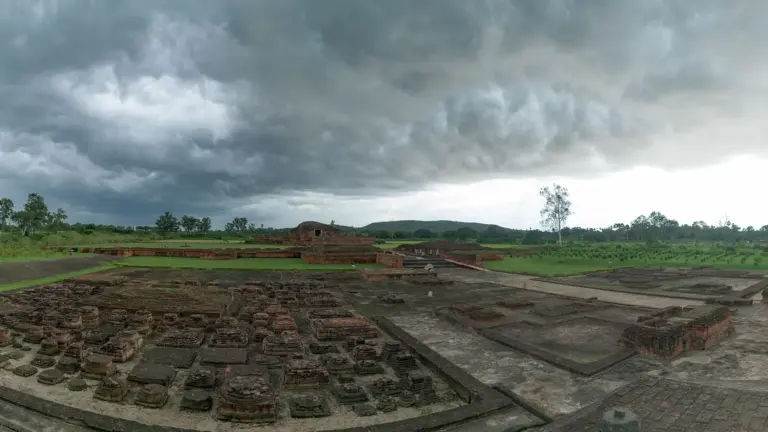
- Vikramashila, at Antichak in Bhagalpur district, Bihar, founded by Dharmapala; the ASI’s excavation of 1972-82 exposed a large square monastery with a cruciform stupa at its center.
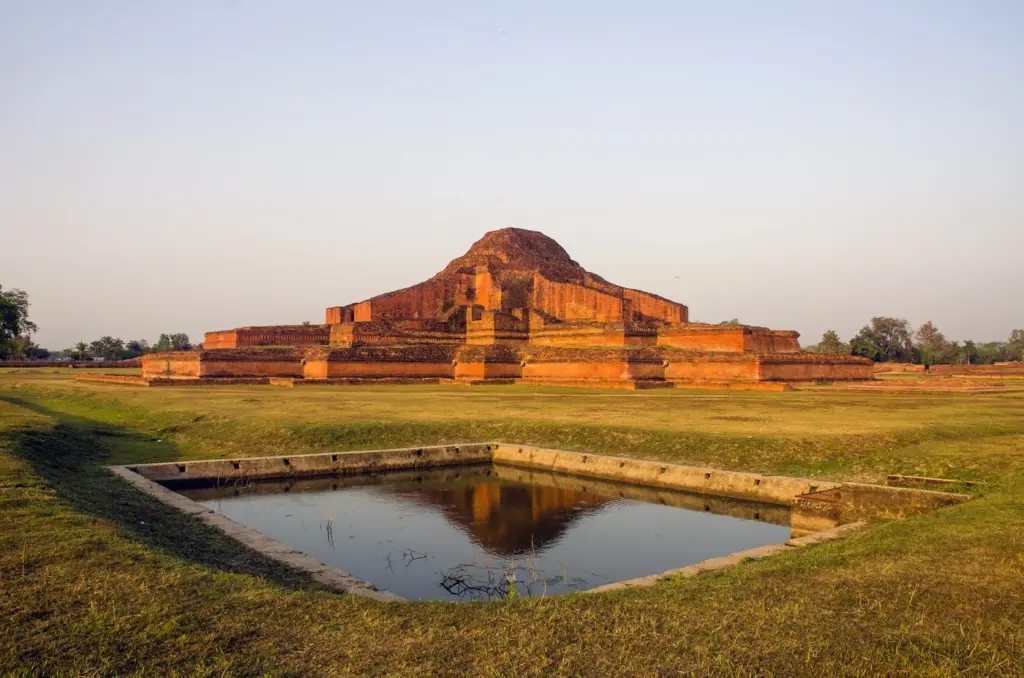
- Somapura Mahavihara, at Paharpur in Naogaon district, Bangladesh, where a clay seal names Dharmapala as the first builder; 177 monks’ cells ring a cross-shaped central shrine.
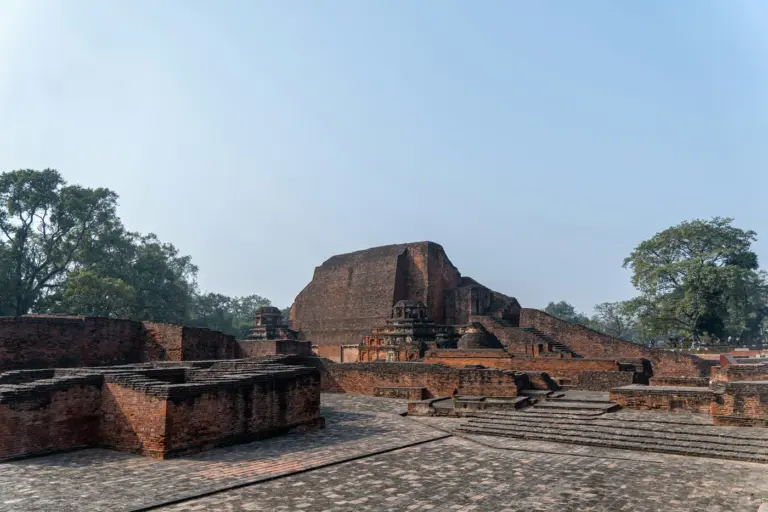
- Nalanda, already centuries old, endowed by Devapala and still producing illustrated manuscripts in Ramapala’s reign.
- Odantapuri, counted with Nalanda and Vikramashila among the three leading monasteries of the Pala age.
The most famous endowment is often misstated. The Nalanda copper plate, found at Nalanda in 1921 and now in the National Museum, New Delhi, carries Devapala’s seal. It records that Balaputradeva, the Shailendra king of Suvarnadvipa and Java, had built a monastery at Nalanda and asked Devapala through an envoy to support it. Devapala granted five villages, four of them in the Rajagriha area, for its monks and upkeep. So the grant was Devapala’s and the monastery was Balaputradeva’s. IGNOU’s unit on Southeast Asia adds that these Shailendra-Pala ties brought Nalanda-style Buddhist art to Java. The wider story of the university is in the note on Nalanda University.
UNESCO credits Somapura’s plan with shaping later buildings abroad:
- the temples of Pagan in Myanmar;
- Loro Jonggrang and Chandi Sewu in central Java, both part of the Prambanan temple complex;
- Buddhist architecture as far away as Cambodia.
Pala Buddhism was largely Vajrayana, the “diamond vehicle”, a tantric form of Mahayana that works through ritual and mantra and worships goddesses such as Tara. UNESCO records the Vajrayana trend at Paharpur, and NCERT notes Vajrayana deities in Pala manuscripts. The same world produced Atisha (982-1054), whose arrival in Tibet in 1042 Britannica treats as the start of a reform in Tibetan Buddhism, though its biography of him hedges between 1038 and 1042. The doctrine behind these schools is in the note on Buddhism in India.
What is the Pala school of art?
The Pala school is the art of the monasteries and workshops of Bengal and Bihar from about the 8th to the 12th century, most of it Buddhist. NCERT calls the Pala period the last great phase of Buddhist art in India, and the school worked in three media:
- Bronze. A school of bronze casting grew up at Nalanda around the 9th century, and sculptors at Kurkihar near Nalanda revived the classical Gupta style. NCERT singles out a four-armed Avalokiteshvara standing in tribhanga, the “thrice-bent” pose, and notes that images of Tara became popular as Vajrayana grew.
- Stone. At Paharpur, more than 60 stone images of Hindu deities line the base of the central shrine, and bands of terracotta plaques run around the terrace above them.
- Palm-leaf painting. Illustrated Pala manuscripts, along with Jain ones, are the earliest surviving Indian manuscript paintings, from the 11th and 12th centuries, drawn in a flowing line and soft colors. A fine example is an Ashtasahasrika Prajnaparamita, the “Perfection of Wisdom in 8,000 lines”, painted at Nalanda in Ramapala’s 15th year and now in the Bodleian Library, Oxford.
The art traveled because people did. Students and pilgrims from Southeast Asia, NCERT explains, carried Pala bronzes and manuscripts home, spreading the style to:
- Nepal and Tibet;
- Burma (Myanmar) and Sri Lanka;
- Java.
That’s why the Pala style is one of the roots of Himalayan and Southeast Asian Buddhist art, and why it opens the manuscript tradition traced in the note on Indian painting schools. The Kurkihar revival of the Gupta style is the thread to follow backward to the Mathura and Gandhara schools. Pala art ended in the first half of the 13th century, when the monasteries that sustained it were sacked.
The Pala Empire today: sites, excavations and returned sculptures
The Pala state is long gone, but its monasteries survive as excavated sites and its sculptures are still coming home:
- Somapura Mahavihara has been a UNESCO World Heritage Site since 1985, under criteria (i), (ii) and (vi): UNESCO valued it as an artistic achievement and a model for later temples abroad, and tied it to the rise of Mahayana Buddhism in Bengal. Its statement on the site flags salt and plant growth damaging the uncovered shrine and plaques, and asks for a buffer zone because of possible mining nearby.
- Nalanda’s excavated remains were inscribed on the World Heritage List in 2016.
- At Vikramashila, the ASI’s Patna Circle resumed excavation on 8 February 2024, its first dig there since 1982, PTI reported.
- On 13 May 2026, the Culture Ministry said a batch of 11 antiquities received from Australia in March 2026 included a Pala-period Varaha showing the lifting of Bhudevi, returned by Australian museums.
Pala heritage now sits in two countries, and some of its portable art is still abroad.
How to study the Pala Empire for exams
The Palas sit in General Studies under early medieval history and under art and culture. The History optional syllabus names them in Paper I: ‘Palas, Senas, Rashtrakutas, Paramaras, Polity and administration; Cultural aspects’.
The topic is tested from two sides: Buddhism and patronage, and the Kannauj wars with the polity behind them. Mains 2026 History Optional Paper I asked “‘Royal patronage and religious institutions significantly contributed to the development of Nalanda, Vikramashila and Vallabhi into prominent centres of learning.’ Elucidate.” History Optional Paper I in 2022 asked “Evaluate the importance of tripartite struggle for the domination over North India during the eighth and ninth centuries.” GS Paper I set a direct question on the Pala period and Buddhism in 2020; it opens the practice set below. In the site’s Prelims question bank, History accounts for 184 of the 1,403 questions and Art and Culture for 94, and the Palas fall under both headings.
Seven facts carry most of the marks:
- Gopala, founder, mid-8th century; made king to end matsyanyaya, per the Khalimpur plate.
- Dharmapala (c. 770-810): installed Chakrayudha at Kannauj and founded Vikramashila.
- Devapala (c. 810-850): granted five villages for Balaputradeva’s monastery at Nalanda.
- Mudgagiri (Munger) was probably the main Pala capital.
- Mahipala I (c. 988-1038): revived the kingdom and faced Rajendra Chola’s northern campaign.
- Ramapala (c. 1077-1120): recovered Varendra from the Kaivartas; hero of Sandhyakaranandin’s Ramacharita.
- The Senas replaced the Palas in Bengal in the 12th century.
Four confusions cost marks:
- Two Mahipalas. The Pala Mahipala I ruled c. 988-1038; the Pratihara Mahipala lost Kannauj to the Rashtrakuta Indra III in 915.
- Founder or patron. The Palas founded Vikramashila and Somapura. Nalanda they endowed.
- Whose grant. In the Nalanda plate the villages are Devapala’s gift; the monastery is Balaputradeva’s.
- Which election. Gopala’s rise was acceptance by chiefs or subjects, recorded by a court poet, not a vote.
The Palas make most sense beside their two rivals, and the wider map of the period is in the overview of medieval Indian history.
| Power | Base | Main seat | Rulers in the Kannauj contest |
|---|---|---|---|
| Palas | Bengal and Bihar | Mudgagiri (Munger) | Dharmapala, Devapala |
| Gurjara-Pratiharas | Rajputana and central India | Kannauj, once won | Vatsaraja, Nagabhata II |
| Rashtrakutas | Deccan | Manyakheta (Malkhed) | Dhruva, Govinda III, later Indra III |
One reading beats a stack of guidebooks. IGNOU’s free unit, The Political Scenario II: Rashtrakutas and Palas, covers the whole political story in under 20 pages, with the historians’ debates attached.
Read the Palas as a system rather than a king list. Almost every question on them, from a one-line Prelims statement to a 15-mark answer on Buddhism, comes back to what their copper plates and monasteries show about how a Bengal kingdom made itself imperial and paid for a faith.
Frequently Asked Questions
Who founded the Pala Empire?
Gopala founded the Pala Empire around the middle of the 8th century. He was a local chief accepted as king after a period of anarchy in Bengal, and the Khalimpur copper plate of his son Dharmapala says the prakritis made him king to end matsyanyaya. The IGNOU unit on the period places his death about 780.
What is matsyanyaya in Pala history?
Matsyanyaya, the law of the fishes, means anarchy in which the strong swallow the weak, as big fish eat small ones. The Khalimpur copper plate uses the term for the disorder in Bengal before Gopala. It’s the standard example of an early medieval dynasty justifying its rise as the restoration of order.
What was the tripartite struggle?
It was the long contest for Kannauj in the 8th and 9th centuries between the Palas and two rivals, the Gurjara-Pratiharas and the Rashtrakutas. Dharmapala held Kannauj for a time through his nominee Chakrayudha, lost it to the Pratihara Nagabhata II and saw the Rashtrakutas march north twice. No power held the city for long.
Who was the greatest Pala ruler?
Dharmapala and Devapala are the usual answers. R.C. Majumdar, cited in the IGNOU unit, ranks Dharmapala among the greatest kings to rule Bengal, and under Devapala the empire made its widest claims. Mahipala I and Ramapala are remembered for revivals rather than expansion.
Which monasteries did the Palas support?
Dharmapala founded Vikramashila in Bihar and is named as the first builder of Somapura Mahavihara at Paharpur, now in Bangladesh. The Palas also endowed Nalanda, which was centuries older, and Odantapuri was the third great monastery of their age. Devapala’s Nalanda copper plate records a grant of five villages for a monastery built there by Balaputradeva of Suvarnadvipa.
What is the Pala school of art known for?
It’s known for Buddhist images in bronze and stone and for painted palm-leaf manuscripts, made in Bengal and Bihar between roughly the 8th and 12th centuries. Nalanda and Kurkihar were bronze centers, and manuscripts such as the Ashtasahasrika Prajnaparamita show its flowing line and soft colors. Students and pilgrims carried the style to the Himalayas and Southeast Asia.
Why did the Pala Empire decline?
Pala power weakened after Devapala as the Pratiharas and other neighbors pressed on its lands, and its dependence on feudatory chiefs made it fragile. The Kaivarta revolt of the late 11th century cost the kings their home region of Varendra for a time. After Ramapala the kingdom broke up and the Senas took Bengal, though Pala kings lingered in southern Bihar.
Where is Somapura Mahavihara?
Somapura Mahavihara stands at Paharpur in Naogaon district, in northwestern Bangladesh. A clay seal found there names Dharmapala as its first builder, and UNESCO inscribed the ruins as a World Heritage Site in 1985. Its cross-shaped central shrine influenced later temples in Myanmar and Java.
Practice Questions
Prelims
1. Consider the following statements about the Khalimpur copper plate:
1. It was issued by Dharmapala.
2. It describes Gopala being made king to end matsyanyaya.
3. It records a grant of villages to a Buddhist monastery at Nalanda.
Which of the statements given above is/are correct?
- (a) 1 only
- (b) 1 and 2 only
- (c) 2 and 3 only
- (d) 1, 2 and 3
Answer: (b) The plate, of Dharmapala’s 32nd year, grants villages to a temple of Nunna-Narayana; the Nalanda grant belongs to Devapala.
2. Consider the following statements about the tripartite struggle:
1. It was a contest for control of Kannauj.
2. The three contestants were the Palas, the Gurjara-Pratiharas and the Chalukyas of Badami.
Which of the statements given above is/are correct?
- (a) 1 only
- (b) 2 only
- (c) Both 1 and 2
- (d) Neither 1 nor 2
Answer: (a) The third contestant was the Rashtrakutas of the Deccan, who had displaced the Badami Chalukyas.
3. Which Pala ruler founded the Vikramashila monastery?
- (a) Gopala
- (b) Dharmapala
- (c) Devapala
- (d) Ramapala
Answer: (b) Dharmapala founded Vikramashila, at Antichak in Bhagalpur district of Bihar.
4. Consider the following statements about the Nalanda copper plate of Devapala:
1. It records a grant of five villages for a monastery at Nalanda.
2. The grant was made at the request of Balaputradeva, ruler of Suvarnadvipa.
3. It records the founding of Nalanda by the Palas.
Which of the statements given above is/are correct?
- (a) 1 only
- (b) 1 and 2 only
- (c) 2 and 3 only
- (d) 1, 2 and 3
Answer: (b) Nalanda is older than the Palas; the plate records Devapala’s grant for the monastery Balaputradeva built there.
5. The Ramacharita of Sandhyakaranandin narrates the life of which ruler alongside the story of Rama?
- (a) Devapala
- (b) Mahipala I
- (c) Ramapala
- (d) Dharmapala
Answer: (c) Each verse can be read as referring to Rama or to Ramapala, whose recovery of Varendra from the Kaivartas is its subject.
Mains
- Pala period is the most significant phase in the history of Buddhism in India. Enumerate. (10 marks, 150 words) Previous year: Mains 2020, GS Paper I.
- The Khalimpur copper plate presents Gopala’s rise as the end of matsyanyaya. What does this claim reveal about how early medieval dynasties legitimized their power? (10 marks, 150 words)
- Why did the tripartite struggle for Kannauj produce no lasting winner? Discuss with reference to the Palas. (15 marks, 250 words)
- The Kaivarta revolt has been read both as a rebellion of samantas and as a peasant uprising. Evaluate these readings. (15 marks, 250 words)
- How did the Pala school of art travel beyond India, and what do its bronzes and manuscripts reveal about Vajrayana Buddhism? (15 marks, 250 words)
Tell Google you want more of this.
Add Anantam IAS as a preferred sourceOne tap, and this site shows up more often in your own Top Stories, AI Overviews and AI Mode. Remove it any time.