The ochre coloured pottery culture, or OCP culture, is the name archaeologists give to the Bronze Age farming villages of the upper Ganga-Yamuna doab and its western fringe, known above all from a thick red pottery whose ochre wash comes off on the fingers. It belongs to the 2nd millennium BCE, after the Harappan cities declined and before the Painted Grey Ware (PGW) appeared, though the dates on offer run anywhere from 2600 to 1200 BC depending on the method and the site. It matters because it fills that gap in the western Ganga plain, and because it carries two of the liveliest debates in Indian protohistory: the Copper Hoards and the burials at Sanauli.
Most readers picture OCP as a people or a kingdom, the way they picture the Harappans. It isn’t one. It’s a label for a kind of pot, and the people who made it left so few house floors that several excavated sites show no regular habitation at all. The Copper Hoards are not the same thing either: most hoards are chance finds of copper weapons, and only a handful have turned up in the same layer as OCP. So three questions need to be kept apart: what the pottery is, what the copper tells us, and what Sanauli’s carts do and don’t prove.
Ochre coloured pottery culture at a glance
The short version fits in a table. Every date below is attributed, because the dates are the part that moves most from one book to the next.
| Fact | Detail |
|---|---|
| What it is | A Bronze Age culture named after its pottery, a thick red ware with an ochre wash that rubs off |
| Where | Upper Ganga-Yamuna doab in western Uttar Pradesh, with sites also reported in Haryana, Rajasthan and Punjab |
| Identified by | B. B. Lal, in trial digs at Bisauli (Badaun) and Rajpur Parsu (Bijnor) in 1950-51 |
| Dates | Thermoluminescence dates on sherds from 4 sites: 2600 to 1200 BC; a narrower bracket of about 2000 to 1300 BC for central upper Ganga sites |
| Key sites | Hastinapur, Atranjikhera, Lal Qila, Saipai, Bahadarabad, Ambkheri, Jhinjhana, Sanauli |
| Metal | Copper only; the hoard objects are generally pure copper with little alloying |
| Linked culture | Copper Hoards, found in the same layer as OCP at Saipai |
| Came after it | Black and Red Ware at Atranjikhera, then Painted Grey Ware, with which iron appears |
What is ochre coloured pottery?
Ochre coloured pottery is a red ware of medium-grained clay covered in an ochre wash that ranges from orange to red and tends to rub off, according to the IGNOU unit on the Chalcolithic and early Iron Age. Ochre is the earthy iron pigment that gives a red or yellow stain. Pick up a sherd and the color stays on your hand, which is where the name comes from.
The pottery looks badly fired. Its fabric is porous and the edges of the sherds are weathered and rolled, as the University of Lucknow’s teaching notes describe it. The shapes are ordinary household ones:
- storage jars and vases
- basins and bowls, some ring-footed
- lids and dishes-on-stand
- miniature pots
Why does the ochre come off? Two explanations are offered, and neither has been shown for every site. The first is waterlogging: the sherds lay for centuries in soaked ground that softened the surface. There’s field evidence for water at Madarpur near Moradabad, where D. V. Sharma’s trenches showed flood-like layers laid over the OCP settlement two or three times. The second is that the pots were simply fired at low heat, which would give the same porous, crumbly body.
It helps to know how archaeologists name these cultures. A pottery type becomes the label because it’s the most distinctive thing at the site, not because it’s the only thing there. So “OCP culture” means “the sites where this ware is the signature find”. It says nothing yet about language, rulers or ethnicity.
Who discovered the OCP culture?
B. B. Lal identified it. In 1950-51 he dug small trenches at Bisauli in Badaun district and Rajpur Parsu in Bijnor district, two spots where copper hoards had been found earlier. He found no new copper, but he did find this weathered ochre pottery, and he proposed that the hoards and the pottery belonged together. He published the hoards in 1951 in the journal Ancient India.
The name itself firmed up at Hastinapur, which Lal excavated in 1951-52. There the ochre ware sat at the bottom of the sequence, below the Painted Grey Ware, with a break in occupation between the two. The same break shows up at Ahichchhatra.
Later digs filled in the map. The main excavated sites, each with its excavator:
- Hastinapur (Meerut): B. B. Lal, 1951-52; OCP at the base, a gap, then PGW.
- Atranjikhera (Etah): R. C. Gaur of Aligarh Muslim University, from 1962, with the report out in 1983; OCP is its earliest occupation, followed by Black and Red Ware.
- Lal Qila (Bulandshahr): also dug by R. C. Gaur’s team, which reported it as a habitational OCP site.
- Saipai (Etawah): L. M. Wahal, 1971-72; a copper harpoon and a hooked spearhead came out of the OCP layer.
- Sanauli (Baghpat): the ASI under D. V. Sharma from 2005, and S. K. Manjul in 2018.
IGNOU counts more than 100 sites stretching from Mayapur in Saharanpur district to Saipai in Etawah, and later surveys have reported more in Haryana and Rajasthan.
How the OCP people lived
The OCP people were small-village farmers who settled on river banks, and most of their settlements seem to have been short-lived. The mounds are small and low at Bahadarabad, Bisauli, Rajpur Parsu and Saipai, and neighboring sites sit about 5 to 8 km apart.
The house evidence is thin and it comes mostly from Lal Qila:
- floors of rammed earth;
- wattle-and-daub walls, known from burnt mud plaster with reed and bamboo impressions;
- terracotta bangles and beads, beads of carnelian, animal figurines and cart wheels with a central knob;
- stone querns and pestles and bone points.
Here the sources don’t agree. IGNOU lists Lal Qila and Atranjikhera among the sites where excavation showed no regular habitation, yet Gaur’s own report calls Lal Qila a habitational site. The fair reading is that the structural evidence exists but is scanty, and that most OCP sites give us pots in plain earth and little else.
For food, plant remains from Atranjikhera show rice, barley, gram and khesari, so the farmers grew rice as well as winter crops such as barley and gram. For metal, Lal Qila gave a copper arrowhead, a pendant, a bead, broken celt pieces and terracotta crucibles, and Atranjikhera gave a crucible with copper granules still inside. That’s evidence of copper working, a craft covered more broadly in the note on science and technology in ancient India.
What is the Copper Hoard culture?
The Copper Hoard culture is the name for caches of copper weapons, tools and figures found mostly in the Ganga-Yamuna doab and eastern India. The first object, a harpoon, turned up at Bithur in Kanpur district in 1822. IGNOU counts nearly 1,000 objects from 85 sites, and Paul Yule’s 1997 count ran past 1,500 objects from about 129 hoards.
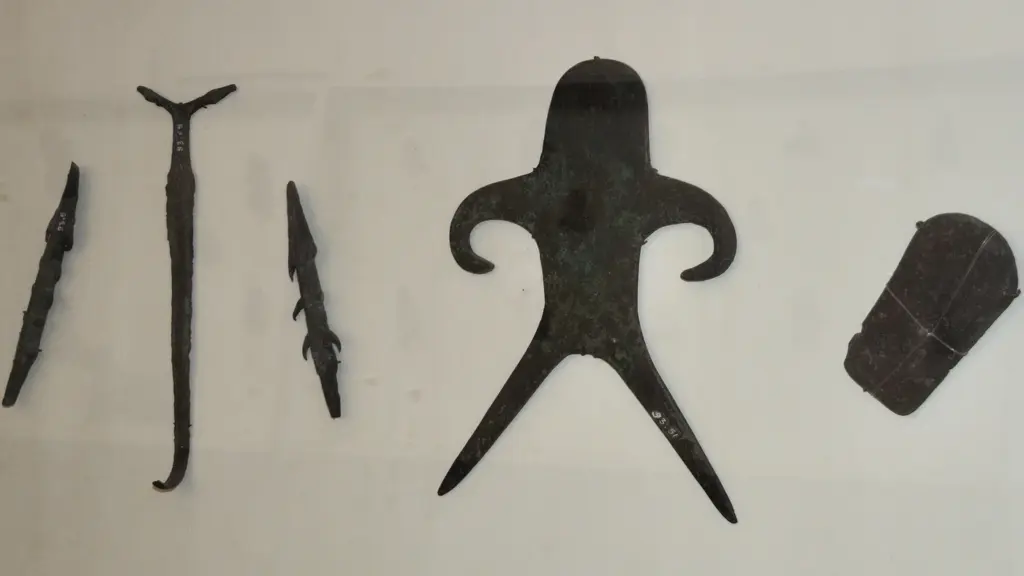
Most hoards hold between 1 and 47 objects. The exception is Gungeria in Madhya Pradesh, with 424 copper objects and 102 thin sheets of silver. Lal’s list of the main types is still the one textbooks follow:
- flat, shouldered and bar celts, which are axe-like blades;
- double axes;
- antennae swords, whose hilt splits into two curls like an insect’s antennae;
- hooked swords;
- barbed harpoons;
- anthropomorphs, flat copper figures shaped roughly like a human.
The types cluster by region. The University of Lucknow notes split them into three zones:
- Zone A: Bengal, Bihar and Odisha, with celts and double axes.
- Zone B: Uttar Pradesh and Haryana, with anthropomorphs, antennae swords, hooked swords and harpoons, plus the Zone A celts.
- Zone C: Rajasthan, with flat and bar celts only.
The metal is generally pure copper with very little alloying, and the Khetri mines of Rajasthan are one suggested source.
How the hoards were linked to OCP
The link rests on very few excavated finds. Almost every hoard came to light while someone was ploughing a field, digging a canal or cutting a road, so it has no layer to date it by. Saipai is the one site IGNOU accepts, where the harpoon and a hooked weapon lay in the same stratum as OCP sherds. Yule adds Ambkheri.
That’s why careful writers hedge. Lal Qila yielded 5 copper objects and none of them matches the typical hoard types. The Lucknow notes are blunt about it: except at Saipai, hoard implements and OCP haven’t been found in the same stratum. So the OCP-Copper Hoard pairing is well supported at one site and reasonable by geography, but it isn’t proven for the doab as a whole. Calling the hoards a “culture” at all is shaky, since most of them are known only from their metal.
Is the OCP culture late Harappan?
There’s no settled answer, and the question matters because it decides whether the doab was colonized from the Harappan west or grew its own culture. Three positions recur.
It is late Harappan, or grew out of it. IGNOU records that some scholars see OCP as a degenerate form of late Harappan pottery, on the basis of shared shapes. Lal himself left it open, asking whether the ware was late Harappan or an independent industry of the Ganga valley that interacted with the Harappans.
It is a separate culture with Harappan contacts. R. C. Gaur sorted the doab’s red wares into three groups:
- genuine OCP sites, such as Atranjikhera, Lal Qila and Saipai;
- OCP sites with Harappan influence, such as Bahadarabad and Ambkheri;
- late Harappan sites with OCP influence, such as Alamgirpur and Bargaon.
The craft evidence points the same way. Faience, a glazed paste common in Harappan ornaments, is absent from OCP sites but still outnumbers terracotta bangles at the late Harappan levels of Mitathal and Bhagwanpura.
It carries newcomers. Asko Parpola argued in 2020 that the Copper Hoard people were early speakers of Proto-Indo-Iranian who arrived with bull-drawn carts and met the late Harappans. This is a linguistic reading of archaeological evidence and it’s the most contested of the three.
The middle path is the one the evidence supports best. OCP shared a pottery vocabulary with the late Harappan world of the Harappan Civilization, but it had its own crafts and its own region, and the doab sites don’t look like Harappan towns in miniature. Treating it as a neighbor that borrowed, rather than as a copy or a stranger, keeps you inside what the sherds show.
Where the Painted Grey Ware fits
The later side is clearer. At Atranjikhera, OCP is followed by a Black and Red Ware layer and then PGW. At Hastinapur and Ahichchhatra there’s a break between OCP and PGW. Iron appears with the PGW, not with OCP. That’s why OCP is a copper-using culture and PGW is usually read alongside the later Vedic period.
What did the ASI find at Sanauli?
Sanauli, in Baghpat district of western Uttar Pradesh, is a Bronze Age cemetery that the ASI excavated in two seasons, and it gave the OCP question its most dramatic evidence. The site was a chance discovery: villagers leveling farmland hit skeletons and pots, and the ASI began digging in September 2005.
The first season, under D. V. Sharma, exposed over a hundred burials. The ASI’s own page counted 125 burials by 2006-07 and called Sanauli “a prominent cemetery site of late Harappan period”. The grave goods included:
- vases placed in odd numbers near the head, and a dish-on-stand usually below the hip;
- antennae swords with a copper sheath, which the ASI said resemble Copper Hoard specimens;
- gold and copper bangles and beads of semi-precious stone and steatite;
- a violin-shaped copper container holding about 35 arrowhead-shaped copper pieces.
The 2018 season, led by S. K. Manjul, found something new: coffin burials with vehicles. A 2024 paper in the journal Radiocarbon, with Manjul among its authors, describes eight burials, one a royal burial in a legged coffin decorated with copper, and three full-sized vehicles of wood and copper. Radiocarbon dates and the finds put the site at about 2000 BCE, and the authors assign it to the OCP/Copper Hoard culture. At the time of the dig the ASI gave a range of about 2000 to 1800 BCE. Other finds reported from the season included helmets, shields and more antennae swords.
Chariots or carts?
The ASI team calls the vehicles chariots. Other scholars call them carts, and the reason is the wheels. The Sanauli wheels are solid discs with triangular copper inlays, not spoked wheels. Parpola argues that a chariot, strictly, is a light horse-drawn vehicle with two spoked wheels, probably first built around 2100 BCE in the Sintashta culture of the Trans-Urals, and that the Sanauli vehicles were carts yoked to bulls. The JNU historian Ruchika Sharma also questioned the label in 2018, noting that terracotta carts are already known from late Harappan sites.
So the find is real and remarkable either way: warrior burials with swords, shields and vehicles, around 2000 BCE, in the doab. What it doesn’t settle is who drew the vehicles or what language their owners spoke. The ancestry side of that argument is running through other evidence too, such as the ASI’s ancient DNA work at Rakhigarhi.
The OCP culture today
The OCP story is still being written at Sanauli, and 2 dated developments stand out.
- August 2024: a paper by ASI staff described how the 2018 royal chariot was restored at the ASI’s Pt. Deendayal Upadhyaya Institute of Archaeology in Greater Noida.
- 2024: the Radiocarbon paper put the burials at about 2000 BCE and assigned them to the OCP/Copper Hoard culture.
The label question is still open among the excavators themselves. A November 2025 piece in ThePrint by the archaeologist Disha Ahluwalia recounted that Sharma read his finds as late Harappan while the Manjuls assign theirs to OCP/Copper Hoard. For the wider doab, the older excavation reports from Atranjikhera, Lal Qila and Saipai remain the base evidence.
How to study the ochre coloured pottery culture for exams
The OCP culture sits in GS Paper I under ancient history, in the stretch between the Harappan decline and the rise of the 16 Mahajanapadas, and it returns in History optional Paper I under the Chalcolithic and post-Harappan cultures. It’s tested mostly as a site and sequence question. History optional Paper I in 2025 asked candidates to mark “The Ochre Coloured Pottery (OCP) site” on a map. On the objective side, History accounts for 184 of the 1,403 questions in the Prelims question bank from 2013 to 2026, and the ancient history PYQ analysis is the place to practice that share after this note.
These are the facts to revise:
- Identification: B. B. Lal, Bisauli and Rajpur Parsu, 1950-51; term fixed after Hastinapur, 1951-52.
- Pottery: thick red ware, ochre wash that rubs off; waterlogging or poor firing as the explanations.
- Dates: TL dates of 2600 to 1200 BC from 4 sites; Sanauli at about 2000 BCE by radiocarbon.
- Copper Hoards: first find Bithur, 1822; largest hoard Gungeria, 424 objects; stratified with OCP at Saipai.
- Sequence: OCP, then Black and Red Ware at Atranjikhera, then PGW with iron.
- Sanauli: ASI digs in 2005-06 and 2018; coffin burials, antennae swords, solid-wheeled vehicles.
Four confusions cost marks:
- OCP is not the Copper Hoard culture. One is pottery, the other is metal; they meet in the same layer at Saipai.
- OCP had no iron. Iron comes in with the PGW.
- Hastinapur’s OCP and PGW are not continuous. There’s a break between them there and at Ahichchhatra.
- Sanauli’s chariots are a contested label. Write “vehicles the excavators call chariots”, then give the solid-wheel argument.
The neighbors are easiest to keep apart in a table. The Stone Age and Chalcolithic chapters in the Stone Age in India note come before this one, and the Indus Valley Civilization sits beside it.
| Culture | Pottery look | Metal | Where it’s attested |
|---|---|---|---|
| Late Harappan | Harappan shapes; faience still in use | Copper, with 7 objects at Mitathal IIB | Mitathal IIB, Bhagwanpura, Alamgirpur |
| OCP | Thick red ware, ochre wash rubs off | Copper | Atranjikhera, Lal Qila, Saipai, Hastinapur |
| Black and Red Ware | Black inside and near the rim, red elsewhere | Copper bead and ring at Atranjikhera | Between OCP and PGW at Atranjikhera |
| Painted Grey Ware | Grey, painted | Iron appears | Ahichchhatra, Hastinapur, Atranjikhera, Bhagwanpura |
This topic is small in the syllabus but it’s where the examiner checks whether you can read archaeology honestly. An answer that separates the pot from the copper, dates each claim to its method and gives the chariot debate both sides will read as mature. The aspirant who can do that here will do it for every protohistory question.
Frequently Asked Questions
What is ochre coloured pottery culture?
The ochre coloured pottery culture is a Bronze Age culture of the upper Ganga-Yamuna doab, named after a thick red pottery with an ochre wash that rubs off. Its people were small-village farmers who used copper. It falls in the 2nd millennium BCE, between the Harappan decline and the Painted Grey Ware.
Who discovered the OCP culture?
B. B. Lal identified it. In 1950-51 he dug trial trenches at Bisauli in Badaun district and Rajpur Parsu in Bijnor district, both earlier copper hoard spots, and found the ochre ware. The term was fixed after his Hastinapur excavation of 1951-52.
What is the date of the OCP culture?
The dates vary with the method. Thermoluminescence dates on sherds from Atranjikhera, Lal Qila, Jhinjhana and Nasirpur fall between 2600 and 1200 BC, while a narrower bracket of about 2000 to 1300 BC is given for central upper Ganga sites. Radiocarbon dates put the Sanauli burials at about 2000 BCE.
Why is it called ochre coloured pottery?
The pots carry an ochre wash, an earthy red to orange pigment, and it comes off on the fingers when a sherd is handled. The usual explanations are that the sherds lay in waterlogged or flooded ground, or that the pots were fired at a low heat.
What is the Copper Hoard culture?
It’s the name for caches of copper weapons, tools and figures found mainly in the Ganga-Yamuna doab and eastern India. The types include celts, harpoons, antennae swords, hooked swords, double axes and human-shaped anthropomorphs. Most hoards were chance finds, and only Saipai clearly places hoard objects in the same layer as OCP.
Is the OCP culture related to the Harappan civilization?
Scholars disagree. Some see OCP as a late or degenerate form of Harappan pottery, others as a separate culture with Harappan contacts, and B. B. Lal left the question open. Shared pot shapes suggest contact, while the absence of faience at OCP sites suggests a separate craft tradition.
What was found at Sanauli?
Sanauli in Baghpat district is a Bronze Age cemetery excavated by the ASI in 2005-06 and 2018. It yielded well over a hundred burials, copper antennae swords, coffin burials, helmets, shields and three solid-wheeled vehicles that the excavators call chariots. Other scholars, including Asko Parpola, read the vehicles as bull-drawn carts.
Which are the important OCP sites?
The best-known excavated sites are Hastinapur, Atranjikhera, Lal Qila, Saipai and Sanauli in western Uttar Pradesh. Bisauli and Rajpur Parsu are where the ware was first found, and Bahadarabad, Ambkheri and Jhinjhana are other frequently cited sites.
Practice Questions
Prelims
1. Consider the following statements about the Ochre Coloured Pottery culture: 1. It was first identified by B. B. Lal in trial digs at Bisauli and Rajpur Parsu. 2. A copper harpoon was found in the OCP layer at Saipai. Which of the statements given above is/are correct?
- (a) 1 only
- (b) 2 only
- (c) Both 1 and 2
- (d) Neither 1 nor 2
Answer: (c) Lal’s 1950-51 digs identified the ware, and Saipai gave the harpoon in an OCP stratum.
2. Consider the following statements about the Copper Hoards: 1. The first recorded hoard object was a harpoon found at Bithur in 1822. 2. The largest single hoard comes from Gungeria in Madhya Pradesh. 3. Most hoard objects come from stratified excavations. Which of the statements given above are correct?
- (a) 1 and 2 only
- (b) 2 and 3 only
- (c) 1 and 3 only
- (d) 1, 2 and 3
Answer: (a) Statement 3 is wrong because almost all hoards were chance finds.
3. At Atranjikhera, which is the correct order of pottery cultures from the earliest to the latest?
- (a) Painted Grey Ware, Ochre Coloured Pottery, Black and Red Ware
- (b) Ochre Coloured Pottery, Black and Red Ware, Painted Grey Ware
- (c) Black and Red Ware, Ochre Coloured Pottery, Painted Grey Ware
- (d) Ochre Coloured Pottery, Painted Grey Ware, Black and Red Ware
Answer: (b) Black and Red Ware lies between the OCP and PGW levels at Atranjikhera.
4. Which site in Baghpat district yielded coffin burials with solid-wheeled vehicles in the ASI’s 2018 excavation?
- (a) Atranjikhera
- (b) Lal Qila
- (c) Sanauli
- (d) Hastinapur
Answer: (c) Sanauli’s 2018 season found coffin burials and three vehicles of wood and copper.
5. Consider the following statements: 1. The ochre wash of OCP sherds tends to rub off on handling. 2. Iron tools are a characteristic find of the OCP culture. Which of the statements given above is/are correct?
- (a) 1 only
- (b) 2 only
- (c) Both 1 and 2
- (d) Neither 1 nor 2
Answer: (a) Iron appears only with the later Painted Grey Ware.
Mains
- What is the evidence linking the Ochre Coloured Pottery with the Copper Hoards, and how strong is it? (10 marks, 150 words)
- Discuss the problems of dating the Ochre Coloured Pottery culture, with reference to the methods used. (10 marks, 150 words)
- Critically examine the view that the Ochre Coloured Pottery culture was a late Harappan culture. (15 marks, 250 words)
- The Sanauli burials have revived the debate on chariots in Bronze Age India. Examine the evidence and the rival interpretations. (15 marks, 250 words)
- Trace the sequence of pottery cultures in the Ganga-Yamuna doab from the Ochre Coloured Pottery to the Painted Grey Ware, and explain what it reveals about settlement and technology. (15 marks, 250 words)
Tell Google you want more of this.
Add Anantam IAS as a preferred sourceOne tap, and this site shows up more often in your own Top Stories, AI Overviews and AI Mode. Remove it any time.