The Assisted Reproductive Technology (Regulation) Act, 2021 is the law that finally formalised what was, until recently, the world’s largest unregulated fertility-treatment market. India had been an IVF and surrogacy destination for two decades. Patients flew in from West Asia, Europe, Africa and the United States, drawn by world-class clinical talent and a fraction of the cost charged in their home countries. There were also low-quality clinics, contested parenthood cases, donor exploitation and a quiet crisis in donor children’s rights. The 2021 Act, enforced from 25 January 2022, set out registration requirements, eligibility rules, donor consent, child rights and a regulatory architecture that runs in parallel with the Surrogacy (Regulation) Act, 2021.
For UPSC, ART straddles GS Paper 2 (governance, women, vulnerable groups, health) and GS Paper 3 (biotechnology). The science is moderately deep: aspirants are expected to know IUI, IVF and ICSI in technical outline. The legal architecture is examiner-friendly: definitions, eligibility, regulators and the comparison with the Surrogacy Act produce predictable question stems.
Quick Facts: ART at a Glance
- What it is: Techniques that achieve pregnancy by handling sperm or oocytes outside the human body and transferring gametes or embryos
- Three main techniques: IUI (Intrauterine Insemination), IVF (In Vitro Fertilization), ICSI (Intracytoplasmic Sperm Injection)
- Governing law: Assisted Reproductive Technology (Regulation) Act, 2021, in force from 25 January 2022
- Companion law: Surrogacy (Regulation) Act, 2021, in force from 25 January 2022
- Eligibility (married couples): Woman aged 21 to 50, man aged 21 to 55
- Eligibility (single women): Widow or divorcee, aged 21 to 50
- Excluded under ART Act: Single men, live-in couples, LGBTQ+ couples
- Regulators: National ART and Surrogacy Board, State ART and Surrogacy Boards, National Registry
- Estimated infertility burden in India: 8 to 10 percent of couples in reproductive age, by ICMR estimates
What Is Assisted Reproductive Technology?
ART is the umbrella term for any procedure that involves the manipulation of sperm, oocyte (egg) or embryo outside the human body to achieve a pregnancy. The legal definition under the 2021 Act covers gamete donation, in vitro fertilisation, intracytoplasmic sperm injection, embryo culture, gestational carriers (treated separately under the Surrogacy Act), gamete and embryo cryopreservation, and pre-implantation genetic testing.
ART addresses infertility, defined as the inability to achieve a clinical pregnancy after 12 months of regular unprotected intercourse. According to the Indian Council of Medical Research, infertility affects about 8 to 10 percent of Indian couples in the reproductive age group. ART has therefore moved from a luxury offered by a few private clinics in metro cities to a mainstream medical service, with public-sector ART centres added under the National Health Mission framework.
The Act distinguishes the regulation of ART clinics and gamete banks from the regulation of surrogacy. The two laws, both passed in December 2021 and notified in January 2022, work as a pair: ART rules the clinics, banks and the gamete chain; the Surrogacy Act governs the practice of surrogacy itself.
Background and Historical Context
The first IVF baby in the world was Louise Joy Brown, born in the United Kingdom on 25 July 1978 to parents Lesley and John Brown, with the procedure performed by Patrick Steptoe and Robert Edwards. Edwards received the Nobel Prize in Physiology or Medicine in 2010 for the work. India’s first IVF baby, Kanupriya Agarwal (also known as Durga), was born just 67 days later on 3 October 1978 in Kolkata, in a procedure performed by the late Dr Subhash Mukhopadhyay. The achievement was not officially recognised at the time; Mukhopadhyay’s work was rejected by the establishment, and he died by suicide in 1981. India’s first officially recognised IVF baby, Harsha Chawda Shetty, was born on 6 August 1986 in Mumbai under Dr Indira Hinduja.
Through the 1990s and 2000s, ART expanded rapidly in private clinics. By 2015, India had thousands of fertility centres, ranging from world-class hospitals to small clinics with no clinical embryologists. The legal framework was a vacuum. The ICMR issued advisory guidelines in 2005 (the National Guidelines for Accreditation, Supervision and Regulation of ART Clinics), but these had no statutory force. Parliament debated ART and surrogacy regulation in 2010, 2013 and 2016 without passing a law.
The Surrogacy (Regulation) Act, 2021 and the ART (Regulation) Act, 2021 were finally passed together in December 2021, setting up a unified framework. The two laws and their rules cover commissioning couples, donors, surrogates, clinics, banks, the resulting children, and the regulators. For the surrogacy side, see the parallel guide on stem cell research for the broader bioethics context.
The Three Main ART Techniques
The 2021 Act recognises a long list of ART procedures. Three are clinically dominant.
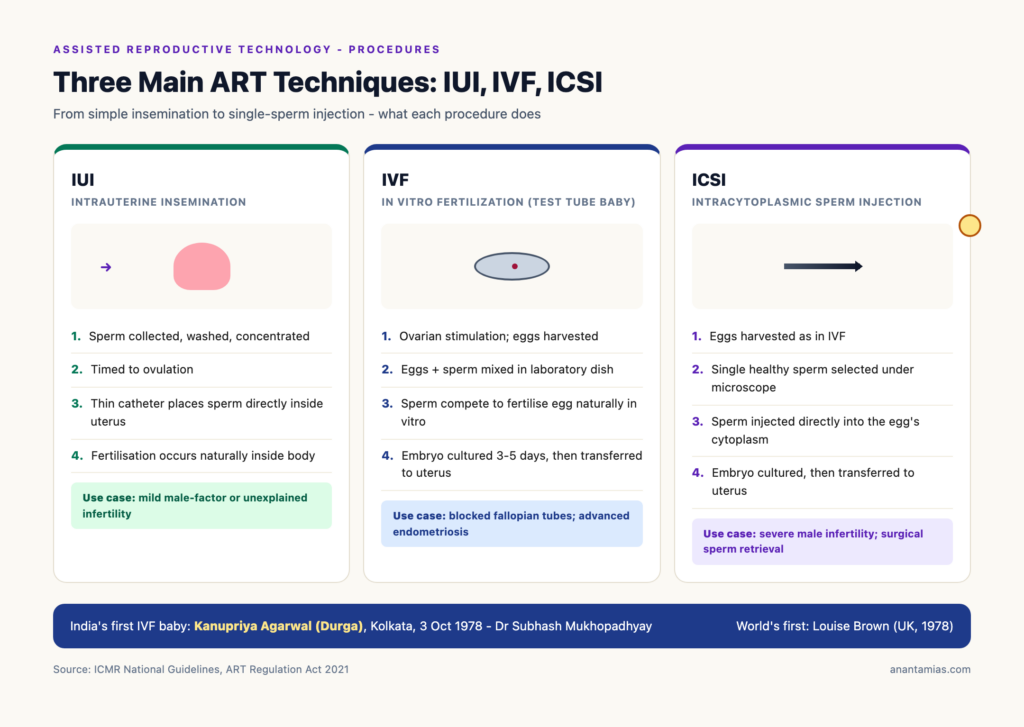
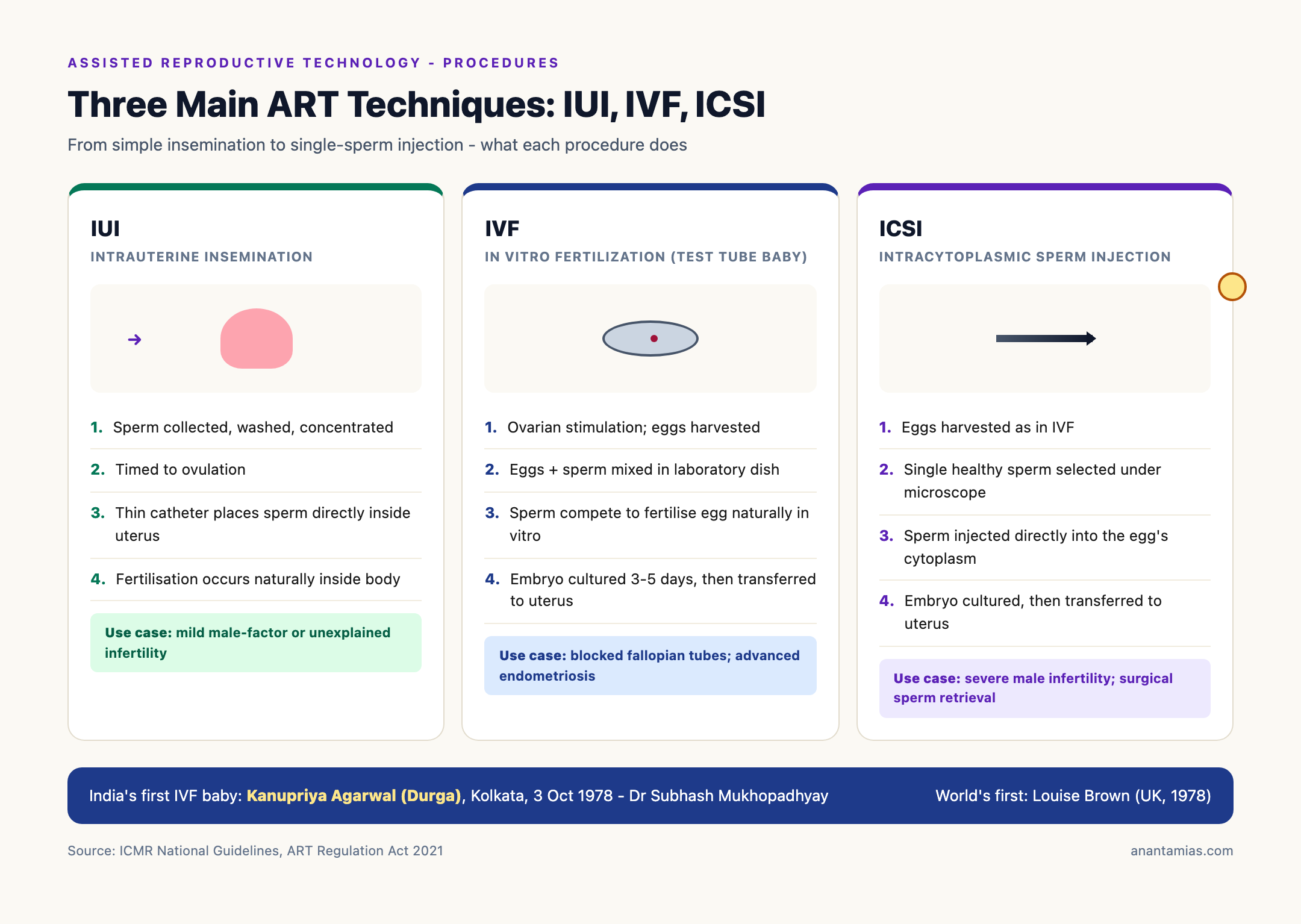
A. IUI: Intrauterine Insemination
IUI is the simplest and oldest ART technique. Healthy sperm is collected from the male partner (or a donor), washed and concentrated in a laboratory to remove dead sperm, debris and seminal fluid that can cause uterine cramping, then deposited directly inside the woman’s uterus through a thin catheter, timed to ovulation.
IUI is the first-line treatment for mild male-factor infertility (low sperm count or motility within a treatable range), unexplained infertility, mild endometriosis or ovulation problems where ovarian stimulation has been used. Success rates per cycle are modest, typically in the 10 to 20 percent range, but it is significantly cheaper and less invasive than IVF.
B. IVF: In Vitro Fertilization
In vitro literally means in glass. The classic IVF procedure removes mature eggs from the woman’s ovaries (after ovarian stimulation with hormone injections), mixes them with sperm in a laboratory dish, allows fertilisation to occur naturally as thousands of sperm compete to enter the egg, cultures the resulting embryos for three to five days, and then transfers one or more embryos into the woman’s uterus.
IVF is indicated for blocked or damaged fallopian tubes, advanced endometriosis, severe male-factor infertility (often combined with ICSI), unexplained infertility that has not responded to IUI, and cases requiring pre-implantation genetic testing. It is the workhorse of modern fertility medicine. Success rates per cycle, by maternal age, range from above 40 percent in younger women to about 5 percent or less in women above 42.
Louise Brown’s birth in 1978 was a classic IVF, and IVF remains the foundation of ART even as more specialised procedures have been built on top of it.
C. ICSI: Intracytoplasmic Sperm Injection
ICSI is a specialised version of IVF designed for severe male infertility. Instead of letting sperm compete to fertilise the egg in a dish, an embryologist selects a single healthy sperm and injects it directly into the egg’s cytoplasm using a microscopic needle.
ICSI bypasses the need for the sperm to penetrate the egg’s outer membrane on its own. It is therefore indicated for very low sperm counts, poor sperm motility or morphology, sperm retrieved surgically from the testis or epididymis (for example, in men with obstructive azoospermia), prior IVF failures with normal-looking sperm, and certain genetic conditions. ICSI is performed at most modern Indian fertility clinics and accounts for a large share of IVF cases globally.
ART Act 2021: The Regulatory Architecture
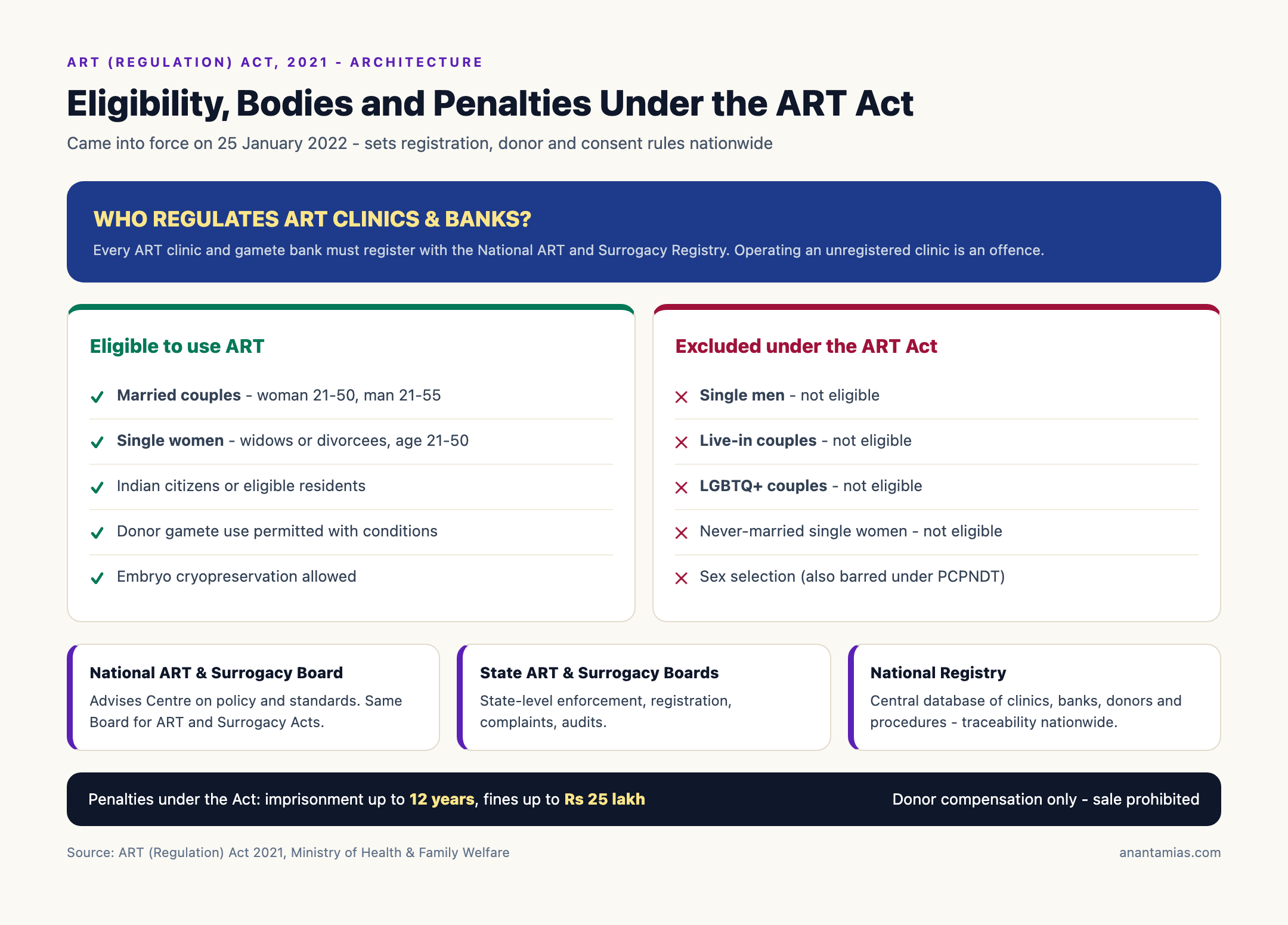
The ART (Regulation) Act, 2021 has four moving parts: registration of clinics and banks, eligibility rules, regulatory bodies, and offences and penalties.
Eligibility: Who Can Use ART?
- Married couples: The woman must be 21 to 50 years old; the man must be 21 to 55 years old. Both must be Indian citizens or eligible residents.
- Single women: Only widows and divorcees, aged 21 to 50, are eligible. Other single women, including never-married single women, are not covered under the Act.
- Single men: Not eligible under the ART Act.
- Live-in couples and LGBTQ+ couples: Not eligible under the ART Act, as it stands.
The exclusions are challenged on equality grounds, and matters relating to the constitutionality of the eligibility provisions have come before the courts.
Registration of Clinics and Banks
Every ART clinic and gamete bank must register with the National ART and Surrogacy Registry. Registration covers physical infrastructure, equipment, qualified personnel (including registered medical practitioners with prescribed embryology and reproductive-medicine training), record keeping and consent procedures. Operating an unregistered clinic is an offence.
Donor Rights and Restrictions
The Act sets specific rules for gamete donors: a single oocyte donor can donate to one couple only, with up to seven oocytes per cycle; sperm donors are similarly capped. Donors must be screened for transmissible diseases, undergo informed consent and receive insurance coverage. Sale of gametes is prohibited; only compensation for medical expenses and inconvenience is permitted.
Regulatory Bodies
- National ART and Surrogacy Board: Advises the central government on policy, sets technical standards, and adjudicates appeals. The same Board serves both the ART and Surrogacy Acts.
- State ART and Surrogacy Boards: Mirror the national board at state level.
- National Registry: A central database where every registered clinic, bank, donor and procedure is recorded for traceability.
Offences and Penalties
The Act lists offences including sex selection (already prohibited under the PCPNDT Act), sale of gametes, abandonment of an ART child, exploitation of donors and operating unregistered clinics. Penalties include imprisonment up to 12 years and fines up to Rs 25 lakh, depending on the offence.
Why ART Matters: Public Health, Gender and Rights
Three lenses make the ART discussion central to UPSC GS Paper 2 and Paper 3.
Public health and demographics. Infertility is rising globally and in India, driven by delayed marriage, urban lifestyles, polycystic ovary syndrome, environmental exposures and obesity. With Total Fertility Rate now at or below replacement in India, the political economy of infertility is changing. Couples want children later in life, and the gap between desired fertility and actual fertility is what ART exists to bridge.
Gender and consent. ART procedures, despite involving both partners, place far greater physical and emotional burden on women, including hormonal stimulation cycles, egg retrieval, embryo transfer and the psychological impact of repeated cycles. Donor egg programmes raise questions about coercive recruitment of vulnerable women. The ART Act, 2021 attempts to address these concerns with consent rules and donor-protection provisions.
Rights of the child. The Act recognises the ART-conceived child as the biological and legal child of the commissioning couple, with full inheritance and other rights. Donor anonymity is preserved, but the child has the right to certain non-identifying medical information. Donor children’s rights are an evolving area in Indian and global jurisprudence.
Detailed Analysis: ART Act vs Surrogacy Act
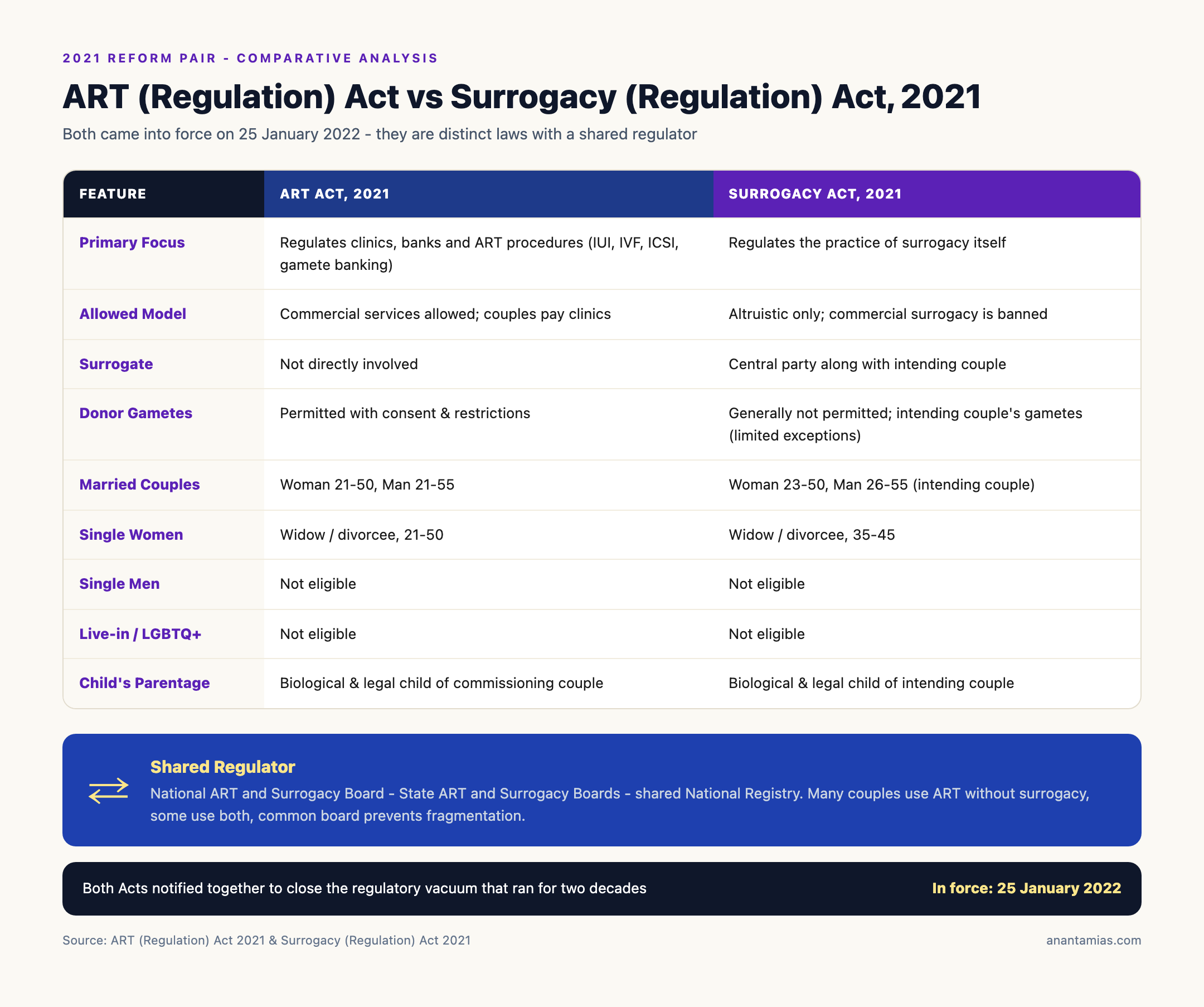
The two 2021 laws are often confused. They are distinct.
| Feature | ART (Regulation) Act, 2021 | Surrogacy (Regulation) Act, 2021 |
|---|---|---|
| Primary focus | Regulates clinics, banks and ART procedures (IVF, IUI, ICSI, gamete banking) | Regulates the practice of surrogacy itself |
| Allowed model | Commercial services allowed; couples pay clinics for ART | Altruistic only; commercial surrogacy is banned |
| Surrogate involvement | Not directly involved | Central party along with intending couple |
| Donor gametes | Permitted with conditions | Generally not permitted; the surrogate must use the intending couple’s gametes (with limited exceptions) |
| Single women eligibility | Widows and divorcees (aged 21 to 50) | Widows and divorcees (aged 35 to 45) |
| Single men eligibility | Not eligible | Not eligible |
| Live-in or LGBTQ+ couples | Not eligible | Not eligible |
| Child’s parentage | Biological and legal child of commissioning couple | Biological and legal child of intending couple |
| Regulator | National and State ART and Surrogacy Boards (shared) | National and State ART and Surrogacy Boards (shared) |
The shared regulator is deliberate: many couples use ART without surrogacy, some use ART with surrogacy, and the same clinic infrastructure often supports both. A common board prevents regulatory fragmentation.
Challenges and Open Questions
Equality concerns. Excluding single men, never-married single women and LGBTQ+ couples raises constitutional questions about equality and reproductive autonomy. Litigation is ongoing.
Cost and access. ART remains expensive, with a single IVF cycle in private clinics costing Rs 1.5 lakh to Rs 3 lakh. Public-sector ART services exist but are limited. Cost continues to exclude lower-income groups.
Donor recruitment ethics. The legitimate cap on commercial gamete sale must be balanced against donor protection. Coercive or exploitative recruitment of egg donors, particularly young women in financial distress, remains a concern despite the law.
Embryo storage and disposal. Long-term storage of cryopreserved embryos creates legal and ethical questions about ownership, especially after divorce, death or relationship breakdown.
Cross-border ART. Indian patients and clinics still operate in international gamete and embryo markets that are regulated unevenly. Cross-border parentage disputes are increasing.
For broader biotech context, see the gene therapy guide and the article on stem cells.
Prelims Pointers
- The ART (Regulation) Act, 2021 came into force on 25 January 2022, alongside the Surrogacy (Regulation) Act, 2021.
- The three main ART techniques are IUI (Intrauterine Insemination), IVF (In Vitro Fertilization) and ICSI (Intracytoplasmic Sperm Injection).
- IVF means in vitro = in glass; IVF is the classic test-tube baby technique.
- ICSI involves injection of a single sperm directly into the egg using a microneedle.
- Eligibility under the ART Act: married couples (woman 21 to 50, man 21 to 55) and single women (widow or divorcee, 21 to 50).
- The ART Act excludes single men, live-in couples and LGBTQ+ couples.
- The National ART and Surrogacy Board is shared with the Surrogacy Act.
- The world’s first IVF baby was Louise Joy Brown (UK, 25 July 1978).
- India’s first scientifically performed IVF baby was Kanupriya Agarwal (Kolkata, 3 October 1978, by Dr Subhash Mukhopadhyay); the first officially recognised IVF baby was Harsha Chawda Shetty (Mumbai, 6 August 1986, by Dr Indira Hinduja).
- Robert Edwards received the Nobel Prize in Physiology or Medicine in 2010 for the development of IVF.
Mains Practice Questions
- Explain the principal techniques of Assisted Reproductive Technology (ART). Discuss the salient features of the ART (Regulation) Act, 2021. (GS Paper 3, 250 words)
- Compare the ART (Regulation) Act, 2021 with the Surrogacy (Regulation) Act, 2021. Why were two separate laws considered necessary? (GS Paper 2 / 3, 250 words)
- The ART Act has been criticised for excluding single men, never-married single women and LGBTQ+ couples. Critically analyse these exclusions in the light of constitutional rights to equality and reproductive autonomy. (GS Paper 2, 250 words)
- Discuss the public-health, gender and ethical issues raised by the rapid expansion of ART services in India. Suggest measures for a more equitable access regime. (GS Paper 2 / 3, 250 words)
Way Forward
The ART (Regulation) Act, 2021 is a foundation, not a finished product. Three priorities should guide the next phase. First, the Centre should review the eligibility provisions in the light of constitutional jurisprudence on equality and reproductive autonomy, and consider expanded coverage for never-married single women, single men and same-sex couples through legislative or executive amendments. Second, the National Health Mission should integrate basic ART services, including IUI and selected IVF cycles, into public-sector tertiary hospitals so that lower-income couples have access without falling into medical debt. Third, the National Registry should publish anonymised data annually on success rates, donor pool sizes, complications and outcomes, so that patients can make informed decisions and policymakers can track quality. With those three steps, India can move from being the world’s largest unregulated fertility market to its largest regulated, equitable and clinically excellent ART system.
Frequently Asked Questions
What is Assisted Reproductive Technology (ART)?
ART is the set of medical techniques that handle sperm, oocytes (eggs) or embryos outside the human body to achieve a pregnancy. The most common ART techniques are intrauterine insemination, in vitro fertilisation and intracytoplasmic sperm injection.
What is the difference between IUI, IVF and ICSI?
IUI places washed sperm directly into the uterus during ovulation. IVF removes eggs from the ovaries and mixes them with sperm in a laboratory dish, then transfers the resulting embryo into the uterus. ICSI is a specialised IVF in which a single sperm is injected directly into the egg, used for severe male infertility.
What is the ART (Regulation) Act, 2021?
The ART Act regulates clinics and gamete banks providing assisted reproductive technology services. It sets eligibility rules for users, registration norms for clinics, donor-protection provisions, and offences and penalties. It came into force on 25 January 2022.
Who is eligible to use ART under the 2021 Act?
Married couples (woman 21 to 50, man 21 to 55) and single women who are widows or divorcees (aged 21 to 50). The Act, as currently drafted, does not cover single men, live-in couples or LGBTQ+ couples.
How is the ART Act different from the Surrogacy Act?
The ART Act regulates the clinics, banks and ART procedures themselves. The Surrogacy Act regulates the practice of surrogacy. Commercial ART is allowed; only altruistic surrogacy is permitted. Both laws share a common National Board.
Is commercial ART allowed in India?
Yes. Couples pay clinics for ART services. What is prohibited is the commercial sale of gametes (eggs and sperm) and the practice of commercial surrogacy.
Who was India’s first IVF baby?
The first IVF baby in India was Kanupriya Agarwal (also known as Durga), born on 3 October 1978 in Kolkata, in a procedure performed by Dr Subhash Mukhopadhyay. India’s first officially recognised IVF baby was Harsha Chawda Shetty, born on 6 August 1986 in Mumbai under Dr Indira Hinduja.
What is the cost of IVF in India?
A single IVF cycle in a private clinic typically costs between Rs 1.5 lakh and Rs 3 lakh, depending on the centre, the use of donor gametes and any additional procedures such as ICSI or pre-implantation genetic testing.
Who regulates ART in India?
The National ART and Surrogacy Board (advisory and policy), the State ART and Surrogacy Boards (state-level enforcement) and the National ART and Surrogacy Registry (the central database for clinics, banks and procedures).
What rights does an ART-conceived child have?
Under the ART Act, an ART-conceived child is the biological and legal child of the commissioning couple, with the same inheritance and other rights as a naturally conceived child. The donor has no parental rights or obligations.
Tell Google you want more of this.
Add Anantam IAS as a preferred sourceOne tap, and this site shows up more often in your own Top Stories, AI Overviews and AI Mode. Remove it any time.