The missiles of India are the guided weapons the country designs and builds for its own forces, from the Prithvi and Agni ballistic missiles to the BrahMos cruise missile, the Akash air defense system and the Nag anti-tank missile. Most come from the Defence Research and Development Organisation (DRDO), and the modern effort dates to the Integrated Guided Missile Development Programme of 1983. They matter because the longest-range ones carry India’s nuclear deterrent, the shorter ones guard its airspace and borders, and a few now earn export orders.
Two ideas trip up most readers. The first is that Agni-5 is an intercontinental missile, when the government’s own releases call it an intermediate-range ballistic missile with a range of up to 5,000 km. The second is that BrahMos is a purely Indian weapon, when an Indo-Russian joint venture builds it. The list below settles both, sorts every major missile by the job it does and gives each one only the range an official source has published.
List of missiles of India by role
India’s missiles are easiest to hold in memory by role, so the table runs from ballistic missiles down to the one anti-satellite test. The range column carries only what DRDO, the Ministry of Defence or BrahMos Aerospace has published. Where no official figure exists, the cell says “not officially stated”, because many numbers that circulate online are estimates.
| Missile | Role and class | Developer | Range as officially stated | Status and latest dated milestone |
|---|---|---|---|---|
| Prithvi (Army, Air Force and Navy versions) | Ballistic: short-range, surface-to-surface | DRDO, under the IGMDP | 150, 250 and 350 km for the three versions | Inducted; Prithvi-II user launch on 17 July 2025 |
| Agni-1 | Ballistic: called medium-range in 2023 and short-range in 2025 | DRDO | Not officially stated | With the Strategic Forces Command; user launch on 17 July 2025 |
| Agni-3 | Ballistic: intermediate-range | DRDO | Not officially stated | User launch on 6 February 2026 |
| Agni-4 | Ballistic: intermediate-range in 2022, medium-range in 2026 | DRDO | 4,000 km | User launch on 6 August 2026 |
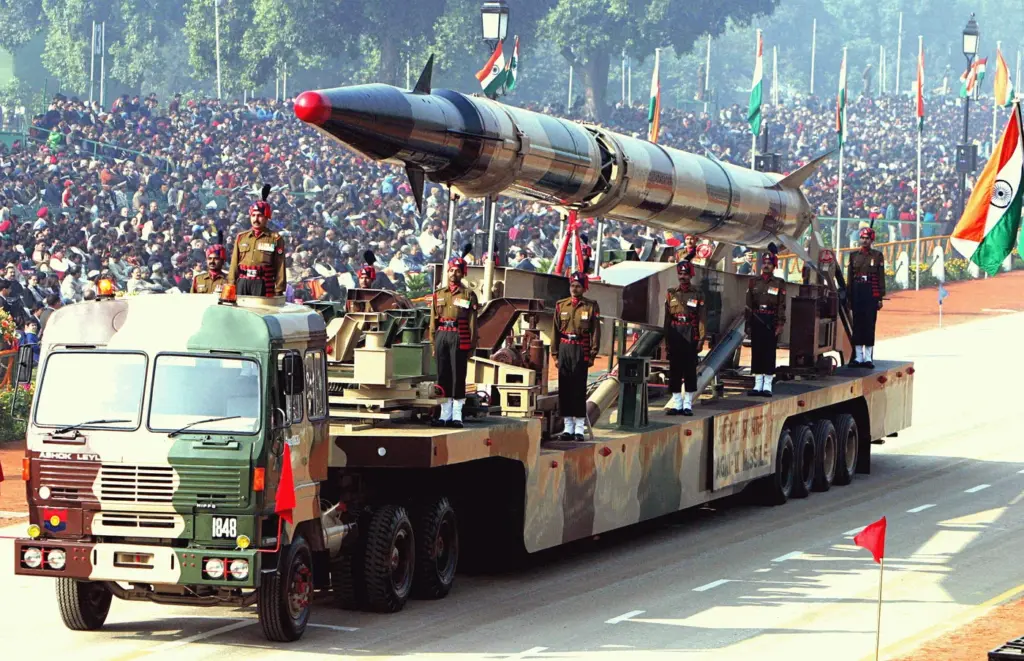
| Agni-5 | Ballistic: intermediate-range, three-stage solid fuel | DRDO | Up to 5,000 km | First MIRV flight (Mission Divyastra) in March 2024; user launch on 20 August 2025 |
| Agni-Prime (Agni-P) | Ballistic: new-generation, canister-launched | DRDO | 1,000 to 2,000 km | Fired from a rail-based launcher on 24 September 2025 |
| Pralay | Ballistic: quasi-ballistic, conventional warhead | DRDO (Research Centre Imarat) | 150 to 500 km | User trials in July 2025; two-missile salvo on 31 December 2025 |
| BrahMos | Cruise: supersonic, anti-ship and land attack | BrahMos Aerospace (DRDO with NPO Mashinostroyenia of Russia) | Full range of 290 km in a 2019 test | With the Navy and Army; export contract with the Philippines on 28 January 2022 |
| Nirbhay | Cruise: long-range, subsonic | DRDO (Aeronautical Development Establishment) | Flew more than 1,000 km in its 2014 test | Sixth development trial on 15 April 2019 |
| ITCM and LRLACM | Cruise: subsonic, land attack | DRDO, with an engine from the Gas Turbine Research Establishment | Not officially stated | ITCM tested 18 April 2024; LRLACM maiden test 12 November 2024 |
| Long-range hypersonic missile | Hypersonic | DRDO (Dr APJ Abdul Kalam Missile Complex, Hyderabad) | Greater than 1,500 km | First flight trial on 16 November 2024 |
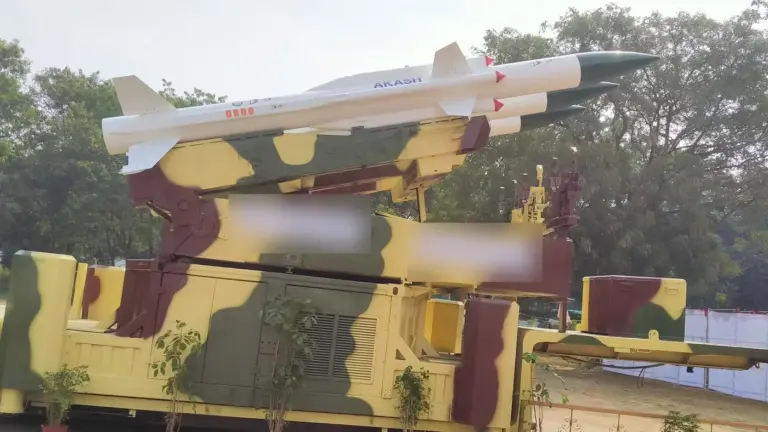
| Akash, Akash Prime and Akash-NG | Surface-to-air: short-range | DRDO (Defence Research and Development Laboratory) | 25 km (Akash) | Akash inducted by the IAF in 2014 and the Army in 2015; Akash-NG user trials completed in December 2025 |
| Trishul | Surface-to-air: short-range | DRDO, under the IGMDP | Not officially stated | Closed as a technology demonstrator |
| MRSAM | Surface-to-air: medium-range | DRDO with Israel Aerospace Industries | Not officially stated | Firing units delivered to the IAF and Army; Army version tested 3 and 4 April 2025 |
| VSHORADS | Surface-to-air: man-portable | DRDO (Research Centre Imarat) | Not officially stated | Three flight trials reported on 1 February 2025 |
| Kusha | Surface-to-air: long-range | DRDO | Not officially stated | Maiden flight test on 23 July 2026 |
| Phase-II BMD interceptor | Ballistic missile defense | DRDO | Built to defend against ballistic missiles of the 5,000 km class | Flight test on 24 July 2024 |
| Nag and Nag Mk 2 | Anti-tank: third-generation fire-and-forget | DRDO; missile produced by Bharat Dynamics Limited (BDL) | Not officially stated | Final user trial on 22 October 2020; Mk 2 declared ready for induction in January 2025 |
| Helina and Dhruvastra | Anti-tank: helicopter-launched | DRDO | Not officially stated | Joint user trials in February 2021; high-altitude trial on 11 April 2022 |
| Astra Mk 1 | Air-to-air: beyond visual range | DRDO; produced by BDL | Exceeds 100 km | Rs 2,971 crore order with BDL on 31 May 2022; indigenous seeker tested 11 July 2025 |
| Rudram and RudraM-II | Air-to-surface: anti-radiation and strike | DRDO | Not officially stated | Rudram first tested 9 October 2020; RudraM-II on 29 May 2024, with fresh trials reported on 2 June 2026 |
| NASM-SR | Anti-ship: helicopter-launched | DRDO with the Indian Navy | Not officially stated | Trials on 25 February 2025; first salvo launch reported on 29 April 2026 |
| Mission Shakti interceptor | Anti-satellite: hit-to-kill | DRDO | Struck an Indian satellite in low earth orbit | Tested once, on 27 March 2019 |
Read down the range column and a pattern shows. The government publishes ranges for most strategic missiles and a few flagship tactical ones, and says little about the rest. That gap is why a note that fills every cell with a confident number deserves suspicion.
Where it began: the IGMDP of 1983
The Integrated Guided Missile Development Programme, or IGMDP, was launched in 1983 in DRDO under Dr APJ Abdul Kalam, and it was sanctioned to build five missiles. Each of the five went a different way:
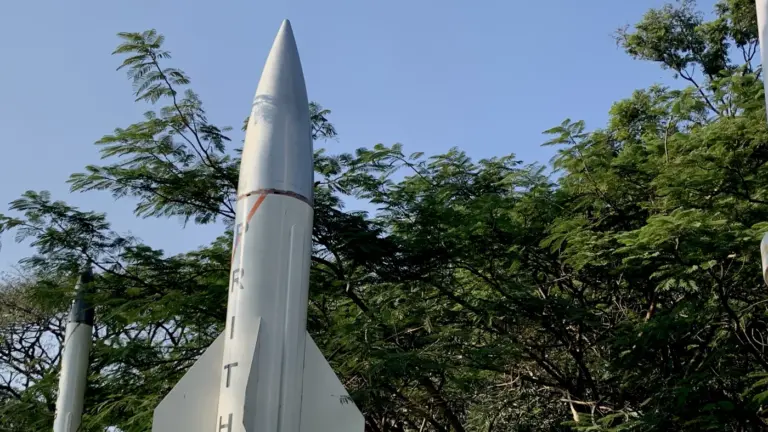
- Prithvi: a surface-to-surface missile in 150, 250 and 350 km versions for the Army, Air Force and Navy. The series was inducted.
- Agni: a technology demonstrator for re-entry, the stage where a warhead comes back through the atmosphere without burning up. That technology went into the whole Agni series.
- Trishul: a short-range surface-to-air missile, completed only as a technology demonstrator because the technology arrived late and the armed forces’ requirement changed.
- Akash: a surface-to-air missile with a 25 km range, inducted by the IAF in 2014 and the Army in 2015.
- Nag: a third-generation anti-tank missile with fire-and-forget and top-attack modes. It passed its final user trial in 2020 and moved to production at Bharat Dynamics Limited.
Many notes say the program closed in 2008. The official record doesn’t support that. In February 2008 the Defence Minister told the Rajya Sabha that the IGMDP was not being abandoned, and in August 2012 the ministry told the Lok Sabha it had been completed in March 2012. The site’s note on the IGMDP under Kalam covers the program and Kalam’s part in it in more depth.
The 2008 reply also gave the spending up to 16 January 2008, and the figures show where the effort went:
- Akash: Rs 516.86 crore.
- Prithvi: Rs 298.95 crore.
- Trishul: Rs 282.68 crore.
- Nag: Rs 212.27 crore.
- Agni: Rs 74.34 crore, for the demonstrator only.
Akash cost the most and took the longest to reach service. Trishul cost nearly as much as Prithvi and never entered service. So the honest scorecard reads like this: two missiles in service, one in production, one closed and one that turned into a technology base. Bharat Dynamics Limited, a Ministry of Defence company incorporated on 16 July 1970, is the production partner for many of the missiles that followed.
Ballistic missiles: Prithvi, the Agni series and Pralay
A ballistic missile burns its rocket only in the first part of its flight, then coasts on a high arc and falls onto its target, much as a thrown stone does. India’s ballistic line runs from Prithvi to Agni-5, with the conventional Pralay alongside, and the Agni missile series note walks through each Agni version.
Here’s where most notes go wrong. They memorize the class labels, but the government’s own releases use those labels loosely:
- Agni-1: “medium-range” in June 2023, “short-range” in July 2025.
- Agni-4: “intermediate-range” in June 2022, “medium-range” in August 2026.
- Agni-5: “long range” in January 2018, “intermediate-range” in August 2025.
The stated ranges stay put while the labels move, so learn the number and treat the label as secondary. For Agni-5 the current official label is intermediate-range, and that’s the one to write in an answer.
Agni-5 is a three-stage, solid-fuelled missile that can strike targets up to 5,000 km away, according to the Ministry of Defence. Its 2021 test release tied it directly to India’s policy of credible minimum deterrence and No First Use. In other words, the missile exists to make retaliation certain, not to strike first.
The newest step is MIRV, short for Multiple Independently Targetable Re-entry Vehicle. It means one missile carries several warheads and releases each toward a different target, like a bus that drops passengers at separate stops. DRDO first flew Agni-5 with MIRV in Mission Divyastra, announced on 11 March 2024, from Dr APJ Abdul Kalam Island off Odisha. On 8 May 2026 an “Advanced Agni” carried multiple payloads to targets spread over a large area of the Indian Ocean Region.
Agni-Prime is the newer, lighter design, with a stated range of 1,000 to 2,000 km. It’s canister-launched, sealed in a tube that doubles as its launcher so it can be fired at short notice. On 24 September 2025 it flew from a rail-based launcher that can move on the rail network without preconditions.
The routine firings now belong to the Strategic Forces Command (SFC), the command that handles India’s strategic missiles. Its recent user launches show these missiles are in service, not in development:
- Prithvi-II and Agni-1: 17 July 2025.
- Agni-5: 20 August 2025.
- Agni-3: 6 February 2026.
- Agni-4: 6 August 2026.
Pralay is the odd one out, because it carries a conventional warhead, not a nuclear one. It flies a quasi-ballistic path, mostly ballistic but able to steer, over 150 to 500 km. User trials on 28 and 29 July 2025 tested its maximum and minimum range, and on 31 December 2025 two Pralay missiles left the same launcher in quick succession. The site’s Pralay test report follows the trial series.
India’s submarine-launched K series stays largely off the public record, with no official range published. Follow the reporting on the K-4 launch from INS Arighaat with that caution in mind.
Cruise and hypersonic missiles: BrahMos, Nirbhay and the scramjet push
A cruise missile flies like a small pilotless jet. An air-breathing engine powers it for most of the flight, and it can fly low to stay under radar. BrahMos, which is supersonic, and Nirbhay, which is subsonic, are India’s two main lines.
BrahMos is a joint product, not a DRDO missile alone. Its joint venture began with an Inter-Governmental Agreement signed in Moscow on 12 February 1998 between India and Russia, pairing DRDO with Russia’s NPO Mashinostroyenia. The Indian side holds 50.5% and the Russian side 49.5%, and the name joins the Brahmaputra and the Moskva rivers. According to DRDO, the missile launches from land, sea and air, comes in anti-ship and land-attack versions and is in service with the Navy and the Army. A test on 30 September 2019, with Indian-made propulsion and airframe, flew its full range of 290 km.
Its export record is the clearest sign of change. On 28 January 2022 BrahMos Aerospace signed a contract with the Philippines for a shore-based anti-ship missile system. On 11 May 2025 the Defence Minister opened the BrahMos Integration and Testing Facility Centre in Lucknow, and the ministry’s review of 2025 says the first missiles made there were flagged off within five months. The site’s BrahMos missile note covers the joint venture in more depth.
Nirbhay’s first launch in March 2013 was only a partial success. On 17 October 2014 it flew for a little over an hour and 10 minutes, and DRDO’s chief said it covered more than 1,000 km. Two newer missiles build on that work:
- ITCM (Indigenous Technology Cruise Missile): tested on 18 April 2024 with an engine from the Gas Turbine Research Establishment, flying very low over the sea.
- LRLACM (Long Range Land Attack Cruise Missile): maiden test on 12 November 2024, developed by the Aeronautical Development Establishment in Bengaluru, with BDL and Bharat Electronics Limited as production partners.
Hypersonic means faster than five times the speed of sound, which the ministry puts at over 6,100 km/h. India is working on it along two tracks. The first is the scramjet, an air-breathing engine that burns fuel in air rushing through it at supersonic speed. The Hypersonic Technology Demonstrator Vehicle flew on 7 September 2020 at six times the speed of sound for more than 20 seconds, and a full-scale scramjet combustor ran on the ground for over 1,200 seconds on 9 May 2026.
The second track is the long-range hypersonic missile flown on 16 November 2024, designed to carry payloads over ranges greater than 1,500 km. Keep the two tracks apart. The release on that missile doesn’t say it uses a scramjet, so an answer that joins them claims more than the record shows.
Air defense and anti-satellite missiles: Akash to Kusha
India’s defensive missiles are built in layers by range. Shoulder-fired VSHORADS and Akash cover the inner layers, MRSAM and the new Kusha reach further out, and a separate ballistic missile defense program sits above them.
Akash is the veteran. It has a range of 25 km, the ministry put its indigenous content at over 96 percent, and the Cabinet approved its export on 30 December 2020. DRDO calls it a short-range system, though a 2014 ministry release called it medium-range, so go with DRDO’s own description. Two upgrades followed:
- Akash Prime: first tested on 27 September 2021 with an indigenous radio-frequency seeker, the missile’s own radar eye for the final approach.
- Akash-NG: completed its user evaluation trials in December 2025, hitting targets at low altitude near the edge of its range and at long range and high altitude, as the Akash-NG trials report explains.
Above Akash sit the longer-range systems. MRSAM is a joint program of DRDO and Israel Aerospace Industries, with firing units already delivered to the IAF and the Army. Kusha, the indigenous long-range surface-to-air missile, made its maiden flight on 23 July 2026 and intercepted an electronic target that simulated a fast, high-flying threat. The Defence Minister said the capability is held by only a handful of nations.
Ballistic missile defense means shooting down an incoming ballistic missile in flight. On 24 July 2024 DRDO tested its Phase-II endo-atmospheric interceptor, a missile that makes its kill inside the atmosphere, against a target mimicking an enemy missile, and said the test showed a capability against 5,000 km class ballistic missiles. On 15 August 2025 the Prime Minister announced Mission Sudarshan Chakra from the Red Fort, aimed at neutralizing enemy defense infiltrations.
The same interceptor family gave India its one anti-satellite test. In Mission Shakti on 27 March 2019, a DRDO ballistic missile defense interceptor, a three-stage missile with two solid rocket boosters, destroyed an Indian satellite in low earth orbit in hit-to-kill mode, meaning by direct impact rather than an explosion. The ministry said this made India the fourth nation with the capability. The Mission Shakti note covers the test in detail.
Tactical missiles: anti-tank, air-to-air and anti-ship
Tactical missiles are battlefield weapons fired from vehicles, helicopters, fighters and ships. They’re less famous than Agni, but this is where India’s production and export story is newest.
Nag is a fire-and-forget anti-tank missile: once it’s fired, it steers itself to the tank, so the crew can move away. Its top-attack mode hits the tank’s roof, where the armor is thinner. It passed its final user trial at Pokhran on 22 October 2020 from NAMICA, a missile carrier based on the BMP-II vehicle. BDL makes the missile, and Nag Mk 2 was declared ready for induction into the Army in January 2025.
Helina, for the Army, and Dhruvastra, for the Air Force, are the helicopter-launched cousins. Both are lock-on-before-launch missiles, which means the seeker locks onto the tank before the missile leaves the helicopter.
Astra Mk 1 is India’s beyond-visual-range air-to-air missile, built to hit enemy aircraft too far away for the pilot to see. Its stated range exceeds 100 km. The ministry signed a Rs 2,971 crore contract with BDL on 31 May 2022 for the IAF and the Navy, and on 11 July 2025 two Astra missiles with an indigenous seeker destroyed their targets, as the Astra seeker test report explains.
Rudram is India’s first indigenous anti-radiation missile, which homes in on an enemy radar’s own signals and is meant for suppressing enemy air defenses from a long stand-off distance. It was first tested from a Su-30 MKI on 9 October 2020. Its successor, RudraM-II, flew on 29 May 2024, and the RudraM-II flight tests continued with new trials reported on 2 June 2026.
At sea, NASM-SR is the Navy’s first indigenous air-launched anti-ship missile, fired from a Sea King helicopter. On 25 February 2025 it hit a small ship target at maximum range while sending live seeker images back to the pilot, who could change targets in flight. The first salvo launch of two missiles from one helicopter was reported on 29 April 2026.
The rules India follows: MTCR and the Hague Code
India belongs to the two main arrangements that deal with missiles. It joined the Missile Technology Control Regime (MTCR) on 27 June 2016 as its 35th member, and it has taken part in the Hague Code of Conduct against Ballistic Missile Proliferation since June 2016. Neither is a treaty. The MTCR is an informal group of states that coordinate export controls on missiles and related technology, and under the Hague Code India gives advance notice of its ballistic missile and space launches.
Two other export control groups followed within 2 years:
- Wassenaar Arrangement: India joined on 8 December 2017 as the 42nd participating state.
- Australia Group: India joined on 19 January 2018 as the 43rd participant.
Membership doesn’t limit what India builds for its own forces; it changes how India trades sensitive technology with other members. The site’s note on multilateral export control regimes compares all four groups, including the one India hasn’t joined.
Missiles of India today: what changed from 2024 to 2026
Three shifts define the last two years:
- multiple warheads on Agni;
- a first long-range hypersonic flight;
- a push into long-range air defense.
The dated record, from official releases:
- 11 March 2024: Mission Divyastra, the first MIRV flight of Agni-5.
- 16 November 2024: first flight of the long-range hypersonic missile.
- 11 May 2025: the BrahMos facility in Lucknow opened.
- 15 August 2025: Mission Sudarshan Chakra announced.
- 24 September 2025: Agni-Prime fired from a rail launcher.
- 23 December 2025: Akash-NG completed user evaluation trials.
- 8 May 2026: Advanced Agni flown with MIRV.
- 23 July 2026: Kusha’s maiden flight.
The pattern is plain. The strategic missiles are now routine, fired by the Strategic Forces Command to check readiness, while the new work has moved to hypersonic flight, multiple warheads and air defense.
How to study missiles of India for exams
The topic sits in three places in the syllabus:
- GS Paper III: science and technology, especially indigenization of technology, and internal and external security.
- GS Paper II: international relations, for the export control regimes and defense exports.
- Prelims: science and technology current affairs, where test names, ranges and developers recur.
Questions test classification and the difference between systems more than lists. Mains 2021 GS Paper III asked “How is S-400 air defence system technically superior to any other system presently available in the world?“, a 10-mark question that rewards knowing where an imported system fits among India’s own layers. Prelims 2023 set a two-statement item that called Agni-V “a medium-range supersonic cruise missile” and BrahMos “a solid-fuelled intercontinental ballistic missile”. Both statements were wrong, and the swap is the very confusion this note opened with. Science and Technology accounts for 192 of the 1,403 questions in the site’s Prelims question bank.
Revise these until they’re automatic:
- IGMDP: launched 1983 under Kalam, five missiles, completed March 2012.
- Agni-5: up to 5,000 km, officially intermediate-range; first MIRV flight in Mission Divyastra, March 2024.
- Agni-Prime: 1,000 to 2,000 km; rail launch on 24 September 2025.
- Pralay: 150 to 500 km, conventional and quasi-ballistic.
- BrahMos: joint venture from 12 February 1998, 50.5% Indian; first export contract with the Philippines on 28 January 2022.
- Ranges to know: Akash 25 km, Astra over 100 km, hypersonic missile over 1,500 km.
- Dates to know: MTCR on 27 June 2016 and Mission Shakti on 27 March 2019.
Five confusions cost marks:
- Agni-5 and ICBMs: the official label is intermediate-range.
- BrahMos and Nirbhay: BrahMos is supersonic and Indo-Russian; Nirbhay is subsonic and wholly DRDO.
- Trishul: an IGMDP missile that never entered service.
- Akash’s class: DRDO calls it short-range, whatever an older release said.
- MTCR and treaties: the MTCR and the Hague Code are voluntary arrangements, not treaties.
The quickest way to keep the classes apart is by how each one flies:
| Class | How it flies | Indian examples | Officially stated range |
|---|---|---|---|
| Ballistic | Rocket boost, then an unpowered arc | Prithvi, Agni series, Pralay | 150 km (Prithvi) to 5,000 km (Agni-5) |
| Cruise | Air-breathing engine for most of the flight, low and level | BrahMos, Nirbhay, ITCM, LRLACM | 290 km (BrahMos full-range test, 2019); Nirbhay flew over 1,000 km |
| Hypersonic | Above five times the speed of sound | Long-range hypersonic missile; HSTDV as a demonstrator | Greater than 1,500 km |
| Interceptor | Fired to destroy incoming aircraft, missiles or satellites | Akash, MRSAM, Kusha, Phase-II interceptor, Mission Shakti | 25 km (Akash); defends against 5,000 km class missiles (Phase-II) |
This topic rewards a small, exact core over a long list. Learn the ranges the government has published, the firsts of 2024 to 2026 and the two missile regimes, and every new test becomes an update to a map you already hold. An aspirant who can explain why Agni-5 is filed as intermediate-range has understood more than a page of memorized names would show.
Frequently Asked Questions
What are the missiles of India developed under the IGMDP?
The Integrated Guided Missile Development Programme of 1983 was sanctioned to build five missiles: Prithvi, Agni, Trishul, Akash and Nag. Prithvi and Akash entered service, Nag reached production and Trishul was closed as a technology demonstrator. Agni began as a re-entry demonstrator whose technology fed the whole Agni series.
What is the range of Agni-5?
The Ministry of Defence says Agni-5 can strike targets up to 5,000 km away. It uses a three-stage solid-fuelled engine, and the government’s releases call it an intermediate-range ballistic missile. In March 2024 it flew with multiple independently targetable warheads in Mission Divyastra.
Is BrahMos an Indian or a Russian missile?
It’s both. BrahMos is built by BrahMos Aerospace, a joint venture of India’s DRDO and Russia’s NPO Mashinostroyenia that began with an agreement signed on 12 February 1998, with India holding 50.5%. The name joins the Brahmaputra and Moskva rivers.
Which is the longest-range missile of India?
Among missiles with an officially stated range, Agni-5 is the longest, at up to 5,000 km. The long-range hypersonic missile tested in November 2024 is designed for ranges greater than 1,500 km. India publishes no official range for its submarine-launched missiles, so they can’t be ranked on the record.
When did India join the MTCR?
India joined the Missile Technology Control Regime on 27 June 2016 as its 35th member. The same month it became a participant in the Hague Code of Conduct against Ballistic Missile Proliferation. Neither is a treaty; both are voluntary arrangements on missile exports and transparency.
What was Mission Shakti?
Mission Shakti was India’s anti-satellite missile test of 27 March 2019. A DRDO ballistic missile defense interceptor destroyed an Indian satellite in low earth orbit by direct impact. The government said it made India the fourth nation with this capability.
Who manufactures India’s missiles?
DRDO designs most of them, and Bharat Dynamics Limited, a Ministry of Defence company set up in 1970, produces missiles such as Nag and Astra. BrahMos is made by the Indo-Russian joint venture BrahMos Aerospace, and newer programs also bring in private industry as development and production partners.
Practice Questions
Prelims
1. Consider the following statements about the Integrated Guided Missile Development Programme: 1. It was launched in 1983 under DRDO. 2. Trishul was inducted into the armed forces as one of its operational missiles. Which of the statements given above is/are correct?
- (a) 1 only
- (b) 2 only
- (c) Both 1 and 2
- (d) Neither 1 nor 2
Answer: (a) Trishul was completed only as a technology demonstrator and never entered service.
2. Mission Divyastra, announced in March 2024, was the first flight test of which of the following?
- (a) Agni-Prime from a rail-based launcher
- (b) Agni-5 with Multiple Independently Targetable Re-entry Vehicle technology
- (c) A long-range hypersonic missile
- (d) An anti-satellite interceptor
Answer: (b) Mission Divyastra was the first Agni-5 flight with MIRV technology.
3. Consider the following statements about BrahMos: 1. It is produced by a joint venture of DRDO and Russia’s NPO Mashinostroyenia. 2. It is a subsonic cruise missile. 3. Its first export contract was signed with the Philippines. Which of the statements given above are correct?
- (a) 1 and 2 only
- (b) 1 and 3 only
- (c) 2 and 3 only
- (d) 1, 2 and 3
Answer: (b) BrahMos is supersonic; Nirbhay is India’s subsonic cruise missile.
4. Which Indian missile has an officially stated range of 150 to 500 km and carries a conventional warhead?
- (a) Prithvi-II
- (b) Agni-Prime
- (c) Pralay
- (d) Astra Mk 1
Answer: (c) Pralay is a quasi-ballistic missile with a stated range of 150 to 500 km.
5. Consider the following statements: 1. India joined the Missile Technology Control Regime in 2016. 2. India participates in the Hague Code of Conduct against Ballistic Missile Proliferation. 3. India joined the Wassenaar Arrangement before joining the Missile Technology Control Regime. Which of the statements given above are correct?
- (a) 1 and 2 only
- (b) 2 and 3 only
- (c) 1 and 3 only
- (d) 1, 2 and 3
Answer: (a) India joined the Wassenaar Arrangement in December 2017, after the MTCR in June 2016.
Mains
- India’s missile program has moved from technology demonstration under the IGMDP to exports. Trace this journey and assess the gaps that remain. (15 marks, 250 words)
- What is MIRV technology? Explain the significance of Mission Divyastra for India’s doctrine of credible minimum deterrence and No First Use. (10 marks, 150 words)
- Distinguish between ballistic, cruise and hypersonic missiles with Indian examples. Why does scramjet propulsion matter for hypersonic cruise missiles? (15 marks, 250 words)
- Explain the idea of layered air defense with reference to Akash, MRSAM, Kusha and India’s ballistic missile defense program. (15 marks, 250 words)
- How has membership of the MTCR and other export control regimes shaped India’s missile exports? Illustrate with examples. (10 marks, 150 words)
Tell Google you want more of this.
Add Anantam IAS as a preferred sourceOne tap, and this site shows up more often in your own Top Stories, AI Overviews and AI Mode. Remove it any time.