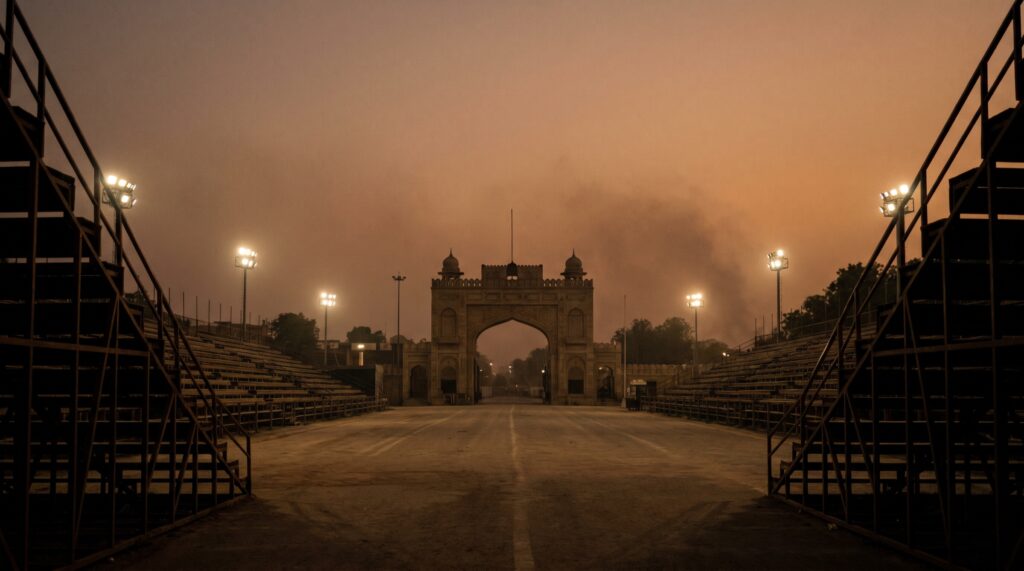
Two names, one line on the map, and endless confusion about which is which. People say “the Wagah border ceremony” as if Wagah were an Indian place, then wonder why Indian officials keep calling it Attari. Here is the fix, once and for all: Attari is the village on the Indian side, in Punjab’s Amritsar district, and Wagah is the village just across the line on the Pakistani side, near Lahore. The boundary that runs between them is the Radcliffe Line, drawn at the Partition in 1947. It is the same crossing seen from two countries, which is exactly why the flag-lowering drill you have seen on the news is a mirror image performed twice, once by each side, every single evening.
Where is the Attari-Wagah border, and why is this crossing special?
The Attari-Wagah border is the only functioning road crossing between India and Pakistan, sitting on the historic Grand Trunk Road roughly midway between Amritsar and Lahore. Attari lies about 28 kilometres west of Amritsar; Wagah lies about 24 kilometres east of Lahore. The two great cities are barely 50 kilometres apart, close enough that on a clear day the crossing feels less like an international frontier and more like the seam where one Punjab was cut into two.
That “only road crossing” fact is what gives the place its outsized weight. India and Pakistan share a long land boundary, but for decades the Attari-Wagah point has been the single spot where people, goods, and the occasional diplomatic gesture could physically move across by road. The Samjhauta Express train ran through the adjacent Attari railway station, and the Delhi-Lahore bus service crossed here too. When relations warmed, this is where the warmth showed; when they froze, this is where the freeze was felt first. One gate, two flags, and the entire India-Pakistan relationship pressed into a few hundred metres of road.
The line itself is a piece of frozen history. When the barrister Cyril Radcliffe drew the boundary in 1947 with almost no local knowledge and only weeks to do it, he split the Punjab down the middle, and the wound of that split runs directly through this crossing. Understanding the Partition of India is the backstory to everything that happens here, because the ceremony’s mix of hostility and shared heritage only makes sense once you know the two sides were one people a lifetime ago.
The Beating Retreat: choreographed aggression at sunset
The Beating Retreat, also called the lowering-of-flags ceremony, is the daily military drill held just before sunset at the Attari-Wagah border, run on the Indian side by the Border Security Force (BSF) and on the Pakistani side by the Pakistan Rangers. It has been performed every evening since 1959, which makes it one of the longest-running joint rituals between two hostile neighbours anywhere in the world. The two forces lower their national flags in perfect synchrony, and the gates between the countries close for the night.
What the crowd comes for is the theatre. Tall soldiers in ceremonial dress, fan-crested turbans on the Indian side, march toward the gate with exaggerated high kicks that seem to reach the forehead, stamp their boots, throw aggressive glares across the line, and puff out their chests in a display of controlled belligerence. The drill is deliberately confrontational, a piece of choreographed aggression in which each side tries to out-stomp and out-shout the other. And then, at the climax, comes the twist that gives the ritual its meaning: the two flags come down together at exactly the same speed, so neither is ever lower than the other, and a BSF soldier and a Ranger exchange a brisk, curt handshake before the gates slam shut. Hostility performed, parity preserved, contact maintained. That is the whole ceremony in one gesture.
It draws enormous crowds. On the Indian side the BSF built stadium-style seating that holds thousands, and on ordinary evenings the stands fill with families, students, and tourists who chant, wave the tricolour, and treat the sunset like a match day. The BSF runs the spectacle as part drill, part public-facing symbol of the force that guards this frontier the rest of the day; if you want the wider picture of what the Border Security Force actually does beyond this half-hour of ceremony, that is a topic in its own right. Amritsar’s tourist circuit leans on it heavily, pairing the evening retreat with a daytime visit to the Golden Temple barely half an hour away.
Here is the part visitors rarely notice: the aggression is a performance both governments have agreed to keep performing. In periods of high tension the ceremony has been toned down, with the theatrical stomping softened or the customary handshake quietly dropped, and those small edits are read by watchers on both sides as barometers of the relationship. When the handshake goes, something has gone wrong. When it returns, something has thawed.
The Integrated Check Post at Attari: the trade gateway
The Integrated Check Post (ICP) at Attari is the modern facility that handles the actual cross-border movement of goods and people, and it is a very different thing from the ceremony next door. Inaugurated in April 2012 and spread over roughly 120 acres, it was built to bring immigration, customs, security, and cargo handling under one roof at a single point, replacing the older, scattered arrangements. It is managed by the Land Ports Authority of India (LPAI), a statutory body under the Ministry of Home Affairs created to run India’s land borders the way ports and airports are run.
For years this was the main artery of legal India-Pakistan land trade. Trucks carried Indian exports like soybean meal, tomatoes, and other produce west, and brought back cement, gypsum, rock salt, and dry fruits, including Afghan dry fruits that transited through Pakistan. It was never a huge share of either country’s total trade, but for the specific goods that moved by road, and for the border economy of porters, traders, and transporters on both sides, the Attari ICP was the lifeline.
The trade has repeatedly been suspended, and this is where current affairs meets the geography. After the Pulwama attack in February 2019, India withdrew Pakistan’s Most Favoured Nation status and raised customs duty on Pakistani goods to 200 percent, which effectively priced out the trade overnight. You can read the trade angle in the context of Most Favoured Nation status under the WTO framework. Later that year, after India reorganised Jammu and Kashmir, Pakistan suspended bilateral trade in response. Since then, formal trade through Attari has been minimal to shut, and the crossing has been fully closed at moments of acute crisis. So the ICP stands as both an achievement and a warning: a modern trade gateway that only functions when the politics allows it, which lately it often has not.
The strategic and symbolic significance of the crossing
Strategically, Attari-Wagah matters because it is the chokepoint where the entire land relationship between two nuclear-armed neighbours is concentrated into one controllable point. Whatever moves overland between India and Pakistan, a diplomat, a returning prisoner, a peace delegation, a truck of tomatoes, tends to move here, which makes the crossing a lever. Opening it signals goodwill; closing it is a quick, visible way for either side to register anger without firing a shot. Few frontiers in the world carry that much political meaning in so small a space.
Symbolically, the crossing holds two opposite ideas at once, and that tension is the point. On one hand, the nightly retreat is a ritual of rivalry, a controlled release of the hostility that defines the India-Pakistan relationship. On the other, the same spot is where the two societies keep a thread of contact alive: the synchronised flag-lowering that refuses to let one nation stand above the other, the handshake, the families on both sides of the fence who can at least see the other country from the stands. On Independence Day each August, people gather here on both sides, and the shared date of freedom, won together and then split apart, hangs heavily over the line.
That double meaning is why the crossing shows up so often as a shorthand for the whole relationship. It is at once the most militarised piece of theatre the two countries stage and the last thin road that still, in better times, lets them touch. Nowhere else is the paradox of two neighbours who were one country, and cannot stop being rivals, made so physical.
Quick facts: the Attari-Wagah border at a glance
| Feature | Detail |
|---|---|
| Indian side | Attari village, Amritsar district, Punjab |
| Pakistani side | Wagah village, near Lahore |
| Road | Grand Trunk Road, between Amritsar and Lahore |
| Distance from Amritsar | About 28 km |
| Distance from Lahore | About 24 km |
| Boundary | Radcliffe Line, drawn at Partition in 1947 |
| Ceremony | Beating Retreat / lowering of flags, daily since 1959 |
| Forces involved | Border Security Force (India), Pakistan Rangers (Pakistan) |
| Trade facility | Integrated Check Post (ICP) at Attari, opened April 2012 |
| ICP managed by | Land Ports Authority of India, under the Ministry of Home Affairs |
| Status of trade | Suspended at times, notably after the 2019 Pulwama attack |
How to study and remember this
Hold the topic on three pegs and the details hang neatly off them. Peg one is place: Attari is India, Wagah is Pakistan, the road is the Grand Trunk Road, and the line is Radcliffe’s, 1947. Get the “which side is which” straight and half the confusion is gone. Peg two is the ceremony: Beating Retreat, since 1959, BSF versus Pakistan Rangers, synchronised flag-lowering and a handshake, aggression performed but parity kept. Peg three is the check post: the Attari ICP, opened 2012, run by the Land Ports Authority of India under the Home Ministry, the main road-trade gateway, suspended after Pulwama in 2019.
When a topic like this comes up in the wider syllabus, it usually sits at the meeting point of geography, internal security, and foreign policy, so link it outward rather than memorising it in isolation. Connect the ceremony to the role of the BSF and India’s border-management architecture, connect the trade suspension to the broader arc of India-Pakistan relations and instruments like MFN status, and connect the line itself back to Partition. The crossing is a single case study that lets you touch four or five themes at once, which is exactly why it repays being understood as a story, not a fact sheet. Remember the meaning over the trivia: this is the one road where two rivals still, on a good evening, shake hands.
Frequently Asked Questions
What is the difference between Attari and Wagah?
Attari is the village on the Indian side of the border, in Amritsar district, Punjab. Wagah is the village just across the line on the Pakistani side, near Lahore. The crossing is often loosely called the “Wagah border,” but the Indian side is correctly Attari.
What is the Beating Retreat ceremony at the Attari-Wagah border?
It is a daily military drill held just before sunset in which the Border Security Force and the Pakistan Rangers lower their national flags in synchrony and close the border gates. It has run every evening since 1959 and features high-stepping marches, aggressive posturing, and a brief handshake between soldiers of the two sides.
Which forces conduct the ceremony?
The Border Security Force (BSF) conducts it on the Indian side, and the Pakistan Rangers conduct it on the Pakistani side. The Indian Army does not run this ceremony; border-guarding here is the BSF’s job.
What is the Integrated Check Post at Attari?
The Attari ICP is a roughly 120-acre facility, opened in April 2012, that houses immigration, customs, security, and cargo handling for cross-border movement in one place. It is managed by the Land Ports Authority of India under the Ministry of Home Affairs.
Is trade still going on through the Attari-Wagah border?
Formal trade has been suspended or minimal for extended periods. After the Pulwama attack in February 2019, India withdrew Pakistan’s Most Favoured Nation status and imposed a 200 percent duty, and trade has largely not resumed since, with the crossing fully closed at times of acute tension.
Why is the Attari-Wagah crossing so significant?
Because it is the only road crossing between India and Pakistan, the entire land relationship, from trade to diplomacy to symbolism, is concentrated at this one point. Opening or closing it is a quick, visible signal of goodwill or anger between the two countries.
When is the best time to see the ceremony?
It happens every evening shortly before sunset, so the timing shifts a little with the season, earlier in winter and later in summer. Crowds are largest at weekends and on national days like Independence Day and Republic Day.
Practice Questions
1. At the Attari-Wagah border, which is the Indian side?
a) Wagah
b) Attari
c) Both are on the Indian side
d) Neither; both are in Pakistan
Answer: b) Attari
2. The Beating Retreat ceremony at the Attari-Wagah border is conducted on the Indian side by:
a) The Indian Army
b) The Central Reserve Police Force
c) The Border Security Force
d) The Assam Rifles
Answer: c) The Border Security Force
3. The Integrated Check Post at Attari is managed by which body?
a) The National Highways Authority of India
b) The Land Ports Authority of India
c) The Airports Authority of India
d) The Border Roads Organisation
Answer: b) The Land Ports Authority of India
4. The boundary running through the Attari-Wagah crossing was drawn at Partition and is known as the:
a) Durand Line
b) McMahon Line
c) Radcliffe Line
d) Line of Control
Answer: c) Radcliffe Line
5. Trade through the Attari-Wagah border was severely disrupted after which event?
a) The Kargil conflict of 1999
b) The Pulwama attack of February 2019
c) The Uri attack of 2016
d) The Mumbai attacks of 2008
Answer: b) The Pulwama attack of February 2019
Mains-style questions
1. The Attari-Wagah border is described as both a site of rivalry and a channel of contact between India and Pakistan. Discuss with reference to the daily Beating Retreat ceremony.
2. Examine the role of the Integrated Check Post at Attari in India-Pakistan land trade, and explain why this trade has been vulnerable to political disruption.
3. “As the only road crossing between the two countries, the Attari-Wagah border carries disproportionate strategic and symbolic weight.” Analyse this statement.
4. Discuss the role of the Border Security Force at the India-Pakistan frontier, using the Attari-Wagah crossing as an illustration of its ceremonial and security functions.
5. Trace how the legacy of the 1947 Partition continues to shape the significance of the Attari-Wagah crossing in contemporary India-Pakistan relations.
The Attari-Wagah border rewards anyone who looks past the spectacle. The high kicks and the glaring make for good television, but the meaning is in the details the cameras skip: two flags lowered at the identical instant so neither dips first, a handshake that survives even when almost nothing else does, and a single gate that both governments know they can open or shut to say what words will not. Learn it as the one place where the whole India-Pakistan story is compressed into a few hundred metres of road, and it stops being a tourist attraction to memorise and becomes the clearest window there is onto how these two neighbours actually deal with each other.
Tell Google you want more of this.
Add Anantam IAS as a preferred sourceOne tap, and this site shows up more often in your own Top Stories, AI Overviews and AI Mode. Remove it any time.