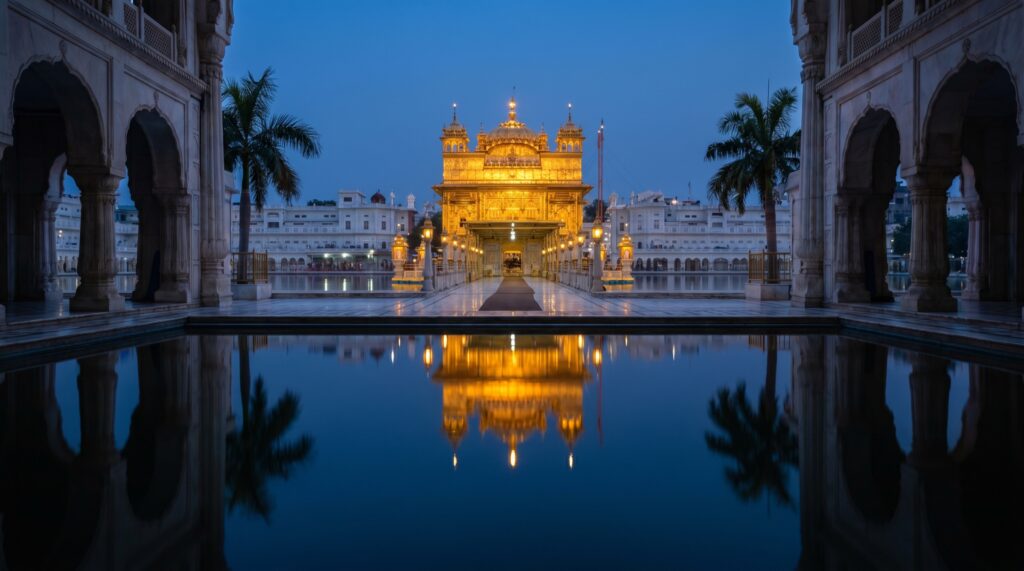
Most people know it as the Golden Temple, picture the gleaming dome mirrored in still water, and stop there. But the name that Sikhs use, Harmandir Sahib or Sri Darbar Sahib, tells you what the gold is wrapped around: not a monument to be admired from a distance, but a working house of worship that anyone on earth can walk into, sit down in, and be fed. The confusion worth clearing up first is that this is not a temple in the sense of a shrine to a deity. There is no idol inside. What sits at the centre, under a canopy, is a book. Understanding why a book, why four doors, and why a free kitchen that never closes is the whole story of what this place means.
What is the Golden Temple, and why do Sikhs call it Harmandir Sahib?
The Golden Temple is the holiest gurdwara in Sikhism, sitting in the middle of a sacred pool in Amritsar, Punjab. “Gurdwara” means the doorway (dwara) to the Guru, and that is exactly how Sikhs treat it: a place where you come into the presence of the Guru, which in Sikhism is now the scripture itself. The formal name Harmandir Sahib translates roughly as “the abode of God,” and the older ceremonial name Sri Darbar Sahib means “the exalted court.” “Golden Temple” is the tourist-era English name, earned by the gold leaf added centuries after the building went up.
Here is the part that trips up first-time visitors. Inside, there is no statue and no image. On a raised platform lies the Guru Granth Sahib, the Sikh holy scripture, read aloud almost continuously through the day by a granthi. Sikhs bow to it not as they would to an idol but as to a living teacher, because the tenth Guru, Guru Gobind Singh, ended the line of human Gurus in 1708 and vested that authority permanently in the scripture. So when you bow at Harmandir Sahib, you are bowing to the word, not to a form. That single fact separates Sikh practice from most temple worship you may have seen, and it is why the building is called a gurdwara and never a mandir in Sikh usage.
The pool it sits in is not decoration either. It is the Amrit Sar, the “pool of nectar,” and the city of Amritsar takes its name from it. Pilgrims bathe in it before entering. The idea of sacred water pools runs through much of the broader devotional culture of the subcontinent, and the Bhakti movement that shaped the age gave Sikhism much of its early vocabulary of direct, personal devotion without priestly gatekeeping.
Who built the Golden Temple, and when?
The site and the temple came from two different Gurus, one generation apart, and the timeline matters. The fourth Sikh Guru, Guru Ram Das, founded the settlement and had the sacred tank excavated in the 1570s, which is why the town was first called Ramdaspur before it became Amritsar. He acquired the land and set the pool going, but he did not build the shrine in the water.
That was his successor. The fifth Guru, Guru Arjan, designed and built the central temple, completing it around 1604. In the same year he did something even more foundational: he compiled the first authoritative Sikh scripture, the Adi Granth, and installed it inside the newly finished Harmandir Sahib. So 1604 is the hinge date to remember. It is both the year the temple opened and the year the scripture that would one day become the eternal Guru first took its place at the centre of it. This was the era of the Mughal Empire under Akbar and then Jahangir, and the fortunes of the shrine would rise and fall with Mughal and Afghan politics for the next two centuries.
The gold that gives the temple its English name came much later. It was the Sikh ruler Maharaja Ranjit Singh, who consolidated a Sikh empire in Punjab in the early nineteenth century, who had the upper storeys covered in gold leaf and the interior decorated with marble and inlay work in the 1830s. So the shrine is three layers of history at once: a sixteenth-century pool, a seventeenth-century temple, and a nineteenth-century golden skin.
The architecture: four doors, two storeys, and a deliberate lowness
The design of Harmandir Sahib is an argument built in marble and gold, and every choice says something. Start with the four doors, one on each side. Most sacred buildings of the age had a single controlled entrance. Harmandir Sahib opens on all four sides on purpose, a physical statement that the house of God is open to people coming from every direction and every background, of any caste, creed, or none. The four doors are the building telling you its theology before you have read a word.
Then notice how low it sits. You walk down the steps to reach it, not up. Almost every temple tradition raises the sanctum on a high plinth so worshippers climb toward the divine. Harmandir Sahib reverses that. You descend to the level of the water and below the surrounding walkway, an architectural gesture of humility, the idea that you lower yourself to approach God rather than being elevated. That inversion is easy to miss and it is one of the most quietly radical things about the building.
The style itself blends two vocabularies that were usually kept apart. The lower marble sections and the pointed arches echo the Islamic architectural language of the age, while the fluted dome, the ornamented pavilions, and the profusion of decorative detail draw on Hindu temple traditions. The famous inverted-lotus dome on top is a shared motif. This fusion is not accidental leftover borrowing; it fits a faith that grew in the space between the two great religious worlds of the medieval subcontinent. The upper storeys carry the gold leaf, roughly 750 kilograms of it applied over Ranjit Singh’s copper sheeting, which is what flashes in the water at dawn.
The building stands connected to the shore by a single causeway, the Guru’s Bridge, so the temple appears to float. Around the whole tank runs the marble parikrama, the walkway pilgrims circle. The effect is calculated: a small, low, glittering house sitting alone in a mirror of water, reached by one narrow path, open on every side.
The langar: the world’s largest free kitchen, and what it is really for
The langar at the Golden Temple is a free community kitchen that serves a simple vegetarian meal to anyone who comes, and by most reckonings it feeds on the order of 100,000 people on an ordinary day, rising past this on festival days, which makes it the largest free kitchen on the planet. Nobody is charged. Nobody is asked their religion, caste, income, or reason for being there. You sit on the floor in long rows, shoulder to shoulder with strangers, and eat the same food off the same steel plate as everyone else.
That last detail is the whole point. Langar was instituted by the very first Guru, Guru Nanak, and formalised through the early Gurus as a direct assault on caste hierarchy. In a society where who you could eat with was the sharpest marker of caste, sitting everyone on the same floor at the same level, called pangat, and feeding them the same meal was a deliberate levelling. A king and a labourer eat side by side and are indistinguishable in the row. The langar is not charity in the pity sense. It is a daily, edible sermon on equality.
It runs almost entirely on seva, voluntary service. Volunteers chop vegetables, roll and cook the rotis (increasingly with the help of large automated machines), serve the food, and wash the tens of thousands of plates by hand in a continuous cycle. Seva, selfless service without expectation of reward, is one of the pillars of Sikh ethical life, and the langar hall is where it becomes concrete. If you want to understand Sikh values faster than any book will teach you, spend an hour washing plates there.
The Akal Takht: temporal power beside spiritual authority
Directly facing Harmandir Sahib, across the parikrama, stands the Akal Takht, the “Throne of the Timeless One,” and the relationship between the two buildings encodes a core Sikh idea. The Akal Takht was established in 1606 by the sixth Guru, Guru Hargobind, the son of Guru Arjan, as the seat of temporal, political, and community authority, deliberately built taller than the ground the shrine sits on and positioned to face it.
The two together express the Sikh doctrine of miri-piri, the twin sovereignty of the worldly and the spiritual. Harmandir Sahib is piri, spiritual authority, the house of the word. The Akal Takht is miri, worldly authority, where the community deliberates, issues edicts (hukamnamas), and settles matters of collective concern. Guru Hargobind is said to have worn two swords to symbolise exactly this: a Sikh is meant to hold devotion and civic responsibility together, not retreat from one into the other. The Akal Takht is the highest of the five takhts (seats of authority) in Sikhism, and its pronouncements carry weight across the Sikh world.
A careful note on the shrine in modern history
The Golden Temple complex has been at the centre of some of the hardest chapters of modern Punjab, and it deserves to be stated plainly and without sensationalism. Through the eighteenth century the shrine was attacked and desecrated several times during Mughal and Afghan invasions, notably by Ahmad Shah Abdali, and each time the Sikh community rebuilt and reconsecrated it. In June 1984, the Indian Army conducted Operation Blue Star inside the complex to remove armed militants who had fortified themselves there, an operation that caused significant loss of life and heavy damage to the Akal Takht, and which remains a deeply painful and contested event in Indian history. The assassination of Prime Minister Indira Gandhi followed months later. These events sit within the wider story of Punjab in the decades after the Partition of India and are best studied soberly, with respect for the loss involved on all sides, rather than reduced to slogans.
Quick facts: the Golden Temple at a glance
| Feature | Detail |
|---|---|
| Sikh names | Harmandir Sahib, Sri Darbar Sahib |
| Location | Amritsar, Punjab, India |
| Sacred pool | Amrit Sar (“pool of nectar”), gives the city its name |
| Site founded by | Guru Ram Das (4th Guru), pool excavated in the 1570s |
| Temple built by | Guru Arjan (5th Guru), completed around 1604 |
| Scripture installed | Adi Granth, placed inside in 1604 |
| Gold leaf added by | Maharaja Ranjit Singh, 1830s |
| Akal Takht established | Guru Hargobind (6th Guru), 1606 |
| Entrances | Four doors, open on all sides |
| Langar | Free kitchen, feeds roughly 100,000 people daily |
| Managing body | Shiromani Gurdwara Parbandhak Committee (SGPC) |
How to study and remember this
Anchor the whole topic on three linked ideas rather than a pile of dates, and it stays put. First, the openness: four doors, a lowered sanctum you step down into, and a kitchen that turns nobody away. All three say the same thing, that this faith rejects gatekeeping and hierarchy, so learn them as one cluster. Second, the word not the image: no idol, a scripture at the centre, the Guruship passing to the Guru Granth Sahib in 1708. Third, miri-piri: Harmandir Sahib and the Akal Takht facing each other, spiritual and temporal authority held together.
For the founding sequence, remember it as a relay across generations. Guru Ram Das made the pool, Guru Arjan built the temple and installed the scripture around 1604, Guru Hargobind added the Akal Takht in 1606, and Ranjit Singh added the gold two centuries later. If you are building a broader base on the faith, pair this with a wider read on Sikhism’s founders and core beliefs, because the temple only makes full sense as the physical expression of ideas the Gurus taught first in words.
Frequently Asked Questions
Is the Golden Temple a Hindu or Sikh place of worship?
It is the holiest site in Sikhism, a gurdwara, not a Hindu temple. Its architecture borrows from both Islamic and Hindu traditions, but the worship is entirely Sikh: no idol, the Guru Granth Sahib at the centre, and langar for all.
Why is it called the Golden Temple?
Because Maharaja Ranjit Singh had the upper storeys covered in gold leaf in the 1830s. Sikhs themselves call it Harmandir Sahib or Sri Darbar Sahib. “Golden Temple” is the popular English name earned by that gold.
Can non-Sikhs and people of other religions enter?
Yes. The four doors symbolise that the shrine is open to everyone regardless of religion, caste, or nationality. Visitors cover their heads, remove their shoes, and may eat in the langar like anyone else.
What is kept inside the temple if there is no idol?
The Guru Granth Sahib, the Sikh scripture, rests on a platform under a canopy and is recited through the day. Sikhs revere it as the living, eternal Guru, which is why there is no statue.
What is the langar and is the food really free?
The langar is the community kitchen that serves a free vegetarian meal to all comers, roughly 100,000 people a day. It runs on donations and voluntary service, and everyone sits on the floor together to eat as equals.
What is the difference between Harmandir Sahib and the Akal Takht?
Harmandir Sahib is the spiritual centre, the house of the scripture. The Akal Takht, facing it, is the seat of temporal and community authority. Together they express the Sikh idea of miri-piri, worldly and spiritual power held in balance.
Who manages the Golden Temple today?
The Shiromani Gurdwara Parbandhak Committee (SGPC), a statutory body that administers historic gurdwaras in Punjab, Haryana, and Himachal Pradesh, manages the complex and its institutions, including the langar.
Practice Questions
1. The Golden Temple (Harmandir Sahib) is located in which city?
a) Anandpur Sahib
b) Amritsar
c) Patiala
d) Ludhiana
Answer: b) Amritsar
2. The central temple at Harmandir Sahib was built and the Adi Granth installed there by which Guru?
a) Guru Ram Das
b) Guru Hargobind
c) Guru Arjan
d) Guru Gobind Singh
Answer: c) Guru Arjan
3. The four doors of the Golden Temple primarily symbolise:
a) The four Vedas
b) Openness to people of all backgrounds and directions
c) The four seasons
d) The four earlier Gurus
Answer: b) Openness to people of all backgrounds and directions
4. The Akal Takht, which sits facing Harmandir Sahib, represents which aspect of the Sikh doctrine of miri-piri?
a) Spiritual authority (piri)
b) Temporal and community authority (miri)
c) Both, equally, in one building
d) Neither; it is a rest house for pilgrims
Answer: b) Temporal and community authority (miri)
5. The gold leaf that gives the Golden Temple its popular name was added by:
a) Guru Arjan
b) Emperor Akbar
c) Maharaja Ranjit Singh
d) Guru Ram Das
Answer: c) Maharaja Ranjit Singh
Mains-style questions
1. The architecture of Harmandir Sahib reflects the core values of Sikhism. Discuss, with reference to its four entrances, its lowered sanctum, and its fusion of architectural traditions.
2. Explain the significance of the langar as an institution of social equality. How does it challenge caste hierarchy in practice?
3. Discuss the doctrine of miri-piri and how the relationship between Harmandir Sahib and the Akal Takht gives it physical form.
4. Trace the founding and development of the Golden Temple complex across the period of the Sikh Gurus and the Sikh empire, highlighting the contribution of each key figure.
5. The Golden Temple has been both a spiritual centre and a site of political history. Examine, with balance, its place in the modern history of Punjab.
The Golden Temple rewards the visitor who reads the building itself. Every element, the four open doors, the descent to the water, the book instead of an idol, the endless free meal, and the throne of worldly authority staring back across the pool, is the same set of convictions rendered in stone and gold and lentils. Learn it that way, as a faith you can walk through, and the dates and names stop being a list to memorise and become a place that finally makes sense.
Tell Google you want more of this.
Add Anantam IAS as a preferred sourceOne tap, and this site shows up more often in your own Top Stories, AI Overviews and AI Mode. Remove it any time.