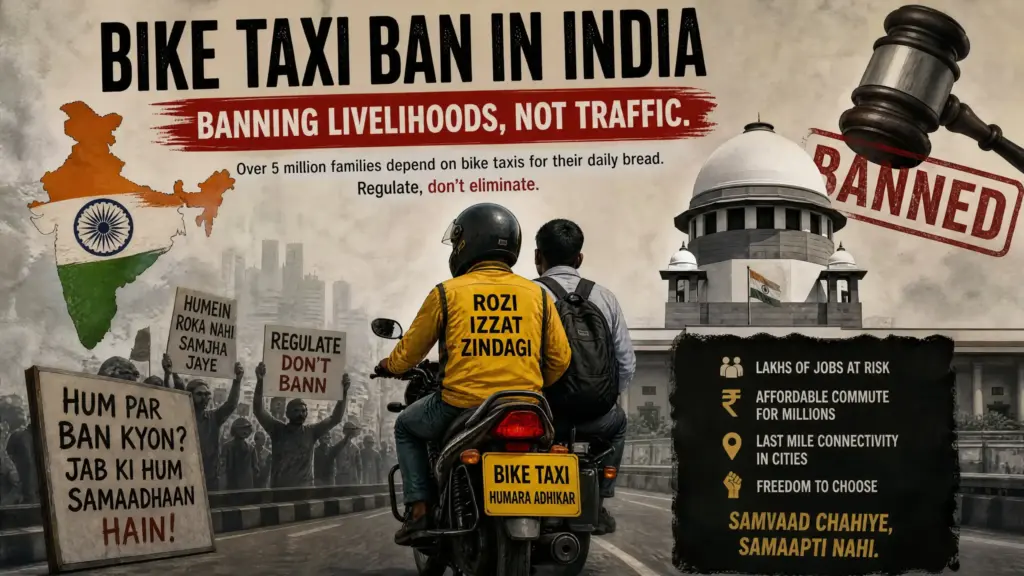
A bike taxi ban is usually not a ban on motorcycles themselves. It is a regulatory action against using two-wheelers, often privately registered motorcycles, to carry passengers for hire through app-based platforms.
The issue matters because bike taxis sit at the intersection of urban mobility, state transport regulation, platform economy, road safety, and livelihoods of gig workers. For UPSC, it is a compact example of how old transport law is being stretched by app-based services.
What Is a Bike Taxi?
A bike taxi is a two-wheeler ride service where a passenger books a motorcycle or scooter ride through an app or local platform. It works like a cab aggregator, but the vehicle is a two-wheeler.
The common regulatory question is simple: can a vehicle registered as a private/non-transport vehicle legally be used to carry passengers for payment?
That question has produced different answers across states. Some states have allowed bike taxis under licensing or aggregator rules. Some have restricted them. Some have acted against platforms for operating without permits or using private vehicles for commercial passenger transport.
Why Do States Ban or Restrict Bike Taxis?
State transport departments usually cite one or more of these reasons:
- Use of private vehicles for commercial passenger service without a valid permit.
- Absence of a clear state-level licensing framework for two-wheeler taxis.
- Passenger safety concerns, including helmets, insurance, driver verification and accident liability.
- Competition concerns raised by auto-rickshaw and taxi unions.
- Uncertainty over whether app platforms are only intermediaries or transport operators.
- Lack of clarity on fare regulation, surge pricing and grievance redressal.
The problem is not only legal. It is also administrative. A state must decide who is responsible when a bike taxi ride fails safety norms: the driver, the app aggregator, the vehicle owner, or the transport department that licensed the platform.
Legal Background
The bike taxi debate begins with the Motor Vehicles Act, 1988 and the rules made under it.
Transport vs non-transport vehicle
Indian transport law distinguishes between vehicles used for private purposes and vehicles used to carry passengers or goods for hire or reward. A vehicle used commercially generally needs the correct registration, permit, fitness, insurance and tax compliance.
Bike taxi platforms became controversial because many rides were offered through privately registered two-wheelers. States argued that a private motorcycle cannot automatically become a commercial passenger vehicle merely because an app lists it.
Aggregators under the Motor Vehicles Act
The Motor Vehicles Amendment Act, 2019 introduced a formal legal recognition of aggregators. An aggregator is a digital intermediary or marketplace that connects passengers with drivers.
Under the Act, aggregators need a license from the state government, and the license must follow conditions prescribed by the central and state framework. This created the legal route through which app-based transport platforms can be regulated.
In practice, however, the central guidelines do not remove the state’s role. Transport is administered heavily at the state level. That is why bike taxi legality can vary from one state to another.
Central Guidelines vs State Rules
The Union Ministry of Road Transport and Highways has issued aggregator guidelines to help states regulate app-based transport services. These guidelines cover issues such as driver verification, vehicle standards, fare structure, insurance, app transparency, data sharing and passenger grievance redressal.
But central guidelines are not the same as an automatic all-India permission for every platform to operate every class of vehicle. States still have to issue licenses and frame or adopt operational conditions.
This is the main reason the bike taxi question keeps coming back in courts and transport departments. Platforms argue that bike taxis improve last-mile connectivity and create livelihoods. State departments argue that commercial transport cannot operate outside permit, safety and licensing rules.
Key Issues in the Bike Taxi Debate
1. Last-mile connectivity
Bike taxis solve a real urban problem. Metro stations, bus stops and offices are often separated by the last 2 to 5 km. A low-cost two-wheeler ride can be faster than a cab and more flexible than a fixed-route bus.
For cities struggling with congestion, bike taxis can also reduce vehicle occupancy inefficiency. A single rider hiring a four-wheeler cab for a short trip is not always the best use of road space.
This connects directly with urbanization in India and the need for multimodal public transport.
2. Livelihood and gig work
Bike taxi work has become a source of income for many young workers, students and migrants. A ban can immediately affect thousands of platform workers.
At the same time, platform work often lacks stable wages, social security and predictable working conditions. The bike taxi question therefore overlaps with the larger debate on gig workers and platform labour regulation.
The policy choice is not simply “ban or allow”. A better question is whether states can create a licensing model that protects both workers and passengers.
3. Passenger safety
Two-wheeler passenger transport has higher safety risks than four-wheeler cabs. States must account for:
- Helmet use for both driver and passenger.
- Valid driving license and background verification.
- Vehicle fitness and age.
- Insurance cover for passenger injury.
- Emergency assistance and trip tracking.
- Safety of women passengers.
If these safeguards are weak, a bike taxi system can create avoidable risks.
4. Federalism and state transport powers
Road transport is governed through a mix of central law and state-level administration. States issue permits, collect road taxes, regulate routes and enforce motor vehicle rules.
So when one state permits bike taxis and another restricts them, that variation is not unusual. It reflects the federal character of transport regulation.
5. Fair competition
Auto-rickshaw and taxi unions often oppose bike taxis, arguing that bike platforms operate with lower compliance costs. If one segment pays commercial taxes, permit fees and insurance costs while another does not, competition becomes uneven.
This is a legitimate regulatory concern. The answer, however, should be rule parity and safety compliance, not arbitrary enforcement.
Policy Options
India has three broad options for regulating bike taxis.
| Option | What it means | Problem |
|---|---|---|
| Complete ban | No bike taxi passenger service allowed | Hurts last-mile mobility and gig livelihoods |
| Unregulated permission | Platforms operate freely | Safety, insurance and tax gaps remain |
| Licensed regulation | Bike taxis allowed with permits, app accountability and safety rules | Requires strong state capacity |
The third option is the most balanced. It recognizes the service while bringing it under formal transport regulation.
What a Good Bike Taxi Framework Should Include
A strong state bike taxi framework should include:
- Clear distinction between private use and commercial passenger use.
- Mandatory aggregator license.
- Driver police verification and training.
- Passenger helmet requirement.
- Insurance cover for driver and passenger.
- Fare transparency and limits on arbitrary surge pricing.
- In-app SOS, trip sharing and complaint redressal.
- Data sharing with transport authorities without violating privacy.
- Social security contribution for gig workers.
- Strict penalties for unlicensed operation.
This is where digital governance matters. App-based regulation can make enforcement easier if the state uses real-time licensing, vehicle databases and grievance systems. For wider context, see e-governance in India.
UPSC Relevance
Prelims focus:
- Motor Vehicles Act, 1988.
- Motor Vehicles Amendment Act, 2019.
- Aggregator licensing.
- Transport vs non-transport vehicle.
- State role in issuing permits and regulating local transport.
Mains GS-II angle:
- Federalism in transport regulation.
- Regulatory challenges in the platform economy.
- Balancing livelihood, safety and consumer welfare.
Mains GS-III angle:
- Urban mobility.
- Digital economy.
- Gig work and social security.
- Road safety.
Exam Takeaways
- Bike taxi bans are usually about commercial use of private two-wheelers, not about motorcycles as a category.
- Central aggregator guidelines guide states, but state licensing remains crucial.
- The issue combines mobility, safety, federalism and platform labour.
- A regulated model is better than both blanket bans and unregulated permission.
- Bike taxis can improve last-mile connectivity only if passenger safety and worker protections are built into the framework.
Official Sources
- Ministry of Road Transport and Highways for central road transport rules, notifications and aggregator guidance.
- Motor Vehicles Act, 1988 on India Code for the parent law governing motor vehicles, permits and aggregator regulation.
Frequently Asked Questions
Are bike taxis legal in India?
There is no single all-India answer. Bike taxi legality depends on the state’s transport rules, aggregator licensing framework and enforcement approach. A state may allow, restrict or act against bike taxis depending on how vehicles are registered and whether platforms hold the required license.
Why are bike taxis banned in some states?
States usually object to private two-wheelers being used for commercial passenger service without transport permits, commercial insurance, safety compliance or aggregator licenses.
Which law regulates bike taxi aggregators?
The Motor Vehicles Act, 1988, as amended in 2019, recognizes aggregators and allows state governments to license them under prescribed conditions.
What is the UPSC angle of bike taxi regulation?
The topic links to urban transport, platform economy, gig workers, road safety, federalism and regulatory governance. It is useful for GS-II and GS-III answers.
Should bike taxis be banned completely?
A complete ban may reduce safety and compliance risks, but it also hurts last-mile connectivity and worker livelihoods. A licensed regulatory model is usually a more balanced solution.
Bottom Line
Bike taxi regulation is a test of whether Indian cities can adapt old transport law to new platform-based mobility. The sensible path is not unregulated growth or blanket bans. It is a clear licensing system that protects passengers, gives gig workers basic security and lets states enforce transport rules fairly.
Tell Google you want more of this.
Add Anantam IAS as a preferred sourceOne tap, and this site shows up more often in your own Top Stories, AI Overviews and AI Mode. Remove it any time.