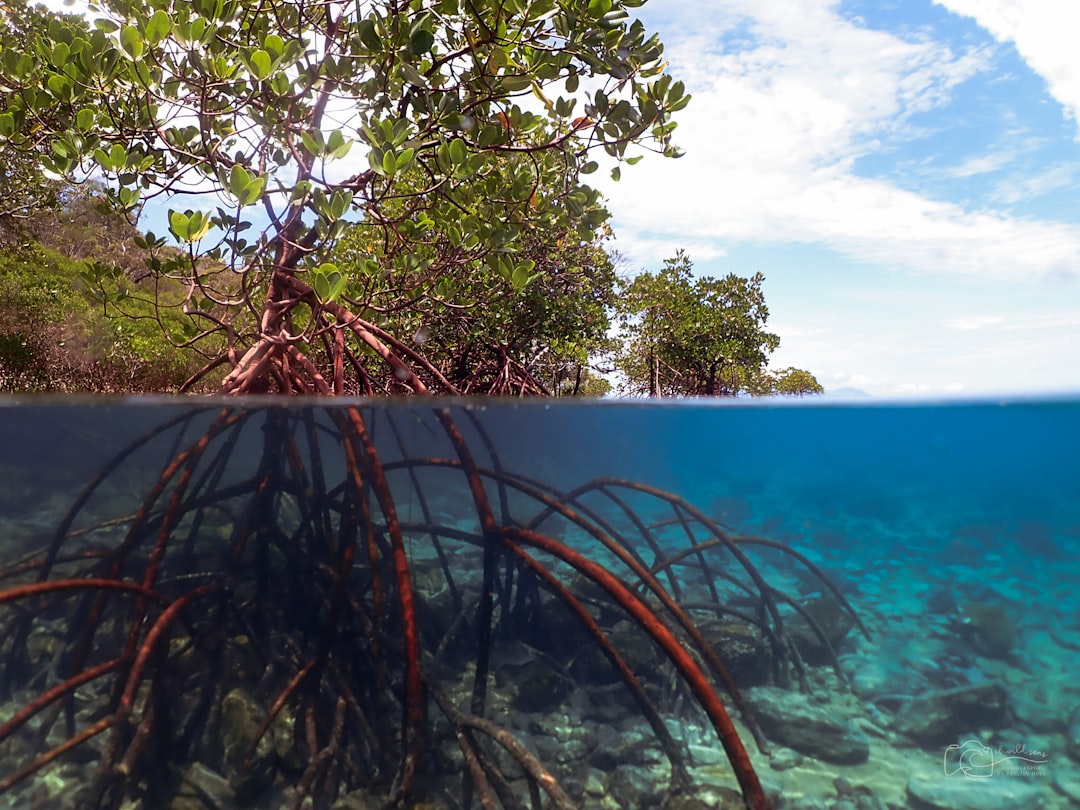
Walk through a mangrove forest at low tide and you are standing on one of the most powerful carbon stores on the planet — and almost nobody would guess it. The trees are short and tangled, the mud underfoot is black and smells of rotten eggs, and there is none of the grandeur of a rainforest. Yet acre for acre, this scruffy coastal swamp pulls carbon from the air and buries it faster and more durably than the Amazon ever could. That hidden talent has a name now — blue carbon — and over the past few years it has moved from a niche idea among marine scientists into climate policy, carbon markets and India’s own coastal strategy.
The term covers the carbon captured and stored by the ocean and, above all, by three coastal ecosystems that sit where land meets sea: mangroves, seagrass meadows and tidal salt marshes. It matters for an aspirant because blue carbon ties together threads UPSC loves to test in one place — climate mitigation, biodiversity, disaster resilience, the blue economy and India’s flagship coastal schemes. Get the mechanism and the India angle right, and you have a ready answer for GS3 environment and even an essay on living with nature rather than against it.
What Blue Carbon Is and Why It Got Its Colour
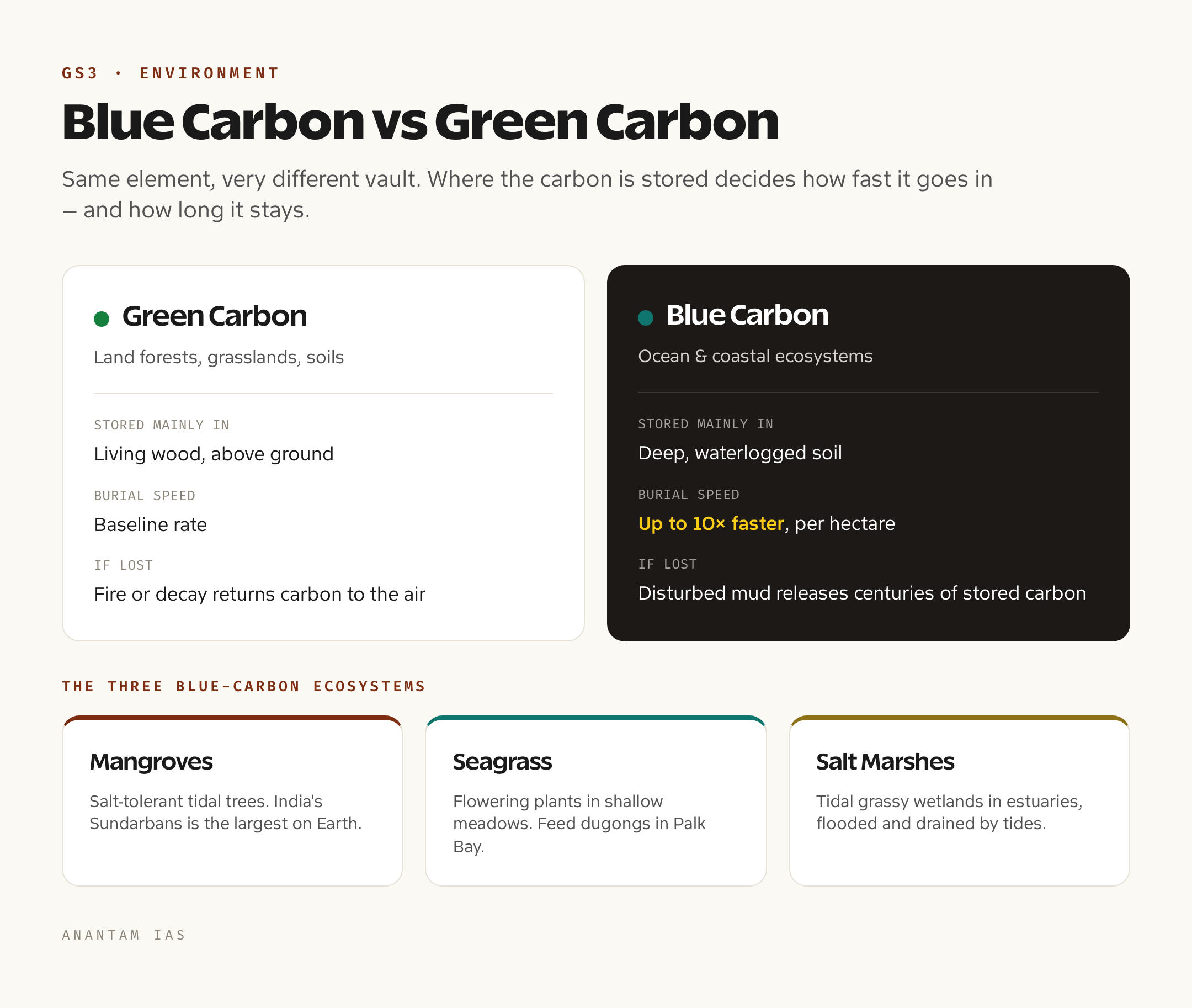
Start with the name, because it carries the whole idea. Scientists call the carbon stored by land plants and soils “green carbon” — the forests, grasslands and farmland that dominate the usual climate conversation. “Blue carbon,” coined in a 2009 report by UN agencies, is the carbon captured and locked away by the ocean and its coastal vegetation. The ocean is the biggest carbon sink on Earth, absorbing roughly a quarter of the carbon dioxide humans emit each year. But within that vast blue system, a few small, leafy ecosystems do something special, and it is those that the term mostly points to in practice.
There are three classic blue-carbon ecosystems. Mangroves are salt-tolerant trees and shrubs that grow in the tidal zone of tropical coasts, on stilt-like roots that trap mud. Seagrasses are true flowering plants — not seaweeds — that form underwater meadows in shallow, sunlit waters; our explainer at https://anantamias.com/seagrass-vs-seaweed/ covers how they differ from seaweed. And tidal salt marshes are grassy coastal wetlands, flooded and drained by the tides, common in temperate estuaries. Together these three cover a tiny sliver of the planet — well under one per cent of the seabed — yet they account for around half of all the carbon buried in ocean sediments each year. That mismatch between footprint and effect is why policymakers have started paying attention.
So what makes a plant a “blue” carbon plant rather than a wet version of a forest? It is where the carbon ends up. A rainforest holds most of its carbon in living wood, so when a tree dies or burns, much of that carbon goes back to the air. A mangrove or seagrass meadow does the opposite: it pushes most of its carbon down into the waterlogged soil beneath it, where, as the next section explains, it can stay locked away for centuries. Blue carbon, in short, is not just carbon stored near the sea — it is carbon stored in a way that is unusually fast to accumulate and unusually slow to escape.
Why Coastal Ecosystems Are Carbon Superstars
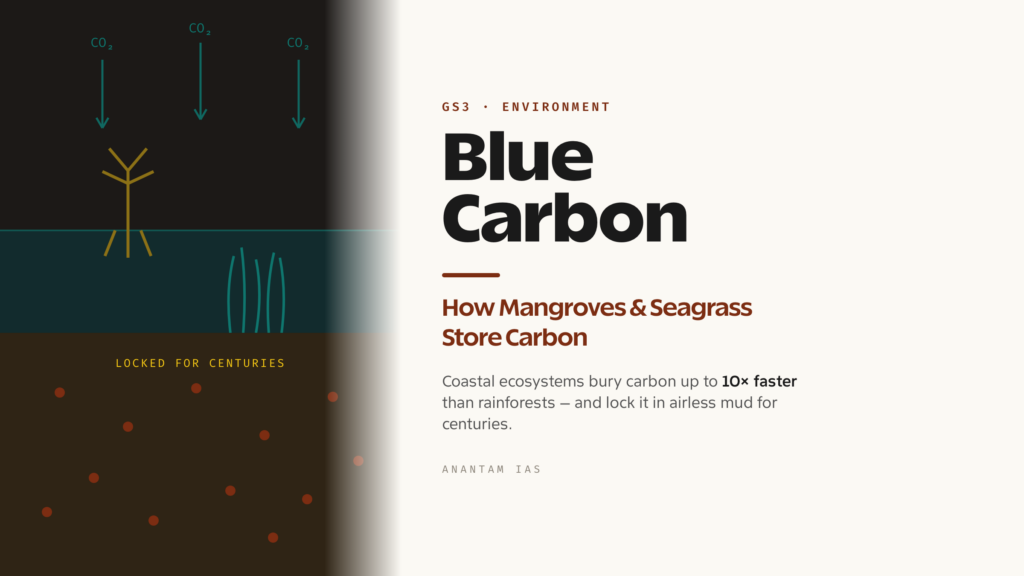
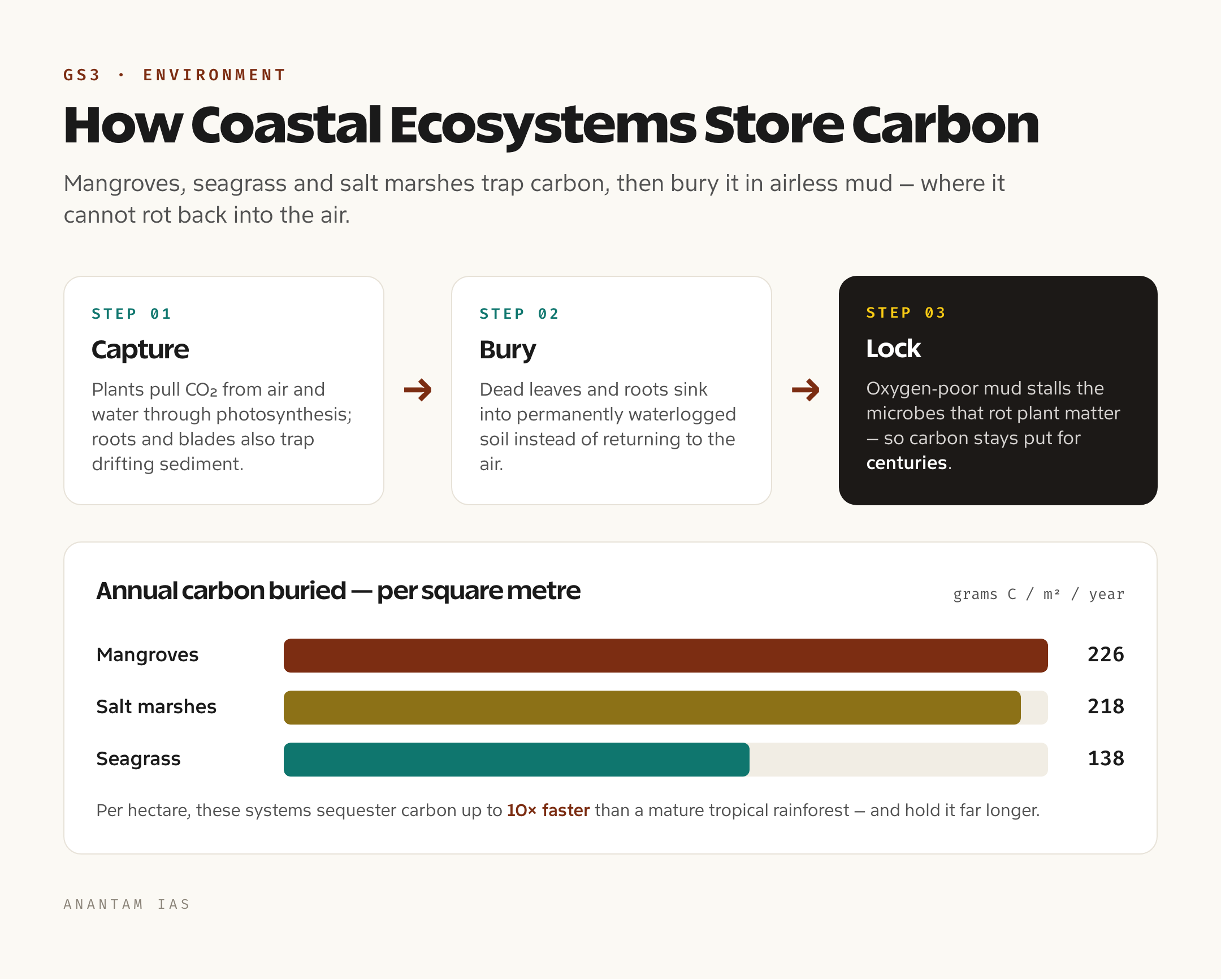
Here is the number that makes scientists sit up. Mangroves, seagrass meadows and salt marshes sequester carbon at a rate up to ten times faster, per hectare, than a mature tropical rainforest. A rainforest is a magnificent carbon store, but a coastal wetland of the same size is a far quicker pump. Mangroves bury organic carbon at roughly 226 grams per square metre every year, salt marshes around 218 grams, and seagrasses about 138 grams. Some estimates put the total carbon locked in a single hectare of mangrove at around a thousand tonnes once you count the deep soil. That is why these ecosystems punch so far above their tiny share of the Earth’s surface.
The secret is not the plants so much as the mud they grow in. On dry land, when a leaf or root dies, soil microbes that need oxygen quickly break it down and respire its carbon back into the air — which is why forest soils, for all their richness, leak carbon steadily. In a tidal wetland the soil is permanently waterlogged and starved of oxygen. Those oxygen-poor, or anoxic, conditions cripple the microbes that would otherwise rot the dead plant matter. So instead of decomposing, leaves, roots and trapped sediment pile up year after year, building deep layers of carbon-rich peat and mud. The carbon goes in and, crucially, does not come back out. Because the water keeps rising with sea level and the plants keep adding material on top, these soils can grow for centuries, and the carbon at the bottom may have been laid down thousands of years ago. The International Atomic Energy Agency notes that blue-carbon sediments can hold their carbon for up to millions of years — a permanence no forest can match.
There is a second reason the carbon accumulates so fast: these ecosystems are sediment traps. Mangrove roots and seagrass blades slow the water around them, so fine particles drifting in from rivers and the sea settle out and stay. Much of that incoming sediment carries its own organic carbon, washed down from the land. So a mangrove forest stores not only the carbon it fixes through its own photosynthesis but also a steady supply of carbon produced elsewhere and captured as it passes through. The plants build the trap; the tides keep filling it. Put the two mechanisms together — rapid burial plus oxygen-starved preservation — and you have the closest thing nature offers to a permanent carbon vault.
The Co-Benefits: Shields, Fisheries and Livelihoods
If blue carbon only mopped up carbon dioxide it would still be valuable, but these ecosystems pay several dividends at once, and that bundle is what makes protecting them such an easy call. The first is physical protection. A belt of mangroves is a living sea wall — its dense roots and trunks break the force of waves, blunt storm surges and slow coastal erosion. When a cyclone hits, villages sheltered behind healthy mangroves take far less damage than those on bare coast, which is why these forests are often called bio-shields. In a warming world of fiercer storms and rising seas, that buffering is climate adaptation, not just mitigation — the same ecosystem defends the coast and stores the carbon. India’s broader mangrove story, including how these belts protect a long, cyclone-prone coastline, is covered in our companion piece at https://anantamias.com/mangroves/.
The second dividend is life. Blue-carbon ecosystems are nurseries for the sea. Fish, prawns and crabs spawn and shelter among mangrove roots and seagrass blades before moving to open water, so these habitats underpin coastal fisheries that millions eat from and earn from. Seagrass meadows feed grazers like the dugong, the gentle “sea cow” that survives in India only where its seagrass food survives. Salt marshes and mangroves host migratory birds, crocodiles and the Sundarbans’ famous tigers. Lose the habitat and you lose the biodiversity stacked on top of it — and the fish catch with it.
The third dividend is livelihoods and water quality. Coastal communities draw honey, fuelwood, fodder and fish from these systems, and increasingly income from eco-tourism and carbon finance. The plants also filter pollutants and excess nutrients out of coastal water. So the case for blue carbon is never only about the climate ledger. A single hectare of healthy mangrove is at once a carbon vault, a storm barrier, a fish nursery, a biodiversity refuge and a source of food and income — a rare combination, and why the IUCN says mangroves behave like ecological superheroes.
When the Vault Breaks: Degradation, Emissions and Carbon Markets
Now the warning, because it is the heart of why this is a policy issue and not just a nature lesson. The same feature that makes these ecosystems such good carbon stores makes them dangerous when destroyed. All that carbon buried in the mud over centuries stays locked only as long as the soil stays waterlogged and undisturbed. Clear a mangrove for a shrimp farm, drain a salt marsh for construction, or dredge a seagrass meadow, and you expose the ancient carbon to oxygen. Microbes that were held in check come alive, and the soil starts releasing its stored carbon back into the atmosphere — sometimes for years after the plants are gone. A protected blue-carbon ecosystem is a carbon sink; a degraded one flips into a carbon source. That switch is the single most important idea in the subject: conserving these habitats is itself a climate mitigation measure, because it prevents an emission that would otherwise happen.
And the threats are real and global. Coastal development, aquaculture, pollution, dam-building that starves deltas of sediment, and rising seas have already wiped out a large share of the world’s mangroves and seagrass, and losses continue. Every hectare cleared is a double blow — it stops future carbon capture and releases a stock built up over generations. This is why the conservation argument has shifted from “nice to have” to “cheaper than the alternative”: preventing the loss of an existing blue-carbon ecosystem avoids emissions far more cheaply than capturing the same carbon by machine.
That logic has given rise to blue-carbon credits — the carbon-finance angle reshaping how these projects are funded. A community or government that protects or restores a coastal ecosystem can have the resulting carbon storage measured, verified by a standard such as Verra or the Gold Standard, and sold as credits to companies offsetting their emissions. The money flows back into conservation and local livelihoods, turning a standing forest into a payable asset. The market is young but growing fast: blue-carbon credit prices climbed to a record of around 29 dollars per tonne in 2025, and a study in npj Ocean Sustainability noted the rising tide of such projects advancing both climate and biodiversity goals. Mangroves dominate this market almost entirely, because their carbon is easiest to measure and their co-benefits easiest to sell. The catch is permanence and integrity — a credit is only worth anything if the protected forest is genuinely safe from a future cyclone or bulldozer, which is why critics watch blue-carbon credits closely for over-claiming.
India’s Blue Carbon: Sundarbans, Seagrass and the MISHTI Push
India is unusually rich in blue carbon, and this is where the topic becomes a high-value India answer. The country has a coastline of more than 7,500 kilometres and, according to the India State of Forest Report 2023, a mangrove cover of about 4,992 square kilometres — roughly 0.15 per cent of its land area, but a global treasure all the same. The crown jewel is the Sundarbans in West Bengal, the largest contiguous mangrove forest on Earth, shared with Bangladesh and home to the Royal Bengal tiger; the Indian portion alone covers more than 2,000 square kilometres. Gujarat, Andhra Pradesh, Odisha’s Bhitarkanika and the Andaman and Nicobar Islands hold the rest of India’s major tracts. Encouragingly, the ISFR data shows India’s mangrove cover has grown over the past two decades, against the global trend of loss.
India’s seagrass is smaller but no less important. The National Centre for Sustainable Coastal Management has estimated the country’s seagrass meadows at roughly 517 square kilometres, concentrated in the Gulf of Mannar and Palk Bay off Tamil Nadu and in the Gulf of Kachchh. These meadows feed India’s dugongs, and in 2022 the country notified its first Dugong Conservation Reserve in Palk Bay — about 448 square kilometres protecting more than 12,000 hectares of seagrass — a reserve the IUCN went on to recognise. Protecting seagrass for the dugong and protecting it for its blue carbon turn out to be the same task.
On policy, India has moved from protection to active restoration. The flagship is MISHTI — the Mangrove Initiative for Shoreline Habitats and Tangible Incomes — announced in the 2023-24 Union Budget and run by the Ministry of Environment, Forest and Climate Change. MISHTI aims to restore roughly 540 square kilometres of mangroves across nine coastal states and three Union Territories over 2023 to 2028, funded largely through the CAMPA afforestation fund in convergence with MGNREGS, with an estimated outlay of about 1,250 crore rupees. Its name signals the philosophy — “tangible incomes” — that conservation must pay coastal communities, not just store carbon. MISHTI sits alongside older efforts such as the IUCN-led “Mangroves for the Future” partnership and the National Coastal Mission under the climate action plan, and it dovetails with India’s net-zero-by-2070 pledge and its blue-economy push. For India, blue carbon is not an abstraction — it is climate mitigation, cyclone defence for a vulnerable coast, a livelihood programme and a carbon-finance opportunity rolled into one coastal strategy.
For Your Mains Answer
This is a high-value topic for GS Paper 3, which covers environment, conservation, climate change and the blue economy, and it can feed a disaster-management answer too because mangroves are bio-shields. Questions on nature-based solutions, carbon sinks, coastal ecosystems, India’s mangrove or seagrass policy, and carbon markets can all be answered with this material. It also gives a fresh, concrete example for an Essay on sustainable development or living in harmony with nature. The skill examiners reward is the one this article models: explain the mechanism crisply, stack the co-benefits, then anchor it in India’s Sundarbans, seagrass and MISHTI with a few exact figures.
How to Build the Answer
Move in a logical chain: define blue carbon and name its three ecosystems, explain why they store carbon faster and more durably than forests (waterlogged anoxic soil), list the co-benefits (coastal protection, fisheries, biodiversity, livelihoods), flag the threat (degradation turns a sink into a source, so conservation equals mitigation), bring in carbon credits as the finance tool, and close on India — Sundarbans, seagrass in Palk Bay, and MISHTI. That arc — define, store, benefit, threaten, finance, localise — fits almost any blue-carbon question.
Common Mistakes to Avoid
Don’t say blue carbon is just “carbon in the sea” — the marks are in the mechanism, the burial in oxygen-poor soil. Don’t confuse seagrass with seaweed; seagrasses are flowering plants and the major blue-carbon ones, seaweeds are algae. Don’t forget the reverse flow — that degrading these systems releases stored carbon, which is the reason protecting them counts as mitigation. And don’t list MISHTI without its purpose: tangible incomes for communities, not only plantation targets.
A Compact Answer Spine
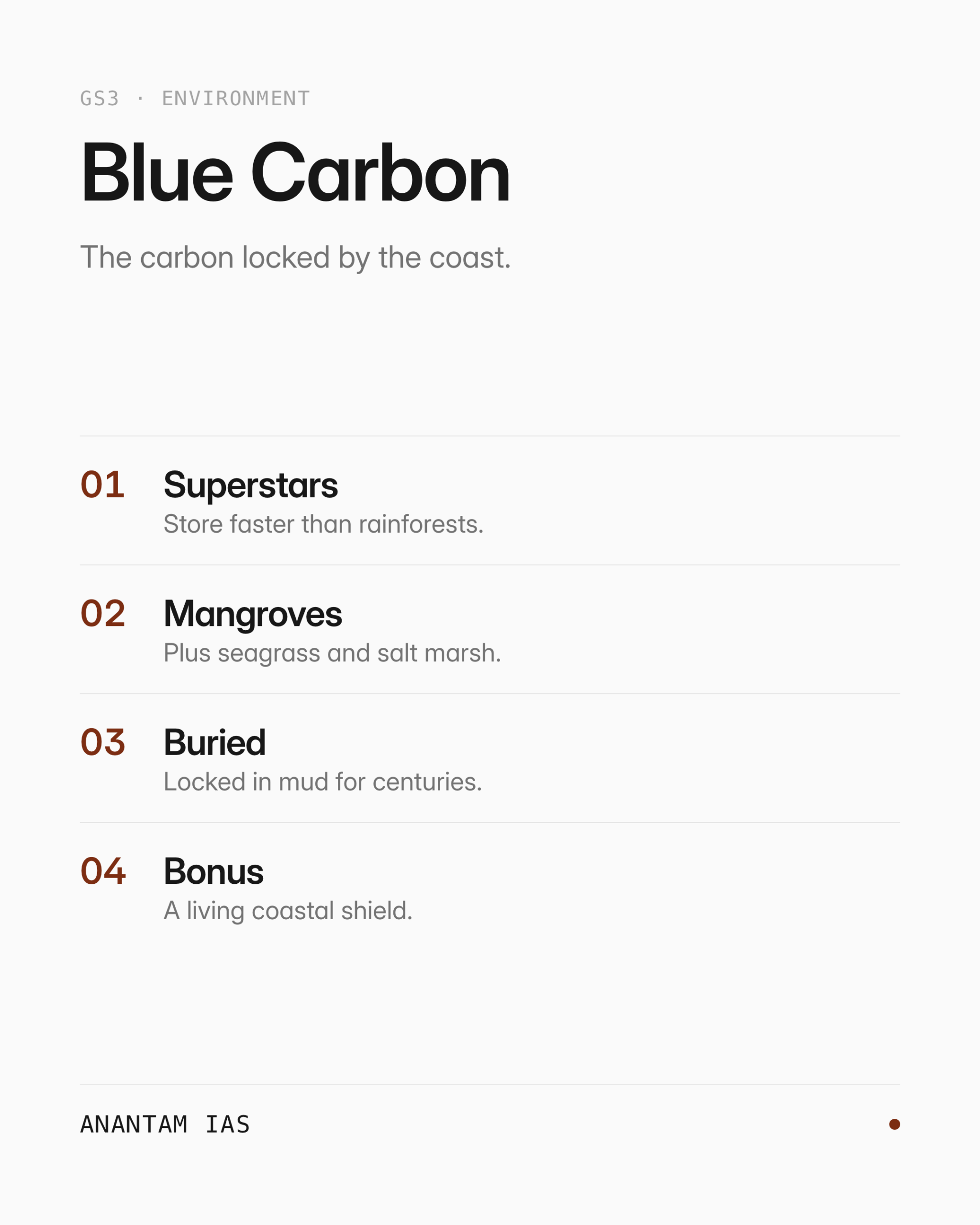
Blue carbon = carbon stored by ocean + 3 coastal ecosystems (mangroves, seagrass, salt marshes) → sequester up to 10x faster per hectare than rainforest, buried in waterlogged anoxic soil for centuries → co-benefits: bio-shields vs storms/erosion, fish nurseries, biodiversity (dugong, tiger), livelihoods → degradation flips sink to source, so conservation = mitigation → blue-carbon credits monetise protection → India: ~4,992 sq km mangroves (Sundarbans largest on Earth), ~517 sq km seagrass (Palk Bay dugong reserve), MISHTI restoring ~540 sq km over 2023-28 → verdict: a nature-based climate solution that defends the coast and pays communities.
Diagram or Flowchart Idea
Draw a simple cross-section of a coast: mangroves at the tideline, seagrass meadow offshore, salt marsh in the estuary, with downward arrows showing carbon moving from air and water into a deep, dark, waterlogged soil layer labelled “stored for centuries.” Add side labels for the co-benefits — wave-break, fish nursery, dugong. One clean coastal cross-section communicates mechanism and benefits together.
A Balanced-Conclusion Line
A line that lands the marks: “Blue carbon is where climate mitigation, coastal defence and livelihoods meet in the same hectare — and India, with the world’s largest mangrove forest and schemes like MISHTI, is well placed to protect this asset, provided restoration is matched by genuine community incomes and credible carbon accounting.”
How to Use Data Without Cramming
You need only a handful of anchors: up to 10x faster than rainforest (the sequestration claim), ~4,992 sq km of Indian mangroves, the Sundarbans as the world’s largest mangrove forest, ~517 sq km of Indian seagrass, and MISHTI’s ~540 sq km target over 2023-28. Attribute them plainly — “as the India State of Forest Report 2023 recorded” — rather than scattering numbers loose.
Frequently Asked Questions
What exactly is blue carbon, and which ecosystems store it?
Blue carbon is the carbon captured and stored by the ocean and, above all, by three coastal ecosystems — mangroves, seagrass meadows and tidal salt marshes. The term, coined in a 2009 UN report, distinguishes this ocean-and-coast carbon from “green carbon” held by land forests and soils. Though these three ecosystems cover under one per cent of the seabed, they account for about half of all carbon buried in ocean sediments each year.
Why do mangroves and seagrass store carbon better than rainforests?
Two reasons. First, they grow fast and trap drifting sediment, so they bury organic carbon up to ten times faster per hectare than a tropical rainforest. Second, and more importantly, their soil is permanently waterlogged and starved of oxygen, which stops the microbes that would normally rot dead plant matter. So the carbon piles up and stays locked in the mud for centuries or millennia, rather than returning to the air as it does on dry land.
How does destroying these ecosystems make climate change worse?
The carbon buried in coastal soils stays safe only while the soil is undisturbed and waterlogged. Clearing mangroves for aquaculture or draining a marsh exposes that ancient carbon to oxygen, and microbes release it back into the atmosphere. So a healthy blue-carbon ecosystem is a sink, but a degraded one becomes a source. That is why simply protecting these habitats counts as climate mitigation — it prevents emissions that would otherwise happen.
What is the MISHTI scheme and why does it matter?
MISHTI — Mangrove Initiative for Shoreline Habitats and Tangible Incomes — is India’s flagship mangrove-restoration scheme, announced in the 2023-24 Budget and run by the Environment Ministry. It aims to restore roughly 540 square kilometres of mangroves across nine states and three Union Territories by 2028, funded mainly through the CAMPA afforestation fund with MGNREGS convergence. Its name captures its philosophy: restore the carbon-storing, coast-protecting forests while delivering tangible incomes to coastal communities.
Practice Questions
Prelims MCQs
- Which of the following are considered the three classic “blue carbon” ecosystems?
(a) Coral reefs, kelp forests and salt marshes
(b) Mangroves, seagrass meadows and tidal salt marshes
(c) Mangroves, coral reefs and estuarine mudflats
(d) Seagrass meadows, peat bogs and salt marshes
Answer: (b) The three classic blue-carbon ecosystems are mangroves, seagrass meadows and tidal salt marshes, all coastal vegetated habitats that bury carbon in waterlogged soil. - Blue-carbon ecosystems store carbon for very long periods mainly because their soils are
(a) frozen for most of the year
(b) rich in oxygen, which preserves plant matter
(c) waterlogged and oxygen-poor, which slows decomposition
(d) highly acidic from volcanic activity
Answer: (c) Permanently waterlogged, anoxic soils starve the microbes that decompose dead plant matter, so carbon accumulates and stays buried for centuries. - With reference to seagrasses, which statement is correct?
(a) They are a type of marine algae like seaweed
(b) They are flowering plants that form underwater meadows
(c) They grow only in the deep, dark ocean floor
(d) They store no carbon and have little ecological value
Answer: (b) Seagrasses are true flowering plants, not algae; they form underwater meadows in shallow sunlit waters and are major blue-carbon stores and dugong habitat. - The MISHTI scheme launched by India is primarily associated with
(a) restoration of coral reefs in the Andaman Sea
(b) mangrove plantation and restoration along the coastline
(c) cleaning of major rivers under the Namami Gange programme
(d) promotion of seaweed farming for biofuel
Answer: (b) MISHTI — Mangrove Initiative for Shoreline Habitats and Tangible Incomes — focuses on restoring mangroves along India’s coast while supporting community livelihoods. - Why is protecting an existing mangrove forest considered a climate-change mitigation measure?
(a) Mangroves reflect sunlight back into space and cool the air
(b) Protecting them prevents the release of carbon already stored in their soils
(c) Mangroves directly absorb methane from the atmosphere
(d) They convert carbon dioxide into oxygen faster than any other plant
Answer: (b) Degrading a mangrove exposes centuries of buried soil carbon to oxygen and releases it; protecting the forest prevents that emission, which is itself mitigation.
Mains Practice Questions
- Explain the concept of blue carbon and discuss why coastal ecosystems sequester carbon more effectively than terrestrial forests. (15 marks, 250 words)
- “Conserving a mangrove forest is itself a climate-change mitigation measure.” Critically examine this statement with reference to the dynamics of carbon storage and release in blue-carbon ecosystems. (15 marks, 250 words)
- Discuss the co-benefits that blue-carbon ecosystems provide beyond carbon storage, and analyse their relevance to India’s coastal disaster resilience. (15 marks, 250 words)
- Evaluate the role of carbon-credit markets in financing the conservation of blue-carbon ecosystems. What risks must such markets guard against? (10 marks, 150 words)
- Assess India’s policy response to coastal ecosystem conservation, with special reference to the MISHTI scheme and the protection of seagrass meadows. (15 marks, 250 words)
Tell Google you want more of this.
Add Anantam IAS as a preferred sourceOne tap, and this site shows up more often in your own Top Stories, AI Overviews and AI Mode. Remove it any time.