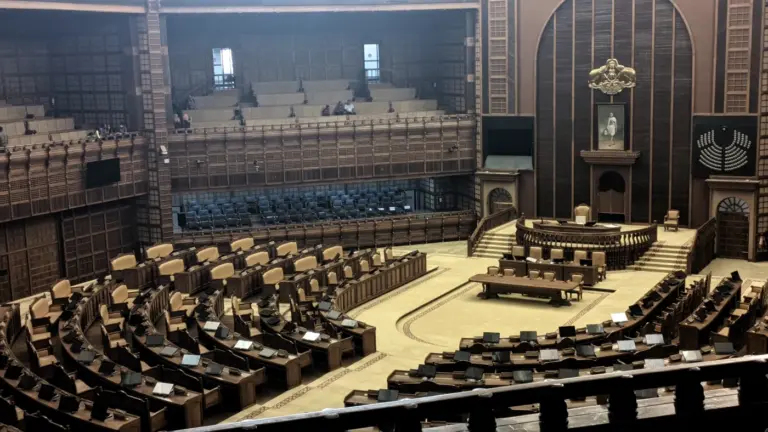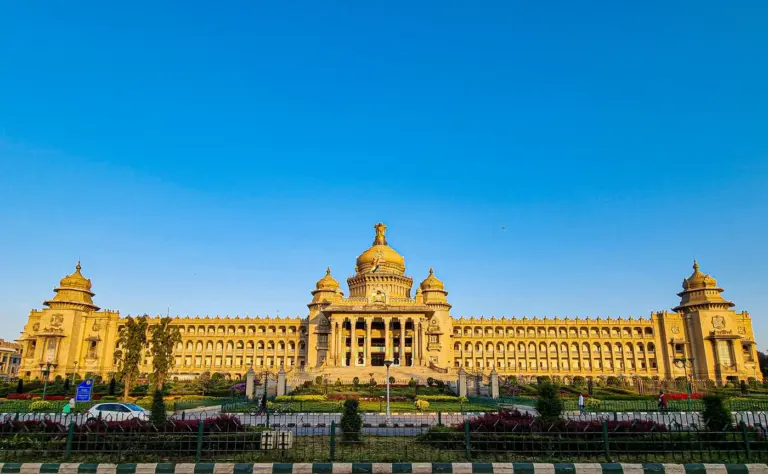
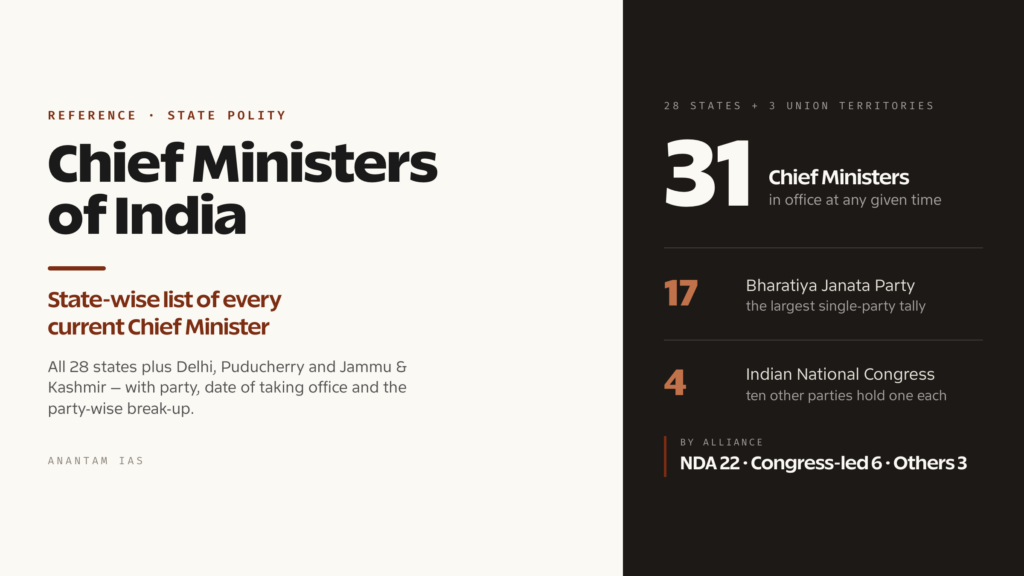
India has 31 Chief Ministers at any given time — one for each of the 28 states, and one each for the three Union Territories that have their own legislature: Delhi, Puducherry and Jammu & Kashmir. This page lists all of them as they stand in July 2026, with the party each belongs to and the date each took office. The 2026 round of assembly elections in Tamil Nadu, West Bengal, Kerala, Assam and Puducherry, along with mid-term changes in Bihar, Karnataka and Manipur, reshuffled a large part of this list, so several names here are new.
The Chief Minister is the real head of government in a state. The Governor is the constitutional head, but executive power is exercised on the advice of the Council of Ministers led by the Chief Minister, who stays in office only as long as the legislative assembly has confidence in them. Everything else on this page — the party tally, the tenure records, the firsts — follows from that one arrangement.
The Chief Minister’s Office in the Indian Constitution
Article 163 says there shall be a Council of Ministers with the Chief Minister at its head to aid and advise the Governor, except where the Governor acts in their own discretion. Article 164 then does the practical work: the Chief Minister is appointed by the Governor, and the other ministers are appointed by the Governor on the Chief Minister’s advice.
There is no election to the post written into the Constitution. The Governor appoints whoever can command a majority in the assembly — in practice, the leader chosen by the majority party or coalition. Ministers hold office during the pleasure of the Governor, but the Council of Ministers is collectively responsible to the legislative assembly, and that collective responsibility is what actually keeps a government in power.
A Chief Minister must be a member of the state legislature, or become one within six months of appointment. There is no fixed term. An assembly runs for five years unless dissolved earlier, and a Chief Minister serves as long as the majority holds. Article 164(1A) caps the size of the council at 15 per cent of the assembly’s strength, with a floor of twelve ministers.
The three Union Territories work slightly differently. Delhi’s arrangement comes from Article 239AA, which gives the National Capital Territory an assembly and a Council of Ministers headed by a Chief Minister, but keeps public order, police and land with the Union — and the Lieutenant Governor holds powers no state Governor has. Puducherry runs under the Government of Union Territories Act, 1963, with its assembly’s law-making power subject to the Administrator. Jammu & Kashmir was reorganised into a Union Territory with a legislature by the Jammu and Kashmir Reorganisation Act, 2019, which came into force on 31 October 2019; police and public order there rest with the Union through the Lieutenant Governor. Assembly elections were held in September and October 2024, and an elected government took office that month.
Current Chief Ministers of All States and Union Territories
The table below covers all 28 states and the three Union Territories with legislatures, with the date each incumbent took office. Where someone has been re-sworn after winning a fresh election, the date shown is the start of their continuous run in the post, not the latest oath.
| State / UT | Current Chief Minister | Party | In Office Since |
|---|---|---|---|
| Andhra Pradesh | N. Chandrababu Naidu | TDP | 12 June 2024 |
| Arunachal Pradesh | Pema Khandu | BJP | 17 July 2016 |
| Assam | Himanta Biswa Sarma | BJP | 10 May 2021 |
| Bihar | Samrat Choudhary | BJP | 15 April 2026 |
| Chhattisgarh | Vishnu Deo Sai | BJP | 13 December 2023 |
| Goa | Pramod Sawant | BJP | 19 March 2019 |
| Gujarat | Bhupendra Patel | BJP | 13 September 2021 |
| Haryana | Nayab Singh Saini | BJP | 12 March 2024 |
| Himachal Pradesh | Sukhvinder Singh Sukhu | INC | 11 December 2022 |
| Jharkhand | Hemant Soren | JMM | 4 July 2024 |
| Karnataka | D. K. Shivakumar | INC | 3 June 2026 |
| Kerala | V. D. Satheesan | INC | 18 May 2026 |
| Madhya Pradesh | Mohan Yadav | BJP | 13 December 2023 |
| Maharashtra | Devendra Fadnavis | BJP | 5 December 2024 |
| Manipur | Yumnam Khemchand Singh | BJP | 4 February 2026 |
| Meghalaya | Conrad Sangma | NPP | 6 March 2018 |
| Mizoram | Lalduhoma | ZPM | 8 December 2023 |
| Nagaland | Neiphiu Rio | NPF (formerly NDPP) | 8 March 2018 |
| Odisha | Mohan Charan Majhi | BJP | 12 June 2024 |
| Punjab | Bhagwant Mann | AAP | 16 March 2022 |
| Rajasthan | Bhajan Lal Sharma | BJP | 15 December 2023 |
| Sikkim | Prem Singh Tamang | SKM | 27 May 2019 |
| Tamil Nadu | C. Joseph Vijay | TVK | 10 May 2026 |
| Telangana | A. Revanth Reddy | INC | 7 December 2023 |
| Tripura | Manik Saha | BJP | 15 May 2022 |
| Uttar Pradesh | Yogi Adityanath | BJP | 19 March 2017 |
| Uttarakhand | Pushkar Singh Dhami | BJP | 4 July 2021 |
| West Bengal | Suvendu Adhikari | BJP | 9 May 2026 |
| Delhi (NCT) | Rekha Gupta | BJP | 20 February 2025 |
| Jammu & Kashmir (UT) | Omar Abdullah | JKNC | 16 October 2024 |
| Puducherry (UT) | N. Rangaswamy | AINRC | 7 May 2021 |
Five of these thirty-one took office in 2026 alone. Samrat Choudhary became Bihar’s first BJP Chief Minister on 15 April 2026 after Nitish Kumar resigned to move to the Rajya Sabha. C. Joseph Vijay’s Tamilaga Vettri Kazhagam won its first election and broke a fifty-nine-year run of Dravidian-party rule in Tamil Nadu. Suvendu Adhikari became West Bengal’s first BJP Chief Minister after fifteen years of Trinamool government. V. D. Satheesan returned the Congress-led UDF to power in Kerala after a decade. And D. K. Shivakumar replaced Siddaramaiah mid-term in Karnataka in June 2026.
Two long-running incumbents anchor the other end of the table. Pema Khandu has led Arunachal Pradesh continuously since July 2016, and Yogi Adityanath has led Uttar Pradesh since March 2017 — the two longest-serving Chief Ministers currently in office. Manipur’s row is the newest kind of entry: President’s Rule was imposed there in February 2025 after N. Biren Singh resigned and was revoked on 4 February 2026, when Yumnam Khemchand Singh took the oath.
Party-Wise Break-Up
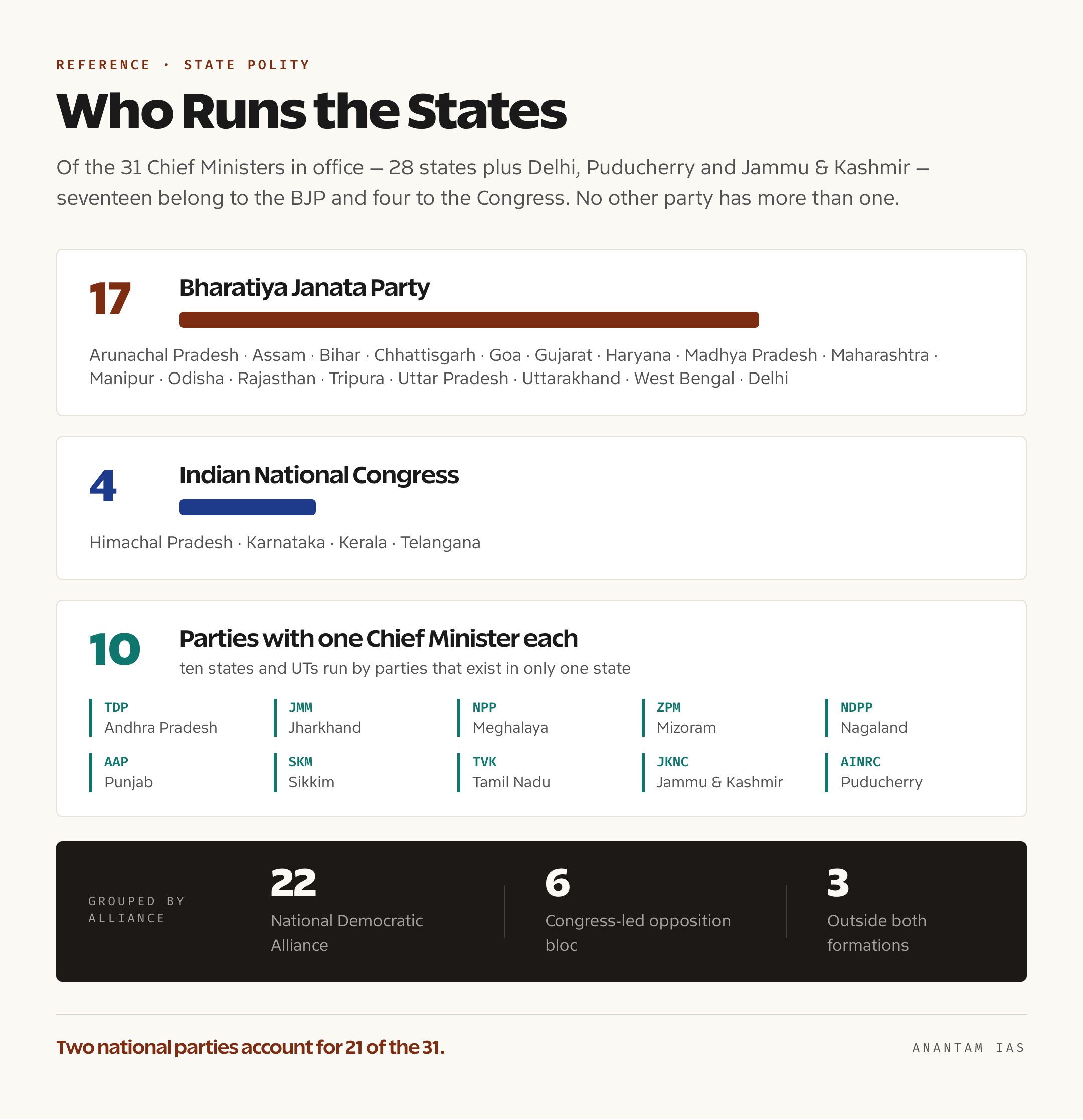
Of the 31 Chief Ministers in office, seventeen belong to the Bharatiya Janata Party and four to the Indian National Congress. No other party has more than one.
| Party | Number | States / UTs |
|---|---|---|
| Bharatiya Janata Party (BJP) | 17 | Arunachal Pradesh, Assam, Bihar, Chhattisgarh, Goa, Gujarat, Haryana, Madhya Pradesh, Maharashtra, Manipur, Odisha, Rajasthan, Tripura, Uttar Pradesh, Uttarakhand, West Bengal, Delhi |
| Indian National Congress (INC) | 4 | Himachal Pradesh, Karnataka, Kerala, Telangana |
| Telugu Desam Party (TDP) | 1 | Andhra Pradesh |
| Jharkhand Mukti Morcha (JMM) | 1 | Jharkhand |
| National People’s Party (NPP) | 1 | Meghalaya |
| Zoram People’s Movement (ZPM) | 1 | Mizoram |
| Naga People’s Front (NPF) | 1 | Nagaland |
| Aam Aadmi Party (AAP) | 1 | Punjab |
| Sikkim Krantikari Morcha (SKM) | 1 | Sikkim |
| Tamilaga Vettri Kazhagam (TVK) | 1 | Tamil Nadu |
| Jammu & Kashmir National Conference (JKNC) | 1 | Jammu & Kashmir |
| All India N.R. Congress (AINRC) | 1 | Puducherry |
| Total | 31 |
Grouped by alliance rather than party, the arithmetic looks like this. The BJP’s seventeen plus its five allies in office — the TDP in Andhra Pradesh, the NPP in Meghalaya, the NPF in Nagaland, the SKM in Sikkim and the AINRC in Puducherry — give the National Democratic Alliance 22 of the 31 governments. The Congress’s four, plus the JMM in Jharkhand and the National Conference in Jammu & Kashmir, give the Congress-led opposition bloc six. The remaining three governments sit outside both national formations: the AAP in Punjab, the ZPM in Mizoram, and the TVK in Tamil Nadu, which governs with Congress and Left support at the state level without being part of a national alliance.
The BJP’s seventeen is a record for a single party in the post-1989 era, and it now includes Bihar and West Bengal, where the party had never held the office before 2026. The Congress’s four is a modest recovery from its low point of three, helped by Kerala returning to the UDF in May 2026. Between them, the two national parties account for 21 of 31 Chief Ministers, leaving ten states and UTs run by parties that exist in only one state.
Longest-Serving Chief Ministers in Indian History
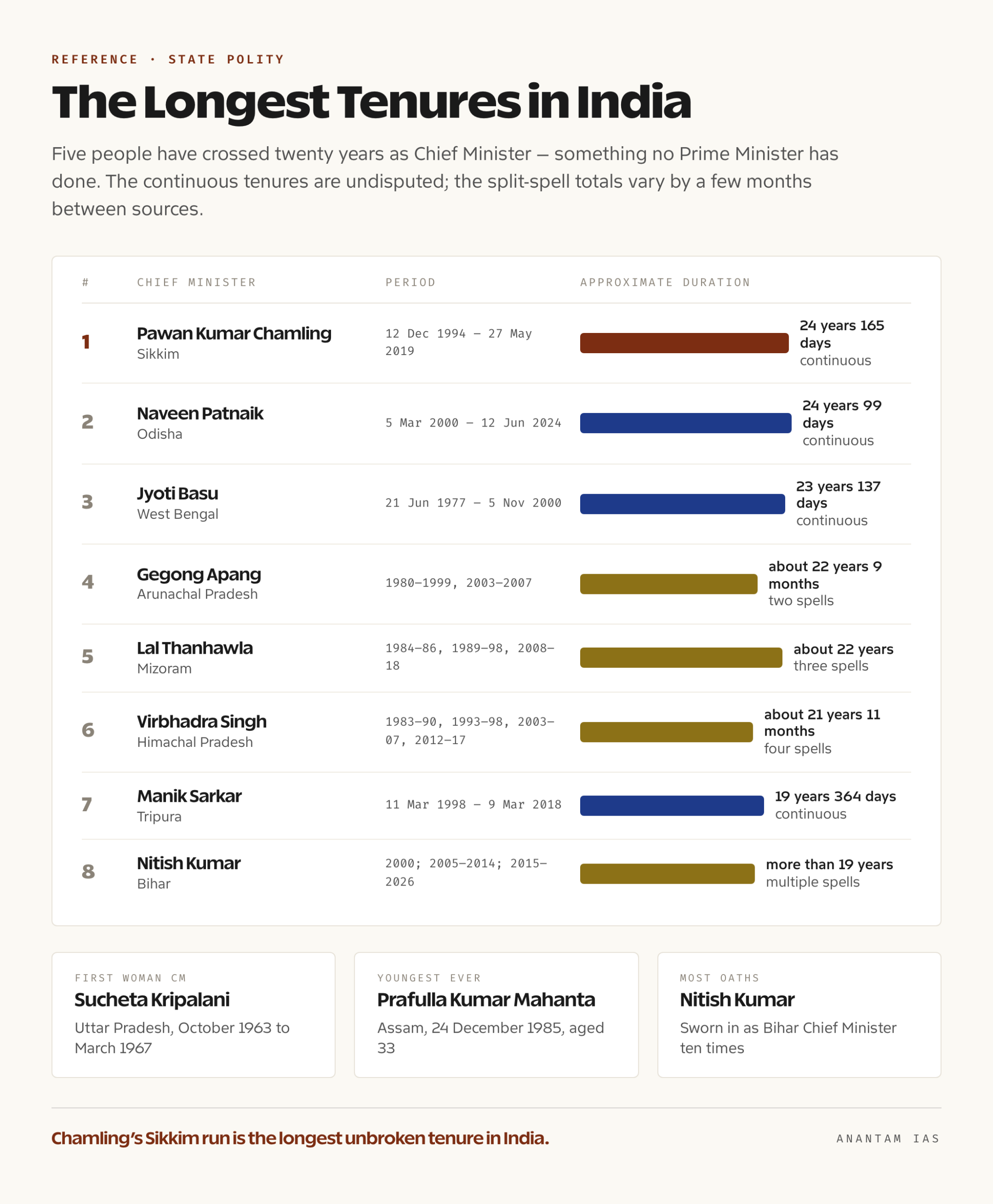
Long tenures are the norm rather than the exception at the top of this list — five people have crossed twenty years in the job, something no Prime Minister has done.
| # | Chief Minister | State | Period | Approximate Duration |
|---|---|---|---|---|
| 1 | Pawan Kumar Chamling | Sikkim | 12 Dec 1994 – 27 May 2019 | 24 years 165 days (continuous) |
| 2 | Naveen Patnaik | Odisha | 5 Mar 2000 – 12 Jun 2024 | 24 years 99 days (continuous) |
| 3 | Jyoti Basu | West Bengal | 21 Jun 1977 – 5 Nov 2000 | 23 years 137 days (continuous) |
| 4 | Gegong Apang | Arunachal Pradesh | 1980-1999, 2003-2007 | about 22 years 9 months (two spells) |
| 5 | Lal Thanhawla | Mizoram | 1984-86, 1989-98, 2008-18 | about 22 years (three spells) |
| 6 | Virbhadra Singh | Himachal Pradesh | 1983-90, 1993-98, 2003-07, 2012-17 | about 21 years 11 months (four spells) |
| 7 | Manik Sarkar | Tripura | 11 Mar 1998 – 9 Mar 2018 | 19 years 364 days (continuous) |
| 8 | Nitish Kumar | Bihar | 2000; 2005-2014; 2015-2026 | more than 19 years (multiple spells) |
Chamling’s run in Sikkim is the longest unbroken tenure any Chief Minister has managed — five consecutive assembly terms without a break. Patnaik’s Odisha record is only sixty-six days shorter and was also unbroken. Basu’s twenty-three years in West Bengal remains the longest for a Left Front government anywhere in India.
The cumulative totals for Apang, Thanhawla and Virbhadra Singh vary by a few months depending on which source you use, because each served in separated spells and the start and end dates of a couple of those spells are recorded differently. The continuous tenures — Chamling, Patnaik, Basu and Sarkar — are not disputed. Nitish Kumar’s case is unusual for a different reason: his cumulative time is close to twenty years, but it is spread across spells that include a seven-day government in March 2000, and he took the oath of office as Chief Minister ten times, a record no one else comes close to.
Firsts and Records Worth Knowing
First woman Chief Minister. Sucheta Kripalani, a freedom fighter and Constituent Assembly member, became Chief Minister of Uttar Pradesh in October 1963 and served until March 1967 — the first woman to head any state government in India.
Only serving woman Chief Minister. After the 2026 West Bengal result, Rekha Gupta of Delhi is the only woman holding the office among the 31. She took charge on 20 February 2025 and is Delhi’s fourth woman Chief Minister.
Youngest ever. Prafulla Kumar Mahanta became Chief Minister of Assam on 24 December 1985 at the age of 33, months after leading the Assam Movement and founding the Asom Gana Parishad.
Most Chief Ministers. Bihar has had the most individuals in the chair — 23 since 1946 — with Uttar Pradesh close behind at 22. Kerala, with 12 since 1957, has had the fewest among the large states, a reflection of its stable two-front alternation.
Most President’s Rule spells. Manipur has been placed under President’s Rule more often than any other state. The imposition of February 2025 was its eleventh spell. Uttar Pradesh follows with ten. By duration rather than count, Jammu & Kashmir has spent the longest under central rule — well over 4,600 days — followed by Punjab at roughly 3,900 days.
Most oaths. Nitish Kumar took the oath as Chief Minister of Bihar ten times between 2000 and 2025, more than anyone else in any state.
Newest party in office. The Tamilaga Vettri Kazhagam, founded in 2024, formed a government in Tamil Nadu in its very first election in 2026 — one of the fastest routes from party registration to a Chief Minister’s chair in Indian politics.
FAQ
How many Chief Ministers are there in India right now? There are 31 — one for each of the 28 states and one each for Delhi, Puducherry and Jammu & Kashmir, the three Union Territories with their own legislative assemblies. The other five Union Territories are run by Lieutenant Governors or Administrators and have no Chief Minister.
Which party has the most Chief Ministers? The Bharatiya Janata Party, with 17 of the 31. The Indian National Congress has four — Himachal Pradesh, Karnataka, Kerala and Telangana. Every other party in office has exactly one Chief Minister.
Who is the longest-serving Chief Minister in Indian history? Pawan Kumar Chamling of Sikkim, who served 24 years and 165 days without a break, from December 1994 to May 2019. Naveen Patnaik of Odisha is a close second at 24 years and 99 days.
Who was India’s first woman Chief Minister? Sucheta Kripalani, who headed the Uttar Pradesh government from October 1963 to March 1967.
How is a Chief Minister appointed? Under Article 164, the Governor appoints the Chief Minister. There is no separate election for the post — the Governor appoints the person who can command a majority in the legislative assembly, normally the leader chosen by the majority party or coalition. The Chief Minister must be a member of the state legislature within six months of taking office and stays in power only while the assembly’s confidence lasts.
Practice Questions
Practice MCQs
- Which Article of the Constitution provides for the appointment of the Chief Minister by the Governor? (a) Article 155 (b) Article 163 (c) Article 164 (d) Article 167 — Answer: (c) Article 164 states that the Chief Minister shall be appointed by the Governor and other ministers appointed on the Chief Minister’s advice.
- How many Union Territories in India have a Chief Minister? (a) Two (b) Three (c) Five (d) Eight — Answer: (b) Delhi, Puducherry and Jammu & Kashmir have legislative assemblies, so each has a Chief Minister; the remaining Union Territories are administered by Lieutenant Governors or Administrators.
- Who holds the record for the longest unbroken tenure as a Chief Minister in India? (a) Jyoti Basu (b) Naveen Patnaik (c) Pawan Kumar Chamling (d) Gegong Apang — Answer: (c) Chamling led Sikkim continuously for 24 years and 165 days between December 1994 and May 2019.
- Sucheta Kripalani, India’s first woman Chief Minister, headed the government of which state? (a) Uttar Pradesh (b) Bihar (c) Madhya Pradesh (d) Punjab — Answer: (a) She was Chief Minister of Uttar Pradesh from October 1963 to March 1967.
- The Jammu and Kashmir Reorganisation Act, which created a Union Territory with a legislature, came into force in which year? (a) 2017 (b) 2018 (c) 2019 (d) 2021 — Answer: (c) The Act came into force on 31 October 2019, and the first assembly election under the new arrangement was held in September and October 2024.
Tell Google you want more of this.
Add Anantam IAS as a preferred sourceOne tap, and this site shows up more often in your own Top Stories, AI Overviews and AI Mode. Remove it any time.