Civil Services Day is observed in India every year on 21 April to recommit the permanent executive to the ideals of integrity, dedication and citizen-centric service. The date marks Sardar Vallabhbhai Patel‘s historic speech of 21 April 1947 at Metcalfe House, Delhi, where he addressed the first batch of probationers of the newly created Indian Administrative Service and described the civil service as the “steel frame” of a free India.
The day is celebrated officially by the Department of Administrative Reforms and Public Grievances (DARPG), Ministry of Personnel, Public Grievances and Pensions, at Vigyan Bhawan, New Delhi, and is the occasion for the conferment of the Prime Minister's Awards for Excellence in Public Administration. For UPSC aspirants, Civil Services Day draws directly on GS Paper 2 (Civil services in a democracy) and GS Paper 4 (Ethics, Integrity and Aptitude).
The Historical Context: 21 April 1947
On 21 April 1947 — four months before Independence — Sardar Patel, then Member for Home Affairs in the interim government, addressed the probationers of the Indian Administrative Service at Metcalfe House, Delhi. The all-India services had been recast only months earlier, replacing the Indian Civil Service (ICS) with the IAS (and IPS).
Extracts from Patel's speech that have entered the lexicon of Indian administration:
- "The Service will have its share in the administration of India. You have to serve the country with detachment, integrity and impartiality."
- "I need hardly dilate on the value to the country of a clean, efficient and incorruptible administration."
- The famous description of the all-India services as the "steel frame" of the Indian Union.
Patel insisted that the new civil service would be the instrument of national integration, ensuring a single administrative culture across a diverse subcontinent. It was his intervention in the Constituent Assembly that led to the inclusion of Article 312 — the constitutional basis of the All-India Services.
Institutionalisation as Civil Services Day
The Government of India formally began observing 21 April as Civil Services Day from 2006, at the initiative of the Department of Administrative Reforms and Public Grievances (DARPG).
Objectives of the day:
- Recommit civil servants to the values of public service articulated by Patel.
- Recognise outstanding initiatives by officers at the district, state and ministry level.
- Create a forum for exchange of ideas on governance reforms.
- Signal the continuity of a merit-based, permanent, politically neutral civil service in a democratic polity.
Venue and Structure of the Celebration
The flagship event is held at Vigyan Bhawan, New Delhi, and is addressed by the Prime Minister, with participation from:
- Cabinet Secretary (ex-officio chair of the Civil Services Board).
- Secretaries to the Government of India.
- Chief Secretaries of States and UTs.
- District Magistrates / Collectors receiving awards.
- Retired civil servants, scholars and civil society figures.
The day includes:
- Prime Minister's keynote address.
- Panel discussions on governance innovations.
- Presentation of the Prime Minister's Awards for Excellence in Public Administration.
- Release of compendia of best practices.
Prime Minister's Awards for Excellence in Public Administration
Instituted in 2006, the Prime Minister's Awards are the highest recognition in Indian civil services. The framework has evolved through multiple revisions (notably in 2014 and 2020) to align with national flagship programmes.
Current structure (as revised):
| Category | Focus |
|---|---|
| Priority Programmes | Recognition for implementation of Aspirational Districts, PM Gati Shakti, PM Awas Yojana, Poshan Abhiyaan, etc. |
| Innovation — Central / State | District-level or department-level innovations |
| Aspirational Districts Programme | Best performing Aspirational Districts |
| Aspirational Blocks Programme | Best performing blocks (from 2023 onwards) |
| Swachh Bharat Mission | Sanitation achievements |
| Viksit Bharat | Outcomes aligned with the Viksit Bharat 2047 vision |
| Public Administration | Outstanding district administration |
Each awarded entity receives:
- A trophy, scroll and cash reward (Rs 10 lakh for district-level awards; Rs 20 lakh for organisations — amounts revised periodically).
- The cash award must be spent on public service improvements — not as personal remuneration.
Selection Process
The Awards are administered by DARPG. The selection process involves:
- Self-nomination by district collectors / implementing organisations on the dedicated portal.
- Scrutiny by Screening Committee.
- State / Central Ministry level verification.
- Expert Committee evaluation.
- Empowered Committee headed by the Cabinet Secretary finalises recommendations.
- Prime Minister approves and presents awards on 21 April.
Civil Services Day 2026
The 2026 edition falls on the 79th anniversary of Patel's 21 April 1947 address and marks two decades of formal celebration since Civil Services Day was first observed in 2006. In line with the Government of India's Viksit Bharat @ 2047 vision, the 2026 theme is centred on "Holistic Development — Saturation of Government Schemes", with particular emphasis on:
- Aspirational Districts and Blocks programme outcomes.
- Delivery of 17 priority interventions in education, health, nutrition, agriculture, drinking water and financial inclusion.
- Public-service innovation enabled by Digital Public Infrastructure (DPI) — Aadhaar, UPI, DigiLocker, e-Sign.
Note: Exact theme and awardee list for 2026 should be confirmed through the official DARPG press release closer to the date.
Civil Services Day vs National Civil Services Day
Both terms are used interchangeably. Some states and agencies add the prefix "National", but the Government of India Gazette notification and DARPG documentation use "Civil Services Day" as the official nomenclature.
Evolution of Indian Civil Services — A Timeline
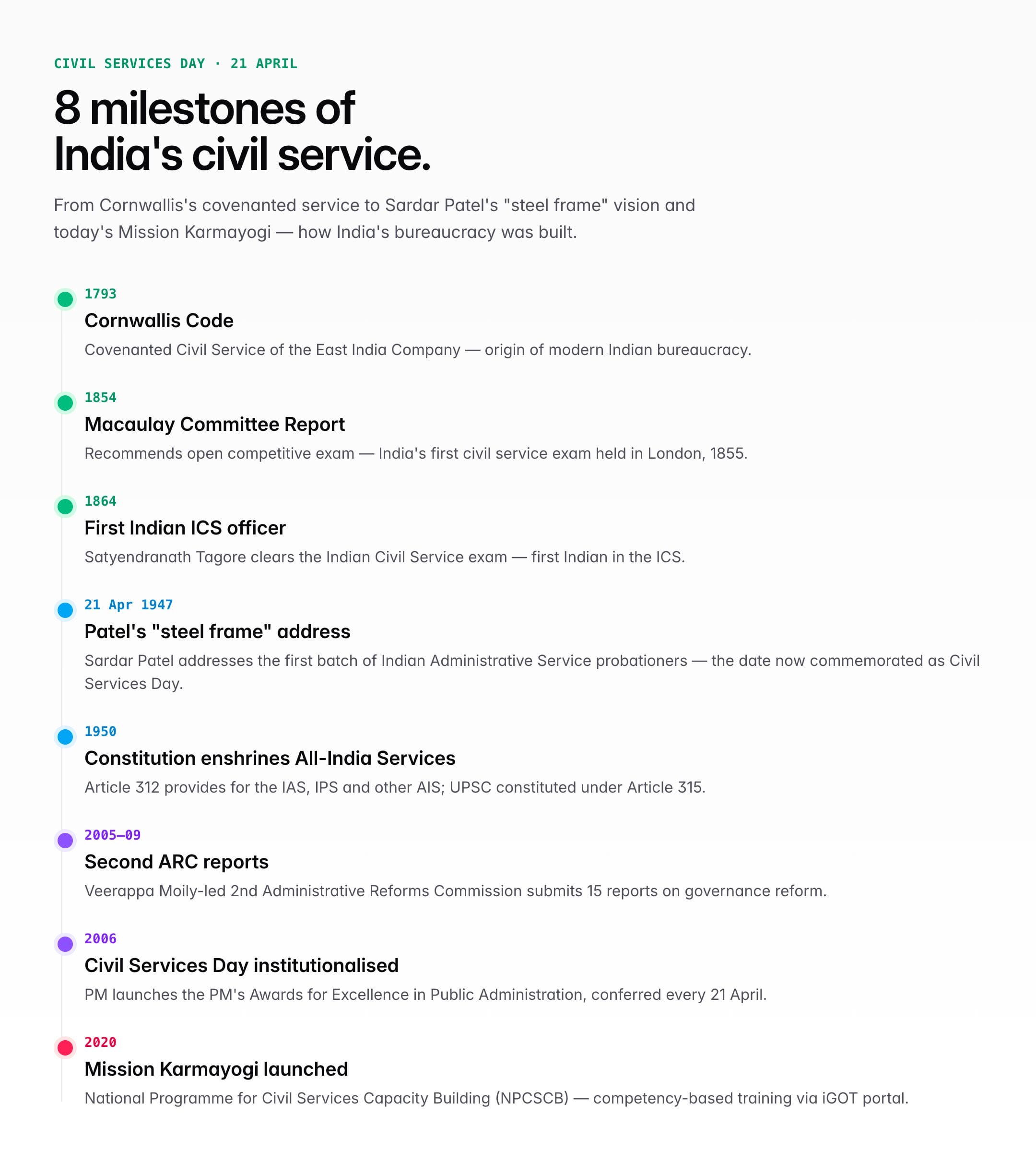
| Year | Landmark |
|---|---|
| 1854 | Macaulay Committee recommends open competition for ICS. |
| 1858 | Government of India Act; ICS under Crown. |
| 1922 | First ICS examination held in India (Allahabad). |
| 1946 | IFS constituted (9 October). |
| 1947 | Patel's "steel frame" speech to first IAS batch (21 April). |
| 1950 | IAS and IPS constituted under the new Constitution. |
| 1951 | All India Services Act enacted. |
| 1966 | Indian Forest Service (IFoS) constituted as the third AIS. |
| 2006 | First Civil Services Day observed; PM's Awards instituted. |
| 2014 | Awards restructured around priority programmes. |
| 2020 | Mission Karmayogi launched for civil services capacity building. |
| 2024 | Awards aligned with Viksit Bharat 2047 goals. |
Structure of Indian Civil Services
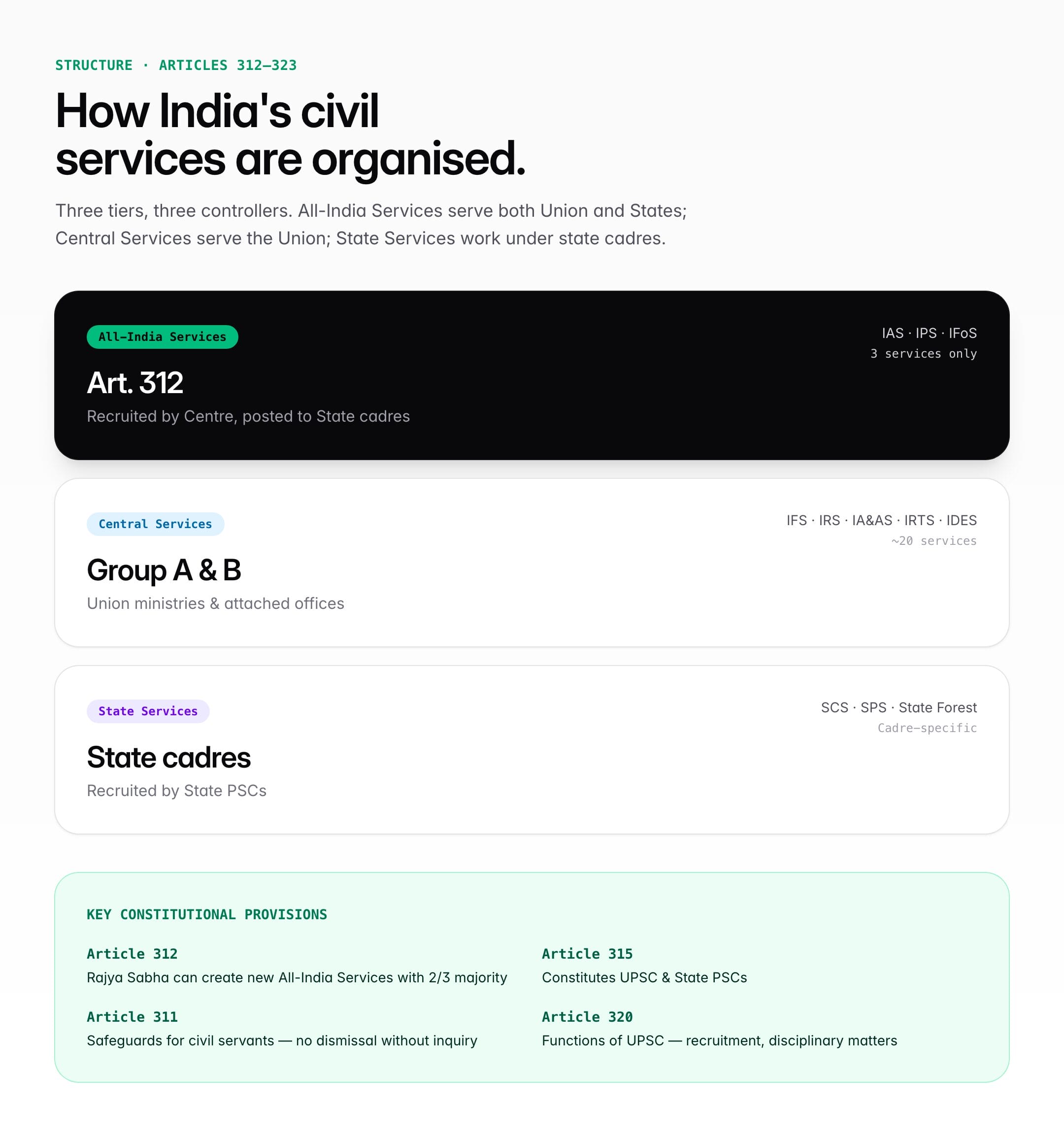
India’s civil services are organised in three broad tiers under Part XIV of the Constitution (Articles 308–323). The All-India Services occupy a unique position, serving both the Union and the States.
1. All-India Services (Article 312)
- Indian Administrative Service (IAS)
- Indian Police Service (IPS)
- Indian Forest Service (IFoS) — constituted 1966
New All-India Services can be created only on a Rajya Sabha resolution passed by 2/3 majority — a federal safeguard.
2. Central Services
Serve only the Union. Key services include IFS (diplomacy), IRS (Income Tax & Customs), IA&AS (CAG), IRMS (Indian Railway Management Service, unified from 2022), Indian Postal Service, and more.
3. State Services
Recruited by State Public Service Commissions under Article 315. Examples: State Civil Service (Deputy Collector), State Police Service (DySP), State Forest Service.
Significance for Indian Democracy
- Continuity across governments — civil services ensure policy implementation survives political change.
- Neutrality and anonymity — the Weberian ideal of an impartial bureaucracy.
- Generalist-specialist balance — IAS as generalists coordinating specialist services.
- Accountability — through RTI 2005, CVC, CAG, Lokpal (2013) and performance appraisals.
- Citizen-centric reforms — Citizens' Charters, Sevottam framework, Right of Citizens to Time Bound Delivery of Goods and Services legislation in several states.
Contemporary Reforms Linked to Civil Services Day
- Mission Karmayogi (2020) — competency-based training via iGOT Karmayogi platform; anchored by the Capacity Building Commission (CBC).
- Lateral entry — direct induction of domain specialists at Joint Secretary / Director levels since 2018.
- 360-degree appraisal for empanelment at Joint Secretary and Additional Secretary levels.
- E-Office, e-HRMS, SPARROW — digitised HR and file management.
- Saturation approach — ensuring every eligible beneficiary receives scheme benefits (PM's recurring theme on CSD).
Ethics and Aptitude Themes (GS 4)
Civil Services Day prompts reflection on values embedded in the Code of Conduct for Civil Servants and Second ARC recommendations:
- Integrity — moral and intellectual.
- Impartiality and neutrality.
- Objectivity in advice and action.
- Dedication to public service.
- Empathy, tolerance and compassion (Nolan Principles: selflessness, integrity, objectivity, accountability, openness, honesty, leadership).
UPSC Relevance
GS Paper 2 — Role of civil services in a democracy; accountability and ethical governance; citizen charters; transparency and accountability; e-governance.
GS Paper 4 — Probity in governance; foundational values for civil service — integrity, impartiality, non-partisanship, objectivity, dedication to public service, empathy.
Essay paper — "The steel frame in a democratic India"; "Ethics in public life".
Key Prelims facts:
- Civil Services Day: 21 April (annually).
- First observed: 2006.
- Origin: Sardar Patel's speech at Metcalfe House, Delhi, on 21 April 1947.
- Venue: Vigyan Bhawan, New Delhi.
- Nodal department: DARPG, Ministry of Personnel, Public Grievances and Pensions.
- Prime Minister's Awards for Excellence in Public Administration: instituted in 2006; restructured in 2014 and 2020.
- Constitutional basis of All-India Services: Article 312.
- Mission Karmayogi: launched 2 September 2020.
- Capacity Building Commission: apex body for civil service training reform.
Tell Google you want more of this.
Add Anantam IAS as a preferred sourceOne tap, and this site shows up more often in your own Top Stories, AI Overviews and AI Mode. Remove it any time.