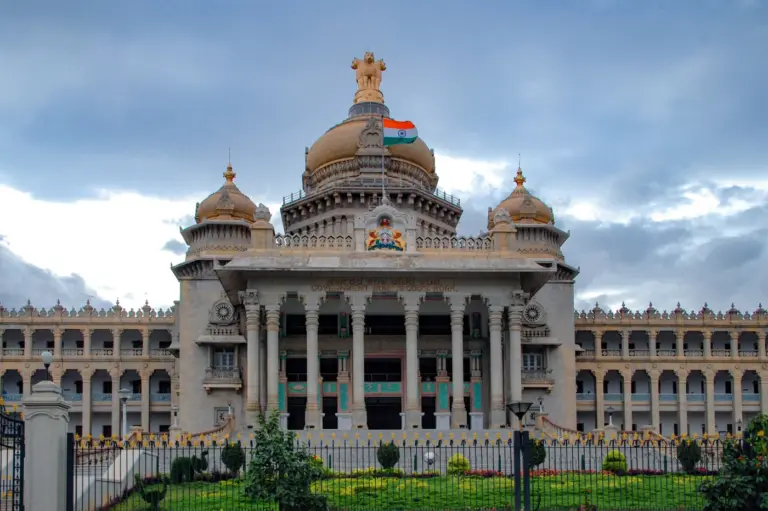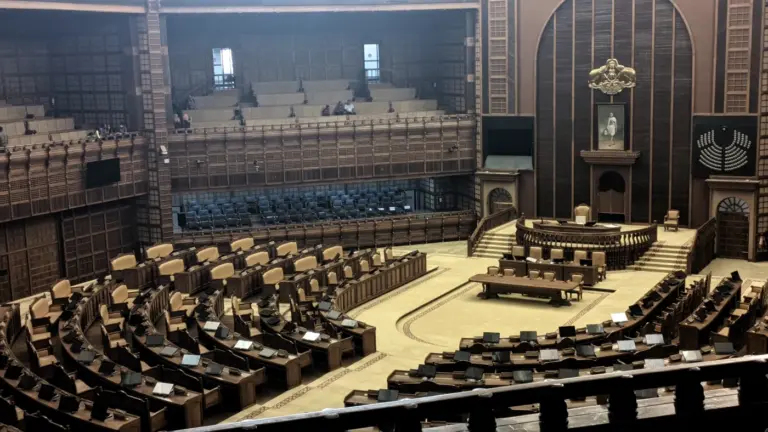
After a decade of single-party majority rule, the 2024 Lok Sabha elections returned India to coalition politics. The BJP could not repeat its 2014 and 2019 majorities; a government was formed with the support of NDA partners, especially the TDP and JD(U). For UPSC Polity, coalition politics is a recurring mains topic that blends constitutional design (parliamentary system), political history (seven phases), and governance outcomes (stability vs representation).
About Coalition Politics
- The term "coalition" is derived from the Latin word coalitio, meaning "to grow together."
- When several political parties join hands to form a government and exercise political power based on a common agreed programme, we describe the system as coalition politics or coalition government.
- Coalitions usually occur in modern parliaments when no single party can muster a majority of votes.
- Two or more parties who have enough members between them to form a majority may agree on a common programme that does not require too many compromises with their individual policies.
- A coalition denotes a cooperative arrangement in which distinct political parties — or at least members of such parties — unite to form a government or ministry.
Features of Coalition Politics
Political scientist J.C. Johari summarised coalition politics as follows:
- It is a phenomenon of multi-party government where several minority parties join hands to run the government.
- A coalition is formed when splinter groups in a House agree to sink their broad differences and form a majority.
- Coalitions are formed for some reward — material or psychic.
- A coalition implies the existence of at least two partners.
- The underlying principle is the temporary conjunction of specific interests.
- Coalition politics is not static but dynamic — coalition players and groups dissolve and form new ones.
- The keynote is compromise; rigid dogma has no place.
- A coalition government works based on a minimum programme — which may not be ideal for each partner.
- Pragmatism, not ideology, is the mark of coalition politics.
- The purpose of coalition is to seize power.
Pre-Poll vs Post-Poll Coalitions
| Type | Meaning | Implication |
|---|---|---|
| Pre-poll coalition | Parties form an alliance before the election and campaign jointly | Voter can choose the combination; joint manifesto is presented |
| Post-poll coalition | Parties come together after election results are announced | Typically when no party secures an outright majority |
Pre-Poll Coalition
A pre-poll alliance is a political arrangement where two or more parties agree to cooperate and support each other before an election. The alliance aims to:
- Improve chances of winning by consolidating votes.
- Avoid vote-splitting.
- Present a united front against common opponents.
Pre-poll coalitions are considered considerably advantageous because they provide a common platform to woo the electorate based on a joint manifesto. The Sarkaria Commission gave first preference to pre-poll alliances in its hung-assembly guidelines.
Post-Poll Coalition
A post-poll alliance is a political arrangement where parties cooperate and form a coalition after the election results are announced. Usually formed when:
- No single party secures an outright majority.
- Collaboration is needed to achieve the numbers required to govern.
Post-election unions enable constituents to share political power and run the government.
Coalition Politics in India: Seven Phases
Phase 1: 1947-1967 — The Congress System
- Indian politics was coalitional in nature — but within the Congress party.
- Political scientists Rajni Kothari, Morris Jones, and Myron Weiner developed a theoretical model of the "one-party dominant system" or "Congress system."
- Rajni Kothari highlighted consensual politics based on pluralism, accommodation, and bargaining within Congress.
- The Congress absorbed diverse interests and served as an umbrella coalition within a single party.
Phase 2: 1967-1977 — Coalitions at the State Level
- Non-Congress opposition parties formed coalitions in 9 states.
- Morris Jones called this a "market polity" leading to a "pretty regular and continuous defectors' market."
- Divergent ideologies helped win elections by providing a mass base, but led to crises in governance.
- This phase gave rise to the Anti-Defection Law debates that eventually produced the 10th Schedule in 1985.
Phase 3: 1977-1979 — The First Non-Congress Coalition at the Centre
- The Emergency (1975-77) led to the defeat of Congress in the 1977 Parliamentary as well as state Assembly elections (in six states).
- The introduction of populist, bureaucratic, and authoritarian modes of politics in Congress had led to the Emergency — which became the reason for the debacle of Congress.
- The Janata Party coalition took power but collapsed within two-and-a-half years due to internal contradictions.
Phase 4: 1980-1989 — Decline of Coalition Politics
- The failure of the Janata coalition gave an opportunity to Congress — recovering from the 1978 split under Indira Gandhi — to capture power in 1980.
- Congress received a massive victory in the 1984 general elections (Rajiv Gandhi wave).
- For a decade, coalition politics came to an end at the Centre; it continued at the state level.
Phase 5: 1989-1999 — Decade of Instability
- Further decline of coalition politics, with immature coalitions leading to:
- Hung assemblies
- Minority governments at the Centre
- Rise of bipolar regional politics at state assemblies
- Seven Prime Ministers in ten years — V.P. Singh, Chandrashekhar, P.V. Narasimha Rao, Deve Gowda, I.K. Gujral, Vajpayee (13 days), Vajpayee (13 months).
- Regional parties became king-makers.
Phase 6: 1999-2014 — Mature Coalitions
- Stable coalitions: The NDA (1999-2004) under Vajpayee and the UPA I (2004-09) and UPA II (2009-14) under Manmohan Singh.
- Common Minimum Programmes became standard.
- Coordination committees and unofficial "super-cabinets" emerged.
- Regional parties institutionalised their role at the Centre.
Phase 7: 2014-2024 — Return of Single-Party Dominance
- 2014: BJP won 282 seats — first single-party majority in 30 years.
- 2019: BJP won 303 seats — reinforced dominance.
- Coalition existed (NDA), but since BJP had its own majority, it was not dependent on coalition partners to fulfil its manifesto.
- Not committed to a Common Minimum Programme.
Phase 8: 2024 Onward — Coalition Returns
- 2024 Lok Sabha: BJP won 240 seats — 32 short of a majority.
- Government formed with TDP, JD(U), and other NDA partners.
- Return of coalition bargaining: Andhra Pradesh special package, Bihar special status demands, cabinet portfolio negotiations.
- Common Minimum Programme-style governance has returned in a muted form.
Merits and Demerits of Coalition Government
Merits
| Merit | Explanation |
|---|---|
| Accommodation of diverse interests | Coalitions channel expectations and redress grievances of different groups — India's cultures, languages, castes, religions, and ethnic groups all find representation |
| Broader representation | Reflects popular opinion of the electorate more fully than single-party government |
| Consensus-based decision-making | Governmental policy requires the concurrence of all coalition partners — leading to more deliberation |
| Strengthens federalism | Coalition governments are more sensitive and responsive to regional demands |
| Checks tyranny | Reduces domination of a single party; balanced decisions |
Demerits
| Demerit | Explanation |
|---|---|
| Instability | Policy differences among coalition partners can cause collapse of the government |
| Constrained PM leadership | The PM must consult coalition partners before major decisions — described as "Super PM" or "Ultra PM" situation |
| Steering Committee as Super-Cabinet | Coordination committees can undermine the Cabinet's role |
| King-maker risks | Smaller constituents may demand more than their strength warrants |
| Regional factors in national decisions | Regional leaders pressure the central executive — threaten coalition withdrawal |
| Jumbo Ministry | Large Council of Ministers (e.g., Vajpayee cabinet 1999 had 70+ ministers) — portfolio distribution becomes difficult |
| Diffused responsibility | Blame games; escape from both collective and individual responsibility |
Latest Developments (2024-26)
- June 2024: 18th Lok Sabha — NDA formed government with coalition support.
- TDP (N. Chandrababu Naidu) and JD(U) (Nitish Kumar) emerged as pivotal coalition partners.
- Cabinet allocation reflected coalition bargaining.
- Budget 2024 included special packages for Andhra Pradesh and Bihar — reflecting regional-coalition priorities.
- Waqf (Amendment) Bill and other contentious legislations saw Opposition plus some coalition partners push back — demonstrating legislative bargaining.
Updated context: Coalition politics has returned as a defining feature of Indian governance, potentially reshaping policy-making, portfolio distribution, and centre-state dynamics through the rest of the decade.
UPSC Relevance
GS-II mapping: Parliament and State legislatures — functioning; appointment and functioning of government; separation of powers; federalism.
Prelims bullets:
- Coalition = Latin coalitio ("to grow together").
- Rajni Kothari — Congress system / one-party dominant system.
- Pre-poll vs post-poll alliance.
- NDA (1999), UPA (2004), NDA-3 (2024).
- Common Minimum Programme (CMP) — key feature of coalition governance.
Mains angles:
- Trace the evolution of coalition politics in India across its seven/eight phases.
- "Coalition politics strengthens federal fabric but weakens governance." Discuss.
- Examine the merits and demerits of coalition government with reference to recent Indian experience.
- How does the 2024 election mark a return to coalition politics and what are its implications for policy-making?
Tell Google you want more of this.
Add Anantam IAS as a preferred sourceOne tap, and this site shows up more often in your own Top Stories, AI Overviews and AI Mode. Remove it any time.