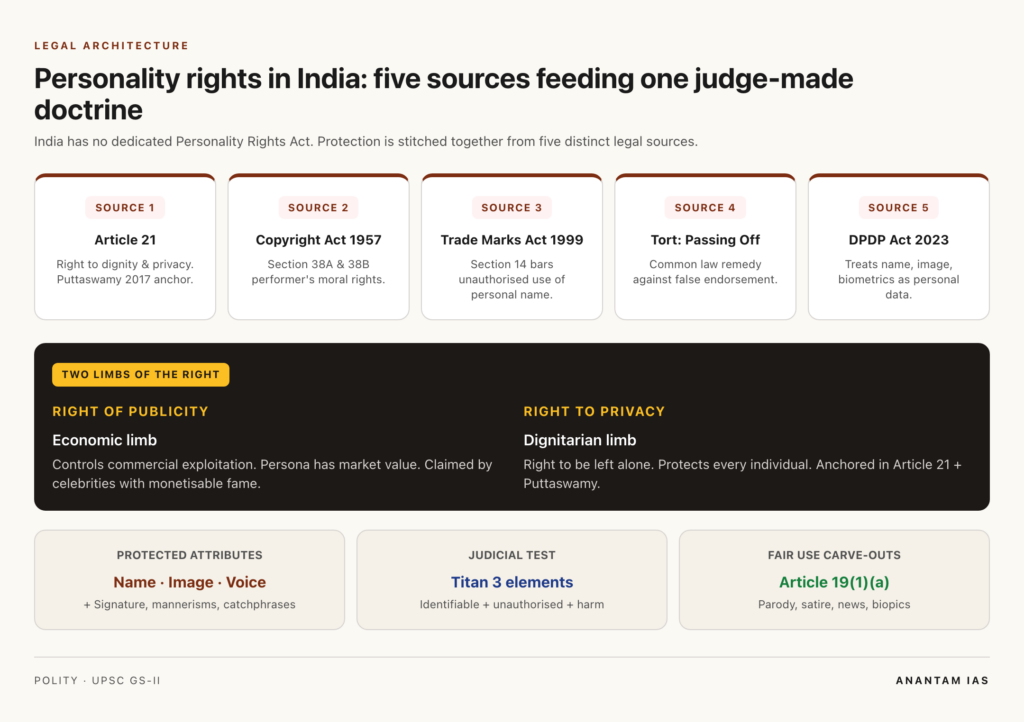
The Delhi High Court has, in the last twenty four months, transformed personality rights from a niche tort into a frontline shield for famous Indians. Anil Kapoor secured a sweeping injunction in September 2023 against unknown defendants morphing his face into AI generated GIFs. Jackie Shroff followed in May 2024 with protection for “Bhidu,” “Jaggu Dada” and his trademark gravelly voice. Amitabh Bachchan, Rajinikanth, Karan Johar and the Sushant Singh Rajput estate have all knocked at the same door. Together, these orders draw the contours of an Indian right to publicity that is still, formally, judge made.
What makes the moment so consequential is technology. Generative AI can clone a Bollywood voice in twelve seconds. Diffusion models can place a star in any frame. Unauthorized merchandise riding on a catchphrase can be drop shipped from a dozen jurisdictions inside a weekend. India, unlike the United States, has no dedicated Personality Rights Act. The law that protects you is therefore stitched together from Article 21, the Copyright Act, the Trade Marks Act, common law torts and a fast growing body of case law. This guide unpacks every thread, ranks the traps that show up in UPSC Prelims and Mains, and shows where the doctrine is heading next.
Quick Facts: Personality Rights at a Glance
- Statutory status: India has no dedicated Personality Rights Act. The right is judge made.
- Constitutional anchor: Article 21, read with the right to privacy recognised in Justice K.S. Puttaswamy (2017).
- Two limbs: a Right of Publicity that protects commercial value, and a Right to Privacy that protects dignity.
- Statutory hooks: Section 38A and 38B of the Copyright Act 1957, Section 14 of the Trade Marks Act 1999, plus the common law tort of passing off.
- Article 19(1)(a) carve outs: satire, parody, news reporting, biopics based on public records.
- Landmark recent order: Anil Kapoor vs Simply Life India (Delhi HC, 2023) restraining AI morphing, deepfake GIFs and unauthorized merchandise.
- Common trap: the Digital Personal Data Protection Act 2023 does not codify personality rights as such, it protects personal data.
What Are Personality Rights
Personality rights are the bundle of legal interests that allow an individual to control how the distinctive features of their identity are used by others, particularly for commercial gain. The protected attributes are wider than most candidates assume. They include the obvious markers, name, photograph, image, signature and voice, but also extend to mannerisms, gait, costume choices, catchphrases, gestures and any trait that the public has come to associate with that one person.
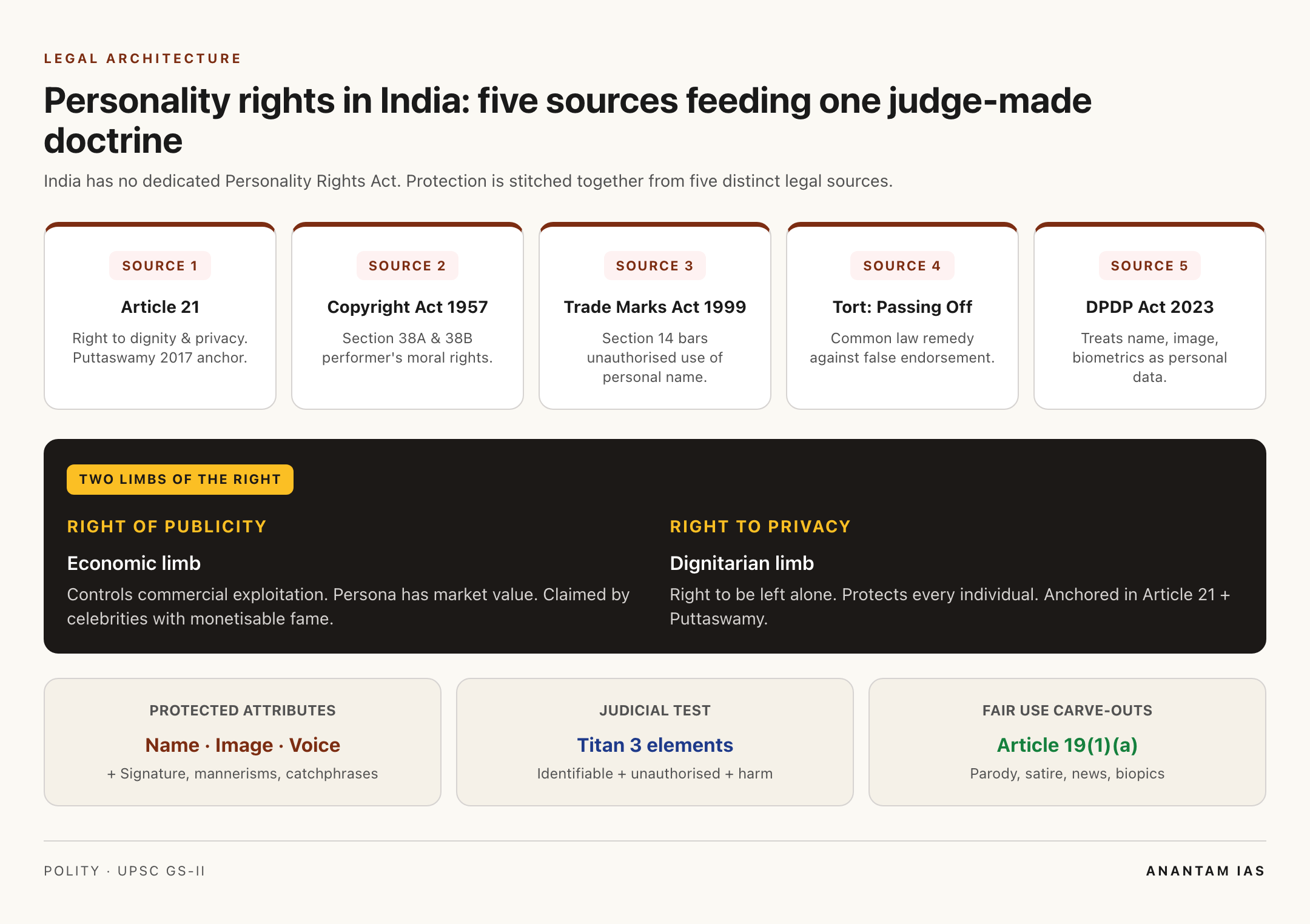
The doctrine has two analytically distinct components. The Right of Publicity is the economic limb. It says that a celebrity’s persona has market value, and that monetising it without consent amounts to unjust enrichment. The Right to Privacy is the dignitarian limb. It says that even where no money is at stake, an individual should not have her likeness paraded in public without her say so. Both limbs are needed because a single misuse can wound on both fronts. A morphed video that puts a film star into a pornographic clip damages dignity and steals commercial control of her persona simultaneously.
Background and Historical Context
Personality rights are an old idea wearing new clothes. Roman law recognised an actio iniuriarum to protect a person’s standing. English common law slowly absorbed similar protection through defamation and passing off. The American breakthrough came in 1953 with Haelan Laboratories vs Topps Chewing Gum, where the Second Circuit recognised a transferable right of publicity in the photographs of baseball players. By the 1980s most US states had codified the doctrine, with Tennessee leading on post mortem rights through its Elvis Act.
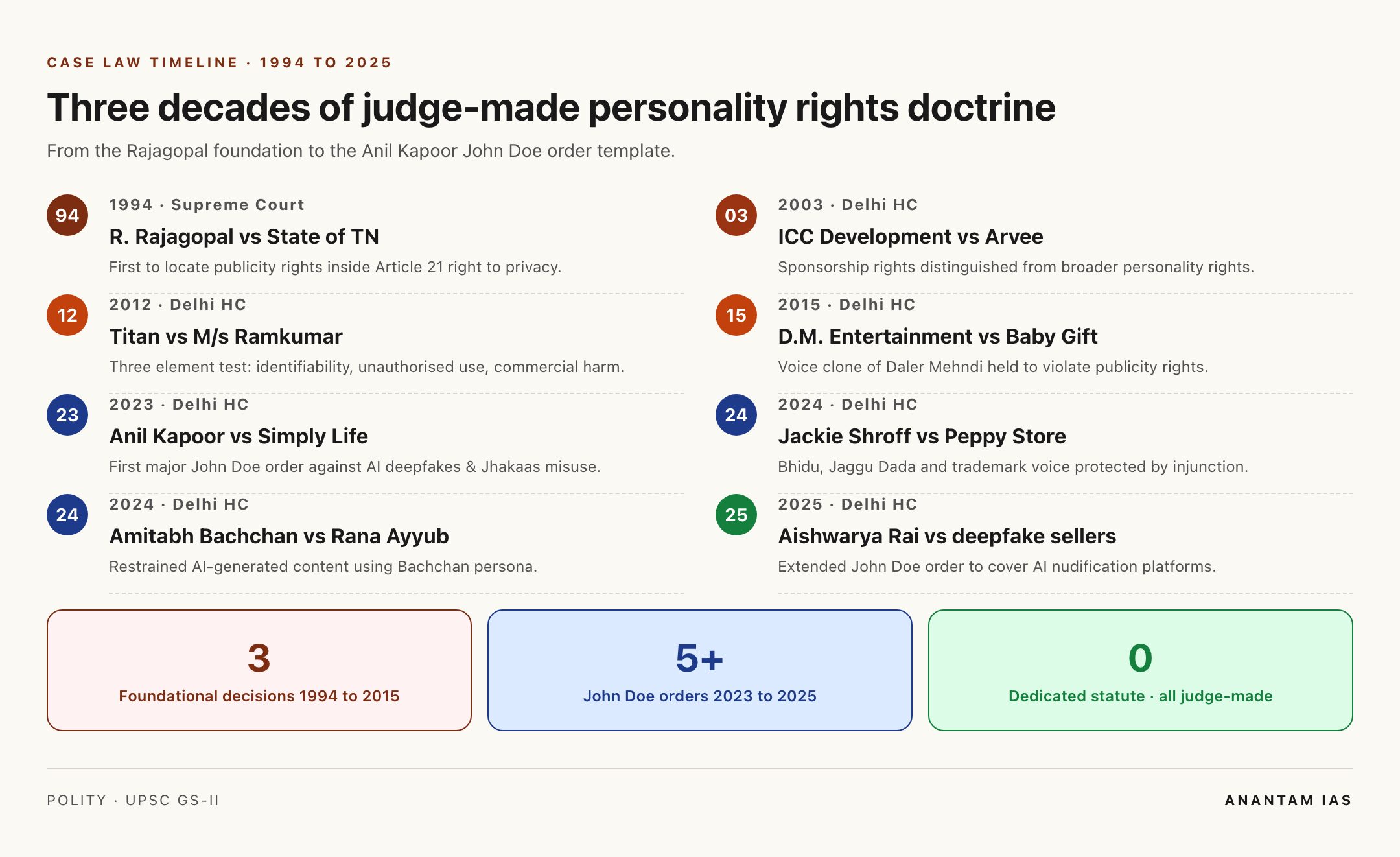
India travelled a different path. Until the 1990s, courts dealt with celebrity grievances under defamation, breach of confidence or passing off. The intellectual leap came in R. Rajagopal vs State of Tamil Nadu in 1994, where the Supreme Court located a right to control one’s own life story inside Article 21. Titan Industries vs M/s Ramkumar Jewellers in 2012 then gave the doctrine its modern Indian shape, holding that personality rights subsist in any person whose identity has acquired such public recognition that it can be commercially exploited. Justice Puttaswamy in 2017 reinforced the foundation by elevating privacy to a fundamental right. The current John Doe order wave is the harvest of those three decisions, not a sudden invention.
Key Provisions and Sources of the Right
Because there is no single codifying statute, the practitioner has to layer five sources to build a full case.
Article 21 of the Constitution, post Puttaswamy, supplies the dignity and informational privacy core. It is the basis for restraining deepfakes that injure reputation even where no commercial use is shown.
Section 38A and 38B of the Copyright Act 1957 create moral rights for performers. Section 38B specifically gives a performer the right to be identified and to object to distortions or modifications that would prejudice reputation. After the 2012 amendment these rights cover live performances and any recording made of them, and they survive for the lifetime of the performer.
Section 14 of the Trade Marks Act 1999 prohibits the registration of a name that falsely suggests a connection with a living person, or with a person whose death occurred in the last twenty years, without the written consent of the person concerned or her legal representatives. This is the statutory hook that lets celebrities oppose merchandise and sound alike trademarks.
The common law tort of passing off travels alongside, allowing an injunction where a defendant misrepresents that goods or services are endorsed by, or associated with, a celebrity. Damages and account of profits both flow from this remedy.
The Digital Personal Data Protection Act 2023 does not codify personality rights as such, but it does treat name, image and biometric data as personal data. Once the Act is operational, processing those identifiers without lawful basis triggers separate compliance liability.
Why Personality Rights Matter
The stakes have changed in three quick steps. First, the Indian celebrity economy is now worth more than thirty thousand crore rupees a year across endorsements, brand collaborations and merchandise. Second, generative AI has made impersonation cheap and convincing. Third, social platforms reach a viewer in any pin code in seconds, so a single deepfake can dent both reputation and earnings before legal process even begins. A robust personality rights doctrine is therefore not a niche entertainment law concern. It is part of the wider constitutional architecture that secures dignity, autonomy and informational self determination, the same architecture you encounter in our fundamental rights deep dive and in the right to privacy material.
For the state, the doctrine matters because it sets the limits of free speech in a high speed media environment. For markets, it determines what a brand can build on without permission. For individuals, including non celebrities, it shapes the remedies available when a face or voice is misused.
Detailed Analysis: The John Doe Order Mechanism
The most striking enforcement device of the last two years is the John Doe injunction. A John Doe order, also called an Ashok Kumar order in Indian usage, is an interim injunction that runs against unknown defendants. The plaintiff names whoever is identifiable and adds John Doe and Jane Doe slots for whoever turns up later. Courts grant these orders when the plaintiff shows that the violations are scattered across many anonymous online accounts and that traditional individual suits would be futile.
The Anil Kapoor order of September 2023 set the template. The actor placed before the court a long list of websites selling NFT collections of his image, AI generated explicit GIFs, fake autograph merchandise and morphed videos using his catchphrase Jhakaas. The court restrained named defendants and any other unknown person from using his name, image, voice, the catchphrase, the manner of dialogue delivery and even his signature pose. Domain registrars were directed to block access. Google was asked to take down infringing content under safe harbour rules. The order has since been used as a model for Jackie Shroff and Amitabh Bachchan.
The judicial doctrine that anchors these orders is the Titan three element test, refined in Indian decisions. The plaintiff must show, first, that her identity is identifiable from the impugned use, second, that the use is unauthorised, and third, that the use causes commercial loss or reputational damage. Courts have read these elements generously, accepting voice clones, AI deepfakes and ambiguous likenesses as identifiable.
Comparative Framework: India, USA and the Post Mortem Question
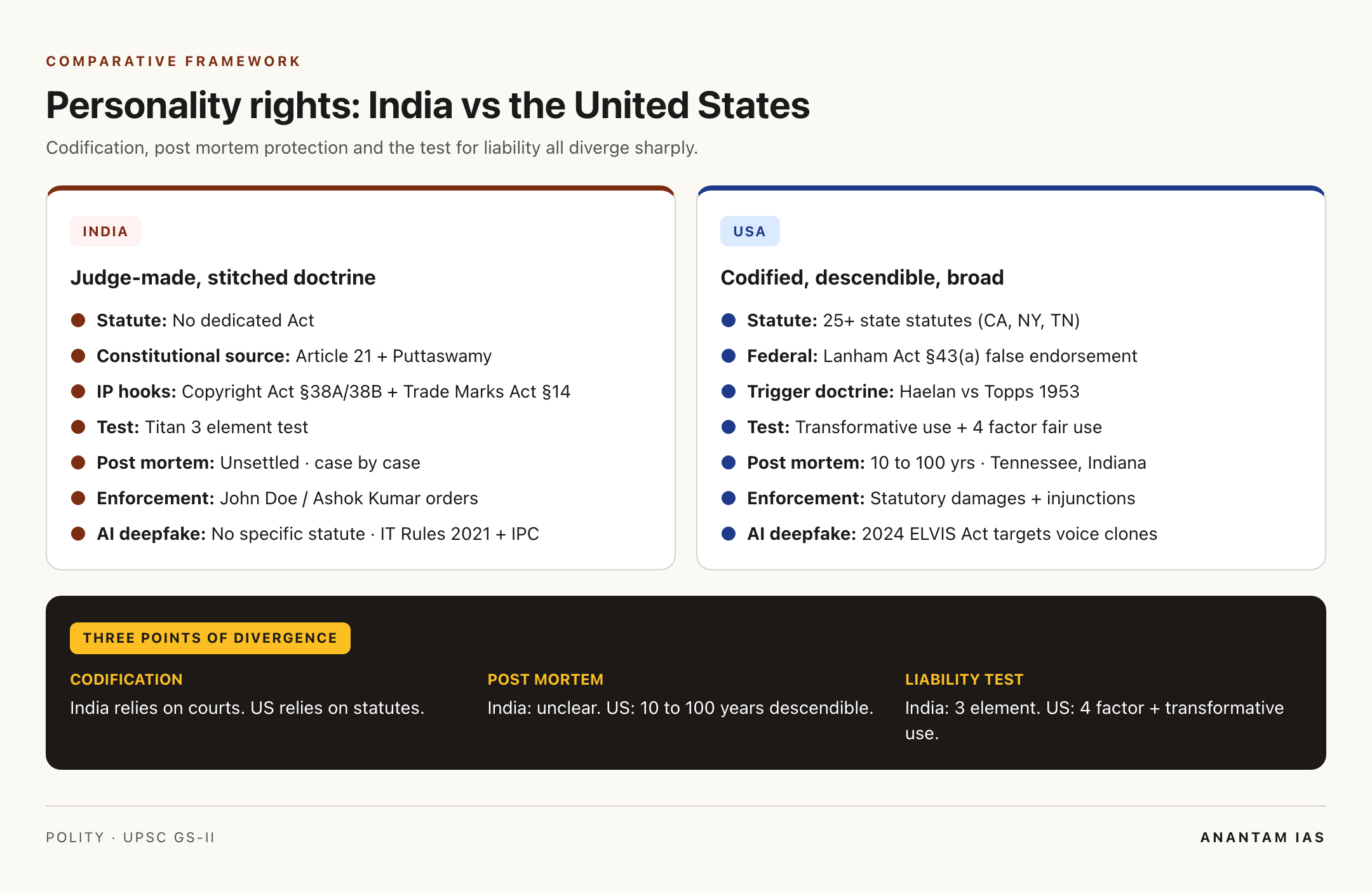
India and the United States diverge sharply on three points that often appear in IPR comparison questions.
The first difference is statutory codification. The United States has state level publicity rights statutes in California, New York, Tennessee, Indiana, Ohio and a dozen other states, plus the federal Lanham Act for false endorsement claims. India relies on judicial creativity and stitched together statutes.
The second is post mortem protection. Tennessee’s original Elvis Act of 1984 made publicity rights descendible for ten years after death, extendable as long as the persona is commercially exploited. The 2024 ELVIS Act amendment specifically targets AI voice clones. Indiana provides protection for one hundred years after death. India has no clear answer. Some High Court orders have protected the heirs of Sushant Singh Rajput against unauthorised biopics on a privacy and dignity reasoning, while other orders, like the Justice for Krishna Kumar Kunnath case for KK’s family, have struggled with the lack of statutory backing. The position remains contested.
The third is the test for liability. American courts apply the four factor fair use test from copyright, plus the transformative use test from Comedy III Productions. Indian courts use the three element Titan test plus the fair dealing exceptions in the Copyright Act, which are narrower and more enumerated.
Challenges and Criticism
The Indian framework attracts three substantive criticisms. The first is doctrinal incoherence. Stitching personality rights together from Article 21, the Copyright Act and the Trade Marks Act produces a doctrine that is hard to predict and easy to game. Defendants can argue that Article 21 covers only state action, that Section 38B applies only to performers in audio visual works, and that passing off requires proof of misrepresentation. Each defence pulls the rug from under a different limb of the right.
The second is a free speech worry. Sweeping John Doe orders that block whole domains can chill legitimate satire, parody and news commentary. Article 19(1)(a) protects the right to criticise public figures. When a court restrains the use of a celebrity’s image in any unauthorised manner, the order can sweep in editorial cartoons, political memes, journalism on public conduct and academic study. The Delhi High Court has tried to handle this by carving out fair use, but the boundaries remain blurry.
The third is enforcement friction. Even where an order is in place, removing AI generated content from offshore servers requires cooperation from intermediaries, registrars and hosting providers spread across jurisdictions. The IT Rules 2021 give some leverage, but the loop between order and takedown is long, especially when content reappears on mirror domains within hours.
Prelims Pointers
- Personality rights in India are judge made; there is no dedicated statute.
- The constitutional source is Article 21 read with the right to privacy from Puttaswamy.
- The right has two limbs: Right of Publicity (commercial) and Right to Privacy (dignitarian).
- Section 14 of the Trade Marks Act 1999 prohibits using a personal name in a mark without consent.
- Sections 38A and 38B of the Copyright Act protect performers, including moral rights.
- A John Doe or Ashok Kumar order is an injunction against unknown defendants.
- The Titan test asks: identifiability, unauthorised use, and commercial or reputational damage.
- Article 19(1)(a) carve outs include parody, satire, news reporting and biopics on public records.
- The DPDP Act 2023 protects personal data, not personality rights as such.
- Post mortem personality rights are unsettled in India, unlike the US Elvis Act regime.
Mains Practice Questions
- The right to publicity in India has expanded faster than the statute book. Critically examine the constitutional and intellectual property foundations of personality rights with reference to recent Delhi High Court orders. (GS Paper 2, 250 words)
- Generative AI has weaponised likeness misuse on an industrial scale. Suggest a regulatory architecture that balances personality rights with the freedom of speech under Article 19(1)(a). (GS Paper 2, 250 words)
- Compare the Indian fair dealing carve outs with the American transformative use doctrine in the context of personality rights. Which framework better serves a democratic public sphere? (GS Paper 2, 150 words)
- Discuss whether personality rights should be made descendible in India. Refer to the experience of the Tennessee Elvis Act and the implications for Indian celebrity estates. (GS Paper 2, 150 words)
Way Forward
A coherent reform agenda would do three things. Parliament should consider a standalone Personality Rights Act that defines the protected attributes, sets out clear fair use exceptions covering satire, news and academic study, and resolves the post mortem question with a fixed term. The Ministry of Electronics and Information Technology should issue specific deepfake rules under the IT Act with notice and takedown timelines tighter than the current 36 hour window. Finally, courts should publish a model John Doe order template that builds in safeguards for legitimate speech, including a sunset clause and an opt out mechanism for journalism and parody.
Until that legislative reform arrives, the Delhi High Court’s John Doe order line will continue to do the heavy lifting. The doctrine is workable but precarious. The next deepfake controversy, and there will be one, will test whether Article 21 alone can carry the weight that fast moving technology is loading onto it.
Frequently Asked Questions
Are personality rights a fundamental right in India?
Personality rights themselves are not listed as a fundamental right. The dignitarian limb is, however, an aspect of Article 21 read with Puttaswamy on privacy. The publicity limb is a common law and statutory right that draws on Article 21 indirectly.
Can a non celebrity claim personality rights?
Yes for the privacy limb, no in practice for the publicity limb. Every individual has the right not to have her image misused, but the right of publicity assumes a persona with monetisable fame, which is rarely available to ordinary citizens.
What is a John Doe order?
It is an interim injunction that runs against unknown defendants, allowing the plaintiff to add specific names later. Indian courts also call it an Ashok Kumar order. The Anil Kapoor 2023 order is the leading recent template.
Does the Digital Personal Data Protection Act 2023 cover personality rights?
It does not codify personality rights, but it protects personal data, which includes name, photograph and biometric data. Processing such data without lawful basis can attract DPDP penalties on top of any personality rights remedy.
What happens to personality rights after death?
The Indian position is unsettled. Some High Courts have protected heirs against unjust enrichment, others have refused to extend the right beyond death. Statutory clarity is needed.
Is mimicry a violation of personality rights?
Generally no, if the mimicry is parody or satire that does not deceive the public into believing the celebrity has endorsed the product. Commercial mimicry that creates a false endorsement, however, can attract passing off liability.
Can a brand use a celebrity catchphrase without consent?
No. The Anil Kapoor order specifically restrained third parties from using Jhakaas in a commercial context. Catchphrases that are publicly identified with a person are now treated as part of the persona.
Which forum hears personality rights cases?
In practice the Delhi High Court hears most cases because of the residence of major celebrities and the willingness of the Court to grant John Doe orders. The Bombay and Madras High Courts have also issued similar injunctions.
How long does protection last?
For living persons, throughout life. Performers’ moral rights under Section 38B run for the lifetime of the performer. Post mortem protection is judicially recognised on a case by case basis but lacks statutory anchoring.
Are deepfakes a separate offence?
Not yet under a dedicated statute. They are usually pursued as a combination of personality rights infringement, defamation, IT Act offences under Sections 66E and 67, and any applicable provision of the Bharatiya Nyaya Sanhita.
Tell Google you want more of this.
Add Anantam IAS as a preferred sourceOne tap, and this site shows up more often in your own Top Stories, AI Overviews and AI Mode. Remove it any time.