UPSC CSE 2026 Essay Paper Discussion

Daily Digest · Friday

12 December 2025 Current Affairs for UPSC

2 current affairs published on Friday, 12 December 2025

12 December 2025 Current Affairs for UPSC — every Why-in-News article AnantamIAS published on Friday, 12 December 2025, broken down with Why in News?, the exact GS paper it feeds, sub-topic mapping, MCQ-ready facts and a UPSC-style practice question. 2 articles in total, covering Polity, Economy, Environment, S&T, IR, Geography, History, Society and Internal Security — the same Why-in-News + GS-paper-mapping + practice-question format the Compass uses across every daily digest on the site.

Daily current affairs for UPSC is where new material enters your prep stream. Read this 12 December 2025 digest end-to-end in 25–35 minutes, attempt the practice question at the foot of each article (it's MCQ for some, 10/15-marker for others), then bookmark the entries that fall inside your active revision window. Everything stays cross-linked: tap any subject pill to jump to that subject's hub, or use the table of contents above to skip straight to a specific story.

Use this page three ways. Read sequentially for a one-sitting scan of everything that mattered on 12 December 2025. Download the 12 December 2025 PDF below for offline study or print revision. Or use the December 2025 Current Affairs compilation to see this day in the month's full context. For the previous day's reading, see 11 December 2025 Current Affairs; the next day's is 13 December 2025 Current Affairs.

Why we publish daily current affairs separately from the monthly compilation: daily is learning, monthly is revision. Use the daily page to add fresh material to your notes the day it breaks; come back to the December 2025 compilation 60 days before Prelims when the noise has settled and only the lasting takeaway is worth re-reading.

India Hosts UNESCO’s 20th Intangible Cultural Heritage Session

Open article →Download PDF

Why in News?

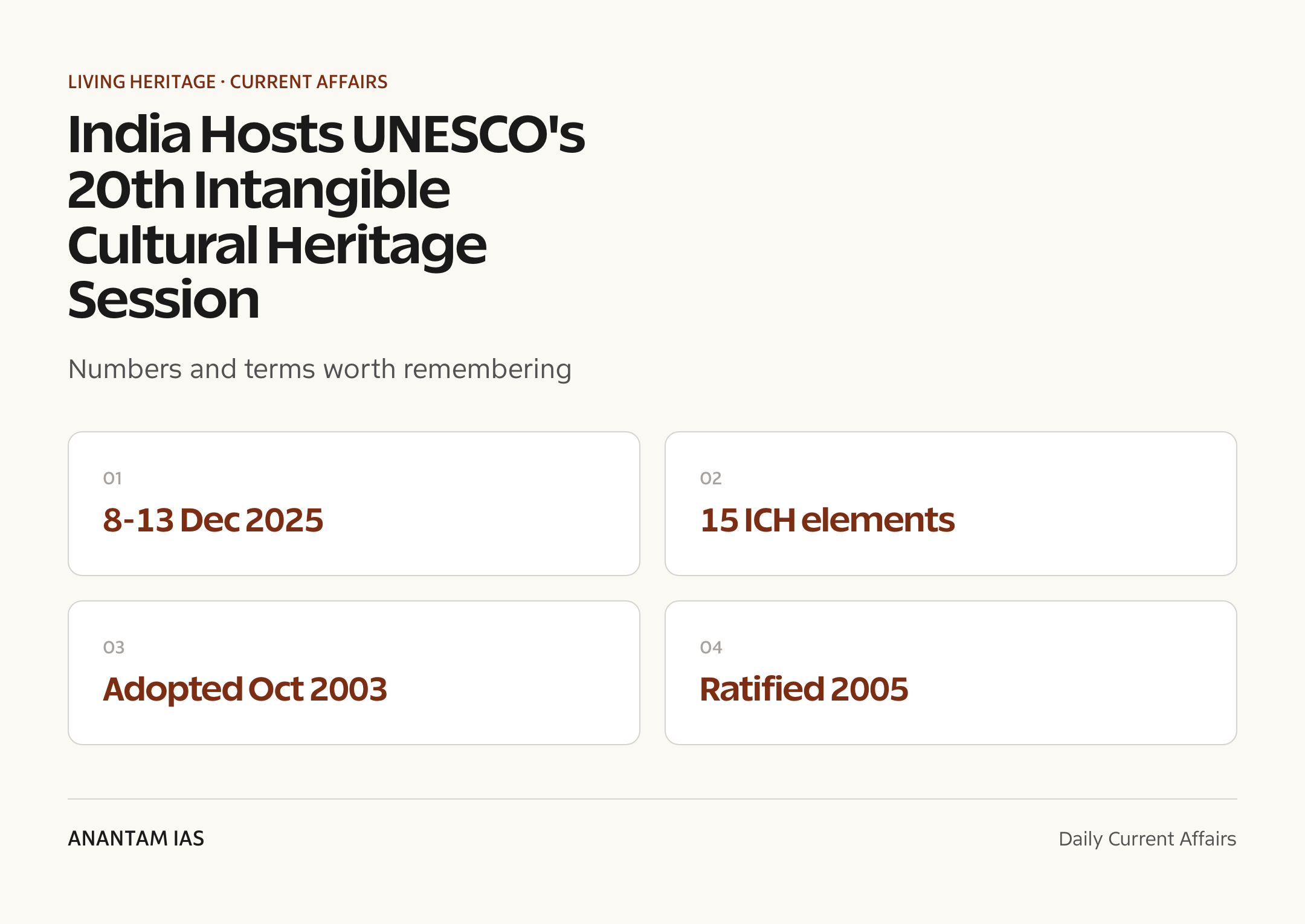
From 8 to 13 December 2025, India for the first time hosted and chaired the 20th session of UNESCO’s Intergovernmental Committee for the Safeguarding of the Intangible Cultural Heritage (ICH) at the Red Fort, New Delhi. PIB confirmed the historic venue — itself a UNESCO World Heritage Site — was chosen to symbolise the convergence of India’s tangible and intangible heritage.

The meeting was chaired by H.E. Vishal V. Sharma, India’s Permanent Delegate to UNESCO, and coincided with the twentieth anniversary of India’s 2005 ratification of the 2003 Convention for the Safeguarding of the Intangible Cultural Heritage.

  • Dates: 8-13 December 2025; venue: Red Fort (Lal Qila), New Delhi.
  • First time India has hosted the ICH Committee session.
  • Chaired by Vishal V. Sharma, India’s Permanent Delegate to UNESCO.
  • Nodal agencies: Ministry of Culture and the Sangeet Natak Akademi (SNA).
  • External Affairs Minister S. Jaishankar opened the session; UNESCO Director-General Khaled El-Enany attended the inaugural.
  • India has 15 elements inscribed on UNESCO’s Representative List; nominations for Chhath Mahaparva and Diwali were under review.

The development matters in the context of:

  • Hosting the apex body of the 2003 Convention is a major instance of India’s cultural diplomacy and soft-power projection.
  • Marks two decades of India operationalising a global instrument distinct from the 1972 World Heritage Convention.
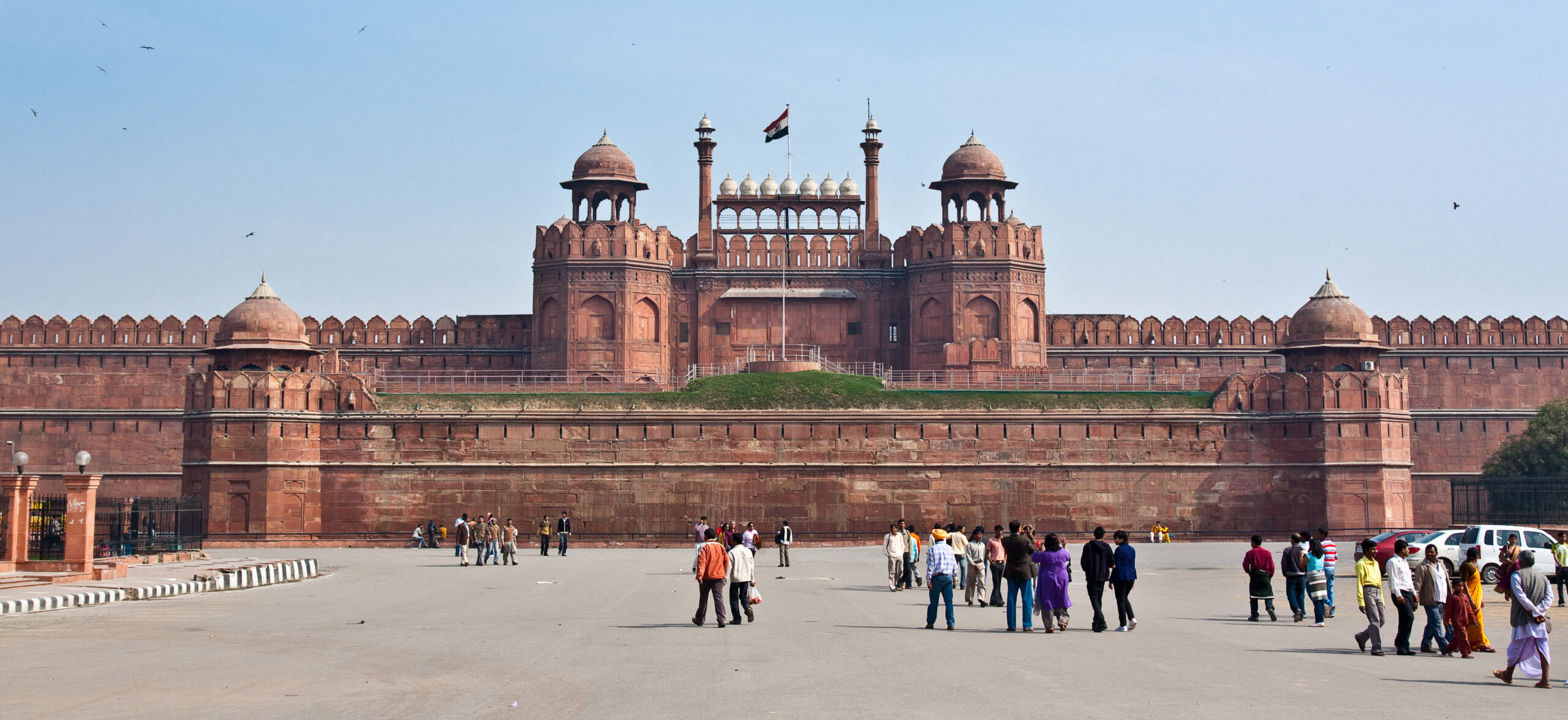
The Red Fort in Delhi, a red sandstone Mughal fortress and UNESCO World Heritage Site
The Red Fort, New Delhi, venue of the 20th UNESCO Intangible Cultural Heritage Committee session Photo: PerSona77, CC BY-SA 3.0 (Wikimedia Commons)
India Hosts UNESCO's 20th Intangible Cultural Heritage Session — quick facts

UPSC Relevance

Prelims Relevance

  • 2003 Convention for the Safeguarding of the Intangible Cultural Heritage — adopted 17 October 2003, 32nd UNESCO General Conference, Paris.
  • India ratified the 2003 Convention in 2005; 20th anniversary in 2025.
  • Intergovernmental Committee — 24 elected States Parties; evaluates nominations and manages the ICH Fund.
  • ICH covers: oral traditions, performing arts, social practices/rituals/festive events, knowledge of nature, and traditional craftsmanship.
  • Distinguish the Representative List, the List in Need of Urgent Safeguarding, and the Register of Good Safeguarding Practices.
  • India’s 15 ICH inscriptions include Kutiyattam, Vedic chanting, Ramlila, Kalbelia, Kumbh Mela, Yoga, Durga Puja, Garba of Gujarat and the Thatheras of Jandiala Guru.
  • Nodal agencies in India: Ministry of Culture and Sangeet Natak Akademi.
  • The Red Fort, built by Shah Jahan (17th century), is a UNESCO World Heritage Site (inscribed 2007).
  • India has served on the Intergovernmental Committee for three terms.

Mains Relevance

GS Paper 1

  • Salient aspects of Indian art forms and the role of UNESCO’s 2003 Convention in safeguarding living traditions.
  • Tangible versus intangible cultural heritage — how the two reinforce each other (Red Fort as venue).

GS Paper 2

  • India and the UN system — leveraging UNESCO bodies for cultural diplomacy and agenda-setting.

GS Paper 1 (Society)

  • Community-centred safeguarding and its links to livelihoods, crafts and social cohesion.

Essay

  • Heritage is not what we inherit but what we choose to carry forward.
  • Soft power and the diplomacy of culture.

Background and Context

What intangible cultural heritage means

ICH is the living, practised heritage that communities recognise as part of their identity.

  • UNESCO defines it as the practices, knowledge, expressions, objects and spaces communities see as part of their cultural identity, transmitted across generations.
  • Five domains: oral traditions and expressions (including language); performing arts; social practices, rituals and festive events; knowledge and practices about nature and the universe; and traditional craftsmanship.
  • Unlike monuments, ICH is process-based and evolving — kept alive by practitioners rather than preserved in stone.
  • It places communities, groups and individual practitioners at the centre of safeguarding.
India Hosts UNESCO's 20th Intangible Cultural Heritage Session — exam lens

The 2003 Convention — the legal instrument

The Convention is the global treaty that created the ICH machinery.

  • Adopted on 17 October 2003 at UNESCO’s 32nd General Conference in Paris; it entered into force in 2006.
  • It answered concerns that oral traditions, performing arts, rituals and craftsmanship were threatened by globalisation, social change and limited resources.
  • Four purposes: safeguard ICH; ensure respect for the heritage of communities; raise awareness of its importance; and provide for international cooperation and assistance.
  • It established the ICH Lists and the Intangible Cultural Heritage Fund, and underscored the interdependence of tangible and intangible heritage.

2003 ICH Convention vs the 1972 World Heritage Convention

The two UNESCO conventions protect different kinds of heritage and must not be confused.

  • The 1972 World Heritage Convention protects tangible sites — monuments, ensembles and natural sites of Outstanding Universal Value (the World Heritage List).
  • The 2003 Convention protects intangible, living heritage — practices and expressions, with no single “site”.
  • 1972 ranks sites by universal value; 2003 deliberately avoids hierarchy — its Representative List showcases diversity rather than “the best”.
  • The Red Fort embodies the link: a 1972 World Heritage monument hosting the 2003 Convention’s committee.

The Intergovernmental Committee and its functions

The Committee is the working body that implements the Convention between sessions of the General Assembly.

  • Promotes and monitors the objectives and implementation of the 2003 Convention.
  • Evaluates nominations for inscription on the ICH Lists (under Articles 16, 17 and 18) and grants international assistance.
  • Prepares the draft plan for using the ICH Fund and mobilises additional resources.
  • Drafts operational directives and examines periodic reports from States Parties.
  • India has served on the Committee for three terms, building a record of engagement before hosting.

India's ICH footprint

India carries one of the world’s richest portfolios of inscribed living traditions.

  • 15 Indian elements sit on UNESCO’s Representative List of the Intangible Cultural Heritage of Humanity.
  • Performing arts: Kutiyattam (Sanskrit theatre), Chhau dance, Sankirtana of Manipur, Kalbelia folk songs and dances of Rajasthan.
  • Rituals and festivals: Vedic chanting, Ramlila, Ramman, Buddhist chanting of Ladakh, Kumbh Mela, Durga Puja in Kolkata, and Garba of Gujarat.
  • Knowledge and craft: Yoga and the brass-and-copper craft of the Thatheras of Jandiala Guru, Punjab.
  • Nominations for Chhath Mahaparva and Diwali were under review at the session.

Why India hosted — agenda and significance

Hosting let India set the agenda and project a safeguarding model to the world.

  • Showcased India’s national ICH safeguarding model — institutional support, community participation, documentation and a national inventory — as a global good practice.
  • EAM S. Jaishankar opened the session, calling intangible heritage the most “democratic expression of culture”, “owned by all and guarded by many”.
  • The Ministry of Culture’s Scheme for Safeguarding the Intangible Heritage and the Sangeet Natak Akademi coordinated exhibitions, performances and nomination dossiers.
  • It advanced cultural diplomacy and soft power, while encouraging joint nominations, capacity building and technical exchange with other States Parties.

Way Forward

Deepen documentation and inventories

  • Expand the national inventory of living traditions, prioritising lesser-known crafts and regional festivals.
  • Build robust nomination dossiers with verified community consent, learning from the Chhath and Diwali files.

Centre the community

  • Tie safeguarding to livelihoods of artisans and performers, so heritage funds reach practitioners.
  • Engage youth through schools, fellowships and digital archiving to ensure transmission.

Convert the hosting spotlight into durable cooperation — joint multinational nominations, shared safeguarding initiatives and technical exchange under the 2003 Convention, rather than a one-off event.

Conclusion

Hosting the 20th ICH Committee session at the Red Fort placed India at the centre of the global conversation on living heritage and marked twenty years since it embraced the 2003 Convention.

The deeper test now is institutional: turning the visibility into stronger inventories, community-led safeguarding and livelihoods for the artisans and performers who keep these traditions alive.

UPSC Practice Questions

Prelims MCQ 1

With reference to UNESCO’s 2003 Convention for the Safeguarding of the Intangible Cultural Heritage, consider the following statements:

  1. It was adopted in 2003 and protects living traditions rather than tangible sites.
  2. India ratified it in 2005.
  3. The Intergovernmental Committee under it evaluates nominations to the Intangible Cultural Heritage Lists.

How many of the above statements are correct?

(a) Only one (b) Only two (c) All three (d) None

Answer: (c) All three

Explanation:

The 2003 Convention (adopted 17 October 2003) safeguards intangible heritage, distinct from the 1972 World Heritage Convention. India ratified it in 2005. The Intergovernmental Committee evaluates inscriptions to the ICH Lists. All three are correct.
Prelims MCQ 2

Which of the following is NOT among the recognised domains of intangible cultural heritage under UNESCO’s 2003 Convention?

(a) Oral traditions and expressions (b) Performing arts (c) Monuments and architectural ensembles (d) Traditional craftsmanship

Answer: (c) Monuments and architectural ensembles

Explanation:

Monuments and architectural ensembles are tangible heritage covered by the 1972 World Heritage Convention. The 2003 Convention’s five domains are oral traditions; performing arts; social practices/rituals/festive events; knowledge of nature; and traditional craftsmanship.

UPSC Mains Questions

  1. India hosting UNESCO’s 20th Intangible Cultural Heritage Committee session reflects a maturing of its cultural diplomacy. Examine how the 2003 Convention differs from the 1972 World Heritage Convention and why the distinction matters for India.
  2. “Intangible cultural heritage survives only when communities, and not the state alone, are its custodians.” Discuss in the context of India’s safeguarding model and its inscriptions on the UNESCO Representative List.

Sources: PIB, Ministry of Culture and DD News.

Frequently Asked Questions

What event did India host at the Red Fort in December 2025?

India hosted and chaired the 20th session of UNESCO’s Intergovernmental Committee for the Safeguarding of the Intangible Cultural Heritage from 8 to 13 December 2025 at the Red Fort, New Delhi. It was the first time India convened this committee, the apex body of the 2003 ICH Convention.

How is the 2003 Convention different from the World Heritage Convention?

The 1972 World Heritage Convention protects tangible sites such as monuments and natural areas of Outstanding Universal Value. The 2003 Convention protects intangible, living heritage like oral traditions, performing arts, rituals and craftsmanship. One safeguards places; the other safeguards practices kept alive by communities.

When did India ratify the 2003 ICH Convention?

India ratified the 2003 Convention for the Safeguarding of the Intangible Cultural Heritage in 2005. The December 2025 session coincided with the twentieth anniversary of that ratification, underscoring two decades of India’s engagement with the Convention’s mechanisms.

How many Indian elements are on UNESCO’s Representative List?

Fifteen Indian elements are inscribed on UNESCO’s Representative List of the Intangible Cultural Heritage of Humanity. They range from Kutiyattam and Chhau dance to Vedic chanting, Ramlila, Kalbelia, Kumbh Mela, Yoga, Durga Puja, Garba of Gujarat and the craft of the Thatheras of Jandiala Guru.

What are the five domains of intangible cultural heritage?

UNESCO recognises five domains: oral traditions and expressions including language; performing arts; social practices, rituals and festive events; knowledge and practices concerning nature and the universe; and traditional craftsmanship. These cover the breadth of living heritage that the 2003 Convention protects.

Which Indian agencies coordinate intangible heritage work?

The Ministry of Culture and its autonomous body, the Sangeet Natak Akademi, are the nodal agencies. They run documentation, inventorying, training, exhibitions and the preparation of UNESCO nomination dossiers, supported by the Ministry’s Scheme for Safeguarding the Intangible Heritage.

GST 2.0: Two-Slab Structure and December 2025 Collections

Open article →Download PDF

Why in News?

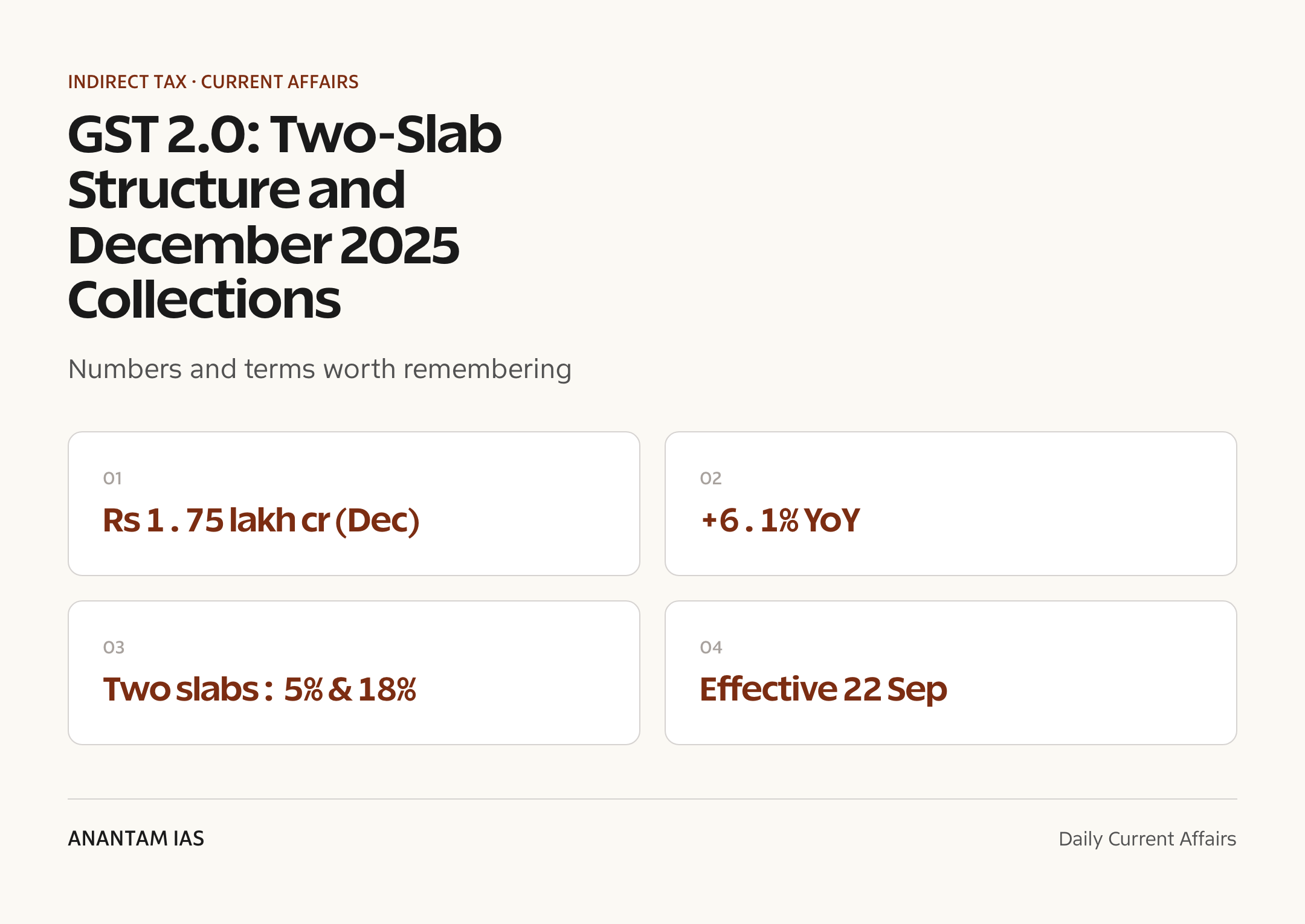
Gross Goods and Services Tax (GST) revenue collected during December 2025 rose to about Rs 1.75 lakh crore, up roughly 6.1% year-on-year. The figure reflects tax largely on November 2025 transactions and is the first full festive-season read on the rationalised two-slab GST.

The number matters because the 56th GST Council meeting compressed the old four-rate structure into a mainly 5% and 18% two-slab regime effective 22 September 2025 — the biggest overhaul since the 2017 rollout. Markets and the Finance Ministry are watching whether lower rates lift consumption enough to offset the revenue forgone.

  • Gross GST for December 2025 stood at about Rs 1.75 lakh crore versus roughly Rs 1.7 lakh crore in November 2025.
  • Growth of about 6.1% over December 2024, with the rise driven more by import GST than by muted domestic collections.
  • Cumulative April-December 2025-26 GST touched about Rs 16.5 lakh crore, up around 8.6% year-on-year.
  • Higher domestic refunds are trimming net receipts as inverted-duty and export claims clear faster.
  • The reading is the first to fully capture the two-slab (5% and 18%) rates in force from 22 September 2025.

The development matters in the context of:

  • Tests whether GST 2.0 rate cuts on essentials, autos and cement revive demand without denting the exchequer.
  • Feeds the fiscal-deficit and devolution maths the Centre and states track jointly under cooperative federalism.
  • Shapes the next round of GST Council bargaining over compensation, cess and the 40% sin-goods slab.
Editorial illustration of a simplified two-step tax-slab ladder with shopfronts, household goods and rising bar charts representing GST reform and collections.
The two-slab GST structure aims to simplify rates while sustaining collections. Illustration: AI-generated (Freepik)
GST 2.0: Two-Slab Structure and December 2025 Collections — quick facts

UPSC Relevance

Prelims Relevance

  • GST is a destination-based, dual indirect tax levied concurrently by the Centre (CGST) and states (SGST), with IGST on inter-state and import supplies.
  • Introduced on 1 July 2017 via the 101st Constitutional Amendment Act, 2016.
  • Article 279A creates the GST Council; Article 246A grants concurrent GST-legislating power.
  • GST Council is chaired by the Union Finance Minister; decisions need a three-fourths weighted majority (Centre one-third, states two-thirds).
  • The 56th GST Council approved the move to a mainly 5% and 18% two-slab structure, effective 22 September 2025.
  • A separate 40% rate applies to sin and luxury goods (tobacco, pan masala, aerated drinks, high-end cars).
  • Petroleum products, alcohol for human consumption and electricity remain outside GST.
  • GSTN is the IT backbone; the GST Compensation Cess funded states’ revenue shortfall for the initial transition years.
  • December 2025 gross GST of about Rs 1.75 lakh crore, up roughly 6.1% year-on-year.

Mains Relevance

GS Paper 3

  • GST rate rationalisation as a tool to balance revenue buoyancy, consumption and simplification.
  • Reading monthly GST collections as a real-time indicator of economic activity and formalisation.

GS Paper 2

  • GST Council under Article 279A as an experiment in cooperative fiscal federalism and consensus decision-making.

Essay

  • One nation, one tax: how far has GST delivered on its promise of a common market?

Background and Context

What GST is and how it is structured

GST is a single, destination-based indirect tax that subsumed a thicket of central and state levies.

  • It replaced excise duty, service tax, VAT, octroi and entry tax with one value-added tax that allows seamless input tax credit across the chain.
  • It is a dual tax: CGST (Centre) and SGST/UTGST (state) on intra-state supply, and IGST on inter-state supply and imports.
  • Being destination-based, tax accrues where goods or services are consumed, not where they are produced — a shift from the old origin-based system.
  • It rests on the 101st Constitutional Amendment, which inserted Article 246A (concurrent taxing power) and Article 279A (the GST Council). See our note on the 101st Amendment.
GST 2.0: Two-Slab Structure and December 2025 Collections — exam lens

The GST Council and fiscal federalism

The Council is the constitutional forum where the Centre and states jointly set rates, exemptions and rules.

  • Article 279A makes it a joint body chaired by the Union Finance Minister, with state finance ministers as members.
  • Voting is weighted: the Centre holds one-third and all states together two-thirds; a decision needs a three-fourths majority of votes cast.
  • This design forces consensus and has been read by the Supreme Court as recommendatory, not binding, on legislatures.
  • The Council’s bargaining over cess and compensation links directly to the Finance Commission’s devolution work — see Finance Commission of India.

GST 2.0: the two-slab rate rationalisation

The 56th GST Council collapsed the four-rate maze into a mainly two-rate structure from 22 September 2025.

  • The old 5%, 12%, 18%, 28% slabs gave way to a primary structure of 5% (merit) and 18% (standard).
  • Household essentials — soaps, toothpaste, Indian breads — moved to 5% or nil; many life-saving drugs fell to nil or 5%.
  • Two-wheelers, small cars, TVs, ACs and cement dropped from 28% to 18%, easing costs for the middle class.
  • Farm machinery and irrigation equipment were cut from 12% to 5% to lower input costs in agriculture.
  • A new 40% slab covers sin and luxury goods — tobacco, pan masala, aerated drinks and premium cars.
  • PIB framed it as a Next-Gen GST reform pitched at the common man, farmers, MSMEs and the middle class.

Reading the December 2025 collections

The December print is the first festive-season test of whether lower rates broaden the base enough to hold revenue.

  • Gross GST collected during December 2025 was about Rs 1.75 lakh crore, up roughly 6.1% over December 2024.
  • The monthly figure reflects tax on November 2025 transactions, since returns and payments lag the consumption month.
  • Growth was led by GST on imports, while domestic collections stayed comparatively muted.
  • Rising refunds — including faster export and inverted-duty clearances — are shrinking the gap between gross and net receipts.
  • Year-to-date April-December 2025-26 collections of about Rs 16.5 lakh crore (up ~8.6%) suggest underlying buoyancy despite the rate cuts.

Why the numbers matter for the macro picture

Monthly GST has become a high-frequency proxy for consumption, formalisation and fiscal health.

  • Steady collections after a rate cut signal that lower prices may be widening the tax base rather than just forgoing revenue.
  • Strong receipts ease pressure on the fiscal deficit and the borrowing programme — see Fiscal Deficit in India.
  • GST trends interact with direct-tax reform momentum, including the new Income-Tax Act, 2025.
  • Digital invoicing and e-way bills keep formalising trade, complementing the UPI-led digital-payments push.

Concerns and criticism

The rationalisation eases compliance but reopens old debates about revenue and state autonomy.

  • States worry about revenue forgone from large rate cuts now that the original compensation window has lapsed.
  • Muted domestic collections raise the question of whether demand is genuinely reviving or merely shifting.
  • Critics argue the system still has classification disputes and an unfinished agenda on bringing petroleum and electricity into GST.
  • The recommendatory nature of Council decisions tests the limits of cooperative federalism when Centre and states diverge.

Way Forward

Stabilise the new rates

  • Hold the two-slab structure steady long enough for businesses to reprice and for the base to settle.
  • Resolve residual classification disputes through clear, time-bound Council rulings.

Protect state finances

  • Design a transparent mechanism to cushion state revenue shortfalls without reviving open-ended compensation.
  • Strengthen joint monitoring with the Finance Commission on devolution and shared bases.

Widen the base

  • Build consensus on phasing petroleum products and other excluded items into GST.
  • Use data analytics and faster refunds to curb evasion while keeping compliance light.

Conclusion

December 2025’s roughly Rs 1.75 lakh crore haul is an early, broadly reassuring read on GST 2.0: the two-slab cuts have not collapsed revenue, even as growth leans on imports and domestic receipts stay subdued.

The harder test lies ahead — sustaining buoyancy while protecting state finances and finishing the unfinished agenda of one nation, one tax. For UPSC, GST remains a live case study in how cooperative federalism, indirect-tax design and fiscal health pull against one another.

UPSC Practice Questions

Prelims MCQ 1

With reference to the Goods and Services Tax (GST) in India, consider the following statements:

  1. GST is a destination-based tax levied on the consumption of goods and services.
  2. The GST Council is established under Article 279A of the Constitution and is chaired by the Union Finance Minister.
  3. Petroleum products and alcohol for human consumption are taxed under GST at the standard rate.

How many of the above statements are correct?

(a) Only one (b) Only two (c) All three (d) None

Answer: (b) Only two

Explanation:

Statements 1 and 2 are correct. GST is destination-based and the Council sits under Article 279A chaired by the Union FM. Statement 3 is wrong: petroleum products and alcohol for human consumption are outside GST, taxed by the older VAT/excise regime.

Prelims MCQ 2

The rate rationalisation approved by the 56th GST Council, effective from September 2025, primarily moved India towards which structure?

(a) A single uniform GST rate for all goods and services (b) A two-slab structure of mainly 5% and 18%, with a 40% rate on sin and luxury goods (c) A three-slab structure of 5%, 12% and 28% (d) Abolition of GST in favour of a national VAT

Answer: (b) A two-slab structure of mainly 5% and 18%, with a 40% rate on sin and luxury goods

Explanation:

The 56th Council collapsed the 5/12/18/28% slabs into a primary 5% and 18% structure from 22 September 2025, retaining a separate 40% slab for sin and luxury goods such as tobacco and aerated drinks.

UPSC Mains Questions

  1. The shift to a two-slab GST structure has been called the biggest indirect-tax reform since 2017. Examine its rationale, and assess whether monthly collection trends suggest it is broadening the tax base without eroding revenue.
  2. The GST Council under Article 279A is often cited as a model of cooperative fiscal federalism. Critically analyse this claim in the light of rate rationalisation and the concerns of states over revenue.

Sources: PIB, Ministry of Finance and SAG Infotech (GST collection data).

Frequently Asked Questions

What was the GST collection in December 2025?

Gross GST collected during December 2025 was about Rs 1.75 lakh crore, up roughly 6.1% over December 2024. This monthly figure reflects tax largely on November 2025 transactions, since returns and payments lag the month of actual consumption.

What is GST 2.0 or the two-slab structure?

GST 2.0 refers to the rate rationalisation approved by the 56th GST Council, effective 22 September 2025. It compressed the earlier 5%, 12%, 18% and 28% slabs into a primary two-rate structure of 5% and 18%, while keeping a separate 40% rate for sin and luxury goods.

Which constitutional provisions govern GST?

GST rests on the 101st Constitutional Amendment Act, 2016. Article 246A gives the Centre and states concurrent power to tax goods and services, while Article 279A establishes the GST Council, the joint body that recommends rates, exemptions and rules.

Why did import GST grow faster than domestic GST?

In December 2025, collections rose mainly on the strength of GST on imports, while domestic collections stayed comparatively muted. Higher import volumes and values lifted IGST on imports, even as the recent rate cuts and rising domestic refunds tempered net domestic receipts.

Who chairs the GST Council and how does it vote?

The Union Finance Minister chairs the GST Council, with state finance ministers as members. Voting is weighted, with the Centre holding one-third and the states together two-thirds; a decision requires a three-fourths majority of the votes cast, forcing broad consensus.

Are petroleum and alcohol covered under GST?

No. Petroleum products, alcohol for human consumption and electricity remain outside GST and continue to be taxed under the older VAT and excise systems. Bringing petroleum into GST is a long-pending reform that requires consensus in the GST Council.