Why in News?
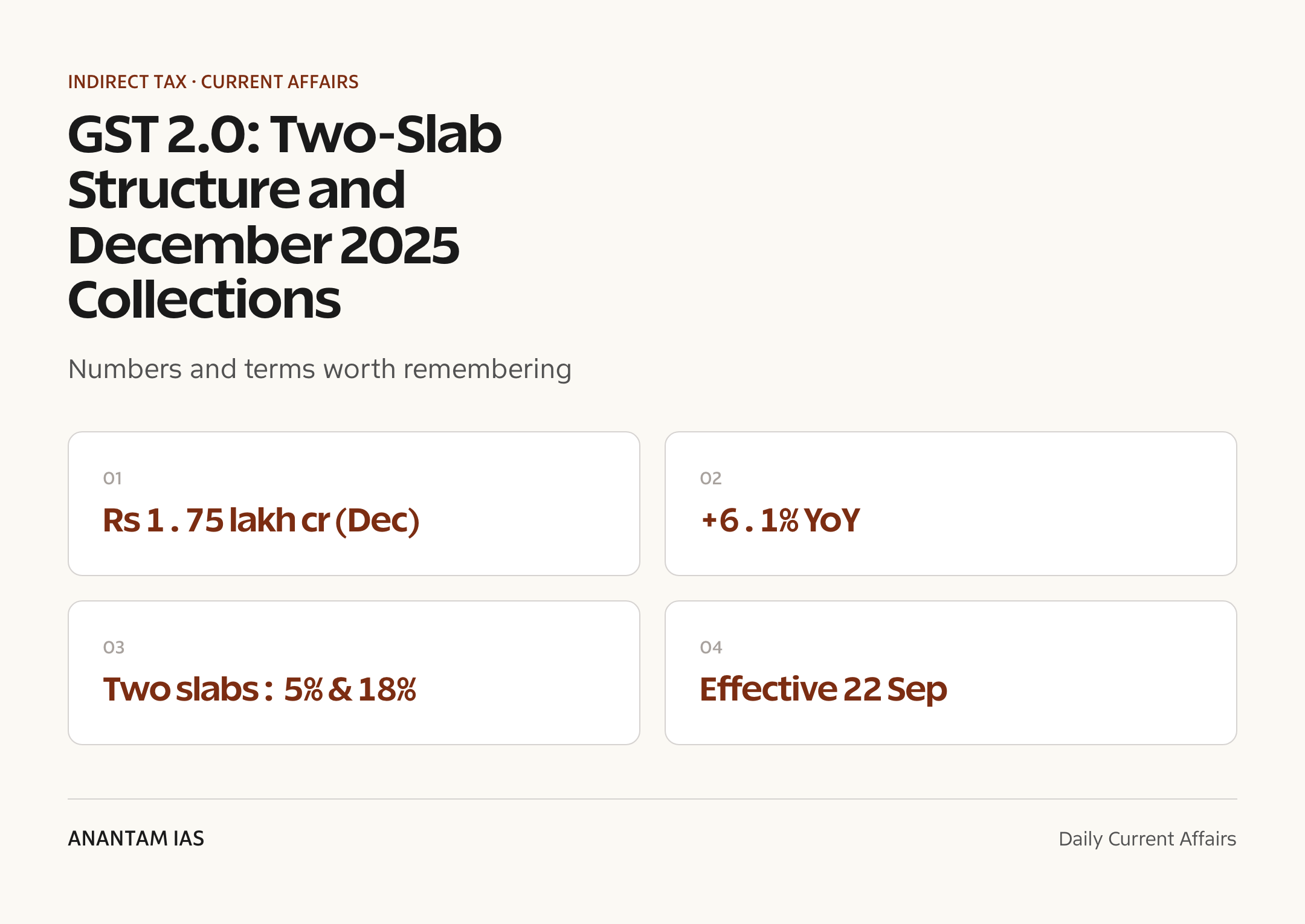
Gross Goods and Services Tax (GST) revenue collected during December 2025 rose to about Rs 1.75 lakh crore, up roughly 6.1% year-on-year. The figure reflects tax largely on November 2025 transactions and is the first full festive-season read on the rationalised two-slab GST.
The number matters because the 56th GST Council meeting compressed the old four-rate structure into a mainly 5% and 18% two-slab regime effective 22 September 2025 — the biggest overhaul since the 2017 rollout. Markets and the Finance Ministry are watching whether lower rates lift consumption enough to offset the revenue forgone.
- Gross GST for December 2025 stood at about Rs 1.75 lakh crore versus roughly Rs 1.7 lakh crore in November 2025.
- Growth of about 6.1% over December 2024, with the rise driven more by import GST than by muted domestic collections.
- Cumulative April-December 2025-26 GST touched about Rs 16.5 lakh crore, up around 8.6% year-on-year.
- Higher domestic refunds are trimming net receipts as inverted-duty and export claims clear faster.
- The reading is the first to fully capture the two-slab (5% and 18%) rates in force from 22 September 2025.
The development matters in the context of:
- Tests whether GST 2.0 rate cuts on essentials, autos and cement revive demand without denting the exchequer.
- Feeds the fiscal-deficit and devolution maths the Centre and states track jointly under cooperative federalism.
- Shapes the next round of GST Council bargaining over compensation, cess and the 40% sin-goods slab.
UPSC Relevance
Prelims Relevance
- GST is a destination-based, dual indirect tax levied concurrently by the Centre (CGST) and states (SGST), with IGST on inter-state and import supplies.
- Introduced on 1 July 2017 via the 101st Constitutional Amendment Act, 2016.
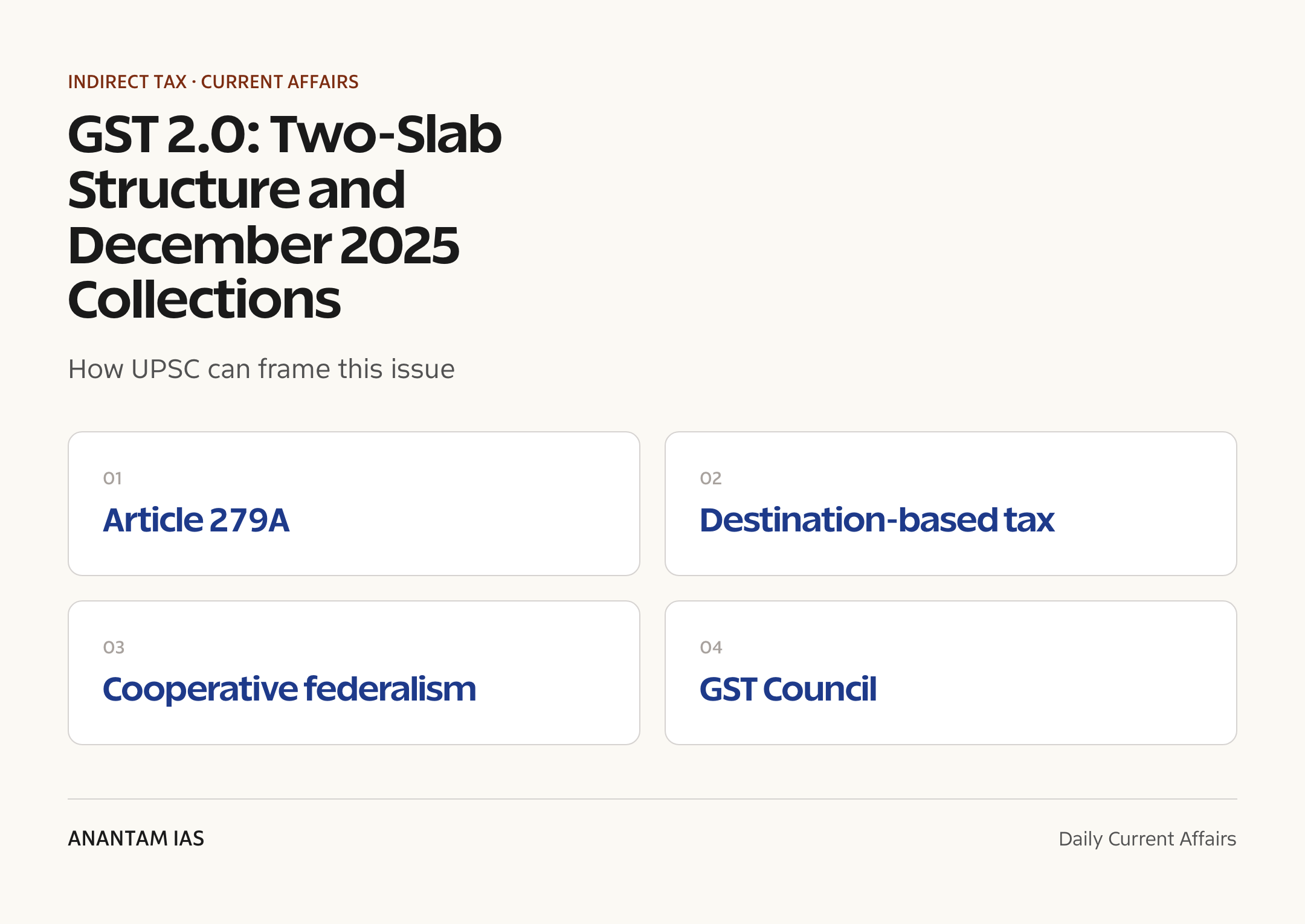
- Article 279A creates the GST Council; Article 246A grants concurrent GST-legislating power.
- GST Council is chaired by the Union Finance Minister; decisions need a three-fourths weighted majority (Centre one-third, states two-thirds).
- The 56th GST Council approved the move to a mainly 5% and 18% two-slab structure, effective 22 September 2025.
- A separate 40% rate applies to sin and luxury goods (tobacco, pan masala, aerated drinks, high-end cars).
- Petroleum products, alcohol for human consumption and electricity remain outside GST.
- GSTN is the IT backbone; the GST Compensation Cess funded states’ revenue shortfall for the initial transition years.
- December 2025 gross GST of about Rs 1.75 lakh crore, up roughly 6.1% year-on-year.
Mains Relevance
GS Paper 3
- GST rate rationalisation as a tool to balance revenue buoyancy, consumption and simplification.
- Reading monthly GST collections as a real-time indicator of economic activity and formalisation.
GS Paper 2
- GST Council under Article 279A as an experiment in cooperative fiscal federalism and consensus decision-making.
Essay
- One nation, one tax: how far has GST delivered on its promise of a common market?
Background and Context
What GST is and how it is structured
GST is a single, destination-based indirect tax that subsumed a thicket of central and state levies.
- It replaced excise duty, service tax, VAT, octroi and entry tax with one value-added tax that allows seamless input tax credit across the chain.
- It is a dual tax: CGST (Centre) and SGST/UTGST (state) on intra-state supply, and IGST on inter-state supply and imports.
- Being destination-based, tax accrues where goods or services are consumed, not where they are produced — a shift from the old origin-based system.
- It rests on the 101st Constitutional Amendment, which inserted Article 246A (concurrent taxing power) and Article 279A (the GST Council). See our note on the 101st Amendment.
The GST Council and fiscal federalism
The Council is the constitutional forum where the Centre and states jointly set rates, exemptions and rules.
- Article 279A makes it a joint body chaired by the Union Finance Minister, with state finance ministers as members.
- Voting is weighted: the Centre holds one-third and all states together two-thirds; a decision needs a three-fourths majority of votes cast.
- This design forces consensus and has been read by the Supreme Court as recommendatory, not binding, on legislatures.
- The Council’s bargaining over cess and compensation links directly to the Finance Commission’s devolution work — see Finance Commission of India.
GST 2.0: the two-slab rate rationalisation
The 56th GST Council collapsed the four-rate maze into a mainly two-rate structure from 22 September 2025.
- The old 5%, 12%, 18%, 28% slabs gave way to a primary structure of 5% (merit) and 18% (standard).
- Household essentials — soaps, toothpaste, Indian breads — moved to 5% or nil; many life-saving drugs fell to nil or 5%.
- Two-wheelers, small cars, TVs, ACs and cement dropped from 28% to 18%, easing costs for the middle class.
- Farm machinery and irrigation equipment were cut from 12% to 5% to lower input costs in agriculture.
- A new 40% slab covers sin and luxury goods — tobacco, pan masala, aerated drinks and premium cars.
- PIB framed it as a Next-Gen GST reform pitched at the common man, farmers, MSMEs and the middle class.
Reading the December 2025 collections
The December print is the first festive-season test of whether lower rates broaden the base enough to hold revenue.
- Gross GST collected during December 2025 was about Rs 1.75 lakh crore, up roughly 6.1% over December 2024.
- The monthly figure reflects tax on November 2025 transactions, since returns and payments lag the consumption month.
- Growth was led by GST on imports, while domestic collections stayed comparatively muted.
- Rising refunds — including faster export and inverted-duty clearances — are shrinking the gap between gross and net receipts.
- Year-to-date April-December 2025-26 collections of about Rs 16.5 lakh crore (up ~8.6%) suggest underlying buoyancy despite the rate cuts.
Why the numbers matter for the macro picture
Monthly GST has become a high-frequency proxy for consumption, formalisation and fiscal health.
- Steady collections after a rate cut signal that lower prices may be widening the tax base rather than just forgoing revenue.
- Strong receipts ease pressure on the fiscal deficit and the borrowing programme — see Fiscal Deficit in India.
- GST trends interact with direct-tax reform momentum, including the new Income-Tax Act, 2025.
- Digital invoicing and e-way bills keep formalising trade, complementing the UPI-led digital-payments push.
Concerns and criticism
The rationalisation eases compliance but reopens old debates about revenue and state autonomy.
- States worry about revenue forgone from large rate cuts now that the original compensation window has lapsed.
- Muted domestic collections raise the question of whether demand is genuinely reviving or merely shifting.
- Critics argue the system still has classification disputes and an unfinished agenda on bringing petroleum and electricity into GST.
- The recommendatory nature of Council decisions tests the limits of cooperative federalism when Centre and states diverge.
Way Forward
Stabilise the new rates
- Hold the two-slab structure steady long enough for businesses to reprice and for the base to settle.
- Resolve residual classification disputes through clear, time-bound Council rulings.
Protect state finances
- Design a transparent mechanism to cushion state revenue shortfalls without reviving open-ended compensation.
- Strengthen joint monitoring with the Finance Commission on devolution and shared bases.
Widen the base
- Build consensus on phasing petroleum products and other excluded items into GST.
- Use data analytics and faster refunds to curb evasion while keeping compliance light.
Conclusion
December 2025’s roughly Rs 1.75 lakh crore haul is an early, broadly reassuring read on GST 2.0: the two-slab cuts have not collapsed revenue, even as growth leans on imports and domestic receipts stay subdued.
The harder test lies ahead — sustaining buoyancy while protecting state finances and finishing the unfinished agenda of one nation, one tax. For UPSC, GST remains a live case study in how cooperative federalism, indirect-tax design and fiscal health pull against one another.
UPSC Practice Questions
Prelims MCQ 1
With reference to the Goods and Services Tax (GST) in India, consider the following statements:
- GST is a destination-based tax levied on the consumption of goods and services.
- The GST Council is established under Article 279A of the Constitution and is chaired by the Union Finance Minister.
- Petroleum products and alcohol for human consumption are taxed under GST at the standard rate.
How many of the above statements are correct?
(a) Only one (b) Only two (c) All three (d) None
Answer: (b) Only two
Explanation:
Statements 1 and 2 are correct. GST is destination-based and the Council sits under Article 279A chaired by the Union FM. Statement 3 is wrong: petroleum products and alcohol for human consumption are outside GST, taxed by the older VAT/excise regime.
Prelims MCQ 2
The rate rationalisation approved by the 56th GST Council, effective from September 2025, primarily moved India towards which structure?
(a) A single uniform GST rate for all goods and services (b) A two-slab structure of mainly 5% and 18%, with a 40% rate on sin and luxury goods (c) A three-slab structure of 5%, 12% and 28% (d) Abolition of GST in favour of a national VAT
Answer: (b) A two-slab structure of mainly 5% and 18%, with a 40% rate on sin and luxury goods
Explanation:
The 56th Council collapsed the 5/12/18/28% slabs into a primary 5% and 18% structure from 22 September 2025, retaining a separate 40% slab for sin and luxury goods such as tobacco and aerated drinks.
UPSC Mains Questions
- The shift to a two-slab GST structure has been called the biggest indirect-tax reform since 2017. Examine its rationale, and assess whether monthly collection trends suggest it is broadening the tax base without eroding revenue.
- The GST Council under Article 279A is often cited as a model of cooperative fiscal federalism. Critically analyse this claim in the light of rate rationalisation and the concerns of states over revenue.
Sources: PIB, Ministry of Finance and SAG Infotech (GST collection data).
Frequently Asked Questions
What was the GST collection in December 2025?
Gross GST collected during December 2025 was about Rs 1.75 lakh crore, up roughly 6.1% over December 2024. This monthly figure reflects tax largely on November 2025 transactions, since returns and payments lag the month of actual consumption.
What is GST 2.0 or the two-slab structure?
GST 2.0 refers to the rate rationalisation approved by the 56th GST Council, effective 22 September 2025. It compressed the earlier 5%, 12%, 18% and 28% slabs into a primary two-rate structure of 5% and 18%, while keeping a separate 40% rate for sin and luxury goods.
Which constitutional provisions govern GST?
GST rests on the 101st Constitutional Amendment Act, 2016. Article 246A gives the Centre and states concurrent power to tax goods and services, while Article 279A establishes the GST Council, the joint body that recommends rates, exemptions and rules.
Why did import GST grow faster than domestic GST?
In December 2025, collections rose mainly on the strength of GST on imports, while domestic collections stayed comparatively muted. Higher import volumes and values lifted IGST on imports, even as the recent rate cuts and rising domestic refunds tempered net domestic receipts.
Who chairs the GST Council and how does it vote?
The Union Finance Minister chairs the GST Council, with state finance ministers as members. Voting is weighted, with the Centre holding one-third and the states together two-thirds; a decision requires a three-fourths majority of the votes cast, forcing broad consensus.
Are petroleum and alcohol covered under GST?
No. Petroleum products, alcohol for human consumption and electricity remain outside GST and continue to be taxed under the older VAT and excise systems. Bringing petroleum into GST is a long-pending reform that requires consensus in the GST Council.
Tell Google you want more of this.
Add Anantam IAS as a preferred sourceOne tap, and this site shows up more often in your own Top Stories, AI Overviews and AI Mode. Remove it any time.