Opens in a new tab
Join Anantam IAS Channel on Telegram

Daily Digest · Saturday

17 January 2026 Current Affairs for UPSC

2 current affairs published on Saturday, 17 January 2026

17 January 2026 Current Affairs for UPSC — every Why-in-News article AnantamIAS published on Saturday, 17 January 2026, broken down with Why in News?, the exact GS paper it feeds, sub-topic mapping, MCQ-ready facts and a UPSC-style practice question. 2 articles in total, covering Polity, Economy, Environment, S&T, IR, Geography, History, Society and Internal Security — the same Why-in-News + GS-paper-mapping + practice-question format the Compass uses across every daily digest on the site.

Daily current affairs for UPSC is where new material enters your prep stream. Read this 17 January 2026 digest end-to-end in 25–35 minutes, attempt the practice question at the foot of each article (it's MCQ for some, 10/15-marker for others), then bookmark the entries that fall inside your active revision window. Everything stays cross-linked: tap any subject pill to jump to that subject's hub, or use the table of contents above to skip straight to a specific story.

Use this page three ways. Read sequentially for a one-sitting scan of everything that mattered on 17 January 2026. Download the 17 January 2026 PDF below for offline study or print revision. Or use the January 2026 Current Affairs compilation to see this day in the month's full context. For the previous day's reading, see 16 January 2026 Current Affairs; the next day's is 18 January 2026 Current Affairs.

Why we publish daily current affairs separately from the monthly compilation: daily is learning, monthly is revision. Use the daily page to add fresh material to your notes the day it breaks; come back to the January 2026 compilation 60 days before Prelims when the noise has settled and only the lasting takeaway is worth re-reading.

India’s Minerals Diplomacy: Securing Critical Minerals for the Energy Transition

Open article →Download PDF

Why in News?

India has stepped up its minerals diplomacy — using overseas asset deals, the National Critical Mineral Mission (NCMM) and supply-chain partnerships to lock in the lithium, cobalt, nickel and rare earths its clean-energy build-out depends on. The push is led by the Ministry of Mines, the state vehicle KABIL and the Geological Survey of India (GSI).

The strategy responds to a single hard fact: a handful of countries hold the ore and China dominates the processing and refining of these minerals, giving it choke-point power over the inputs for electric vehicles (EVs), batteries, wind turbines and solar gear that India must import or build domestically.

  • KABIL (Khanij Bidesh India Ltd) — a joint venture of NALCO, HCL and MECL — pursues overseas mineral assets, including a lithium-exploration deal in Argentina’s Catamarca province.
  • The National Critical Mineral Mission (NCMM) covers the full chain — exploration, mining, processing, recycling and overseas acquisition.
  • The MMDR Act amendments empower the Centre to auction blocks of critical and strategic minerals directly and freed several from the atomic-minerals list.
  • India is a member of the US-led Minerals Security Partnership (MSP) and has supply pacts with resource-rich states such as Australia.
  • GSI exploration flagged a large inferred lithium resource in Reasi, Jammu and Kashmir, the first sizeable domestic find.

The development matters in the context of:

  • Critical minerals are the new strategic commodities — like oil in the 20th century — and access decides who can build the clean-energy economy.
  • India’s net-zero by 2070 and EV ambitions are unworkable without secure, diversified mineral supply chains.
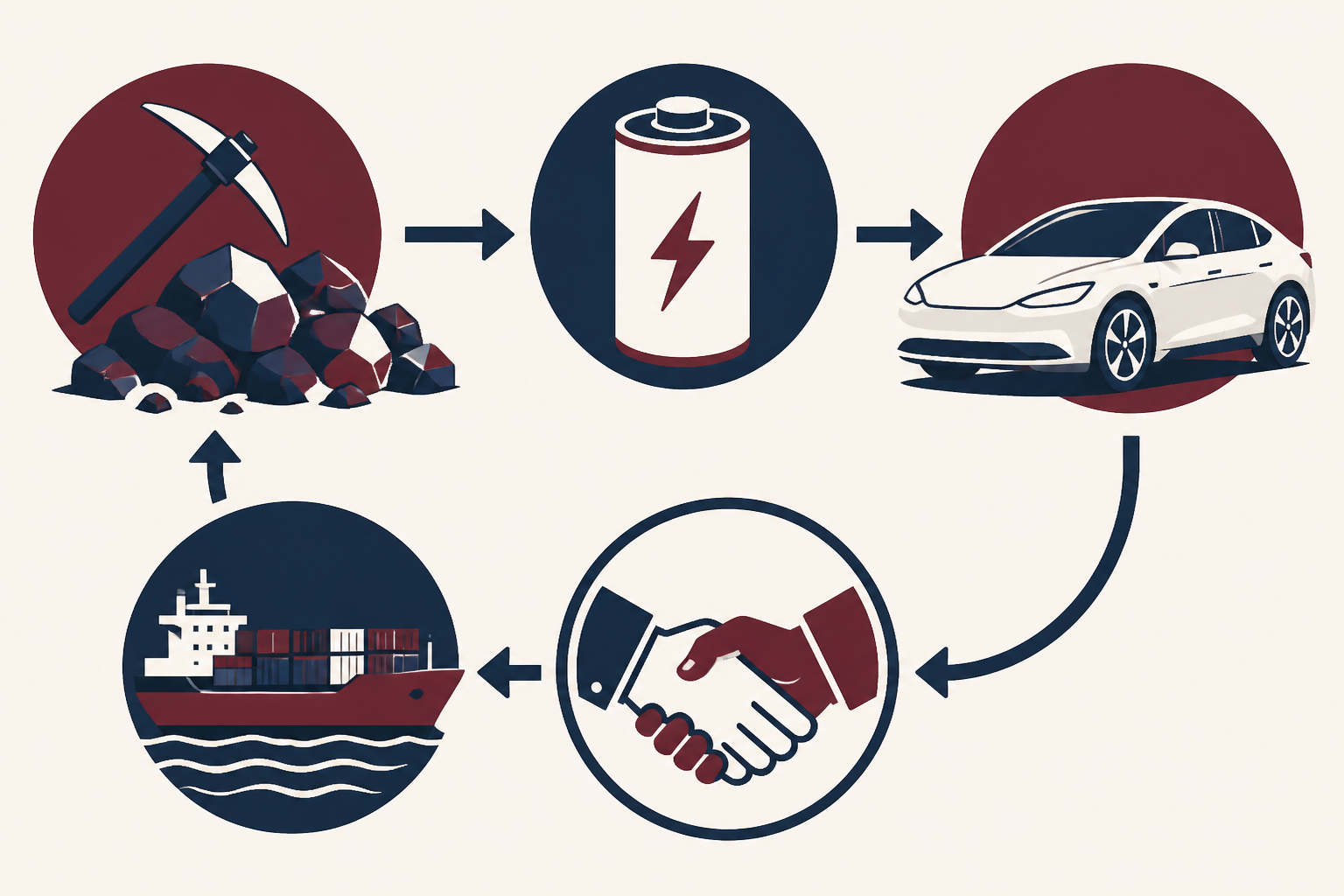
Stylised critical-mineral supply chain linking ore, a battery, an electric car, a ship and a handshake with arrows
Securing the minerals that power the energy transition, from ore to battery to road Illustration: AI-generated (Freepik)
India's Minerals Diplomacy: Securing Critical Minerals for the Energy Transition — quick facts

UPSC Relevance

Prelims Relevance

  • KABIL — a three-PSU joint venture (NALCO, HCL, MECL) for overseas critical-mineral assets
  • National Critical Mineral Mission (NCMM) — covers exploration to recycling, including overseas acquisition
  • MMDR Act (Mines and Minerals Development and Regulation) — basis for auctioning critical-mineral blocks
  • List of critical minerals notified by the Ministry of Mines (lithium, cobalt, nickel, rare earths, graphite and more)
  • Geological Survey of India (GSI) — the chief exploration agency; flagged the Reasi (J&K) lithium resource
  • Minerals Security Partnership (MSP) — a US-led plurilateral grouping for resilient mineral supply chains
  • Rare earth elements are not geologically rare; the bottleneck is mining and especially refining
  • Difference between a mineral reserve and an inferred resource

Mains Relevance

GS Paper 3

  • Critical-mineral security as the backbone of the energy transition, EV manufacturing and battery supply chains.
  • How NCMM, KABIL and MMDR auctions fit together as a resource-security policy stack.
  • Why downstream processing and recycling, not just mining, decide India’s leverage.

GS Paper 2

  • Minerals diplomacy and strategic autonomy — diversifying away from over-dependence on a single supplier country.
  • Plurilateral groupings like the Minerals Security Partnership and bilateral resource pacts as instruments of foreign policy.

Essay

  • Resource security in an age of energy transition — who controls the minerals controls the future.
  • Strategic autonomy means diversification, not isolation.

Background and Context

Why these minerals are 'critical'

A mineral is critical when an economy depends on it and its supply is concentrated, exposed to disruption or hard to substitute.

  • Lithium, cobalt, nickel and graphite are the core inputs for lithium-ion batteries that power EVs and grid storage.
  • Rare earth elements (REEs) — such as neodymium and dysprosium — make the permanent magnets in EV motors and wind turbines.
  • Criticality combines high economic importance with high supply risk, not geological scarcity.
  • The Ministry of Mines has notified a list of critical minerals to guide policy, exploration and incentives.
  • Demand is set to surge with the global shift to clean energy, electrified transport and digital hardware.
India's Minerals Diplomacy: Securing Critical Minerals for the Energy Transition — exam lens

The China choke-point

The supply risk that frames the whole strategy is the concentration of refining in one country.

  • China controls the dominant share of global rare-earth refining and a large share of battery-mineral processing.
  • Mining is spread across countries, but midstream refining is heavily concentrated, creating a single point of leverage.
  • Export controls or curbs on rare earths and processing technology can disrupt downstream manufacturing worldwide.
  • For India, this turns a commercial issue into one of strategic autonomy and supply-chain security.
  • Reducing this dependence requires both alternative sources of ore and India’s own processing capacity.

KABIL and overseas acquisition

The outward arm of the strategy is a dedicated state vehicle that hunts for assets abroad.

  • KABIL (Khanij Bidesh India Ltd) is a joint venture of NALCO, HCL and MECL set up to acquire and develop overseas mineral assets.
  • Its flagship effort is a lithium-exploration agreement in Catamarca, Argentina, part of South America’s ‘lithium triangle’.
  • The aim is long-term offtake and equity stakes in lithium, cobalt and other battery minerals, not one-off purchases.
  • It mirrors the model India uses for overseas oil and gas assets, adapted to the minerals age.
  • Diversifying sources — Argentina, Australia, Africa — cuts exposure to any single supplier.

The domestic policy stack — NCMM and MMDR

At home the strategy rests on a new mission and amended mining law.

  • The National Critical Mineral Mission (NCMM) spans the full value chain — exploration, mining, beneficiation, processing, recycling and overseas acquisition.
  • MMDR Act amendments let the Centre auction blocks of critical and strategic minerals and removed several from the restrictive atomic-minerals list, opening them to private players.
  • Exploration by the Geological Survey of India (GSI) flagged a large inferred lithium resource at Reasi, Jammu and Kashmir.
  • Incentives target recycling and urban mining of e-waste to recover battery metals.
  • The package complements EV manufacturing and battery cell production incentives downstream.

Partnerships and minerals diplomacy

Because India lacks large reserves of most battery minerals, diplomacy does much of the heavy lifting.

  • India joined the US-led Minerals Security Partnership (MSP), a plurilateral push for resilient, diversified supply chains.
  • It signed a critical-minerals investment partnership with Australia, a major lithium and rare-earth producer.
  • Engagement extends to resource-rich states in Africa and Latin America for offtake and joint ventures.
  • These ties knit resource security into foreign policy and the broader logic of geoeconomic statecraft.
  • The goal is a friend-shored network that lowers dependence on any one source country.

Stakes, gaps and the critique

Securing ore abroad is only half the battle; the harder gap is downstream and at home.

  • India’s biggest weakness is the missing midstream — refining and processing capacity, not just mines.
  • Overseas deals take years to convert into delivered metal, and equity stakes carry geopolitical and price risk.
  • Domestic mining of critical minerals raises environmental and tribal-land concerns that need careful clearance.
  • Recycling remains nascent, though it could become a major secondary source as the first EV fleets retire.
  • Without parallel investment in skills, technology and processing, India risks repeating the assembly-not-value trap seen in electronics.

Way Forward

Build the missing midstream

  • Invest in domestic refining and processing so secured ore translates into usable battery-grade metal.
  • Incentivise recycling and urban mining to create a circular secondary supply of battery metals.

Diversify and deepen partnerships

  • Convert KABIL exploration into long-term offtake and equity across Argentina, Australia and Africa.
  • Use the Minerals Security Partnership and bilateral pacts to friend-shore supply away from a single source.

Get the domestic enabling base right

  • Run transparent MMDR auctions with environmental and community safeguards built in.
  • Pair the NCMM with skilling, technology transfer and stable demand from EV and battery makers.

Conclusion

Critical minerals are doing to the 21st century what oil did to the 20th — turning a question of geology into one of geopolitics. India’s response weaves overseas acquisition through KABIL, a full-chain National Critical Mineral Mission, amended mining law and a web of partnerships into a single resource-security strategy.

The real test is leverage, not access. Securing ore abroad matters little if the refining, recycling and processing stay offshore. If India builds the missing midstream while diversifying its sources, minerals diplomacy can underwrite both the energy transition and genuine strategic autonomy; if it does not, it will simply trade one import dependence for another.

UPSC Practice Questions

Prelims MCQ 1

With reference to India’s critical-minerals strategy, consider the following statements:

  1. KABIL is a joint venture of NALCO, Hindustan Copper and Mineral Exploration Corporation set up to acquire overseas mineral assets.
  2. The National Critical Mineral Mission covers exploration, processing, recycling and overseas acquisition.
  3. Rare earth elements are classed as critical mainly because they are among the rarest elements in the Earth’s crust.

How many of the above statements are correct?

(a) Only one (b) Only two (c) All three (d) None

Answer: (b) Only two

Explanation:

Statements 1 and 2 are correct. Statement 3 is wrong: rare earths are reasonably abundant in the crust — they are critical because mining and especially refining are concentrated and difficult, not because the elements are scarce.

Prelims MCQ 2

Which one of the following best explains why China is described as a choke-point in global critical-mineral supply chains?

(a) It holds nearly all of the world’s lithium reserves (b) It dominates the refining and processing of these minerals (c) It is the only country mining cobalt (d) It controls all global rare-earth ore deposits

Answer: (b) It dominates the refining and processing of these minerals

Explanation:

Ore mining is spread across many countries, but China’s dominance lies in the midstream — refining and processing rare earths and battery minerals — which gives it leverage over downstream manufacturing.

UPSC Mains Questions

  1. Critical minerals are to the energy transition what oil was to the industrial age. Examine India’s strategy to secure lithium, cobalt, nickel and rare earths, and discuss why downstream processing matters as much as access to ore.
  2. Evaluate the role of minerals diplomacy in India’s pursuit of strategic autonomy. How do instruments like KABIL, the Minerals Security Partnership and bilateral resource pacts reduce supply-chain dependence on a single country?
  3. Discuss how the National Critical Mineral Mission and the amended MMDR Act seek to build a domestic critical-mineral ecosystem. What environmental and institutional challenges must be addressed?

Sources: PIB, Ministry of Mines and Press Information Bureau.

Frequently Asked Questions

What are critical minerals?

Critical minerals are those an economy depends on but whose supply is risky — concentrated in a few countries, exposed to disruption or hard to substitute. For India they include lithium, cobalt, nickel, graphite and rare earths, which are essential for batteries, electric vehicles, wind turbines and solar equipment. The label reflects economic importance and supply risk, not geological scarcity.

What is KABIL and what does it do?

KABIL (Khanij Bidesh India Ltd) is a state joint venture of NALCO, Hindustan Copper and Mineral Exploration Corporation, created to acquire and develop critical-mineral assets abroad. Its flagship effort is a lithium-exploration agreement in Catamarca, Argentina. KABIL aims to secure long-term supply and equity stakes in battery minerals, mirroring how India pursues overseas oil and gas assets.

Why does China dominate critical-mineral supply chains?

Mining of these minerals is spread across many countries, but China dominates the midstream — the refining and processing of rare earths and battery metals. This concentration gives it choke-point leverage: export curbs or technology restrictions can disrupt manufacturing worldwide. Reducing this dependence is the central aim of India’s minerals diplomacy and domestic processing push.

What is the National Critical Mineral Mission?

The National Critical Mineral Mission (NCMM) is India’s full-value-chain strategy for critical minerals, covering exploration, mining, beneficiation, processing, recycling and overseas acquisition. It works alongside amended MMDR Act provisions that let the Centre auction critical-mineral blocks. The mission aims to secure supply for the energy transition while building domestic capability rather than relying only on imports.

Has India found its own lithium?

Exploration by the Geological Survey of India flagged a large inferred lithium resource at Reasi in Jammu and Kashmir — the first sizeable domestic find. However, an inferred resource is an early estimate, not a proven reserve; extraction faces technical, environmental and processing challenges. Domestic finds reduce import dependence over time but do not replace overseas sourcing in the near term.

How does minerals diplomacy support strategic autonomy?

Because India lacks large reserves of most battery minerals, it diversifies sources through diplomacy — joining the US-led Minerals Security Partnership, signing a critical-minerals pact with Australia and engaging Africa and Latin America. Spreading supply across friendly partners lowers dependence on any single country, turning resource security into an instrument of strategic autonomy and foreign policy.
Dugongs in Indian Waters: Saving the Sea Cow and Its Seagrass Home

Open article →Download PDF

Why in News?

Conservation focus has returned to the dugong (Dugong dugon), India’s only surviving herbivorous marine mammal, after the country anchored its protection around the first dedicated Dugong Conservation Reserve notified in Palk Bay, off the coast of Tamil Nadu.

The gentle, slow-moving ‘sea cow’ now survives in only three Indian pockets — the Gulf of Mannar, the Gulf of Kutch and the waters of the Andaman and Nicobar Islands — making it a textbook case of a flagship marine species clinging to fragmented seagrass meadows.

  • India notified its first Dugong Conservation Reserve in Palk Bay, Tamil Nadu, covering roughly 448 sq km of dugong and seagrass habitat.
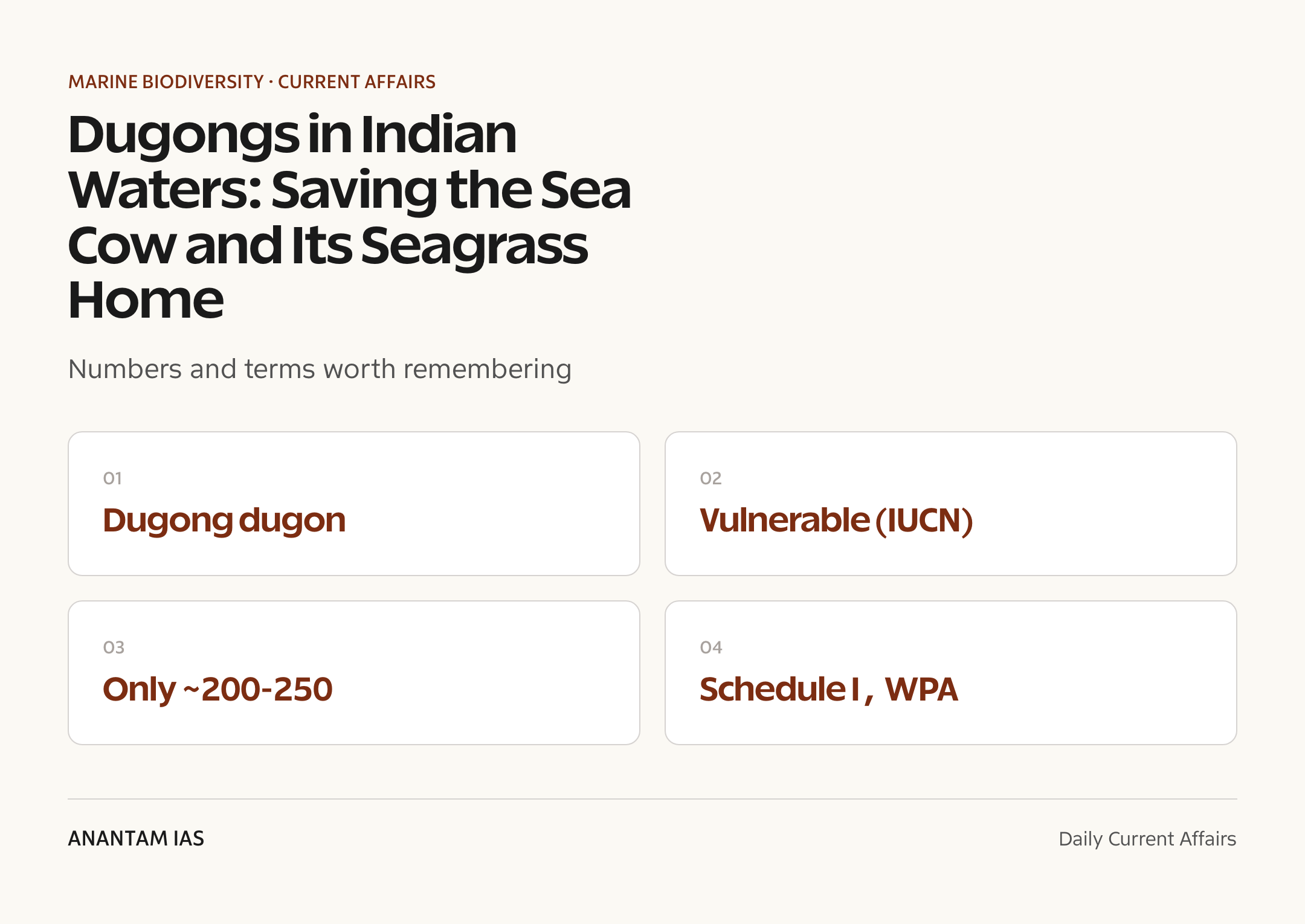
  • The dugong is listed as Vulnerable on the IUCN Red List and is protected under Schedule I of the Wild Life (Protection) Act, 1972.
  • India’s dugong population is estimated at only around 200-250 animals, concentrated in the Gulf of Mannar and Palk Bay.
  • Principal threats are seagrass-meadow loss, accidental gillnet bycatch, and boat and vessel strikes in shallow coastal waters.
  • The species is listed on Appendix I of both CITES and the Convention on Migratory Species (CMS), and India is a signatory to the CMS Dugong Memorandum of Understanding.

The development matters in the context of:

  • The dugong is an indicator species: a healthy dugong herd signals intact, productive seagrass meadows and clean coastal waters.
  • Its decline mirrors the wider stress on India’s coastal blue-carbon ecosystems from fishing pressure, pollution and habitat fragmentation.
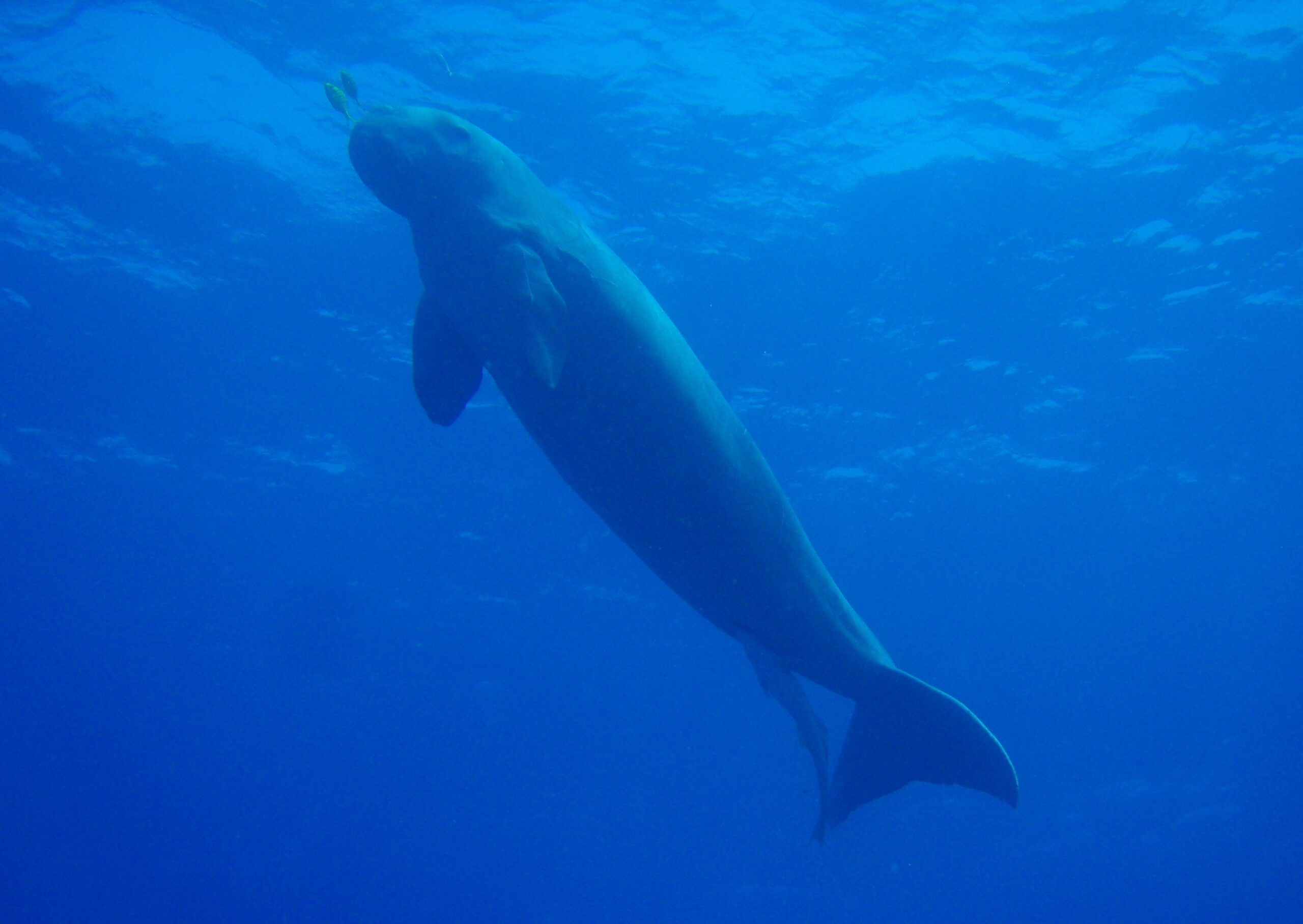
A dugong grazing on seagrass in shallow clear water
A dugong grazing seagrass — India's only herbivorous marine mammal. Photo: Gejuni, CC BY-SA 3.0 de (Wikimedia Commons)
Dugongs in Indian Waters: Saving the Sea Cow and Its Seagrass Home — quick facts

UPSC Relevance

Prelims Relevance

  • Dugong dugon — the only living member of family Dugongidae; India’s sole herbivorous marine mammal
  • Indian range is restricted to the Gulf of Mannar, Gulf of Kutch and Andaman and Nicobar Islands
  • IUCN Red List status — Vulnerable; listed on CITES Appendix I and CMS Appendix I
  • Protected under Schedule I of the Wild Life (Protection) Act, 1972
  • India notified its first Dugong Conservation Reserve in Palk Bay, Tamil Nadu
  • Belongs to order Sirenia; its closest relatives are the manatees
  • Feeds almost exclusively on seagrass, a flowering marine plant (not seaweed/algae)
  • Difference between a conservation reserve, a national park, a wildlife sanctuary and a community reserve
  • Seagrass meadows as blue-carbon sinks alongside mangroves and salt marshes

Mains Relevance

GS Paper 3

  • Conserving a flagship marine mammal through conservation reserves, the Wild Life (Protection) Act and seagrass-habitat protection.
  • Fisheries bycatch and habitat degradation as drivers of coastal marine biodiversity loss.
  • Seagrass meadows as blue-carbon ecosystems and their role in climate mitigation and coastal resilience.

GS Paper 2

  • International conservation cooperation through the CMS Dugong MoU and CITES for a migratory marine species.

Essay

  • Can a single charismatic species protect an entire ecosystem — the promise and limits of flagship marine conservation?

Background and Context

What the dugong is

The dugong is a large, slow-moving marine mammal that grazes seagrass like a cow grazes pasture.

  • Dugong dugon is the only living species in the family Dugongidae and India’s sole herbivorous marine mammal.
  • It belongs to the order Sirenia — the ‘sea cows’ — sharing ancestry with the manatees of the Atlantic.
  • Adults grow to about three metres and live wholly in shallow, warm coastal waters, never venturing onto land.
  • It feeds almost exclusively on seagrass, a flowering marine plant, uprooting whole shoots and leaving distinctive feeding trails.
  • Slow to breed — females calve only once every few years — so populations recover very slowly from any loss.
Dugongs in Indian Waters: Saving the Sea Cow and Its Seagrass Home — exam lens

Where it survives in India

India holds a small, fragmented share of the global dugong population across just three coastal regions.

  • The Gulf of Mannar and adjoining Palk Bay off Tamil Nadu form the country’s most important dugong stronghold.
  • The Gulf of Kutch in Gujarat holds a small, isolated western population in its seagrass shallows.
  • Scattered animals persist in the lagoons and reefs of the Andaman and Nicobar Islands.
  • Total Indian numbers are estimated at only around 200-250 dugongs, well below historic levels.
  • These small, disconnected groups are highly vulnerable to local extinction from chance events and habitat loss.

Why it is threatened

The dugong’s Indian decline is driven by pressure on its seagrass habitat and on the animals themselves.

  • Seagrass-meadow loss from siltation, coastal pollution, dredging and trawling that scours the seabed.
  • Accidental gillnet bycatch, where dugongs drown after becoming entangled in fishing nets.
  • Boat and vessel strikes in busy, shallow coastal channels the slow-moving animals cannot escape.
  • Historic hunting for meat, oil and ivory-like tusks that drove early population crashes.
  • Climate stress and warming that degrades the very seagrass the dugong depends on for food.

Conservation status and legal protection

The dugong sits within an interlocking set of national and international protection frameworks.

  • IUCN Red List — classified as Vulnerable across its global range.
  • Protected in India under Schedule I of the Wild Life (Protection) Act, 1972, the highest level of legal protection.
  • Listed on CITES Appendix I and CMS Appendix I, restricting trade and committing range states to protect it.
  • India is a signatory to the CMS Dugong MoU, a non-binding pact coordinating dugong and seagrass conservation across the Indo-Pacific.
  • The Wildlife Institute of India runs a dedicated dugong-recovery programme tracking the animals and their seagrass habitat.

The Palk Bay Dugong Conservation Reserve

India’s first dedicated dugong reserve marks a shift toward protecting the species through its habitat.

  • Tamil Nadu notified India’s first Dugong Conservation Reserve in Palk Bay, covering about 448 sq km.
  • A conservation reserve is a category under the Wild Life (Protection) Act for protecting habitat that links or buffers existing protected areas, often with community involvement.
  • The reserve targets the seagrass meadows that anchor the dugong, not just the animal alone.
  • It complements the older Gulf of Mannar Marine National Park and Biosphere Reserve next door.
  • Crucially, it aims to balance protection with the livelihoods of coastal fishing communities who share the waters.

Flagship value and seagrass blue carbon

The dugong’s worth to conservation goes well beyond its own numbers, anchoring an entire coastal system.

  • As a flagship species, the dugong’s appeal draws funding, attention and reserve status that benefit the whole seagrass ecosystem.
  • As an indicator species, a thriving dugong herd signals healthy, productive seagrass and clean coastal water.
  • Seagrass meadows are powerful blue-carbon sinks, storing carbon in seabed sediments alongside mangroves and salt marshes.
  • Those meadows are nurseries for fish, stabilise the seabed and shield coasts — so protecting dugongs underpins coastal livelihoods and resilience.
  • The dugong’s fate is a barometer of how well India manages its marine biodiversity and coastal blue-carbon wealth.

Way Forward

Protect and restore the seagrass

  • Map and restore degraded seagrass meadows in the Gulf of Mannar, Palk Bay and Gulf of Kutch.
  • Regulate trawling, dredging and pollution that smother and uproot seagrass beds.

Cut direct mortality

  • Curb gillnet bycatch through gear modification, seasonal no-fishing zones and trained release protocols.
  • Enforce boat speed limits and channel rules in shallow dugong waters to prevent vessel strikes.

Engage communities and cooperate

  • Build fisher-community stewardship and alternative livelihoods around the Palk Bay reserve.
  • Strengthen regional cooperation under the CMS Dugong MoU for this migratory Indo-Pacific species.

Conclusion

The dugong’s Indian story is a reminder that a marine mammal can be globally Vulnerable yet locally on the brink. With only around 200-250 animals left in three shrinking pockets, the species depends entirely on the health of the seagrass meadows it grazes — and on whether India can curb bycatch, vessel strikes and habitat loss in time.

India’s first Dugong Conservation Reserve in Palk Bay signals the right instinct: protect the habitat, not just the animal. Treating the dugong as a flagship for coastal blue-carbon ecosystems means safeguarding seagrass that also stores carbon, nurses fisheries and shields the coast. Keep the meadows intact, and the sea cow stays.

UPSC Practice Questions

Prelims MCQ 1

With reference to the dugong (Dugong dugon), consider the following statements:

  1. It is India’s only herbivorous marine mammal.
  2. In India it is found only in the Gulf of Mannar, Gulf of Kutch and the Andaman and Nicobar Islands.
  3. It is listed as Critically Endangered on the IUCN Red List.

How many of the above statements are correct?

(a) Only one (b) Only two (c) All three (d) None

Answer: (b) Only two

Explanation:

Statements 1 and 2 are correct — the dugong is India’s only herbivorous marine mammal, restricted to the Gulf of Mannar, Gulf of Kutch and the Andamans. Statement 3 is wrong: it is listed as Vulnerable, not Critically Endangered.

Prelims MCQ 2

India’s first Dugong Conservation Reserve has been notified in which one of the following?

(a) Gulf of Kutch, Gujarat (b) Palk Bay, Tamil Nadu (c) Chilika Lake, Odisha (d) Pulicat Lake, Andhra Pradesh

Answer: (b) Palk Bay, Tamil Nadu

Explanation:

India’s first Dugong Conservation Reserve was notified in Palk Bay, Tamil Nadu, covering about 448 sq km of dugong and seagrass habitat.

UPSC Mains Questions

  1. The dugong is often described as a flagship species of India’s coastal waters. Explain what flagship and indicator species mean, and discuss why conserving the dugong matters for the wider seagrass ecosystem.
  2. Examine the main threats to the dugong in India and assess how conservation reserves, the Wild Life (Protection) Act, 1972 and habitat protection can together secure its small, fragmented populations.
  3. Seagrass meadows are increasingly recognised as blue-carbon ecosystems. Critically analyse their ecological and climate significance, and the policy measures needed to protect them in India.

Sources: Ministry of Environment, Forest and Climate Change and Wildlife Institute of India.

Frequently Asked Questions

What is a dugong?

The dugong (Dugong dugon) is a large, slow-moving marine mammal often called the sea cow. It is India’s only herbivorous marine mammal and the sole living member of the family Dugongidae. Belonging to the order Sirenia, it is related to the manatees and feeds almost entirely on seagrass in shallow, warm coastal waters.

Where are dugongs found in India?

In India, dugongs survive in only three regions: the Gulf of Mannar and adjoining Palk Bay off Tamil Nadu, the Gulf of Kutch in Gujarat, and the waters of the Andaman and Nicobar Islands. The total Indian population is estimated at only around 200-250 animals, concentrated mainly in the Gulf of Mannar and Palk Bay.

What is the dugong’s conservation status?

The dugong is listed as Vulnerable on the IUCN Red List. It is protected in India under Schedule I of the Wild Life (Protection) Act, 1972, the highest level of legal protection. It is also listed on Appendix I of both CITES and the Convention on Migratory Species, and India is a signatory to the CMS Dugong Memorandum of Understanding.

Why are dugongs threatened in India?

The main threats are loss of seagrass meadows from pollution, siltation, dredging and trawling; accidental bycatch in gillnets, where dugongs drown after entanglement; and boat or vessel strikes in shallow coastal waters. Historic hunting and climate-driven seagrass degradation add further pressure on the slow-breeding, slow-recovering species.

What is the Palk Bay Dugong Conservation Reserve?

It is India’s first dedicated dugong reserve, notified by Tamil Nadu in Palk Bay and covering about 448 sq km. A conservation reserve is a protected-area category under the Wild Life (Protection) Act, often involving local communities. The reserve protects the seagrass meadows the dugong depends on, complementing the neighbouring Gulf of Mannar Biosphere Reserve.

Why are seagrass meadows important?

Seagrass meadows are the dugong’s only food source and among the most valuable coastal ecosystems on Earth. As blue-carbon sinks, they store large amounts of carbon in seabed sediments, alongside mangroves and salt marshes. They also serve as fish nurseries, stabilise the seabed and protect coastlines, so saving dugongs helps protect coastal livelihoods and climate resilience.