
Opens in a new tab
Join Anantam IAS Channel on Telegram

Daily Digest · Monday

20 April 2026 Current Affairs for UPSC

2 current affairs published on Monday, 20 April 2026

20 April 2026 Current Affairs for UPSC — every Why-in-News article AnantamIAS published on Monday, 20 April 2026, broken down with Why in News?, the exact GS paper it feeds, sub-topic mapping, MCQ-ready facts and a UPSC-style practice question. 2 articles in total, covering Polity, Economy, Environment, S&T, IR, Geography, History, Society and Internal Security — the same Why-in-News + GS-paper-mapping + practice-question format the Compass uses across every daily digest on the site.

Daily current affairs for UPSC is where new material enters your prep stream. Read this 20 April 2026 digest end-to-end in 25–35 minutes, attempt the practice question at the foot of each article (it's MCQ for some, 10/15-marker for others), then bookmark the entries that fall inside your active revision window. Everything stays cross-linked: tap any subject pill to jump to that subject's hub, or use the table of contents above to skip straight to a specific story.

Use this page three ways. Read sequentially for a one-sitting scan of everything that mattered on 20 April 2026. Download the 20 April 2026 PDF below for offline study or print revision. Or use the April 2026 Current Affairs compilation to see this day in the month's full context. For the previous day's reading, see 19 April 2026 Current Affairs; the next day's is 21 April 2026 Current Affairs.

Why we publish daily current affairs separately from the monthly compilation: daily is learning, monthly is revision. Use the daily page to add fresh material to your notes the day it breaks; come back to the April 2026 compilation 60 days before Prelims when the noise has settled and only the lasting takeaway is worth re-reading.

SC warns states to curb Illegal Mining in Chambal Gharial Sanctuary

Open article →Download PDF

Why in News?

The Supreme Court has asked the states of Madhya Pradesh, Rajasthan, and Uttar Pradesh to take “concrete measures” to curb illegal sand mining in the ecologically fragile and protected National Chambal Gharial Sanctuary. Failing which, the court has warned of the deployment of paramilitary forces and a complete ban on sand mining.

  • The SC has directed the installation of high-resolution, Wi-Fi-enabled CCTV cameras across vulnerable stretches and routes used by mining operators. GPS tracking to be installed in mining vehicles and equipment; specialised patrolling teams equipped with modern arms and communication gear to be deployed in high-risk areas. 
UPSC Relevance: GS-3 Environment and Biodiversity: Protected Areas; Biodiversity

Prelims: National Chambal Gharial Sanctuary; Chambal River; Gharial 

National Chambal Gharial Sanctuary:

  • National Chambal Gharial Sanctuary is located along the Chambal River, near the tri-junction of:
    • Rajasthan
    • Madhya Pradesh
    • Uttar Pradesh
  • Nature: A linear (riverine) sanctuary, stretching ~ 400-425 km along the river. 
  • Administration: Tri-state protected area
  • Conservation Status:
    • Recognised as an Important Bird Area (IBA) by BirdLife International (s proposed Ramsar wetland site)
    • Part of India’s efforts under the Gharial Conservation Programme
  • Fauna:
    • Flagship Species: 
      • Gharial: Critically Endangered. It is one of the last viable habitats of the gharial in the wild.
      • Ganges River Dolphin: Endangered
    • Sanctuary supports 8 turtle species: Red-crowned Roofed Turtle (Critically Endangered), Indian Narrow-headed Softshell Turtle, Three-striped Roofed Turtle, etc. 
    • Other Important Fauna: Mugger Crocodile, Smooth-coated Otter, Indian Skimmer (Endangered), Striped Hyena, Indian Wolf
  • Flora: Dominated by dry deciduous vegetation. It is part of the Khathiar-Gir dry deciduous forests. It overlaps with ravine/badland ecosystems, which are ecologically unique.
  • Key Threats: Illegal sand mining, Water abstraction from the Chambal river (dams upstream), & Fishing nets (dolphin & gharial mortality). 

Key facts about the Chambal River: 

  • Origin: Vindhya Range, specifically near Janapav Hills (south of Mhow) in western Madhya Pradesh.
  • It flows northward through Madhya Pradesh, Rajasthan, and Uttar Pradesh. Finally, it joins the Yamuna River in UP.
  • Chambal is one of the major tributaries of the Yamuna, and hence part of the Ganges drainage system.
  • Physiographic Features: 
    • The Chambal basin is famous for badland topography (ravines).
    • Presence of sandbanks, crucial for: Gharial nesting & Turtle breeding.  
  • Chambal is considered one of the least polluted rivers in India, due to (i) Low industrialisation along its course, (ii) Historical inaccessibility of ravine regions. 
  • Fauna: Known for endangered species: Gharial, Ganges River Dolphin, Indian Skimmer
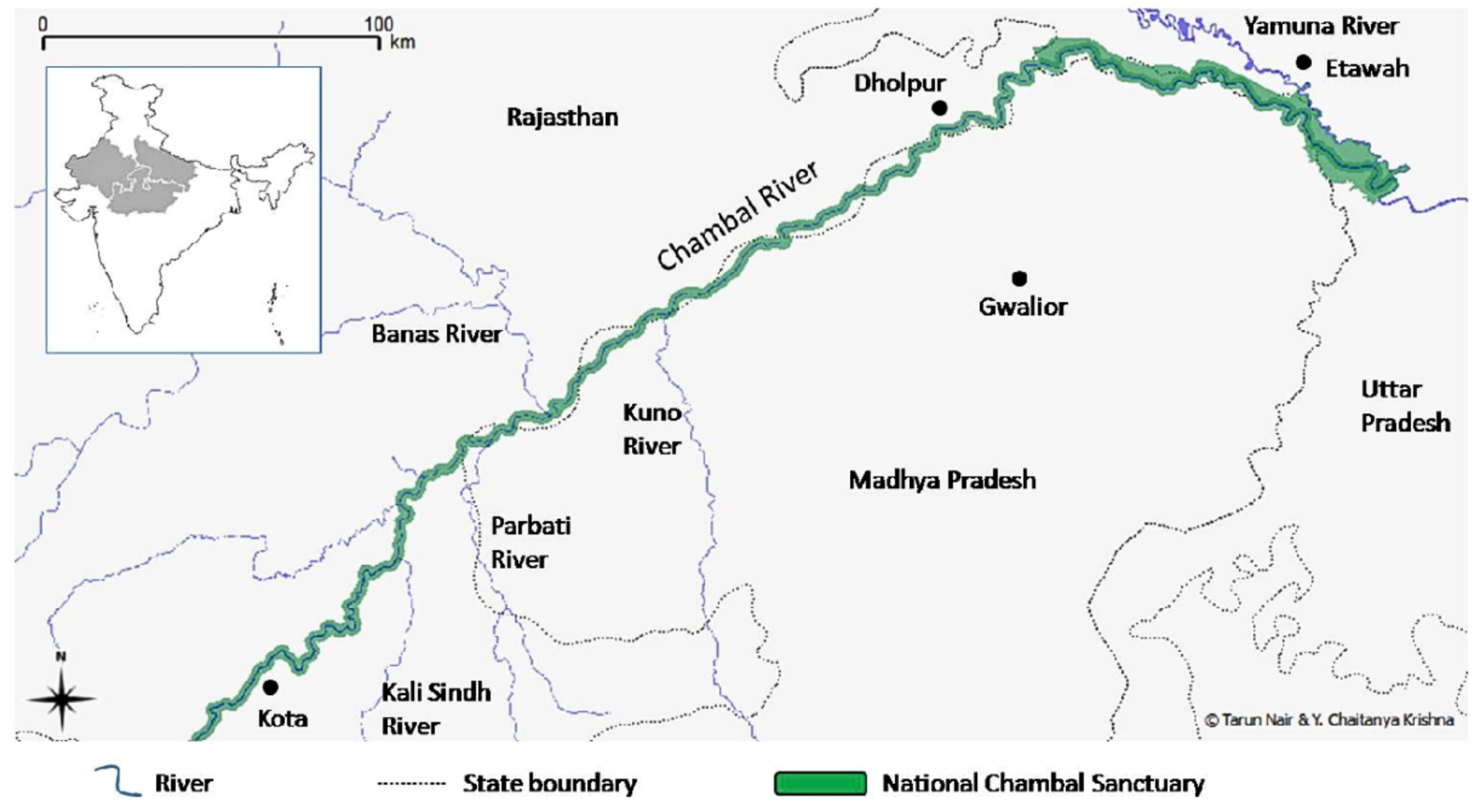
image 62

Key Facts about Gharials:

  • Species of long-snouted fish-eating crocodilians. 
  • Physical Characteristics:
    • Bulbous snout tip of adult males, resembling an inverted pot. 
    • Males grow 3-6 meters, and females 2.6-4.5 meters in length.
  • Distribution: Chambal River (~90% population in wild); other freshwater river systems of India. 
  • Conservation status:
    • IUCN status: Critically Endangered
    • Schedule I of the Wildlife Protection Act 1972
    • CITES: Appendix I

UPSC PYQ 2017

Q. If you want to see gharials in their natural habitat, which one of the following is the best place to visit?

(a) Bhitarkanika Mangroves

(b) Chambal River

(c) Pulicat Lake

(d)  Deepor Beel

Answer: (b)
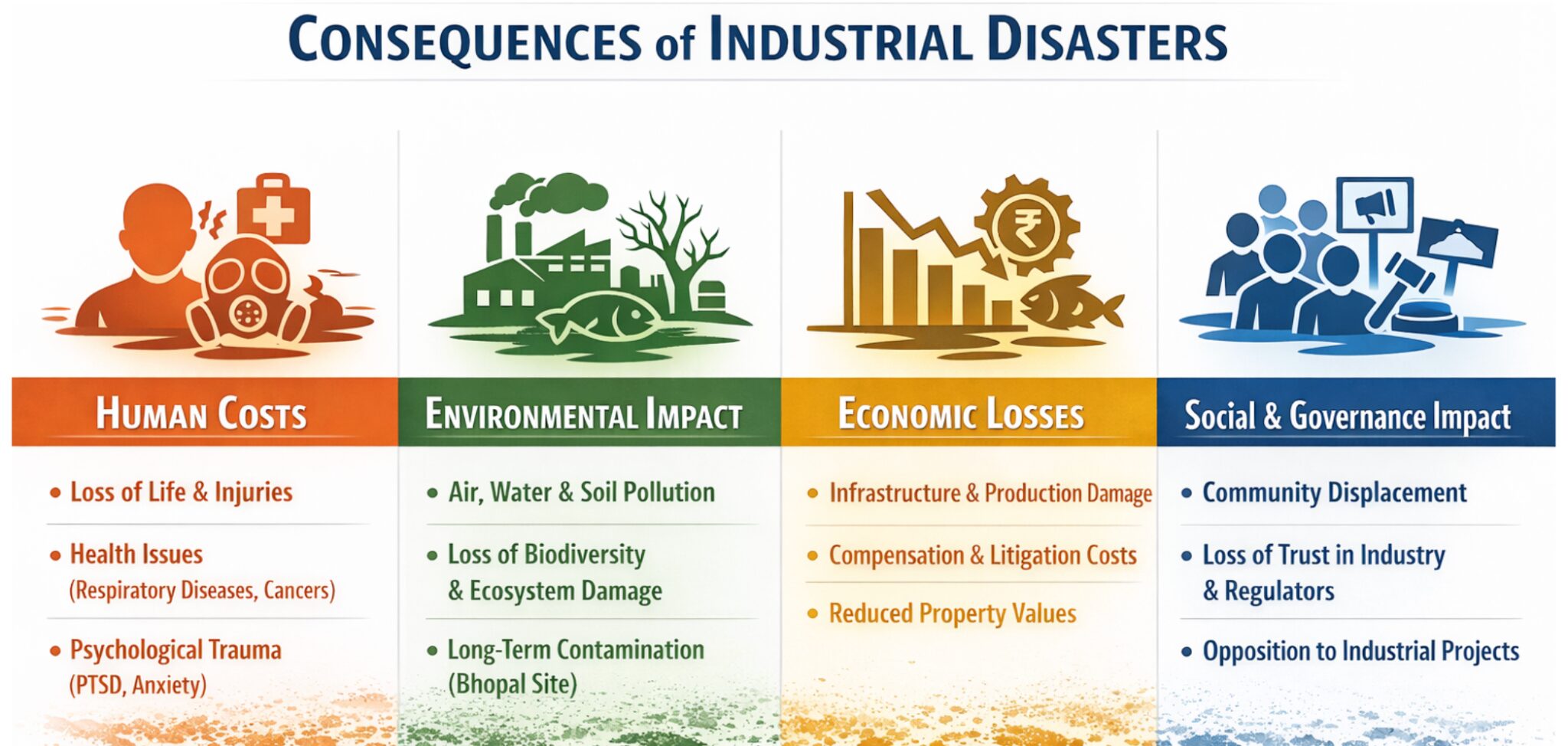
Industrial Disasters in India

Open article →Download PDF

Why in News?

A boiler explosion at Vedanta Limited’s thermal power plant in Sakti district, Chhattisgarh, has resulted in a death toll of at least 24 workers. The incident reflects systemic lapses facing the Indian industry— inadequate safety protocols, insufficient training, and weak enforcement of regulations.

UPSC Relevance: GS-3 Disaster Management: Industrial Disasters; GS-3 Economy: Industrial Policy. 

Mains: Industrial Disasters: Causes, Consequences and Way Forward.

What are Industrial Disasters?

  • Industrial disasters are human-induced catastrophic events caused by failures in industrial processes, hazardous material handling, or safety mechanisms. 
  • India’s rapid industrialisation, coupled with weak regulatory enforcement, has led to recurring accidents. E.g., Bhopal Gas Tragedy (1984), Oleum Gas Leak Case (1986), Vizag Gas Leak (2020), Neyveli Lignite Plant Explosion (2020), Vedanta Ltd.’s Thermal Power Plant explosion (2026), etc. 

Causes of Industrial Disasters:

  • Human and Organisational Factors: Negligence and human error (fatigue, lack of training, poor supervision); Violation of safety norms to meet production targets; Poor ventilation, exposure to toxic chemicals; Inadequate use of PPE (Personal Protective Equipment).
  • Technical and Infrastructure Failures: Ageing machinery and lack of maintenance; Faulty design and use of substandard materials; Sudden operational changes (e.g., boiler overloads in recent accidents)
  • Regulatory and Governance Issues: 
    • Weak enforcement of laws, such as: (i) Factories Act, 1948; (ii) Explosives Act, 1884; Low inspection rates and corruption. 
    • Relaxation of Industrial Regulations, as industrial regulations are viewed as a barrier to ease of doing business in India.
  • Structural Factors: Rapid industrialisation without adequate safeguards; Informalisation of labour and contract workers; Urban-industrial clustering increases vulnerability. 
image 63

Govt. Efforts & Legal Measures for Industrial Safety in India:

  • The Factories Act, 1948: The Act aims to provide a safe working environment to factory workers by mandating safety measures and assigning enforcement powers to inspectors.
    • Regulates the health, safety, and welfare of workers in factories. It covers working conditions, ventilation, sanitation, machinery safety and accident prevention; Fire safety provisions. 
    • Mandates the appointment of safety officers in hazardous industries.
  • The 1987 Amendment to the Factories Act (post the Bhopal Gas Tragedy and Oleum Gas Leak) expanded the focus of the Act from solely internal worker safety to include external public and environmental safety. It introduced:
    • Hazardous process industries classification: To include any activity that threatens the health/safety of workers or the general public in the vicinity.
    • Site Appraisal Committees: Mandated to advise the state government on locating and setting up factories involving hazardous processes.
    • Mandatory Disclosure: Occupiers of every factory involving a hazardous process must disclose health hazards and emergency measures to workers, local authorities, and the surrounding public.
    • Emergency Preparedness: Required the formulation of onsite emergency plans and disaster management protocols. 
  • The Environment Protection Act, 1986 (EPA): Umbrella legislation empowering the Central Government to take measures to protect and improve the environment.
    • Set environmental standards for emissions and discharge of pollutants.
    • Regulate industrial location & restrict areas where industries can operate.
    • Conduct inspections, seize equipment, and close/regulate industries. 
  • The EIA Notification, 2006 (under EPA) mandates Prior Environmental Clearance (EC) for new projects, expansion, or modernisation of industries listed in its Schedule. The project proponents must obtain EC before starting construction. It also includes provisions for monitoring, and industries are liable for environmental damages.
  • The Public Liability Insurance Act, 1991, provides immediate relief to victims of accidents involving hazardous substances. It mandates: (i) hazardous industries must take insurance policies; (ii) Establishment of the Environment Relief Fund (ERF). The Act provides for the “no-fault liability” principle, which means that the industry can be held liable even if it had done everything in its power to prevent the accident. 
  • Disaster Management Act, 2005: Established the National Disaster Management Authority (NDMA). NDMA issues guidelines on chemical and industrial disasters. 
  • The Occupational Safety, Health and Working Conditions Code, 2020: The OSH Code replaces 13 Central Labour laws with a single comprehensive legislation. It enhances safety standards by setting mandatory rules for machinery use, ventilation, fire safety, and hazardous material handling, while introducing a single registration for businesses to improve compliance.

Way Forward:

  • Frame a National Policy on Industrial Disasters: Industrial disaster management in India is regulated by a combination of the Environment (Protection) Act, Factory Act, and NDMA guidelines rather than a single policy document. India needs a more streamlined, centralised approach for better coordination and improved accountability.
  • Adoption of ILO conventions and global safety standards: India has not ratified the Occupational Safety and Health Convention, 1981 (No. 155) or the Promotional Framework for Occupational Safety and Health Convention, 2006 (No. 187). 
  • Proper Inspection: Ensure compliance with the parameters of storage of raw materials, manufacturing processes, and storage. Timely inspection of all equipment as per the safety protocols. Ensure adequate training and equip inspectors with modern tools (AI). Impose higher penalties for non-compliance, punitive action and immediate closure of non-compliant units.
  • Improved Governance: Regular third-party safety audits. Worker participation in safety audits. Use of AI/IoT for real-time monitoring. 
  • Industrial Zoning:  Zoning/ Mapping of industrial zones based on hazard potential. Strict enforcement of the Central Pollution Control Board (CPCB) guidelines to maintain a minimum distance (often 50-100+ meters) between hazardous units and residential areas, schools, or hospitals.

India provides the right to a safe workplace, derived mainly from Article 21, and supported by labour and environmental laws. However, to make it fully effective, India needs a shift from mere legal recognition to strict enforcement and accountability. 

Mains Practice Question:

Q. Industrial disasters in India highlight the gap between legal provisions and ground-level enforcement. Discuss.