Why in News?
India is witnessing early and intense heatwave conditions in 2026, with temperatures crossing 40°C in several regions as early as April. The India Meteorological Department (IMD) has issued alerts for multiple regions, indicating a prolonged and severe summer ahead.
UPSC Relevance
GS-I: Geography (Climatology)
GS-II: Governance, Public Health
GS-III: Environment, Disaster Management, Climate Change
Understanding Heatwaves in India
A heatwave is not just high temperature, but a deviation from normal climatic conditions.
- According to IMD:
- Heatwave: Temperature ≥ 5°C above normal for at least 2 days
- Severe heatwave: ≥ 7°C above normal
- These thresholds vary based on geography (plains, coastal areas, hills).
Heatwave-Prone Regions
India has two major heatwave belts:
- Core Heatwave Zone
Covers northwest and central India (Rajasthan, MP, UP, Bihar, Jharkhand).
These areas experience heatwaves due to high-pressure systems causing descending hot air. - Eastern Coastal Zone
Includes Andhra Pradesh and Odisha.
Heatwaves occur due to disruption of sea breezes by hot inland winds.
Traditionally, southern and northeastern India were less affected, but climate projections indicate increasing vulnerability.
Why are Heatwaves Intensifying?
1. Climate Change and Global Warming
Rising global temperatures are increasing:
- Frequency of heatwaves
- Duration of heat spells
- Night-time temperatures (reducing recovery time)
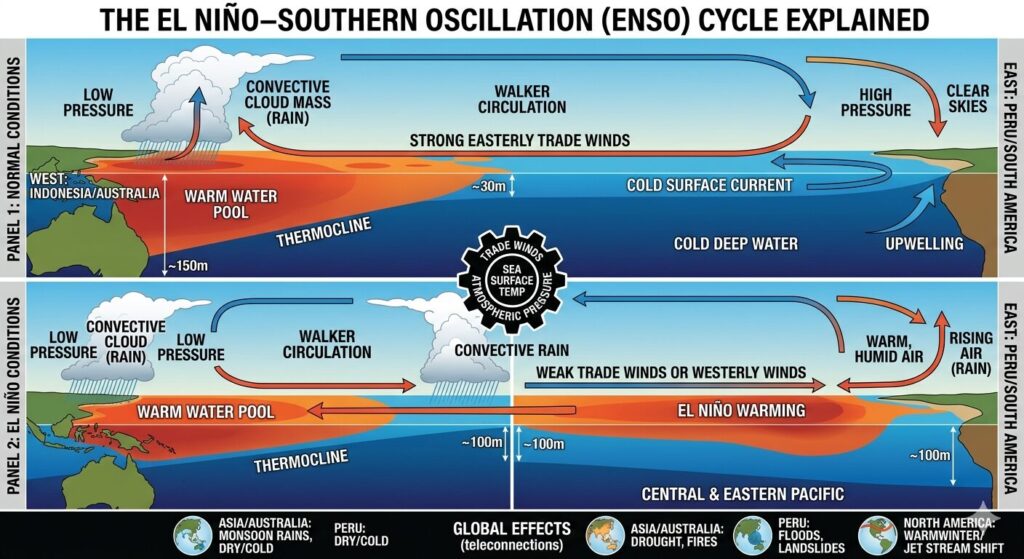
2. Role of El Niño
The El Niño Southern Oscillation plays a crucial role:
- El Niño years → hotter summers, weaker monsoon
- Leads to prolonged and severe heatwaves
- Impact often continues into the following year
3. Atmospheric Conditions
- Lack of western disturbances and thunderstorms reduces natural cooling
- Reduced convection traps heat near the surface
4. Urban Heat Island Effect
Urban areas experience higher temperatures due to:
- Concrete surfaces absorbing heat
- Lack of vegetation
- High population density
5. Changing Land Use
- Loss of green cover
- Expansion of built-up areas
- Reduction in water bodies
Impacts of Heatwaves
1. Health Impacts
- Increased cases of heatstroke, dehydration, and cardiovascular stress
- Warmer nights worsen health outcomes
- Vulnerable groups: elderly, children, outdoor workers
Studies show significant rise in heat-related mortality risks, especially in prolonged heat conditions.
2. Economic Impact
- Around 247 billion work-hours lost globally (2024) due to heat stress
- Most affected sectors:
- Construction
- Agriculture
- Informal sector
This leads to:
- Loss of income
- Reduced productivity
3. Agricultural Impact
- Heat accelerates crop maturity → reduces yield
- Affects rabi crops during harvesting stage
- Can lead to:
- Food insecurity
- Inflationary pressures
4. Social Impact
- Increased burden on healthcare systems
- Disruption of daily activities (schools, work, elections)
- Reduced voter turnout in extreme heat conditions
5. Climate and Habitability Concerns
If current trends continue:
- Some regions may approach human survivability limits
- Heat stress could make outdoor work increasingly unsafe
Heatwaves as a Disaster
Currently, heatwaves are not officially classified as a notified disaster under the Disaster Management Act.
- Recommendation by Finance Commission:
- Include heatwaves as a notified disaster
- Allow use of State Disaster Response Funds (SDRF)
This would improve:
- Relief measures
- Compensation
- Preparedness
Institutional Response: Heat Action Plans (HAPs)
India’s primary policy tool is the Heat Action Plan (HAP).
Key Features
- Early warning systems
- Public awareness campaigns
- Provision of drinking water
- Adjusted work/school timings
- Cooling shelters
Limitations
Most HAPs:
- Focus on short-term emergency response
- Lack funding for long-term structural solutions
They often fail to address:
- Urban planning issues
- Worker safety regulations
- Climate-resilient infrastructure
Recent IMD Advisory
The India Meteorological Department has issued:
- Alerts for northwest, central and peninsular India
- Warning of:
- Temperatures between 40–44°C
- Hot and humid coastal conditions
- Warm nights increasing discomfort
Precautionary Measures Suggested
- Avoid exposure during peak hours
- Stay hydrated
- Wear light clothing
- Special care for vulnerable groups
Way Forward
1. Strengthening Heat Action Plans
Heat Action Plans must move beyond emergency responses and incorporate long-term adaptation strategies. This includes urban re-greening, cool roofing, and climate-sensitive urban planning to reduce heat absorption and improve livability.
2. Legal Protection for Workers
There is a need to introduce heat-safety regulations, especially for informal workers in construction and agriculture. Mandating rest breaks, shaded workspaces, and adjusted working hours can significantly reduce health risks.
3. Recognising Heatwaves as a Disaster
Classifying heatwaves as a notified disaster will enable states to access funds for relief and preparedness. This would strengthen institutional response and improve compensation mechanisms.
4. Urban Planning Reforms
Cities must adopt:
- Green infrastructure (parks, urban forests)
- Reflective materials in buildings
- Preservation of water bodies
This will reduce the urban heat island effect and enhance resilience.
5. Strengthening Healthcare Systems
Public health systems need to:
- Deploy mobile health units during peak heat
- Ensure doorstep delivery of essential services
- Improve heat-related disease surveillance
This reduces both mortality and income loss for vulnerable populations.
6. Climate Mitigation and Global Cooperation
India should actively participate in global initiatives to reduce fossil fuel dependence. This will not only address long-term climate risks but also improve access to climate finance for adaptation measures.
7. Data and Early Warning Systems
Improving forecasting capabilities and dissemination of real-time data will help local administrations take timely preventive actions and reduce casualties.
Conclusion
Heatwaves are no longer seasonal anomalies but structural challenges linked to climate change, urbanisation, and socio-economic vulnerability. Addressing them requires a shift from reactive measures to long-term climate resilience and inclusive policy design.
India’s response must integrate science, governance, and social protection to safeguard both lives and livelihoods in an increasingly warming world.
Practice Questions
Prelims
Q1. With reference to heatwaves in India, consider the following statements:
- A heatwave is declared when temperature rises at least 5°C above normal for two consecutive days.
- Heatwaves are notified disasters under the Disaster Management Act.
- El Niño conditions are associated with increased heatwave intensity in India.
Which of the statements given above are correct?
(a) 1 and 3 only
(b) 2 and 3 only
(c) 1 only
(d) 1, 2 and 3
Answer: (a) 1 and 3 only
Q2. Which of the following regions is known as the core heatwave zone in India?
(a) Northeast India
(b) Northwest and Central India
(c) Coastal Tamil Nadu
(d) Himalayan region
Answer: (b) Northwest and Central India
Mains
Q1. Heatwaves in India are becoming more frequent and intense. Examine the causes and suggest measures to mitigate their impact.
Q2. Critically evaluate the effectiveness of Heat Action Plans in India. What reforms are needed to make them more effective?