Why in News?
The Ministry of Earth Sciences inaugurated AATAL at IITM’s Delhi branch on October 24 to combine atmospheric chemistry, aerosol toxicity analysis and source evidence for Delhi-NCR air-quality management.
- AATAL brings atmospheric measurements and chemical analysis together to examine gases, fine particles, metals and other constituents of polluted air.
- The ministry describes source apportionment as a means to estimate contributions from transport, industry, burning, dust and pollution transported from surrounding regions.
- Integration with IITM’s AIRWISE combines observations, forecasts and source information to support decisions by CAQM and other implementing agencies.
- These are measurement and decision-support capabilities; the inauguration does not establish that pollution has already fallen or that an individual patient’s illness has been explained.
- Concentration, composition and source contribution answer different questions. A useful warning about polluted air does not by itself reveal which activities should be targeted.
- Scientific interpretation must connect laboratory findings with practical intervention and follow-up measurement; acquiring better instruments alone cannot deliver cleaner air.
UPSC Relevance
Prelims Relevance
- Aerosol: solid particles or liquid droplets suspended in a gas.
- PM2.5: fine inhalable particles generally 2.5 micrometres or smaller in diameter.
- Chemical characterisation: identifying the constituents of an atmospheric sample.
- Source apportionment: estimating the contributions of different sources to measured pollution.
- Secondary particles: particles formed through reactions in the atmosphere rather than emitted directly.
Mains Relevance
GS Paper 3
- Using atmospheric science to target pollution controls and assess their effects.
- Distinguishing measurements, model estimates and evidence of environmental improvement.
GS Paper 2
- Coordination between scientific institutions, pollution-control agencies and health authorities.
Essay
- Better public decisions require both useful evidence and institutions able to act on it.
Background and Context
What the Laboratory Measures
The first distinction is between how much pollution is present and what that pollution contains; each measurement supplies a different part of the explanation.
- Particulate matter contains solid particles and liquid droplets. Measuring its concentration establishes the amount present in air, while chemical analysis examines the mixture that produces that reading and may carry different implications for control.
- AATAL’s stated capability includes examining atmospheric gases, fine particles, metals and toxic elements. These observations can deepen understanding of the mixture without reducing every pollutant to a single undifferentiated category of smoke or dust.
- Primary particles enter the air directly from sources such as fires, roads and construction. The US EPA explains that other particles form through atmospheric reactions involving gaseous pollutants, complicating the path from emissions to exposure.
- Chemical transformation matters because the material measured at a monitoring location need not be identical to what originally left an emission source. Understanding reactions helps explain why simply identifying visible smoke cannot describe the whole mixture.
- Potential toxicity is a separate question from mass concentration. The ministry says composition evidence can support health-risk assessment, but a laboratory observation does not independently diagnose illness or determine the exposure history of a particular person.

How Measurements Become Source Evidence
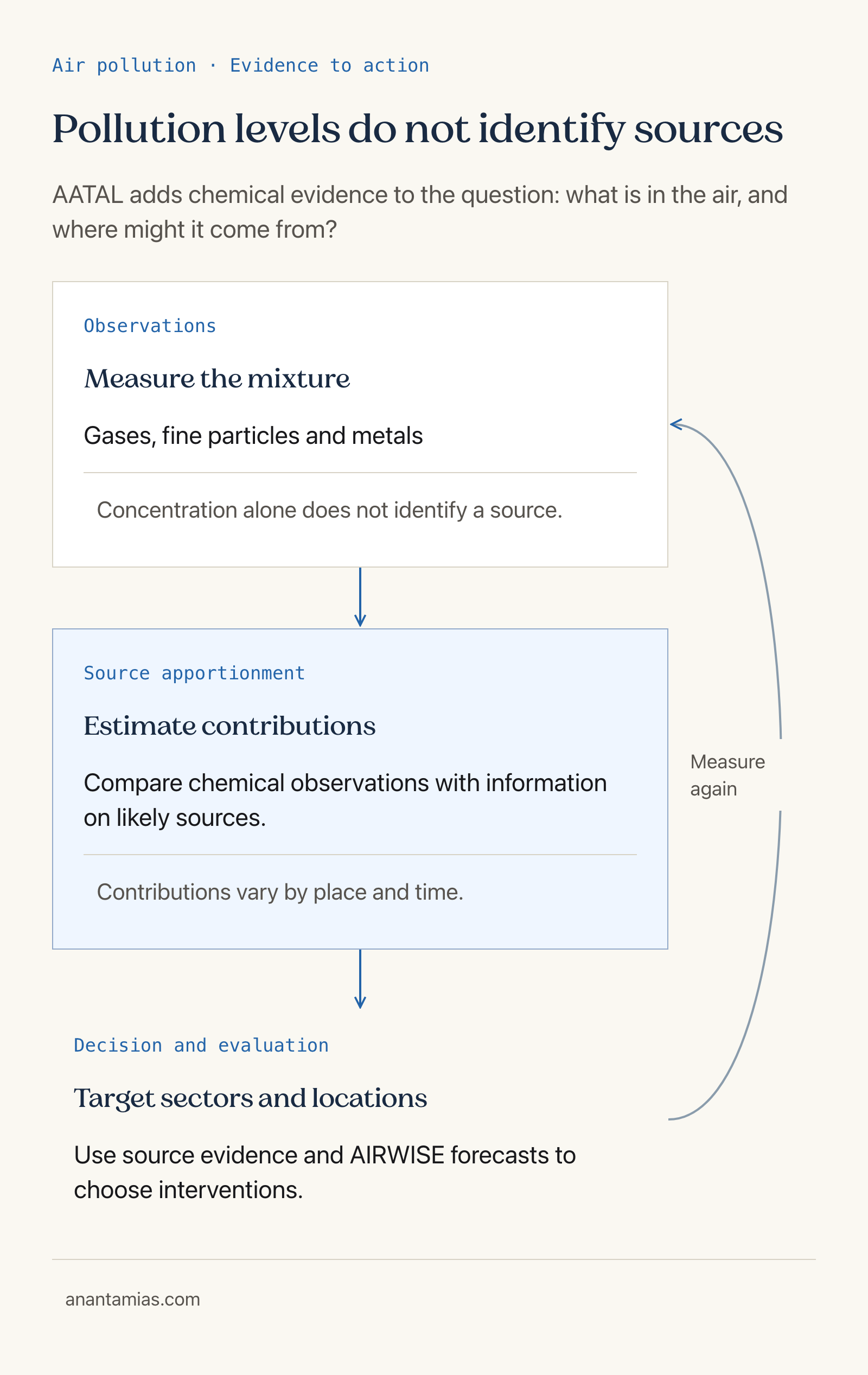
Source apportionment is an inference from observations and analytical methods; the instrument does not directly read the identity of every polluter.
- Receptor models work from chemical and physical characteristics measured where pollution is received. They help identify and estimate contributing source types, complementing other approaches to understanding how emissions affect the air at that location.
- Source characteristics and patterns within measured data help relate a mixed sample to plausible contributors. This is a reasoned estimation process, so the interpretation and quality of the underlying observations matter alongside the equipment used.
- Similar source signatures can limit separation. The EPA explains that chemical mass-balance modelling cannot distinguish sources with similar properties; a contribution assigned to a source category does not automatically identify one specific emitting facility.
- Secondary formation makes attribution harder because atmospheric reactions change the mixture. Supporting analysis can help interpret these contributions; the distinction prevents a simple list of measured chemicals from being treated as a complete explanation of origin.
- Place and time must remain attached to an estimate. A source contribution observed in one setting should not be presented as a permanent share for the entire region, especially when comparing pollution episodes or evaluating interventions.
Turning Evidence Into Accountable Action
The practical value lies in choosing a suitable response, carrying it out and checking whether the intended environmental result follows.
- Targeted intervention uses source evidence to focus attention on relevant sectors and locations. The ministry identifies CAQM and pollution-control agencies as users of this information, with scientific institutions supplying evidence rather than replacing implementation responsibilities.
- Forecasts and observations perform complementary jobs: one supports preparation for expected conditions, while the other records what is measured. Combining them can support timely choices without turning a forecast into proof that an intervention has succeeded.
- Regional coordination matters because the release includes pollutants transported from surrounding areas. A city’s response may require cooperation beyond its administrative boundary, linking local controls with attention to contributions arriving from elsewhere in the region.
- Warning thresholds and source analysis should inform each other. GRAP’s staged response addresses deteriorating conditions, while source evidence helps explain which contributing activities deserve attention within the wider response and its implementation.
- Evaluation should compare the action taken with subsequent measurements and relevant conditions. A lower reading alone is insufficient to establish the causal story; transparent interpretation helps agencies distinguish useful control measures from unsupported claims of success.
Way Forward
Connect Analysis With Decisions
- Publish methods, uncertainty and the place and period represented alongside source estimates so implementing agencies can use them within their actual evidentiary limits.
- Link identified priorities to named implementing agencies and follow-up measurements, keeping the scientific assessment and the administrative response traceable.
- Use health and environmental expertise together when interpreting composition, while communicating clearly that source estimates and potential toxicity are different from individual medical diagnosis.
Conclusion
- AATAL’s significance is the connection between atmospheric measurements, chemical composition and decisions about pollution sources. Its success must be assessed through useful interpretation, targeted action and evidence of outcomes, rather than the inauguration or equipment alone.
- Evidence has different levels: a concentration reading, a source estimate and an observed improvement establish different things. Keeping these distinctions clear supports more credible environmental policy and more accountable claims about the results of intervention.
UPSC Practice Questions
Prelims MCQ 1
With reference to atmospheric particulate matter and source apportionment, consider the following statements:
- All atmospheric particulate matter is emitted directly as particles.
- Chemical analysis can help estimate contributions from different source types.
- A source-category estimate does not necessarily identify a specific emitting facility.
How many of the above statements are correct?
(a) Only one (b) Only two (c) All three (d) None
Answer: (b) Only two
Explanation:
Statements 2 and 3 are correct. Secondary particles form through atmospheric reactions. Source apportionment estimates contributions, while similar source characteristics can limit identification of particular emitters.
Prelims MCQ 2
Which statement best explains the policy value of combining pollution measurements with source apportionment?
(a) It makes implementation by pollution-control agencies unnecessary. (b) It proves that every illness in the monitored area was caused by one pollutant. (c) It establishes permanent source shares for an entire region from one observation. (d) It helps target relevant sources and evaluate interventions, subject to the limits of the evidence.
Answer: (d) It helps target relevant sources and evaluate interventions, subject to the limits of the evidence.
Explanation:
Measurements and source estimates can guide action and assessment. Their interpretation depends on methods and the conditions represented; they do not independently prove individual illness, permanent shares or successful implementation.
UPSC Mains Questions
- Explain how chemical characterisation and source apportionment can improve urban air-quality management. Discuss the limits that policymakers must consider.
- How can scientific institutions and implementing agencies connect pollution-source evidence with accountable action? Discuss with reference to AATAL and Delhi-NCR.
Sources: PIB, Ministry of Earth Sciences and US Environmental Protection Agency.
Frequently Asked Questions
What is AATAL?
AATAL is the Integrated Atmospheric Chemistry and Aerosol Toxicity Analysis Laboratory inaugurated at IITM’s Delhi branch. It combines atmospheric measurements, chemical analysis and source evidence to support air-quality management in Delhi-NCR.
How does source apportionment differ from measuring pollution levels?
Concentration measures how much pollutant is present. Source apportionment uses observations and analytical methods to estimate contributions from different sources. It helps explain the mixture rather than simply indicating its overall level.
Why do secondary particles complicate source identification?
Secondary particles form through atmospheric reactions involving gaseous pollutants. The measured mixture can differ from the original emissions, so identifying its sources may require supporting analysis rather than a direct match to one visible emitter.
Does the new laboratory prove that Delhi’s air has improved?
No. The announcement describes analytical and decision-support capabilities. Cleaner air requires effective action and follow-up assessment. Better measurements can guide that process, but the laboratory’s inauguration does not itself establish an improvement.
Tell Google you want more of this.
Add Anantam IAS as a preferred sourceOne tap, and this site shows up more often in your own Top Stories, AI Overviews and AI Mode. Remove it any time.