
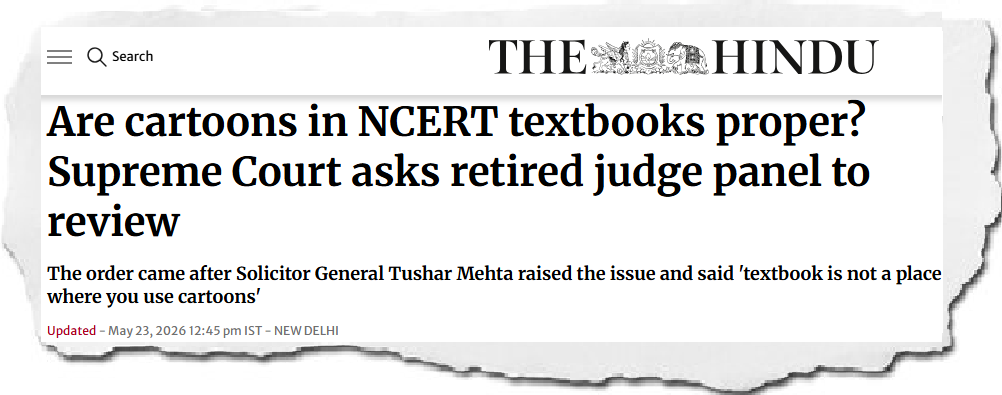
Why in News?
The Supreme Court has asked a committee headed by former Supreme Court judge Justice Indu Malhotra to examine the use of cartoons in NCERT textbooks after the Solicitor General raised concerns regarding their appropriateness in school material. The issue emerged during hearings relating to content in a Class 8 Social Science textbook and has triggered a broader debate on the role of satire, pedagogy and freedom of expression in education.
UPSC Relevance
Prelims: NCERT, freedom of speech and expression, judicial precedents, constitutional provisions related to education.
Mains:
GS II: Issues relating to education, role of institutions, freedom of expression, constitutional values and judicial intervention.
Background/Context
Education is not merely about transmitting factual information; it also develops critical thinking, creativity and democratic values. Textbooks have increasingly adopted illustrations, cartoons and visual methods to simplify complex concepts and improve student engagement.
However, educational content occasionally becomes controversial when questions arise regarding ideological bias, representation of institutions, satire or age appropriateness. Similar debates had previously emerged over cartoons depicting political leaders and constitutional events in educational material.
The recent controversy concerns whether satire and cartoons are pedagogically appropriate within school textbooks and whether such content risks influencing students in unintended ways.
Understanding Cartoons and Satire in Educational Content
Cartoons in educational material are not merely decorative illustrations. They often serve multiple educational functions:
Simplification of complex issues
Political and social issues can often be difficult for children to understand through text alone. Cartoons can simplify abstract ideas through visual representation and relatable examples.
Encouraging critical thinking
Cartoons frequently contain symbolism, humour and implicit messages. Analysing them may encourage students to interpret meaning rather than simply memorise information.
Improving engagement and retention
Visual learning techniques improve attention span and help students retain information more effectively compared to purely text-based content.
Promoting democratic values
Exposure to different viewpoints, including criticism and satire, may strengthen democratic culture and encourage informed citizenship.
At the same time, critics argue that such content should be carefully designed considering the age and maturity of students.
Key Issues Emerging from the Debate
Age appropriateness of educational content
School children belong to different cognitive and emotional stages of development. Material suitable for senior secondary students may not be appropriate for younger students.
Young students may interpret satire literally rather than contextually, creating concerns regarding misunderstanding.
Freedom of expression versus institutional sensitivity
Educational institutions seek to encourage open thinking while maintaining respect for constitutional institutions.
Excessive restrictions may reduce space for debate and critical inquiry, while unrestricted content may generate concerns regarding institutional credibility.
Judicial intervention in educational matters
The Supreme Court’s intervention raises broader questions regarding the extent to which courts should shape curriculum content.
Educational curriculum is generally considered a domain involving expert pedagogical bodies rather than judicial oversight.
Risk of ideological contestation
Textbooks frequently become sites of political and ideological contestation.
Changes in governments often lead to demands for curriculum revision, creating concerns about consistency and academic autonomy.
Constitutional and Legal Dimensions
Article 19(1)(a): Freedom of Speech and Expression
The Constitution guarantees freedom of speech and expression, including artistic and creative expression.
However, Article 19(2) permits reasonable restrictions in specific circumstances.
Article 21A: Right to Education
The State has an obligation to provide quality education that develops the full potential of children.
Quality education includes development of reasoning and critical thinking abilities.
Article 51A(h): Fundamental Duty
Citizens are expected to develop scientific temper, humanism and the spirit of inquiry and reform.
Educational content plays an important role in achieving this objective.
Important Judicial Observations
The Supreme Court in Indibily Creative (P) Ltd. v. State of West Bengal recognised satire as an important form of expression.
The Court observed that satire possesses a unique ability to communicate ideas and stimulate public debate. It cautioned against allowing overly sensitive interpretations to suppress expression.
The Court had earlier also stated that the value of satire should be assessed from the perspective of a reasonable person rather than an excessively sensitive individual.
Arguments Supporting Use of Cartoons in Textbooks
Learning through visual pedagogy
Research increasingly suggests that visual aids improve comprehension and reduce learning barriers.
Development of critical citizenship
Exposure to humour and alternative perspectives helps students understand democratic culture and public discourse.
Global educational practices
Many countries use illustrations, comics and visual narratives in school textbooks to improve conceptual understanding.
Arguments Opposing Use of Cartoons in Textbooks
Possibility of misinterpretation
Children may lack the maturity needed to understand satire properly.
Potential institutional impact
Depictions of constitutional bodies or personalities may unintentionally create biased impressions.
Contextual sensitivity
Certain illustrations may become controversial because of political or cultural interpretations.
Challenges in Textbook Development in India
India’s educational system faces multiple challenges while preparing curriculum:
- Diversity of linguistic, cultural and regional contexts means content suitable in one context may become controversial in another.
- Balancing constitutional values with pedagogical innovation remains difficult.
- Curriculum revision often becomes vulnerable to ideological and political pressures.
- Maintaining academic autonomy while ensuring accountability continues to be a challenge.
Way Forward
Strengthen expert-led curriculum development
Textbook content should primarily be designed and reviewed by educational experts, child psychologists and subject specialists rather than through ad hoc interventions.
Establish age-sensitive content frameworks
Visual material should be categorised according to cognitive and emotional suitability across different age groups.
Encourage contextual learning
Cartoons and illustrations should be accompanied by explanatory questions that guide students towards critical interpretation.
Preserve academic freedom with safeguards
The objective should be responsible expression rather than excessive censorship, ensuring that learning spaces continue to encourage inquiry and debate.
Ensure transparent review mechanisms
Regular review processes involving educators, parents and experts can reduce controversy and increase trust.
Conclusion
The issue is not merely whether cartoons should appear in textbooks, but how educational material should balance creativity, critical thinking and sensitivity. Democratic education requires students to engage with ideas, question assumptions and understand institutions thoughtfully. The challenge lies in designing content that informs and inspires without creating confusion or unnecessary controversy.
Practice Questions
Prelims Question 1
With reference to freedom of speech and expression in India, consider the following statements:
- Satire is not protected under Article 19(1)(a) of the Constitution.
- Reasonable restrictions on freedom of speech are provided under Article 19(2).
- The Supreme Court has recognised satire as a legitimate form of expression.
Which of the statements given above is/are correct?
(a) 1 only
(b) 2 only
(c) 2 and 3 only
(d) 1, 2 and 3
Correct Answer: (c)
Explanation: Article 19(1)(a) protects freedom of expression including satire, while Article 19(2) provides reasonable restrictions. The Supreme Court has recognised satire as a protected form of expression.
Prelims Question 2
Which among the following Fundamental Duties directly promotes critical thinking and scientific inquiry?
(a) Protecting public property
(b) Developing scientific temper and spirit of inquiry
(c) Protecting sovereignty and integrity
(d) Promoting harmony
Correct Answer: (b)
Explanation: Article 51A(h) directs citizens to develop scientific temper, humanism and the spirit of inquiry and reform.
Mains Question 1
- “Educational institutions should balance critical thinking with institutional sensitivity.” Discuss in the context of textbook content and constitutional values.
- Discuss the role of freedom of expression and satire in education. Should educational content be subjected to judicial scrutiny? Examine.
Tell Google you want more of this.
Add Anantam IAS as a preferred sourceOne tap, and this site shows up more often in your own Top Stories, AI Overviews and AI Mode. Remove it any time.