Why in News?
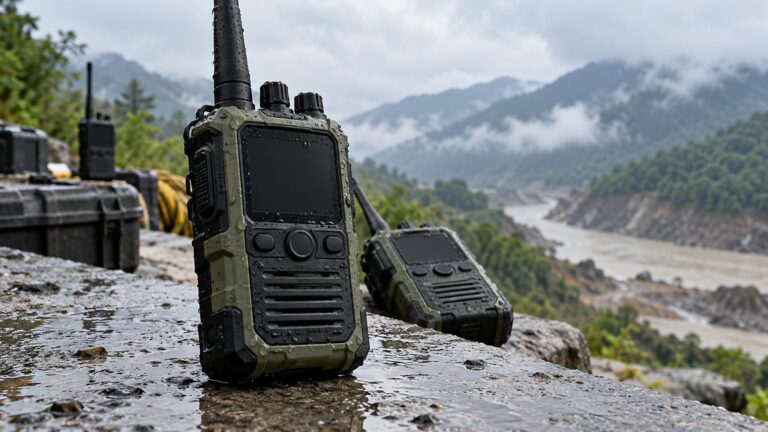
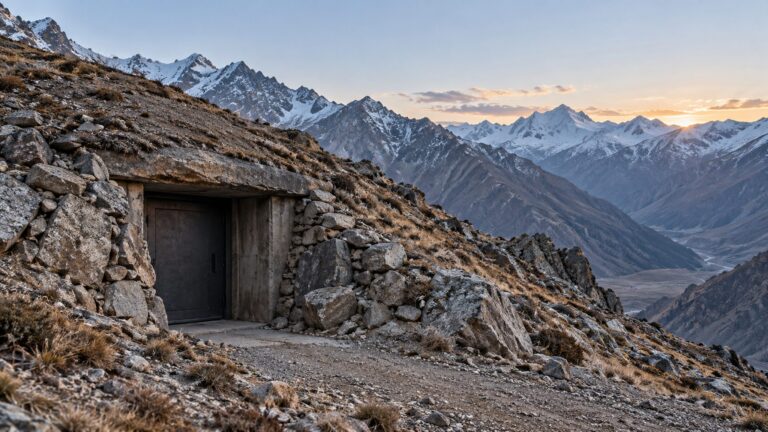
Pakistan has been conducting Operation Shaban in Balochistan since early July after an attack on police personnel near the Mangi Dam area of Ziarat. Pakistan’s state broadcaster describes it as a joint operation by the Pakistan Army, Frontier Corps Balochistan and provincial police, combining ground action, aerial support and intelligence-based operations.
On 16 July, Radio Pakistan said security sources claimed 91 militants had been killed specifically in Operation Shaban and 129 in the operation plus other intelligence-based actions since 5 July. These are Pakistani official figures, not independently verified totals. Initial independent reporting confirmed nine police deaths in the triggering attack, while later accounts connected to the subsequent protest cited a larger cumulative toll, so the numbers should not be merged without qualification.
- Operation Shaban began amid a sharp security escalation in and around Ziarat and Quetta.
- Pakistan’s official reporting calls some targets Fitna al-Khawarij, its preferred label for the Tehreek-e-Taliban Pakistan, or TTP; that terminology is an attribution, not a neutral group name.
- The wider province also faces violence by Baloch separatist organisations, including the Baloch Liberation Army, whose ethnonationalist goals differ from the TTP’s Islamist project.
- The episode has revived debate over whether a security operation can produce durable peace without political inclusion, accountable policing and a credible settlement of resource grievances.
The development matters in the context of:
- Balochistan borders Iran and Afghanistan and opens onto the Arabian Sea, making local instability a regional-security concern.
- The conflict combines identity, federalism, resource control, underdevelopment and human-rights concerns; reducing it to either terrorism alone or grievance alone misses the interaction.
UPSC Relevance
Prelims Relevance
- Balochistan is Pakistan’s largest province by area and lies in the country’s southwest.
- It shares international borders with Iran and Afghanistan and has a coastline on the Arabian Sea.
- Quetta is the provincial capital; Gwadar is the major CPEC-linked port city on the Makran coast.
- CPEC stands for China-Pakistan Economic Corridor; Gwadar Port and its free zone are major components.
- Reko Diq and Saindak are important copper-gold mining areas; Sui is associated with natural gas.
- Article 172(3) of Pakistan’s Constitution provides for joint and equal vesting of mineral oil and natural gas in a province and the federal government, subject to existing commitments.
- The Baloch Liberation Army is an ethnonationalist separatist organisation; the TTP is a distinct Islamist militant network.
Mains Relevance
GS Paper 2
- India and its neighbourhood: instability inside Pakistan, India-Pakistan allegations and the limits of securitised regional politics.
- China-Pakistan relations: CPEC, Gwadar, security of Chinese personnel and infrastructure, and the strategic reach of the corridor.
- International relations: links among Pakistan, Afghanistan, Iran, China and the Arabian Sea security environment.
GS Paper 3
- Internal security: insurgency, counter-insurgency, intelligence coordination and protection of civilians.
- Security-development nexus: how unequal access to jobs, services, royalties and decision-making can deepen alienation in resource-rich regions.
Essay
- Natural wealth can become a source of conflict when local communities do not see fair voice, benefit or accountability.
- Security operations may suppress violence, but legitimacy determines whether peace lasts.
Background and Context
Geography Shapes the Conflict
Balochistan’s geography creates strategic value and exceptional governance costs at the same time.
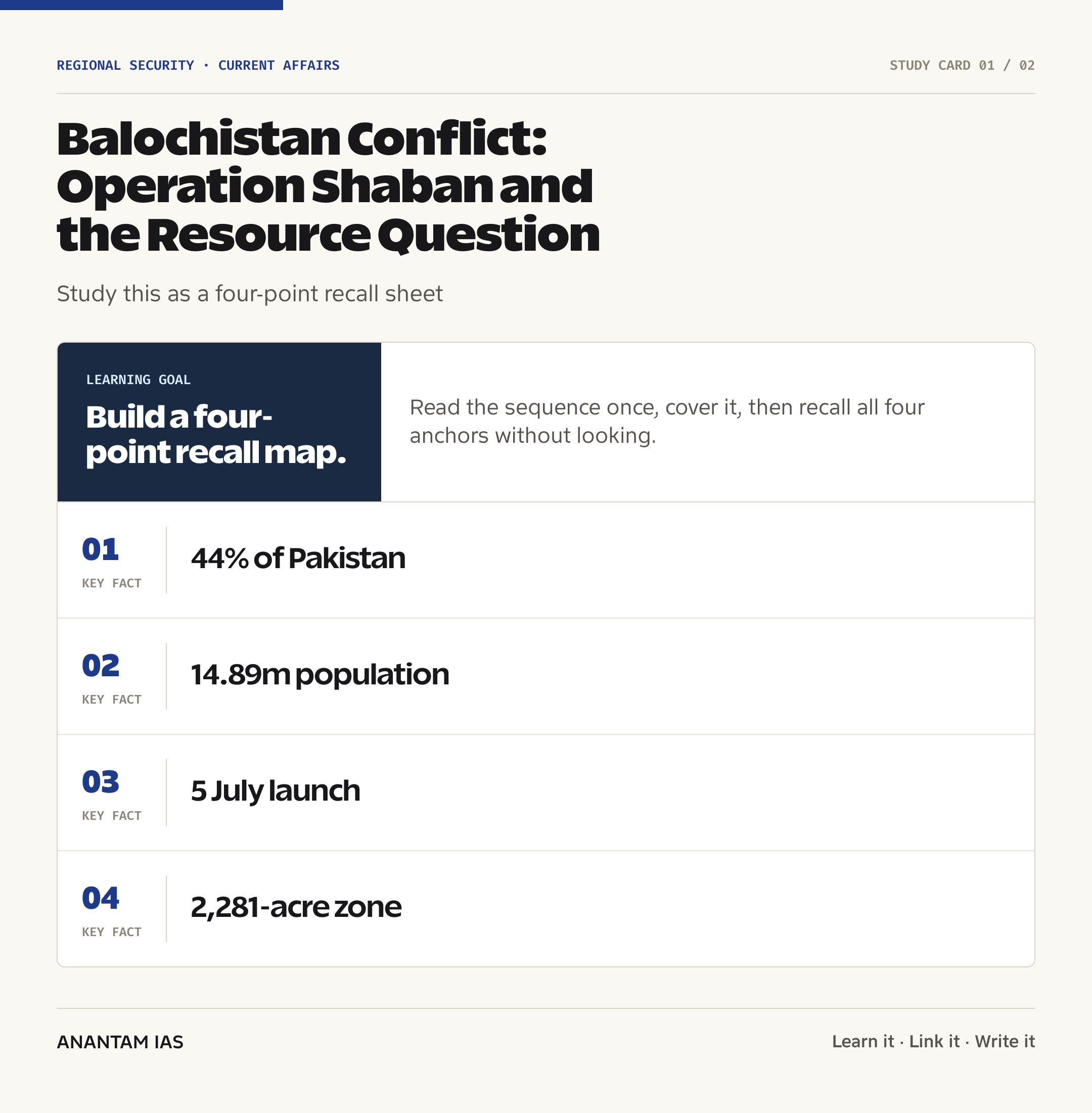
- The province covers 347,190 sq km, close to 44% of Pakistan’s land, but the 2023 census recorded only about 14.89 million residents. Low density, distant settlements and difficult mountains make service delivery and policing expensive.
- Quetta lies in the northeast near historic routes towards Kandahar, while the Makran coast and Gwadar face maritime routes linked to the Persian Gulf.
- The province isn’t ethnically uniform. Baloch communities are prominent across central and southern districts, while many northern districts, including parts around Ziarat, have large Pashtun populations.
- That distinction matters because violence in Balochistan can involve Baloch separatist groups, the TTP, sectarian organisations or criminal networks. Place alone doesn’t identify the actor.
- A useful comparison is the role of difficult terrain and cross-border sanctuaries in border management, where security, local livelihoods and state access must be addressed together.
Historical Roots and Competing Narratives
The present insurgency draws on a disputed history of accession, centralisation and repeated cycles of armed resistance.
- At Partition, present-day Balochistan included British-administered areas and princely entities, the largest being the Khanate of Kalat. Kalat acceded to Pakistan on 27 March 1948.
- Pakistan treats the accession as legal and final. Baloch nationalist narratives contest the circumstances and regard the episode as the starting point of an unresolved political grievance.
- Analysts commonly identify insurgent phases in 1948, 1958-59, 1962-63, 1973-77 and from the early 2000s, though the boundaries between phases vary across accounts.
- The killing of Baloch leader Nawab Akbar Bugti in 2006 during a military operation intensified the current phase and became a powerful symbol in nationalist mobilisation.
- The conflict is not a simple province-versus-state binary. Many Baloch citizens participate in Pakistan’s political, economic and military institutions, while demands range from better provincial autonomy to outright independence.
Resource Wealth and Federal Bargaining
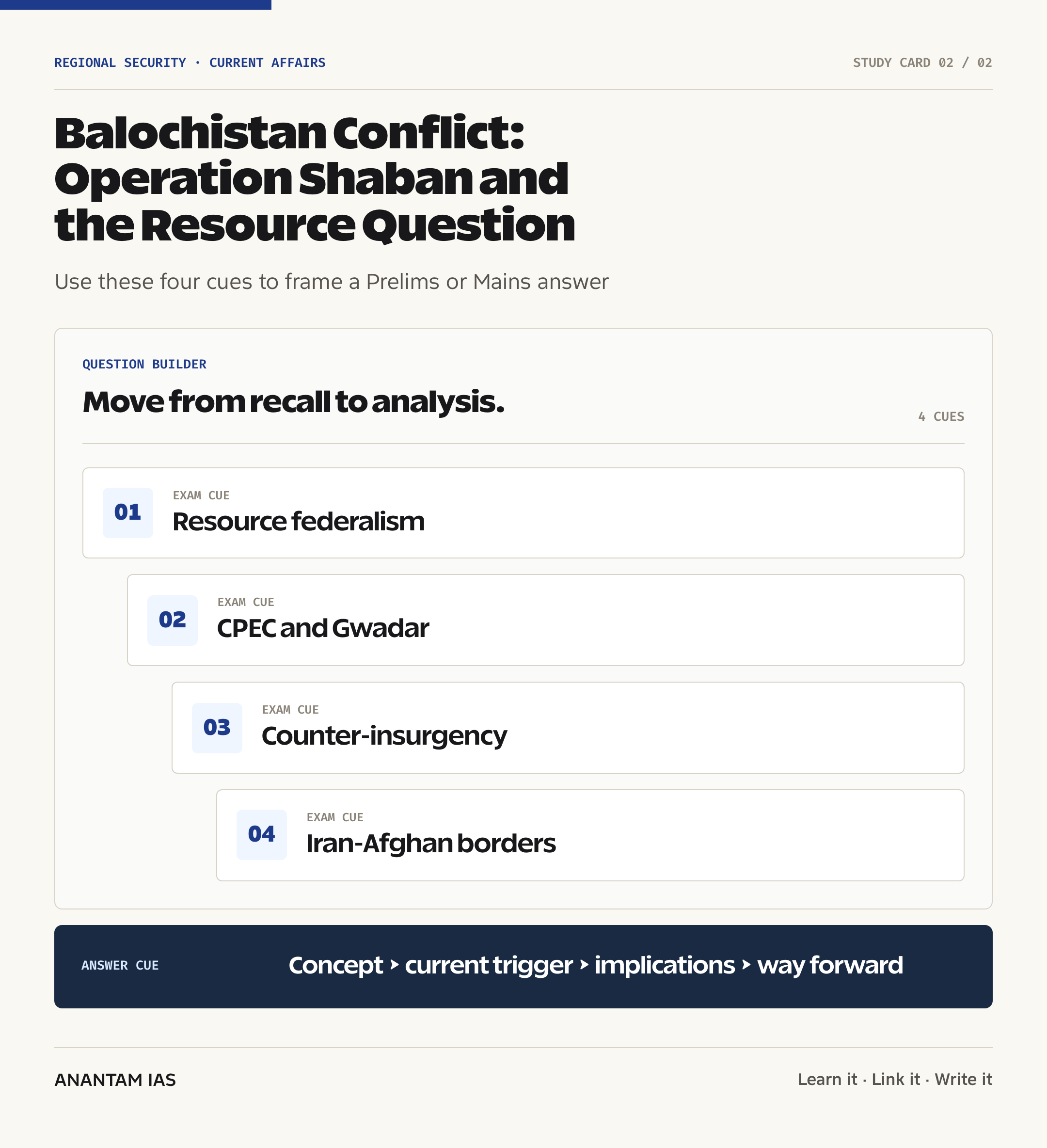
Resource federalism sits at the centre of the dispute because extraction, revenue, jobs and local services are not experienced as the same thing.
- Sui natural gas, copper-gold deposits at Reko Diq and Saindak, coal, chromite and fisheries make the province economically important. Yet infrastructure and human-development gaps remain visible across many districts.
- Local grievances focus on the share of royalties and revenues, the location of processing and procurement, skilled employment for residents, displacement and environmental costs.
- Pakistan’s 18th Constitutional Amendment strengthened provincial autonomy. Article 172(3) now provides that mineral oil and natural gas within a province or adjacent territorial waters vest jointly and equally in that province and the federal government.
- The constitutional clause doesn’t settle every dispute. Project contracts, ownership structures, fiscal transfers, land acquisition and the capacity of provincial institutions still shape who receives the benefit.
- A defensible policy test is not just the value extracted, but whether mining and energy projects finance water, schools, health, transport and local enterprise in affected districts.
- Transparent contracts and independent environmental oversight can turn resources into a peace dividend; opaque decisions can make projects symbols of exclusion.
Gwadar, CPEC and Strategic Infrastructure
Gwadar makes a provincial conflict part of the wider China-Pakistan strategic relationship.
- Gwadar Port lies on the Arabian Sea near the approaches to the Persian Gulf. Pakistan presents it as a trade and trans-shipment hub connecting western China, Pakistan and Central Asia.
- The China-Pakistan Economic Corridor includes port, road, energy, industrial and urban-development projects. Pakistan’s CPEC Secretariat lists a 2,281-acre Gwadar port free zone, with the first 60-acre phase completed.
- For many local residents, the harder questions concern fishing access, water, electricity, land, employment and representation. Infrastructure can coexist with local deprivation if these everyday concerns are not integrated into project design.
- Baloch militant attacks on Chinese-linked targets seek both material disruption and international visibility. Such attacks also raise security costs and can prompt a more coercive state presence.
- The corridor’s strategic geography also intersects with Afghanistan through the Durand Line and with Iran’s coast and Chabahar, making Gwadar more than a commercial-port story.
Different Armed Actors, Different Objectives
Accurate analysis must separate Baloch ethnonationalist militancy from the TTP’s Islamist insurgency.
- The Baloch Liberation Army and other separatist formations frame their struggle around Baloch nationalism, autonomy or independence and opposition to state and external economic control.
- The Tehreek-e-Taliban Pakistan is a separate Islamist militant umbrella opposed to the Pakistani state. It has strong roots in the Afghanistan-Pakistan borderlands and has attacked police, military and civilian targets.
- Security agencies and commentators have alleged tactical contacts among some militant networks, but allegations of contact don’t establish a single command, ideology or political programme.
- Pakistan also repeatedly alleges Indian support for separatist militancy; India rejects the allegation. Without publicly tested evidence, the accusation should be recorded as a competing state claim.
- The distinction mirrors a wider principle in internal-security analysis: threat mapping must identify the actor, objective, recruitment base, finance and territorial pattern before choosing a response.
Operation Shaban and the Limits of Force
Operation Shaban shows the operational logic of counter-terrorism, but also the evidentiary and political limits of official battlefield reporting.
- On 16 July, state media put the toll at 91 militants in Operation Shaban and 129 across the operation and other intelligence-based operations since 5 July. The split confirms that the larger figure isn’t an Operation Shaban-only count.
- These figures were attributed to security sources. No public list, judicial finding or independent verification accompanied the claim, so an exam answer should use phrases such as ‘Pakistan stated’ or ‘official sources claimed’.
- The triggering Mangi-area attack also produced inconsistent public counts as the situation unfolded. Initial reporting confirmed nine police deaths; later reports tied a larger cumulative toll to related violence and the ensuing protest.
- Tactical success can disrupt camps, weapons, leadership and movement. It cannot by itself resolve political alienation, missing-person allegations, weak justice systems or disputed resource-sharing.
- Civilian protection, detention records, transparent investigation and parliamentary or judicial scrutiny are not obstacles to counter-insurgency. They help preserve the legitimacy on which durable intelligence and community cooperation depend.
Way Forward
Separate security tracks by actor
- Use intelligence-led policing against clearly identified armed networks and avoid treating an entire ethnic group, district or protest movement as a security category.
- Create distinct threat assessments for Baloch separatist groups, the TTP, sectarian outfits and criminal networks, with clear inter-agency responsibility.
Open a credible political channel
- Sustain dialogue with elected representatives, peaceful nationalist parties, youth, women, tribal and urban constituencies on autonomy, local government and public services.
- Offer time-bound pathways for surrender, rehabilitation and reintegration where legally possible, without granting impunity for attacks on civilians.
Make resource federalism visible
- Publish contracts, royalty flows, district-level spending and local-employment data for mining, gas, port and CPEC projects.
- Use ring-fenced shares for water, health, education, fisheries and skills in affected communities, backed by independent audits.
Protect rights and strengthen justice
- Investigate allegations of enforced disappearance, unlawful detention and extrajudicial violence through institutions able to compel records and provide remedies.
- Record every detention, notify families, permit legal access and investigate civilian-harm claims. Reliable due process improves both rights protection and intelligence quality.
Conclusion
Operation Shaban may reduce the immediate operational space available to armed groups, but Balochistan’s conflict is rooted in more than one organisation or attack. Geography, repeated insurgent cycles, federal bargaining, rights concerns and unequal perceptions of resource benefit reinforce one another.
The durable lesson is that security and political legitimacy are complements. Precise threat identification, accountable use of force, fair resource-sharing and genuine provincial voice offer a stronger path than either military triumphalism or romanticising armed violence.
UPSC Practice Questions
Prelims MCQ 1
With reference to Balochistan in Pakistan, consider the following statements:
- It shares international borders with both Iran and Afghanistan.
- Gwadar Port is located on its Arabian Sea coast.
- It is Pakistan’s most populous province.
How many of the above statements are correct?
(a) Only one (b) Only two (c) All three (d) None
Answer: (b) Only two
Explanation:
Statements 1 and 2 are correct. Balochistan borders Iran and Afghanistan and contains Gwadar on the Arabian Sea. It is Pakistan’s largest province by area but not its most populous.
Prelims MCQ 2
Which one of the following correctly distinguishes the Baloch Liberation Army from the Tehreek-e-Taliban Pakistan?
(a) Both are official wings of the Balochistan provincial police (b) The BLA is an ethnonationalist separatist group, while the TTP is an Islamist militant network (c) The BLA operates only in Iran, while the TTP operates only in India (d) The BLA administers Gwadar Port, while the TTP manages the CPEC Secretariat
Answer: (b) The BLA is an ethnonationalist separatist group, while the TTP is an Islamist militant network
Explanation:
The BLA frames its violence through Baloch ethnonationalism and separatism. The TTP is a distinct Islamist militant umbrella opposed to the Pakistani state; the two must not be treated as one organisation.
UPSC Mains Questions
- Balochistan shows that resource abundance can coexist with political alienation and poor local outcomes. Examine how federal bargaining, benefit-sharing and accountable institutions can convert extractive projects into a durable peace dividend. (15 marks, 250 words)
- Distinguish the principal armed actors operating in Balochistan and assess why actor-specific intelligence, civilian protection and political dialogue are essential complements to counter-insurgency operations. (15 marks, 250 words)
- Gwadar and CPEC have transformed Balochistan from a domestic federal question into a regional strategic issue. Analyse with reference to China-Pakistan relations, Iran, Afghanistan and Arabian Sea connectivity. (10 marks, 150 words)
Sources: Radio Pakistan and The Indian Express.
Frequently Asked Questions
What is Operation Shaban?
Operation Shaban is Pakistan’s July 2026 joint security operation in Balochistan involving the Army, Frontier Corps and provincial police. State media linked it to the Mangi-area attack and reported coordinated ground, aerial and intelligence-based action. Official casualty totals should be attributed to Pakistani security sources because independent verification is limited.
Why is Balochistan strategically important?
Balochistan borders Iran and Afghanistan, has an Arabian Sea coastline and contains Gwadar Port. Its position connects South Asia with the Persian Gulf approaches, Afghanistan and Central Asian routes. The province also hosts gas, copper-gold, coal and fisheries resources, giving its internal politics regional and economic consequences.
Why is Gwadar central to CPEC?
Gwadar is CPEC’s principal port and coastal-development node. Pakistan plans port terminals, a free zone, transport links and urban infrastructure around it. Its success depends not only on physical security but also on water, electricity, fishing access, jobs and credible participation by the local community.
Are the BLA and TTP the same?
No. The BLA is a Baloch ethnonationalist separatist organisation. The TTP, often called the Pakistani Taliban, is an Islamist militant umbrella with a different ideology and historical base. Claims of occasional contact don’t make them a single organisation or prove common command.
What is Balochistan’s resource question?
The resource question concerns who controls extraction, receives revenue, gets skilled jobs and bears environmental or displacement costs. Pakistan’s Constitution gives provinces a joint stake in oil and gas with the federation, but contracts, fiscal transfers and local delivery determine whether communities experience that stake in practice.
Can force alone end the insurgency?
Force can disrupt armed networks and protect vulnerable sites, but durable peace also requires political dialogue, due process, civilian protection and fair benefit-sharing. If peaceful dissent is conflated with militancy or local communities see extraction without services, coercive gains may not translate into lasting legitimacy.
Tell Google you want more of this.
Add Anantam IAS as a preferred sourceOne tap, and this site shows up more often in your own Top Stories, AI Overviews and AI Mode. Remove it any time.