The Bharat Maritime Insurance Pool, launched in New Delhi on 12 May 2026, is one of those policy moves that looks technical on the surface and turns out to be quietly strategic underneath. On paper it’s a domestic insurance pool that will provide protection and indemnity cover for Indian-flagged vessels operating on international routes. In practice it is the first serious attempt to build an indigenous alternative to the London-centric maritime insurance market that has historically had the power to immobilize parts of Indian shipping whenever sanctions, war risk, or political pressure escalated.
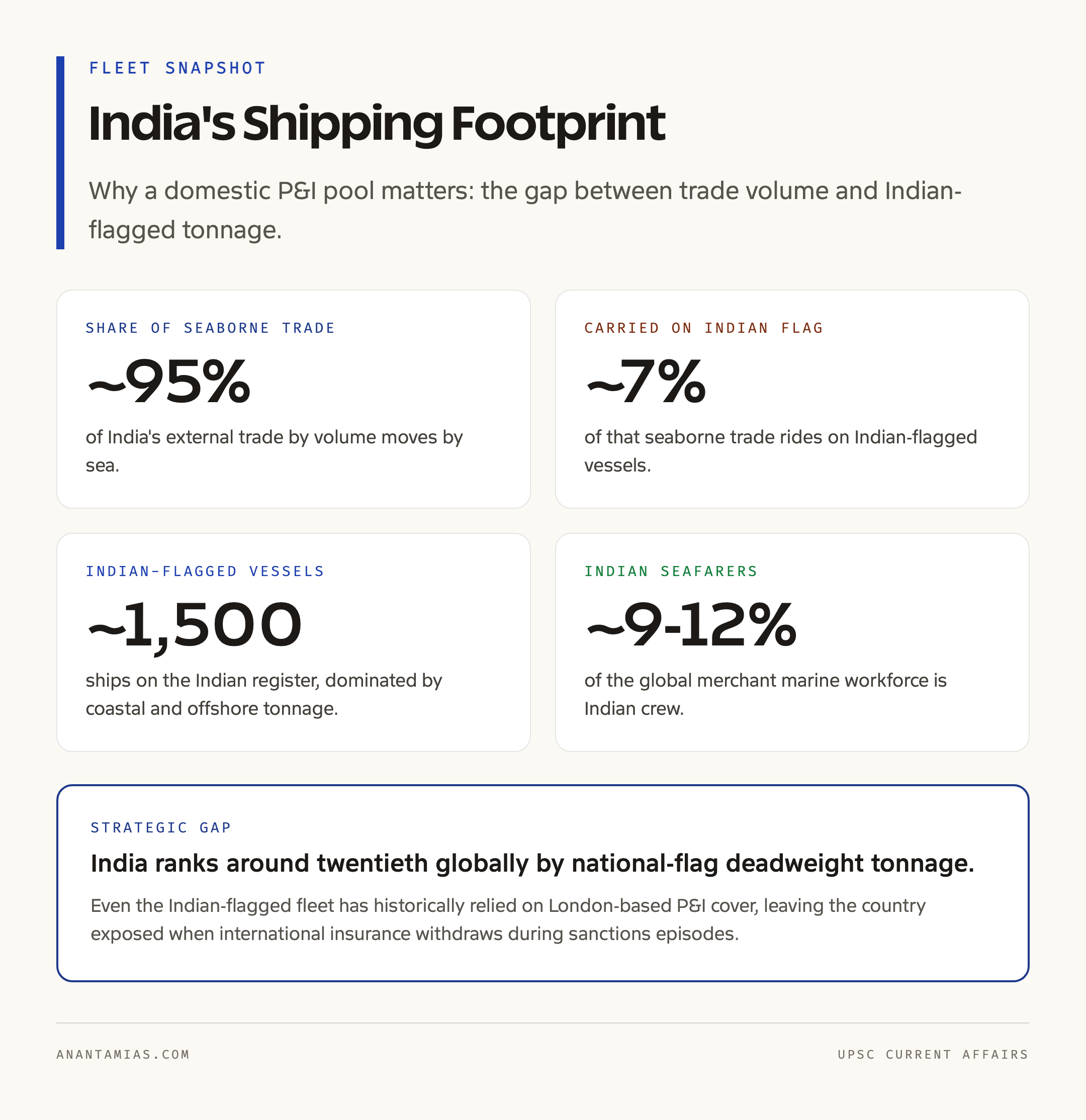
The launch matters for two reasons. India’s seaborne trade has grown sharply, but Indian-flagged ships still carry only a small share of it. Most of the country’s external trade rides on foreign hulls, often insured through the International Group of Protection and Indemnity Clubs based in London and a handful of European centers. When sanctions hit in 2022 and again in 2025, India saw firsthand how quickly insurance withdrawal can disrupt cargo movement. The Bharat Maritime Insurance Pool tries to give the country a domestic backstop.
The deeper context is that maritime insurance is not just commerce. It’s geopolitics. Whoever insures the world’s shipping has effective veto power over what moves on the seas. India is trying to acquire a piece of that veto.
Quick Facts
- Initiative: Bharat Maritime Insurance Pool (BMIP)
- Launch date: 12 May 2026
- Launch venue: New Delhi
- Nodal ministry: Ministry of Ports, Shipping and Waterways
- Regulator: Insurance Regulatory and Development Authority of India (IRDAI)
- Scope: Protection and indemnity (P&I) cover for Indian-flagged vessels on international routes
- Comparable international bodies: International Group of P&I Clubs (IG P&I), Lloyd’s of London market
- Core function: Pooling and reinsurance of marine liability risk
- Strategic objective: Reduce dependence on foreign maritime insurers and improve sanctions resilience
- Coverage areas: Crew claims, third-party damage, oil pollution, wreck removal, collision, war risk add-ons
What Just Happened
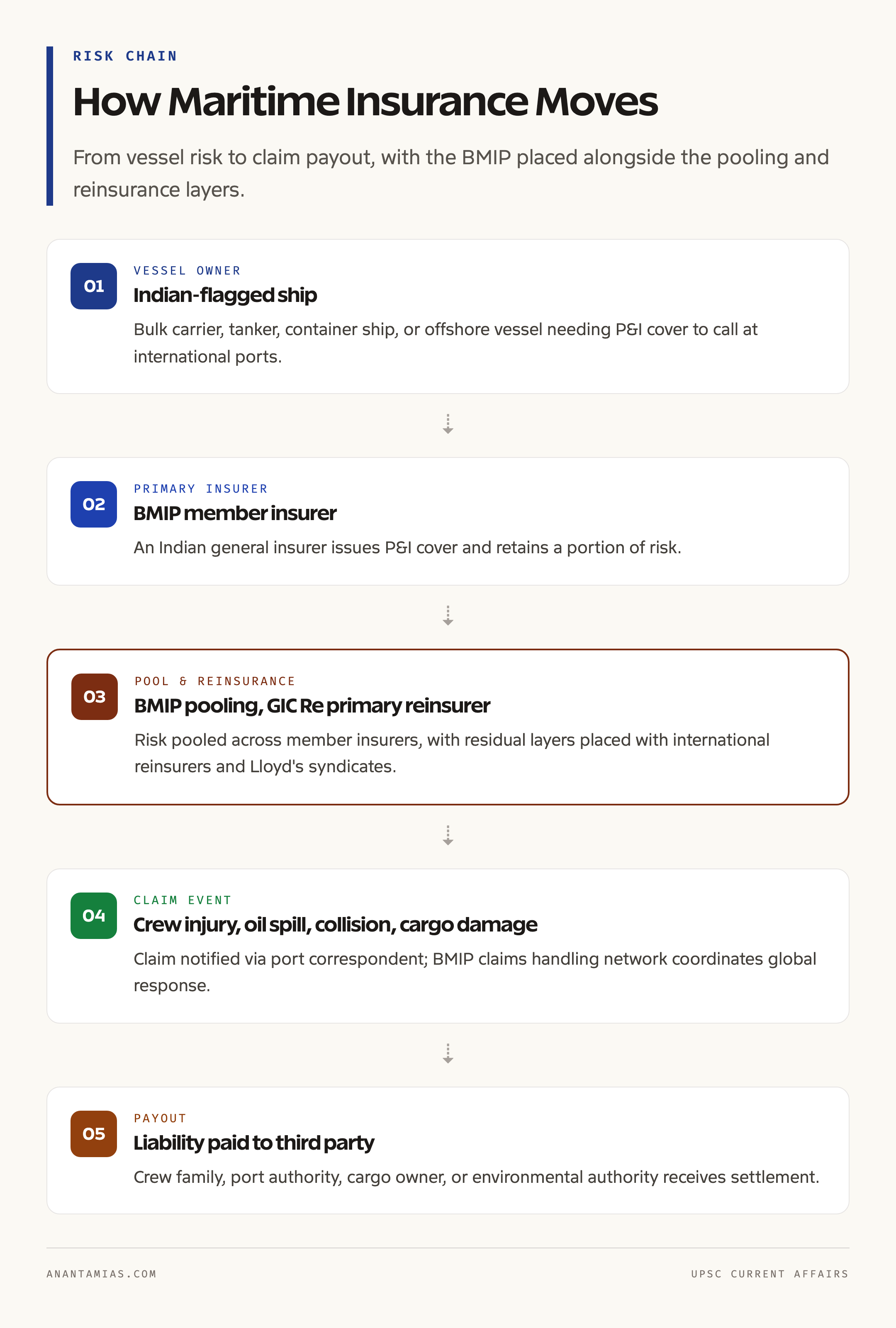
The Government of India formally launched the Bharat Maritime Insurance Pool on 12 May 2026 in New Delhi, with participation from the Ministry of Ports, Shipping and Waterways, IRDAI, the General Insurance Corporation of India, and a consortium of Indian general insurers. The pool will offer P&I cover, the most important class of marine liability insurance, to Indian-flagged vessels engaged in international trade.
The BMIP will operate as a pool, meaning multiple Indian insurers contribute capacity and share risk, with the General Insurance Corporation acting as the principal reinsurer. The pool will issue cover on terms broadly comparable to International Group club standards, including coverage for crew claims, cargo damage, third-party injury, oil pollution liabilities, wreck removal, and collision claims. War risk and sanctions-related coverage extensions are expected as add-on layers. Premium pricing will be benchmarked against international rates while retaining flexibility for strategic fleet segments.
Background and Historical Context
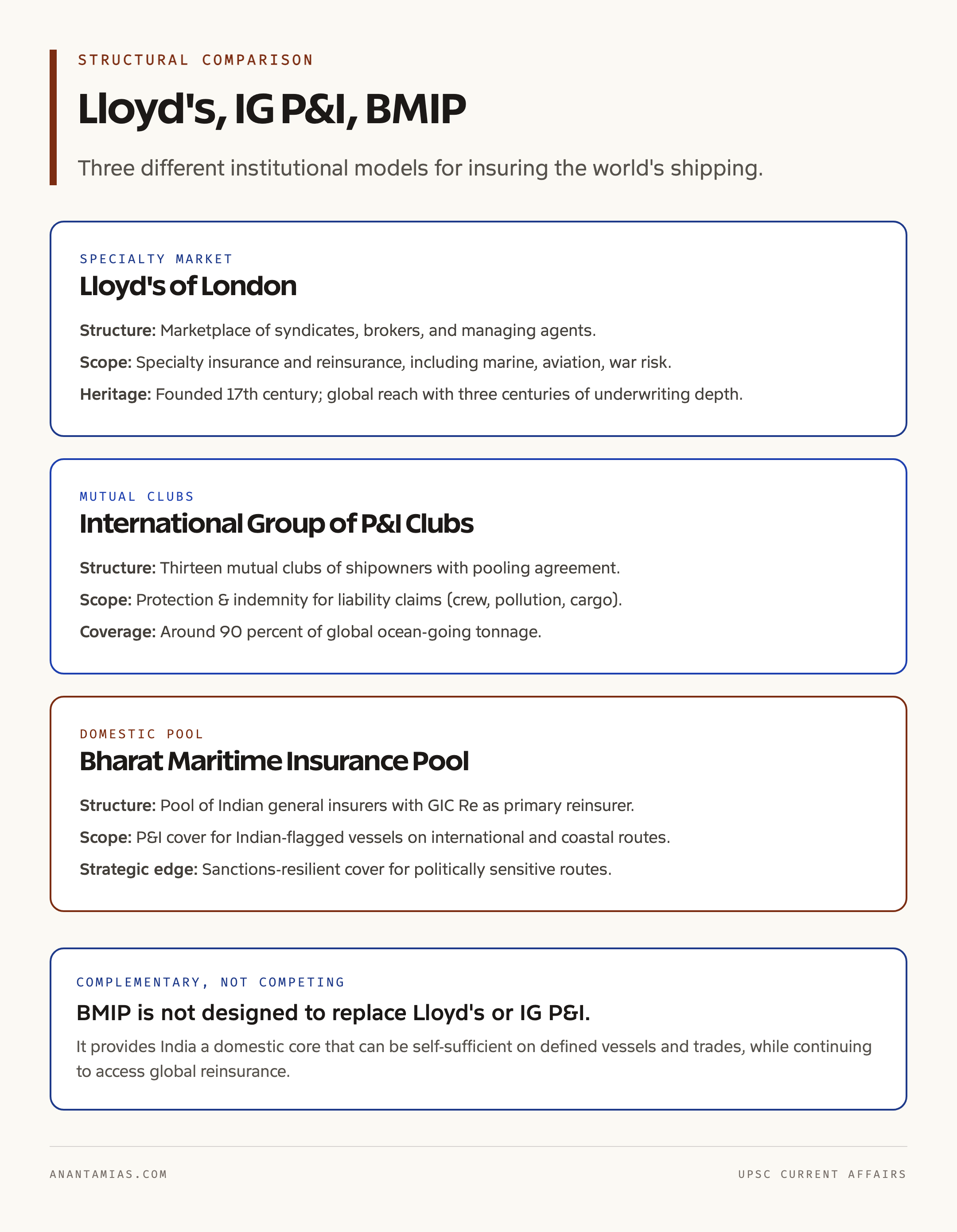
Global maritime insurance has been concentrated in London for over three centuries. Lloyd’s of London, founded in the late seventeenth century as a coffee house where merchants and underwriters met, evolved into the world’s largest specialty insurance market. Alongside Lloyd’s, the International Group of Protection and Indemnity Clubs emerged in the nineteenth century as a mutual structure of shipowners pooling liability risk. Together, IG P&I clubs cover around 90 percent of the world’s ocean-going tonnage.
India’s marine insurance market historically focused on hull and cargo cover for its own trade flows, leaving P&I largely to London. The General Insurance Corporation has held some reinsurance share, and a few Indian insurers offer hull cover, but indigenous P&I capacity has been limited. The vulnerability of this arrangement became obvious after 2022, when sanctions on Russian oil trade caused IG P&I clubs to withdraw cover from vessels involved in that trade. Indian shippers that had been ferrying discounted Russian crude suddenly faced insurance gaps. The episode triggered a serious review of how dependent India was on a single insurance market it didn’t control.
The Bharat Maritime Insurance Pool is the direct policy response. It builds on earlier efforts including the Indian Specie Insurance Pool, the FDI relaxation in insurance, and IRDAI’s regulatory framework for cross-border reinsurance.
Key Provisions of the Bharat Maritime Insurance Pool
The pool is structured as a coordinated capacity rather than a single insurer. Its core design features include:
- Membership: Open to Indian-flagged vessels engaged in international and coastal trade, including bulk carriers, tankers, container ships, and offshore vessels.
- Coverage classes: Standard P&I cover, with optional layers for war risk and sanctions-resilient routes.
- Premium structure: Competitive with IG P&I rates, with concessions for vessels meeting flagging, crew, and environmental compliance benchmarks.
- Capacity pooling: Multiple Indian general insurers contribute capacity. GIC Re acts as primary reinsurer and aggregates risk before placing residual layers in international markets.
- Claims handling: Domestic claims handling network with global correspondents, modeled on the IG P&I network of port correspondents.
- Strategic flexibility: The pool can underwrite voyages and trades where IG P&I cover may be unavailable, including certain politically sensitive routes.
- Governance: A pool board with representation from the Ministry of Ports, IRDAI, GIC Re, member insurers, and the Indian shipping industry.
Why It Matters
The Bharat Maritime Insurance Pool matters for three reasons.
First, strategic autonomy. India’s ability to move cargo, particularly energy imports, in a crisis depends on whether vessels can be insured. A domestic pool reduces the chokepoint risk that comes with relying entirely on London-centric insurers.
Second, financial sector deepening. Maritime insurance is high-skill, high-margin business. Building domestic capability in P&I cover trains underwriters, claims handlers, and surveyors. It is a step toward turning India’s financial services sector into one that can serve global niche markets, similar to how the Gujarat International Finance Tec-City (GIFT City) framework is positioning India in cross-border reinsurance.
Third, shipping sector competitiveness. Indian shipowners have historically faced higher operating costs partly because P&I cover and reinsurance flow through foreign markets in foreign currencies. A domestic pool can reduce frictional cost and provide tailored cover for the Indian fleet.
Detailed Analysis
The BMIP is a strategic instrument as much as a commercial one. The economics are not trivial. P&I clubs are mutuals, which means their pricing reflects pooled global risk rather than any single market’s profitability. Replicating that risk pool domestically requires either a large fleet base (which India does not yet have) or aggressive reinsurance into international markets (which partly defeats the autonomy goal).
The design seems to acknowledge this trade-off. By using GIC Re as a primary reinsurer and retaining residual placement in international reinsurance markets, the pool gets the best of both worlds: domestic underwriting and claims handling, with international capacity backing the higher liability layers. The strategic value comes when international reinsurance is withdrawn for specific routes. In those cases, the pool can either retain risk domestically or place it through alternative reinsurance partners.
Three risks should be tracked. Capacity risk: If a single major claim exhausts the pool, India may need a sovereign backstop. Premium risk: If premiums end up higher than IG P&I rates, voluntary participation will be weak. Reputational risk: A poorly handled high-profile claim early in the pool’s life could damage its credibility internationally and deter recognition by foreign port authorities.
Comparative Perspective
The closest comparison is China’s domestic P&I cover, China Shipowners Mutual Assurance Association (CPI), which was set up to insure Chinese-flagged vessels and has grown over decades. India is starting later but with the advantage of an established reinsurance industry under GIC Re and an active IRDAI regulatory regime.
Lloyd’s of London remains the dominant specialty market. The BMIP is not designed to replace Lloyd’s. It is designed to give India a domestic core that can be self-sufficient on a defined set of vessels and trades and that can collaborate with Lloyd’s for other risks.
The IG P&I structure is mutual. The BMIP is a pool of commercial insurers, which is structurally different. Both can deliver similar cover, but the cost of capital, claims philosophy, and governance differ.
Challenges and Concerns
Three challenges stand out. First, the fleet base is small. India ranks around twentieth globally by deadweight tonnage of national-flag fleet. A pool needs scale to absorb large claims without lumpy reinsurance costs. Second, international recognition takes time. Port state authorities, charterers, and cargo interests have to accept BMIP cover as equivalent to IG P&I cover. That recognition cycle could take several years. Third, the claims correspondent network has to be built across major ports globally, which is a substantial operational investment.
The pool also has to navigate the friction between strategic autonomy and commercial competitiveness. Underwriting politically sensitive routes can build strategic value but expose the pool to secondary sanctions risk and reinsurance withdrawal.
Prelims Pointers
- Launch date: 12 May 2026 in New Delhi
- Nodal ministry: Ministry of Ports, Shipping and Waterways
- Regulator: IRDAI
- Primary reinsurer: General Insurance Corporation of India (GIC Re)
- Comparable global bodies: IG P&I Clubs, Lloyd’s of London
- Coverage type: Protection and Indemnity (P&I), with war risk and sanctions add-ons
- Target user: Indian-flagged vessels on international routes
- GIFT City link: India’s emerging cross-border reinsurance hub
- Historical precedent: Indian Specie Insurance Pool
Mains Questions
- GS Paper III (Economy and Infrastructure): Discuss the rationale, design, and strategic significance of the Bharat Maritime Insurance Pool in the context of India’s shipping ambitions. (15 marks, 250 words)
- GS Paper II (International Relations): Examine how maritime insurance can become an instrument of geopolitical leverage. How does BMIP address this dimension? (10 marks, 150 words)
- GS Paper III (Economy): “Maritime insurance is a quiet pillar of strategic autonomy.” Critically evaluate India’s policy moves in this space. (15 marks, 250 words)
- GS Paper III (Financial Services): Analyze the role of GIFT City and GIC Re in deepening India’s reinsurance capacity. (10 marks, 150 words)
Way Forward
The Bharat Maritime Insurance Pool will need to do four things to grow into a credible institution. Build international recognition across major port authorities and charterer communities. Develop a global claims correspondent network within three to five years. Build domestic underwriting and claims-handling talent that can match the depth of London. And calibrate its strategic underwriting carefully so that it preserves international reinsurance partnerships while expanding India’s autonomy.
Coordination across the Ministry of Ports, IRDAI, GIC Re, and the Ministry of External Affairs will be essential. The pool should also be linked to broader maritime initiatives, including the Sagarmala port modernization program, the Maritime India Vision 2030, and the green shipping push. As Indian shipowners modernize their fleets with lower emission vessels, the pool can offer differentiated premium structures that reward cleaner operations.
For UPSC aspirants, the BMIP sits at the intersection of economy, geopolitics, financial services, and infrastructure. It pairs well with the India-Oman CEPA for Gulf trade context, the Jan Suraksha schemes for financial-inclusion architecture, and the agni missile family as a parallel example of an indigenous capability project.
Frequently Asked Questions
What is the Bharat Maritime Insurance Pool?
It is a domestic insurance pool launched on 12 May 2026 to provide protection and indemnity (P&I) cover to Indian-flagged vessels operating on international and coastal routes.
Why is P&I cover important?
P&I cover handles third-party liabilities arising from shipping, including crew claims, cargo damage, oil pollution, wreck removal, and collision liabilities. Without P&I cover, vessels are typically not allowed to call at ports or carry cargo.
Who regulates the BMIP?
The Insurance Regulatory and Development Authority of India (IRDAI) regulates the pool, while the Ministry of Ports, Shipping and Waterways is the nodal policy ministry.
How does BMIP compare to Lloyd’s of London?
Lloyd’s is a specialty insurance market with global scope and three centuries of underwriting depth. BMIP is a domestic pool focused on Indian-flagged vessels. The two are complementary rather than direct competitors.
What is the role of GIC Re?
GIC Re acts as the primary reinsurer for the pool, aggregating risk from member insurers before placing residual layers in international reinsurance markets.
Will BMIP cover war risk?
War risk and sanctions-related coverage are expected as add-on layers on top of standard P&I cover.
How does this improve India’s sanctions resilience?
By providing a domestic alternative to International Group P&I clubs, the pool reduces the risk that withdrawal of foreign insurance can immobilize Indian-flagged shipping during sanctions episodes.
What is the International Group of P&I Clubs?
A grouping of thirteen mutual P&I clubs that together cover around 90 percent of the world’s ocean-going tonnage. They share large claims through a pooling agreement.
Can foreign-flagged vessels join BMIP?
The pool is primarily designed for Indian-flagged vessels, although chartered tonnage with Indian operational interests may be considered over time as the pool matures.
How does BMIP connect to GIFT City?
GIFT City is India’s offshore financial centre and is positioned as a cross-border reinsurance hub. The BMIP can use GIFT City based reinsurers and brokers, deepening the country’s specialty insurance ecosystem.
Tell Google you want more of this.
Add Anantam IAS as a preferred sourceOne tap, and this site shows up more often in your own Top Stories, AI Overviews and AI Mode. Remove it any time.