Why in News?
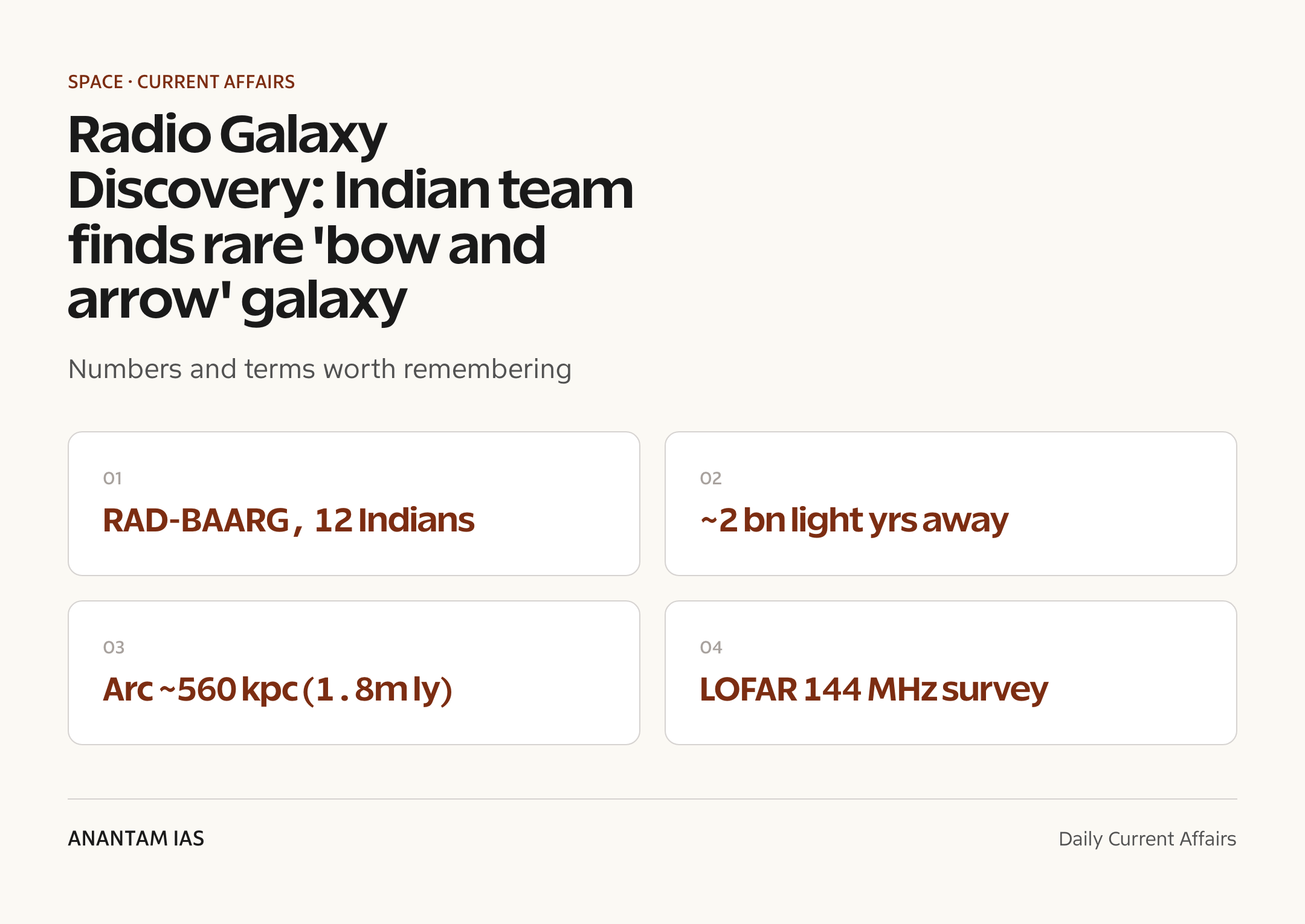
The Hindu reported that a team of 12 Indian researchers working across three countries has discovered a rare, bow-and-arrow-shaped radio galaxy located about 2 billion light years from Earth. The arc-like system spans roughly 1.8 million light years — around 18 times the width of the Milky Way’s visible disc.
The object has been named RAD-BAARG — RAD for the RAD@home Astronomy Collaboratory, India’s first citizen-science research platform in astronomy, and BAARG for Bow And Arrow Radio Galaxy. The researchers say it may be one of the clearest known radio signatures of a giant bow shock produced by a galaxy falling supersonically into a cluster environment.
- The discovery paper was published in the Monthly Notices of the Royal Astronomical Society (MNRAS) on June 22, 2026.
- The source was spotted in ultra-sensitive 144 MHz images from the LOFAR Two-metre Sky Survey, one of the deepest low-frequency radio surveys ever made.
- The lead author is Ananda Hota of the University of Mumbai, founder-director of the 13-year-old RAD@home collaboratory based at Kharghar, Navi Mumbai.
- A giant arc-like radio feature extends over nearly 560 kiloparsecs (about 1.8 million light years) on the galaxy’s western side — the ‘bow’ of the system.
- The find follows the same team’s 2025 identification of the farthest and most powerful Odd Radio Circle known at that time.
The development matters in the context of:
- The discovery is a showcase of Indian radio astronomy capability and of a low-cost citizen-science research model that lets university students make frontier discoveries from home.
- It lands just as India ramps up its role in the Square Kilometre Array Observatory (SKAO), the next-generation global radio telescope, making radio-galaxy science a durable exam theme.
- Bow shocks around infalling galaxies were long predicted by simulations but almost never observed directly — RAD-BAARG offers an unusually detailed radio view of the phenomenon.
UPSC Relevance
Prelims Relevance
- RAD-BAARG — Bow And Arrow Radio Galaxy; rare, asymmetric radio galaxy ~2 billion light years away; total arc structure ~560 kpc (~1.8 million light years).
- Radio galaxy — an active galaxy, powered by a supermassive black hole at its core, that emits enormous energy as radio waves; read the basics of black holes alongside.
- RAD@home Astronomy Collaboratory — India’s first citizen-science research platform in astronomy (founded 2013); based at Kharghar, Navi Mumbai; founder-director Ananda Hota.
- LOFAR (Low Frequency Array) — Europe’s low-frequency radio telescope network centred in the Netherlands; its Two-metre Sky Survey (144 MHz) produced the discovery images.
- Bow shock — a shock front formed when an object moves through a medium faster than the local speed of sound, like the shock wave ahead of a supersonic aircraft.
- Intra-cluster medium (ICM) — the hot, diffuse plasma filling the space between galaxies in a cluster; the infalling host galaxy compresses this gas to create the bow shock.
- Odd Radio Circles (ORCs) — mysterious ring-shaped radio structures; the RAD@home team reported the farthest, most powerful ORC then known in 2025.
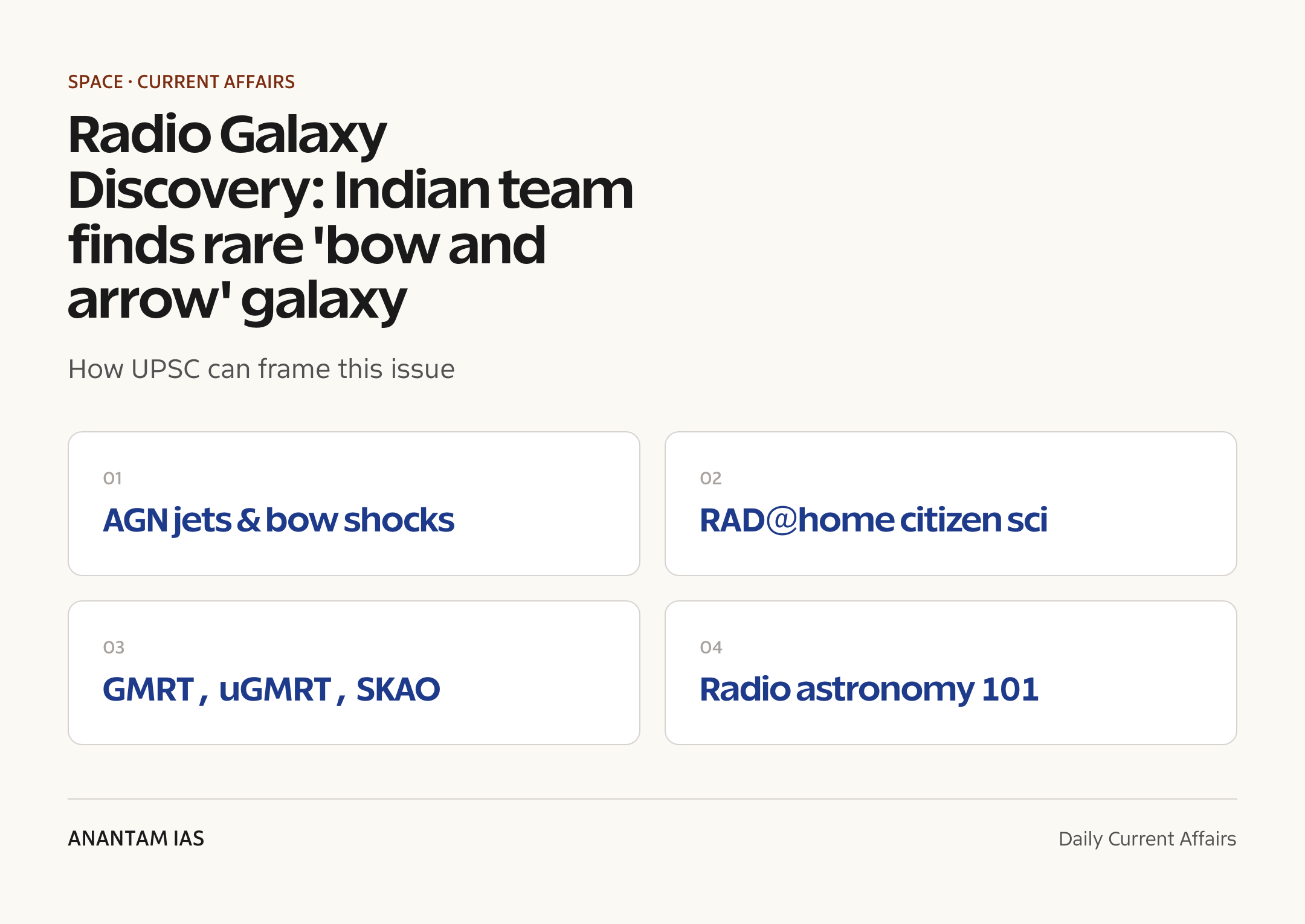
- GMRT / uGMRT — Giant Metrewave Radio Telescope at Khodad near Pune; 30 fully steerable 45-m dishes; operated by NCRA-TIFR; India’s flagship radio astronomy facility.
- SKAO — Square Kilometre Array Observatory, an intergovernmental radio telescope being built in South Africa (mid-frequency) and Australia (low-frequency); India is a member.
- Kiloparsec (kpc) — 1,000 parsecs, about 3,260 light years; a standard unit for galaxy-scale distances.
Mains Relevance
GS Paper 3
- Achievements of Indians in science and technology — a home-grown citizen-science collaboratory producing discoveries in a leading international journal.
- Awareness in the field of space — radio astronomy, AGN jets, and how survey telescopes like LOFAR and the upcoming SKA change discovery science.
- Role of AI and machine learning in mining enormous radio-survey data volumes for unusual sources — a model the RAD-BAARG team explicitly recommends.
GS Paper 2
- International S&T collaborations — India’s membership of big-science projects such as the SKAO, LIGO-India’s global network, and the Thirty Meter Telescope as instruments of science diplomacy.
Essay
- Citizen science and the democratisation of research — discovery is no longer the monopoly of large institutions.
- Big questions, shared telescopes: why frontier science is increasingly a global, collaborative enterprise.
Background and Context
What is a radio galaxy?
Radio galaxies are among the largest single structures in the universe, and their engine sits at the centre of the host galaxy.
- An active galaxy hosts an active galactic nucleus (AGN) — a compact central region far more luminous than the combined starlight of the galaxy.
- The engine is a supermassive black hole, millions to billions of solar masses, feeding on surrounding gas through an accretion disc.
- Part of the infalling matter is flung out as twin jets of relativistic magnetised plasma that punch out of the galaxy into intergalactic space.
- Electrons spiralling in magnetic fields within these jets emit synchrotron radiation, which is brightest at radio wavelengths — this is why such systems are called radio galaxies.
- Standard radio galaxies show a fairly symmetric double-lobed shape; astronomers classify them by lobe brightness patterns (the Fanaroff–Riley classes).
- Peculiar or ‘nonconformist’ morphologies — X-shaped and winged sources, ORCs, and now a bow-and-arrow shape — record how jets interact with their large-scale environment.
RAD-BAARG: what exactly was found
The MNRAS paper describes a highly unusual, asymmetric structure unlike standard radio galaxies.
- The paper is titled “RAD@home discovery of a bow-and-arrow radio galaxy tracing a ~560 kpc bow-shock structure in a multi-halo environment”, published on June 22, 2026.
- On the western side, a narrow jet feeds a sector-shaped emission region and a giant arc-like feature stretching nearly 560 kpc (~1.8 million light years) — the ‘bow’.
- On the opposite side, the jet develops a distorted S-shaped morphology followed by a faint offset tail extending to almost 600 kpc.
- The host galaxy sits in a dynamically complex, multi-halo environment with cluster-scale systems at similar distances.
- The morphology is consistent with radio jets interacting with large-scale gas gradients, bulk gas motions, and shock-related compression tied to the galaxy’s infall.
- The discovery used the LOFAR Two-metre Sky Survey at 144 MHz; the radio image was combined with optical imaging from the BASS survey to place the structure on the sky.
- The 12 authors — all associated with RAD@home — work at institutions across three countries, including the University of Mumbai, SRM University (Sikkim), Midnapore City College, Amity University, and centres in Poland and Abu Dhabi.
The physics: a galaxy falling faster than sound
The bow-and-arrow shape is read as the radio-lit imprint of a giant shock front around an infalling galaxy.
- Galaxy clusters are filled with hot, thin plasma — the intra-cluster medium — which has its own local speed of sound.
- A galaxy pulled in by the cluster’s gravity (an infall) can move through this gas supersonically, compressing the gas ahead of it into a large-scale shock front.
- Team member Shubhrangshu Ghosh told The Hindu the effect is similar to the shock wave ahead of a supersonic aircraft.
- Such shocked gas is extraordinarily diffuse and faint, so bow shocks were predicted by simulations for decades but proved very hard to detect directly.
- In RAD-BAARG, the radio-emitting plasma from the jets appears to illuminate the otherwise invisible shock structure, making it visible in low-frequency images.
- Lead author Ananda Hota said the structure is unlike any radio galaxy he had seen in 25 years of research — a candidate textbook example of jet–environment interaction.
RAD@home: India's citizen-science collaboratory
The discovery is as much a story about how Indian science is organised as about the object itself.
- RAD@home, founded in 2013, is India’s first citizen-science research collaboratory in astronomy, based at Kharghar, Navi Mumbai.
- It trains university students and enthusiasts to inspect real survey images and conduct extragalactic research from home — no telescope ownership needed.
- Founder-director Ananda Hota of the University of Mumbai leads the network; every co-author of the RAD-BAARG paper is associated with it.
- The same collaboratory earlier reported the farthest and most powerful Odd Radio Circle known at the time (2025), showing repeatable discovery capacity.
- The model mirrors global efforts like Galaxy Zoo: human pattern-recognition at scale complements automated pipelines in finding rare, odd-shaped sources.
- It’s a low-cost route to research participation that widens the base of trained astronomers — relevant to debates on scientific temper and research access in India.
India's radio astronomy backbone
India runs one of the world’s premier low-frequency radio facilities and has joined the next-generation global array.
- The Giant Metrewave Radio Telescope (GMRT) at Khodad near Pune — 30 fully steerable 45-metre dishes spread over ~25 km — is run by the National Centre for Radio Astrophysics (NCRA-TIFR).
- Its upgrade, the uGMRT, widened frequency coverage and sensitivity, keeping it among the most sought-after metre-wavelength telescopes globally.
- The Ooty Radio Telescope (532 m long cylindrical antenna, Tamil Nadu) is another long-standing Indian radio facility.
- India is a member of the Square Kilometre Array Observatory (SKAO) — an intergovernmental project building the world’s largest radio telescope across sites in South Africa and Australia — with NCRA-TIFR leading Indian participation and India contributing key observatory software.
- The RAD-BAARG team said next-generation facilities like the SKA will deepen understanding of how radio galaxies evolve within the large-scale cosmic environment.
- LOFAR itself, the discovery instrument, is a Europe-wide low-frequency array centred in the Netherlands — a reminder that survey data is shared globally and mined by whoever looks smartly.
The wider Indian astronomy portfolio
For prelims, place this discovery within India’s growing multi-wavelength and multi-messenger astronomy footprint.
- AstroSat (2015) — India’s first dedicated multi-wavelength space observatory, covering ultraviolet to X-ray bands.
- XPoSat (2024) — India’s X-ray polarimetry satellite studying black holes, neutron stars and AGN; see the full XPoSat explainer.
- Aditya-L1 (2023) — solar observatory at the Sun–Earth L1 point; solar physics complements galactic astronomy.
- LIGO-India — approved gravitational-wave detector at Hingoli, Maharashtra; covered in our note on gravitational waves and LIGO-India.
- Thirty Meter Telescope (TMT) — India is a partner in this next-generation optical telescope project.
- MACE at Hanle, Ladakh — among the world’s highest-altitude gamma-ray Cherenkov telescopes; Devasthal 3.6-m (ARIES) is India’s largest optical telescope.
Way Forward
Preparing for the SKA era
- Scale up Indian participation in SKAO science working groups so Indian teams lead early key-science projects, not just contribute software.
- Invest in big-data infrastructure — regional data centres, high-performance computing and archives — since SKA-scale surveys will dwarf LOFAR data volumes.
- Keep the uGMRT scientifically competitive as a complementary metre-wave facility and a training ground for the SKA generation.
Institutionalising citizen science
- Extend the RAD@home model to other data-rich fields — biodiversity, seismology, air quality — with university credit for verified research contributions.
- Pair trained human classifiers with AI/ML pipelines, as the discovery team recommends, to sift unusual sources from upcoming radio sky surveys.
- Fund small, distributed research collaboratories under national science programmes so discovery capacity spreads beyond metropolitan institutes.
Conclusion
RAD-BAARG is a striking object in its own right — a 1.8-million-light-year arc that may be the clearest radio portrait yet of a galaxy’s supersonic plunge into a cluster. But its deeper significance for India is methodological: open survey data, a citizen-science collaboratory, and careful follow-through produced a discovery published in a leading journal without a single new telescope being built.
As India moves into the SKAO era with the uGMRT, LIGO-India and a widening space-observatory fleet, the pipeline of trained eyes and algorithms that projects like RAD@home create will decide how much of the coming data deluge turns into Indian-led science.
UPSC Practice Questions
Prelims MCQ 1
With reference to the recently discovered ‘bow and arrow’ radio galaxy RAD-BAARG, consider the following statements:
- It was discovered using low-frequency images from the LOFAR Two-metre Sky Survey.
- Its bow-shaped arc is attributed to a bow shock formed as the host galaxy falls supersonically into a cluster environment.
- It was discovered by the Giant Metrewave Radio Telescope (GMRT) near Pune.
How many of the above statements are correct?
(a) Only one (b) Only two (c) All three (d) None
Answer: (b) Only two
Explanation:
Statements 1 and 2 are correct: RAD-BAARG was found in 144 MHz LOFAR Two-metre Sky Survey images, and its ~560 kpc arc is read as a bow shock from supersonic infall into a cluster. Statement 3 is wrong — the discovery instrument was LOFAR, the European low-frequency array, not the GMRT.
Prelims MCQ 2
Which of the following best describes the Square Kilometre Array Observatory (SKAO)?
(a) A space-based X-ray telescope operated by NASA and ESA (b) An intergovernmental radio telescope project with sites in South Africa and Australia, of which India is a member (c) An optical telescope being built in Hawaii with Indian participation (d) A gravitational-wave detector planned in Maharashtra
Answer: (b) An intergovernmental radio telescope project with sites in South Africa and Australia, of which India is a member
Explanation:
The SKAO is building the world’s largest radio telescope — mid-frequency dishes in South Africa’s Karoo and low-frequency antennas in Western Australia. India is a member, with NCRA-TIFR (Pune) leading participation. Option (c) describes the Thirty Meter Telescope; option (d) describes LIGO-India.
UPSC Mains Questions
- Citizen-science platforms are emerging as low-cost engines of frontier research in India. Using the RAD@home collaboratory’s astronomical discoveries as a case study, examine the potential and limits of citizen science in India’s research ecosystem. (250 words)
- India’s participation in mega-science projects such as the Square Kilometre Array Observatory, LIGO-India and the Thirty Meter Telescope serves both scientific and diplomatic goals. Discuss. (250 words)
- Radio astronomy has repeatedly revealed structures invisible to optical telescopes. Explain how radio galaxies form, and discuss India’s strengths and gaps in radio astronomy as it enters the SKA era. (250 words)
Source: The Hindu.
Frequently Asked Questions
What is RAD-BAARG?
RAD-BAARG (Bow And Arrow Radio Galaxy) is a rare, asymmetric radio galaxy discovered by 12 Indian researchers of the RAD@home collaboratory. Located about 2 billion light years away, its arc-like structure spans roughly 560 kiloparsecs — about 1.8 million light years — and traces a giant bow shock.
Which telescope discovered the bow-and-arrow galaxy?
It was found in ultra-sensitive 144 MHz images from the LOFAR Two-metre Sky Survey, one of the deepest low-frequency radio surveys ever conducted. LOFAR (Low Frequency Array) is a Europe-wide radio telescope network centred in the Netherlands, whose survey data is open to researchers globally.
What is RAD@home?
RAD@home Astronomy Collaboratory, founded in 2013 and based at Kharghar, Navi Mumbai, is India’s first citizen-science research platform in astronomy. Founded by Ananda Hota of the University of Mumbai, it trains university students to analyse real survey images and make extragalactic discoveries from home.
What causes the bow-and-arrow shape?
The host galaxy appears to be falling supersonically into a nearby cluster of galaxies. Like the shock wave ahead of a supersonic aircraft, this compresses the hot intra-cluster gas into a giant bow shock, and the galaxy’s radio jets light up this otherwise invisible structure.
What is a radio galaxy?
A radio galaxy is an active galaxy powered by a supermassive black hole at its core. The black hole launches enormous jets of relativistic magnetised plasma whose electrons emit synchrotron radiation, making these systems extremely bright at radio wavelengths and often larger than the visible galaxy itself.
Why does this matter for India?
It showcases Indian radio astronomy capability and a low-cost citizen-science model of research. It also strengthens India’s positioning for the Square Kilometre Array era — India is an SKAO member, runs the uGMRT near Pune, and is building LIGO-India and other frontier facilities.
Tell Google you want more of this.
Add Anantam IAS as a preferred sourceOne tap, and this site shows up more often in your own Top Stories, AI Overviews and AI Mode. Remove it any time.