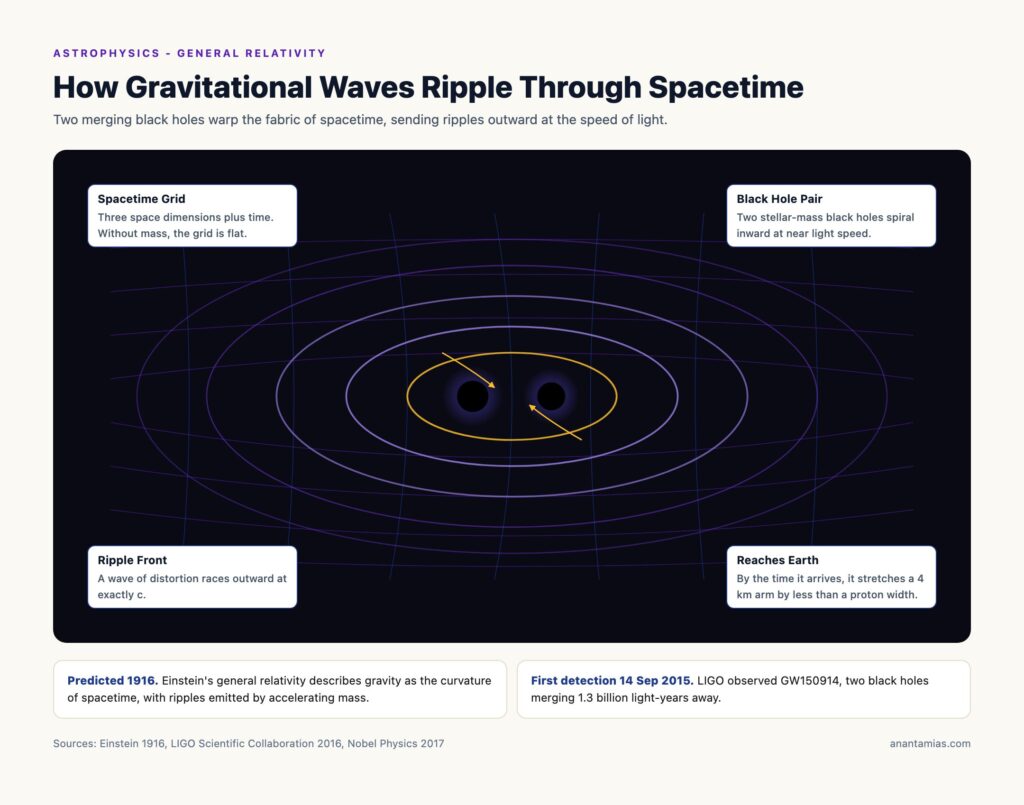
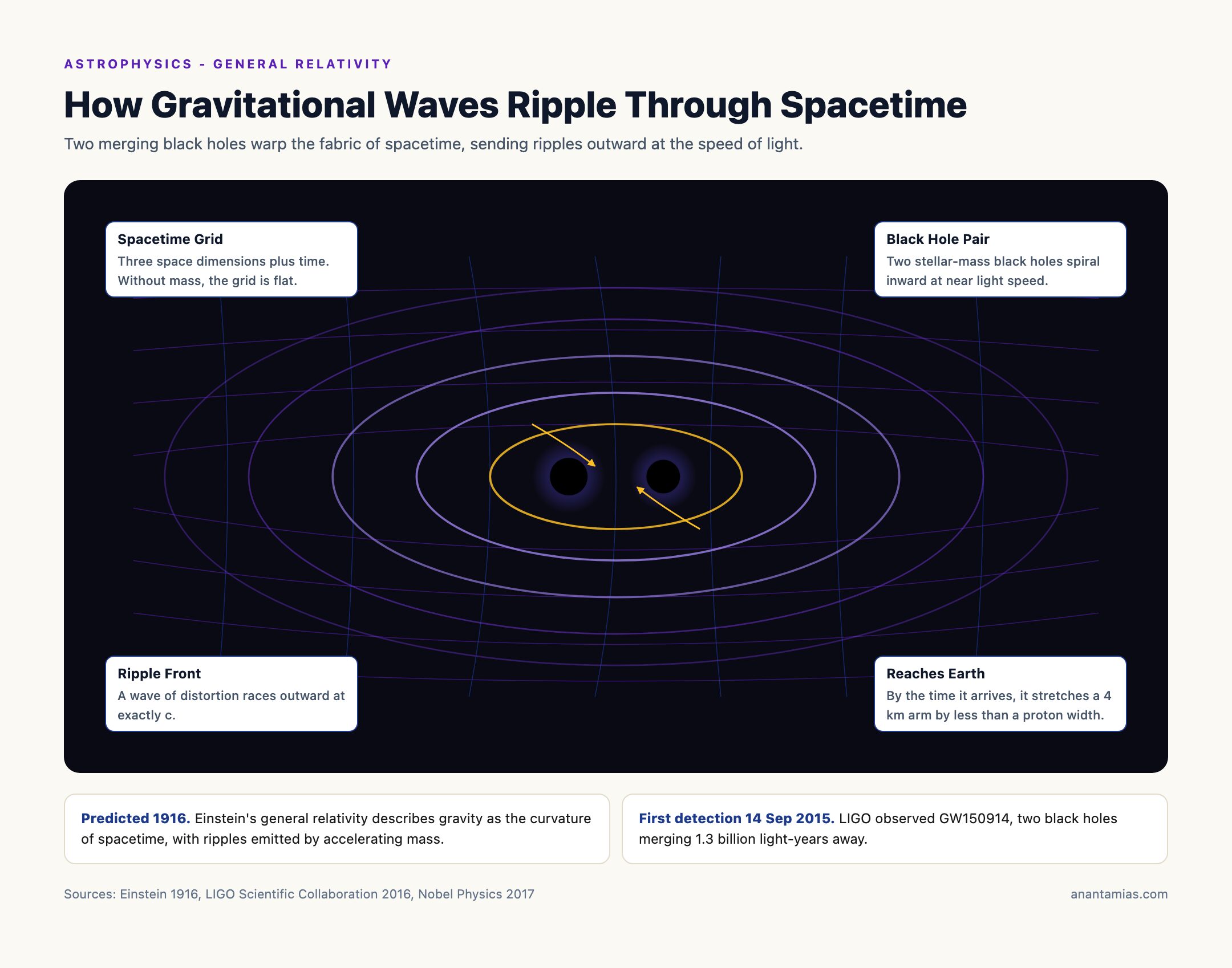
In 1916, Albert Einstein wrote down a set of equations that described gravity not as a force pulling objects together, but as a curvature of spacetime itself. Mass tells space how to bend; bent space tells mass how to move. Almost as a footnote, his equations also predicted that when very heavy objects accelerate violently, like two black holes locked in a death-spiral, they shake the fabric of spacetime itself, sending ripples outward at the speed of light. Einstein himself doubted these ripples would ever be measured. The signal was just too small. A passing wave from a black hole merger a billion light-years away might stretch a four-kilometer ruler by a fraction smaller than the width of a single proton.
A century later, in September 2015, two giant L-shaped detectors in the United States caught exactly that ripple. The signal came from two black holes, each about 30 times the mass of the Sun, that had crashed into each other 1.3 billion years ago. Humanity had grown a new sense. We could now hear the universe.
Gravitational waves matter for UPSC GS-III not because the exam asks for general relativity math, but because India is now part of this story. The LIGO-India project in Hingoli, Maharashtra, will be the fifth major detector in the global network, dramatically improving our ability to triangulate the source of any cosmic event. This guide walks through what gravitational waves are, how they are detected, why low-frequency and high-frequency sources need totally different instruments, and what India brings to the table.
Quick Facts: Gravitational Waves at a Glance
- Predicted by: Albert Einstein in 1916, in his General Theory of Relativity
- First direct detection: 14 September 2015 by LIGO (USA), announced February 2016
- Speed: Travel at the speed of light, about 3 lakh km per second
- 2017 Nobel Prize in Physics: Awarded to Rainer Weiss, Barry Barish and Kip Thorne for LIGO
- First neutron star merger seen in light and gravity: GW170817 in August 2017
- NanoGrav nanohertz detection: Announced June 2023, evidence for a cosmic gravitational wave background from supermassive black hole binaries
- LIGO-India location: Aundha-Nagnath, Hingoli district, Maharashtra
- LIGO-India lead agencies: Department of Atomic Energy (DAE) and Department of Science and Technology (DST)
What Are Gravitational Waves?
A gravitational wave is a propagating distortion of spacetime, the four-dimensional fabric in which all events happen. To picture it, imagine a flat rubber sheet with a heavy bowling ball placed on it. The sheet sags. Roll a marble nearby and it spirals toward the ball. That sagging is what we call gravity in Einstein’s framework. Now imagine two bowling balls orbiting each other very fast. They will set up rhythmic ripples that race outward across the sheet. Replace the rubber sheet with the three spatial dimensions plus time, and the bowling balls with black holes or neutron stars, and you have a gravitational wave.
These ripples have three properties that make them remarkable for science. First, they travel at the speed of light, meaning they carry timely information. Second, they barely interact with matter. Light gets scattered by dust and absorbed by gas. Gravitational waves pass right through. They reach us as pristine messengers from regions that are otherwise opaque, like the cores of supernovae. Third, as a wave passes, it physically stretches space in one direction while squeezing it in the perpendicular direction. If a strong wave passed through your body right now, your height and width would oscillate by a tiny but real amount.
The signal is very weak by the time it reaches Earth. The 2015 detection had to measure a length change smaller than one ten-thousandth the diameter of a proton. That this can be done at all is a triumph of laser physics and noise control. To learn how India is investing in similar precision instruments, see our coverage of ISRO missions and space technology.
Background and Historical Context
The story of gravitational waves runs in three acts. Act one is the prediction. Einstein published the General Theory of Relativity in 1915, and the next year he showed that his field equations admitted wave solutions. For decades, even physicists were not sure if these waves were real or a mathematical artifact. The argument was finally settled in the 1950s by Felix Pirani and others, who showed the waves carried real energy.
Act two is indirect evidence. In 1974, Russell Hulse and Joseph Taylor discovered a binary pulsar, two neutron stars orbiting each other and slowly losing energy. They timed the orbit for years and found the orbital decay matched Einstein’s prediction for gravitational wave emission to extraordinary precision. The discovery won the 1993 Nobel Prize and convinced almost everyone the waves were real, even though no one had seen them directly.
Act three is direct detection. The LIGO project, conceived in the 1980s and built across the 1990s and 2000s, is the result of decades of patient engineering. It first ran from 2002 to 2010 and saw nothing, as expected, because the sensitivity was not yet enough. After a major upgrade to Advanced LIGO, the second observing run began in September 2015. Within just a few days of the first switch-on, on 14 September 2015, both Hanford and Livingston detectors caught a clear signal from a binary black hole merger. The announcement came in February 2016. The 2017 Physics Nobel followed.
A pivotal follow-up came in August 2017. The event GW170817 was the merger of two neutron stars and was seen not just as gravitational waves but also as a gamma-ray burst, an optical kilonova and X-ray afterglow. For the first time, astronomers had observed the same event in both gravitational and electromagnetic channels. The era of multi-messenger astronomy had begun, and that era is the reason every additional detector, including LIGO-India, matters so much.
Sources of Gravitational Waves
Different cosmic events produce waves at very different frequencies, much like different musical instruments produce different pitches. To catch them, we need different detectors. Broadly there are four bands.
The high-frequency band, ranging from tens to thousands of hertz, is produced by stellar-mass compact object mergers, that is, two black holes or two neutron stars or one of each spiralling into each other. These events are transient. They last from a few milliseconds for very heavy black holes up to a minute or so for neutron stars in the audible part of the LIGO frequency band. This is the band LIGO, Virgo and KAGRA are tuned to.
The low-frequency band, in the millihertz range, comes from more massive systems like white dwarf binaries and intermediate-mass black holes. These cannot be detected on Earth because seismic noise drowns them out. The European Space Agency’s planned LISA mission, a trio of spacecraft flying in a triangle five million kilometers on each side, is designed to catch this band from space, expected to launch in the 2030s.
The very low-frequency or nanohertz band is produced by supermassive black hole binaries, pairs of giant black holes at the centers of merging galaxies. These produce waves with periods of years. To catch them, astronomers use the universe itself as a detector through pulsar timing arrays, an approach we will discuss in the next section.
The cosmological band, even lower in frequency, would have been produced in the first fraction of a second after the Big Bang. Detecting these would let us probe physics at energies far beyond anything an accelerator can reach. They have not yet been seen.
How LIGO Works: Laser Interferometry
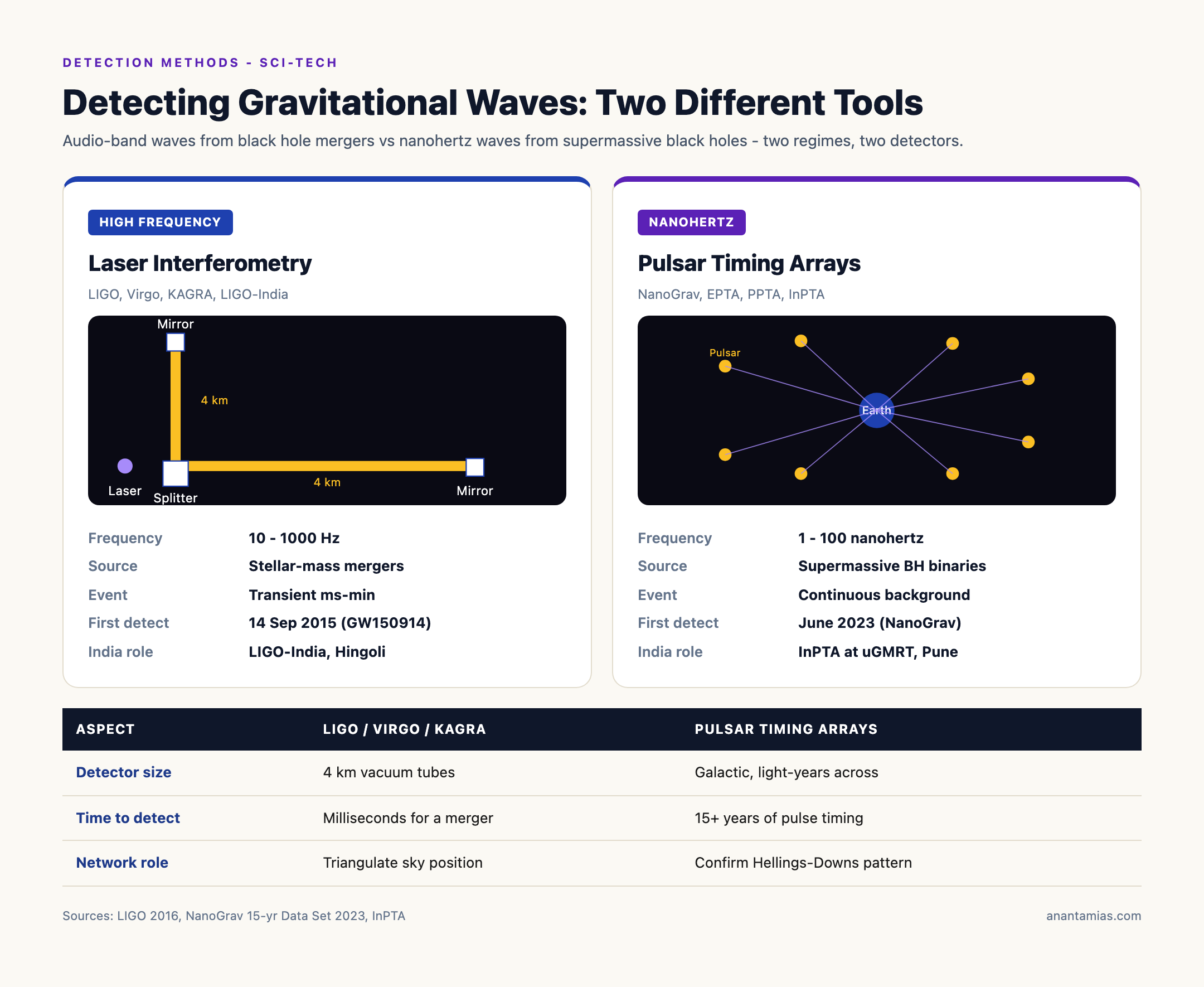
A LIGO-class detector is a giant L-shaped interferometer with two arms each four kilometers long. Inside the arms, the air has been pumped out so thoroughly that the vacuum is among the best ever made on Earth. A powerful laser beam is split into two by a beam splitter at the corner of the L. One half flies down the north arm, the other down the east arm. At the far end of each arm sits a heavy mirror suspended on a multi-stage pendulum that isolates it from ground vibrations. The light reflects back, recombines at the splitter and falls on a photodetector.
The two beam paths are tuned so that, in normal conditions, the recombined light cancels itself out almost completely, a phenomenon called destructive interference. If a gravitational wave passes through, it stretches one arm and squeezes the other by an unimaginably small amount. The two beam paths are no longer perfectly equal. Some light leaks out of the supposedly dark port. That leak is the signal.
The challenge is that this leak is fantastically tiny, less than one part in 10 to the 21st power. To pull it out of the noise, LIGO uses an extraordinary toolkit, including seismic isolation tables, precision-polished mirrors, ultra-stable lasers and a quantum-mechanical technique called squeezed light. Two LIGO sites, Hanford in Washington and Livingston in Louisiana, were built in the 1990s. Virgo, near Pisa in Italy, joined the network in the late 2000s. KAGRA, an underground detector in Japan’s Kamioka mine, came online in 2020. India will be the next to join.
Pulsar Timing Arrays: The Galaxy as a Detector
For the nanohertz band, the LIGO approach simply does not work. The wavelength of a nanohertz gravitational wave is light-years long. You cannot build an interferometer that big. Instead, astronomers use what nature has already provided.
A pulsar is a rapidly spinning neutron star that sweeps a beam of radio waves around like a lighthouse. Some of the most stable pulsars rotate hundreds of times a second and keep time better than atomic clocks over long timescales. If we time the arrival of pulses from many of these millisecond pulsars across the sky for years, we can detect a coordinated wobble in their arrival times caused by gravitational waves passing through the galaxy. The wobble is tiny but it follows a specific pattern, called the Hellings-Downs curve, that distinguishes a real gravitational wave background from local noise.
In June 2023, the North American NanoGrav collaboration, along with European, Australian and Chinese collaborations, announced strong evidence for exactly this kind of nanohertz background. The signal is consistent with the combined hum from millions of supermassive black hole binaries scattered across the universe. India contributes through the Indian Pulsar Timing Array (InPTA), based at the upgraded Giant Metrewave Radio Telescope (uGMRT) near Pune. InPTA’s data is now folded into the international IPTA collaboration.
LIGO-India: Why the Hingoli Detector Matters
The LIGO-India observatory, formally approved by the Indian government in 2023 with a cost of about Rs 2,600 crore, will be built at Aundha-Nagnath in Hingoli district of Maharashtra. The project is led jointly by the Department of Atomic Energy and the Department of Science and Technology, with three Indian institutional partners: the Inter-University Centre for Astronomy and Astrophysics (IUCAA) Pune, the Institute for Plasma Research Gandhinagar and the Raja Ramanna Centre for Advanced Technology Indore. The American LIGO Laboratory at Caltech and MIT contributes the design and key hardware components.
The strategic case rests on geometry. With only three detectors in the existing network at Hanford, Livingston and Pisa, the location of a gravitational wave source on the sky can be pinned down only to a fairly large patch. KAGRA in Japan tightens this. Adding a fifth detector in India, a continent away from the others, dramatically improves triangulation. The error region on the sky shrinks by an order of magnitude. That precision is what allows optical telescopes to point at the right galaxy in time to catch the kilonova, as happened with GW170817.
Beyond science, the project is a major engineering and skills investment for India. It will train a generation of Indian engineers and scientists in the most demanding precision metrology in the world. Civil construction is targeted to start in 2025, with operations expected by 2030. India’s wider scientific posture in advanced technology, including the national quantum mission and nuclear energy programme, shows the same pattern of building indigenous capability at the technology frontier.
Multi-Messenger Astronomy: The Big Payoff
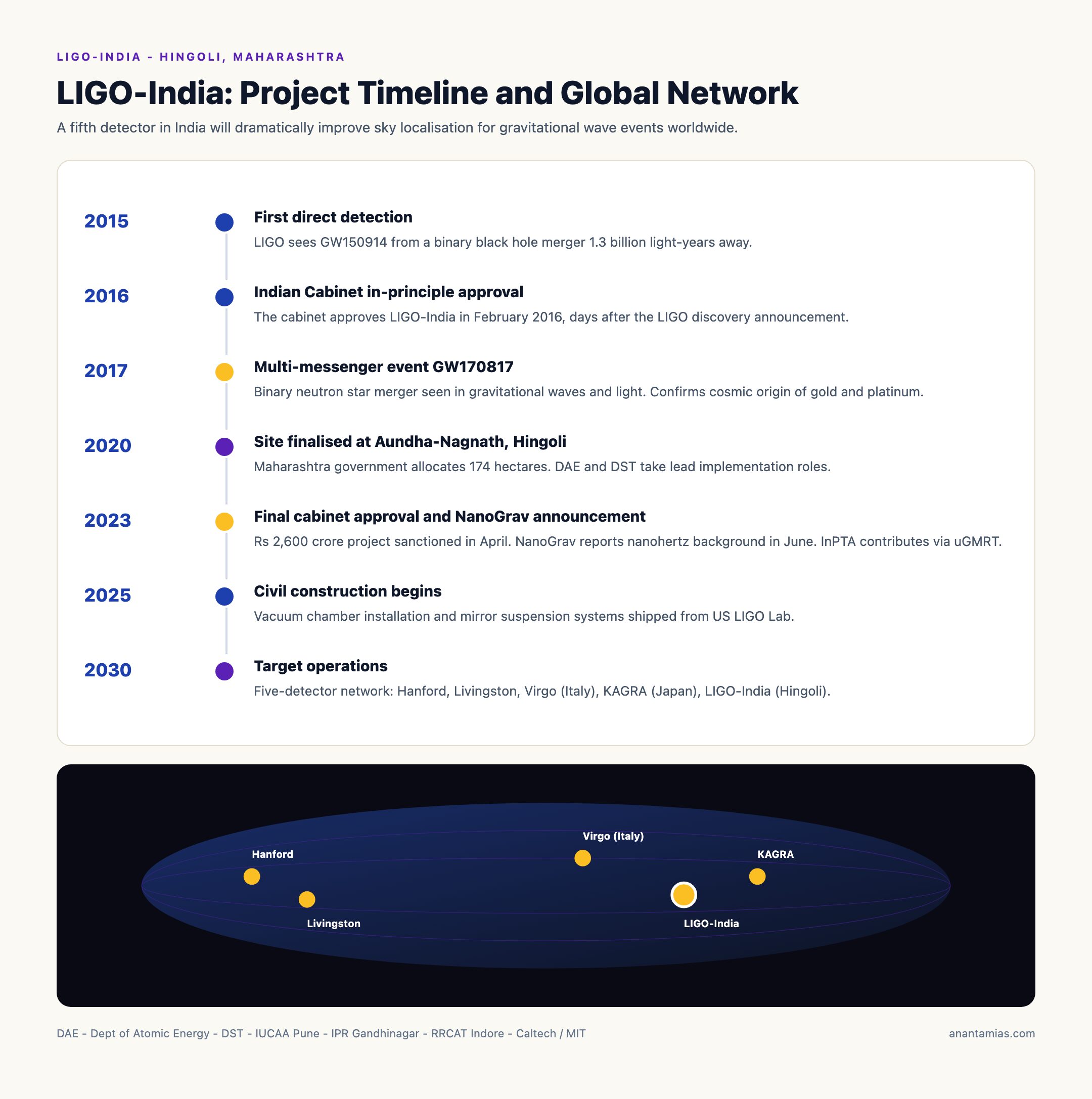
A gravitational wave signal alone tells you the masses, spins and distance of the merging objects. Combined with light, it tells you what was actually happening, which galaxy hosted it, what elements were created, how fast the universe is expanding. GW170817 was a textbook case. From the gravitational wave alone, scientists knew within hours that two neutron stars had merged at a distance of about 130 million light-years. The sky region was small enough that telescopes around the world found the optical kilonova within 11 hours, in galaxy NGC 4993. Spectroscopy of the kilonova confirmed that heavy elements like gold and platinum had just been forged in the merger, settling a long-standing question about the cosmic origin of these elements.
LIGO-India will multiply such opportunities. With a five-detector network running at design sensitivity, the rate of well-localized events is expected to climb sharply, opening a steady stream of multi-messenger discoveries through the late 2020s and 2030s. The technology of precision interferometry and quantum-limited measurement also feeds back into adjacent fields like quantum computing and high-precision metrology.
Comparative: LIGO vs Pulsar Timing Arrays
| Feature | LIGO and Virgo | Pulsar Timing Arrays |
|---|---|---|
| Frequency band | 10 to 1000 Hz (audio) | 1 to 100 nanohertz (years) |
| Source | Stellar-mass compact mergers | Supermassive black hole binaries |
| Event type | Transient bursts, milliseconds to minutes | Continuous cosmic background |
| Detector | 4-km vacuum interferometer with laser | Network of millisecond pulsars timed for years |
| First clear detection | September 2015, GW150914 | June 2023, NanoGrav 15-year dataset |
| Indian participation | LIGO-India in Hingoli, expected by 2030 | InPTA using upgraded GMRT |
Challenges and Limitations
Building a gravitational wave detector is among the hardest engineering tasks ever attempted. The mirrors must be polished to atomic smoothness, suspended on multi-stage pendulums and held at near-perfect vacuum. Seismic noise from distant earthquakes and even ocean waves must be subtracted. The lasers must hold their frequency to one part in trillions over long periods. For LIGO-India, building this in a humid Indian climate at a greenfield site adds civil and logistical challenges on top.
Pulsar timing arrays face a different problem. They need decades of patient observation. The 2023 NanoGrav result is based on a 15-year dataset. Confirming the source as supermassive black holes rather than other exotic backgrounds will need at least another decade of data and better characterization of pulsar noise.
The space-based LISA mission, the next major step into the millihertz band, faces the challenge of flying three spacecraft in formation across millions of kilometers and measuring their separation to picometer precision. Even on the ground, third-generation detectors like the proposed Einstein Telescope in Europe and Cosmic Explorer in the United States will need to be ten times more sensitive than current instruments, requiring underground sites and totally new facility designs.
Prelims Pointers
- Gravitational waves were predicted by Einstein in 1916 in the General Theory of Relativity and travel at the speed of light.
- The 2017 Nobel Prize in Physics was awarded to Rainer Weiss, Barry Barish and Kip Thorne for LIGO.
- The Hulse-Taylor binary pulsar provided the first indirect evidence of gravitational waves and won the 1993 Nobel.
- LIGO uses a 4-km L-shaped vacuum interferometer with split laser beams.
- KAGRA, an underground detector in Japan’s Kamioka mine, joined the network in 2020.
- The first multi-messenger event GW170817 in August 2017 was a binary neutron star merger and confirmed cosmic gold and platinum production.
- NanoGrav announced evidence for a nanohertz gravitational wave background in June 2023.
- Pulsar timing arrays use millisecond pulsars across the galaxy as a giant detector.
- LIGO-India is being built in Aundha-Nagnath, Hingoli district, Maharashtra.
- LIGO-India is led jointly by DAE and DST with IUCAA, IPR Gandhinagar and RRCAT as institutional partners.
- The Indian Pulsar Timing Array (InPTA) uses the upgraded Giant Metrewave Radio Telescope (uGMRT) near Pune.
Mains Practice Questions
- Discuss the strategic and scientific significance of the LIGO-India project. How does adding an Indian detector improve the global gravitational wave network? (250 words)
- Gravitational wave astronomy has opened a new window on the universe. Explain the principle of laser interferometry and the contribution of multi-messenger observations. (250 words)
- Compare ground-based interferometry with pulsar timing arrays as methods for detecting gravitational waves. Discuss India’s contributions in both. (150 words)
- India’s participation in LIGO is part of a wider pattern of investment in fundamental science infrastructure. Critically examine. (250 words)
Way Forward
LIGO-India must move from approval to operation by 2030 to be useful in the current observing era. Civil construction at Hingoli should be tracked carefully through the next two years, since site preparation and vacuum chamber installation are the critical path. Indian scientists need to be embedded in the global LIGO Scientific Collaboration analysis pipelines so that, when the detector switches on, India is a partner in discovery and not merely a host.
In parallel, InPTA’s work at the upgraded GMRT should be expanded with longer-baseline timing campaigns and better integration into the International Pulsar Timing Array. Indian universities should set up dedicated gravitational wave physics groups, and the National Education Policy emphasis on research capability gives a useful policy lever. A national centre for multi-messenger astronomy that links LIGO-India, GMRT, AstroSat-class missions and ground-based optical telescopes would maximize the return on investment.
Finally, the spinoffs of LIGO-class precision technology, in vacuum systems, vibration isolation and quantum measurement, are valuable for adjacent strategic sectors including defence research and nanotechnology. India should treat the project not just as cosmology but as a long-term capability investment.
Frequently Asked Questions
What exactly is a gravitational wave in simple terms?
A gravitational wave is a ripple in the fabric of spacetime itself, set off by accelerating masses such as merging black holes or neutron stars. It travels at the speed of light and very slightly stretches and squeezes space as it passes through.
Who first predicted gravitational waves and when were they detected?
Albert Einstein predicted gravitational waves in 1916 as a consequence of his General Theory of Relativity. The first direct detection was by LIGO on 14 September 2015, from a binary black hole merger 1.3 billion light-years away. The result was announced in February 2016 and won the 2017 Nobel Prize in Physics.
Where is LIGO-India being built and who runs it?
LIGO-India is being built at Aundha-Nagnath in Hingoli district of Maharashtra. It is led jointly by the Department of Atomic Energy and the Department of Science and Technology, with IUCAA Pune, IPR Gandhinagar and RRCAT Indore as the lead institutional partners. The American LIGO Lab at Caltech and MIT contributes design and hardware.
Why does India need its own gravitational wave detector?
A fifth detector dramatically improves triangulation of the source location on the sky. With LIGO-India in place, the network can pinpoint events accurately enough for optical and radio telescopes to find their counterparts quickly, enabling multi-messenger astronomy.
What is the difference between LIGO and a pulsar timing array?
LIGO is a ground-based 4-km laser interferometer that detects high-frequency gravitational waves from stellar-mass black hole and neutron star mergers. A pulsar timing array uses precise timing of millisecond pulsars across the galaxy to detect ultra-low-frequency waves from supermassive black hole binaries.
What is multi-messenger astronomy?
Multi-messenger astronomy is the practice of observing the same cosmic event in different signals such as gravitational waves, light, radio, X-rays and neutrinos. The August 2017 neutron star merger GW170817 was the first multi-messenger event seen in both gravitational and electromagnetic channels.
What did the 2023 NanoGrav announcement actually show?
NanoGrav and partner pulsar timing arrays announced strong evidence for a nanohertz gravitational wave background, consistent with the combined hum of supermassive black hole binaries across the universe. It is the first detection in this very low-frequency band.
Are gravitational waves dangerous?
No. The waves that reach Earth are so weak that they stretch a one-meter ruler by a fraction smaller than the size of a proton. They pass through bodies and instruments without any biological or material effect.
Can gravitational waves help test Einstein’s theory of relativity?
Yes. Each detection is a precision test of general relativity in the strong-field regime. So far, every observation has matched Einstein’s predictions. Future detectors may catch deviations that point toward quantum gravity.
What is India’s role in pulsar timing array research?
India contributes through the Indian Pulsar Timing Array (InPTA), which uses the upgraded Giant Metrewave Radio Telescope near Pune. InPTA data is part of the International Pulsar Timing Array consortium that announced the 2023 nanohertz background result.
Tell Google you want more of this.
Add Anantam IAS as a preferred sourceOne tap, and this site shows up more often in your own Top Stories, AI Overviews and AI Mode. Remove it any time.