Why in News?
On 21 October 2026, the Department of Science and Technology reported an RRI study using four secondary emission lines to infer a co-rotating accretion stream in Centaurus X-3.
- The study concerns a high-mass X-ray binary: a neutron star drawing material from a massive companion.
- The varying secondary lines point to material moving with the pulsar’s rotation, supporting an accretion-stream interpretation.
- This interpretation supports disk-fed accretion, while direct stellar-wind capture is the usual comparison for high-mass X-ray binaries.
- Distant X-ray binaries appear as point sources; changes in their radiation help reconstruct structures that telescopes cannot directly separate.
- The finding links spectroscopy, rotation and magnetic fields, making it useful for understanding how astronomical models are tested.
UPSC Relevance
Prelims Relevance
- Pulsar: a rotating, highly magnetised neutron star whose radiation can appear pulsed.
- High-mass X-ray binary: a compact object accreting material from a massive stellar companion.
- Accretion disk and magnetic accretion stream are different structures.
- Primary radiation and reprocessed secondary emission are distinct signals.
- Spectral variability can reveal spatial structure without a resolved image.
Mains Relevance
GS Paper 3
- Explain how Indian fundamental research improves models of stellar systems.
- Distinguish an observed radiation pattern from the physical mechanism inferred to explain it.
Essay
- Scientific progress through indirect evidence and testable explanations.
Background and Context
What Kind of System Is Centaurus X-3?
The subject is a neutron star receiving matter from a massive companion, with radiation revealing how that matter reaches it.
- An X-ray binary contains two gravitationally bound objects, including a compact star that accretes material from its companion. In Centaurus X-3, the compact object is a neutron star, not a black hole.
- A neutron star compresses stellar mass into a very small volume. Its strong gravity makes accretion energetically important: material falling towards the compact star can produce radiation detectable as X-rays by orbiting instruments.
- A pulsar is a rotating, highly magnetised neutron star. Radiation emerging near its magnetic poles sweeps through space as it spins; an observer can detect repeated pulses when the beam crosses the line of sight.
- The companion is a massive star, making Centaurus X-3 a high-mass X-ray binary. Its supply of matter provides the context for comparing direct stellar-wind capture with disk-fed accretion around the compact object.
- An accretion disk is material orbiting around the compact object, while an accretion stream carries material inward from that disk. Near the neutron star, magnetic fields guide this material towards the magnetic poles.
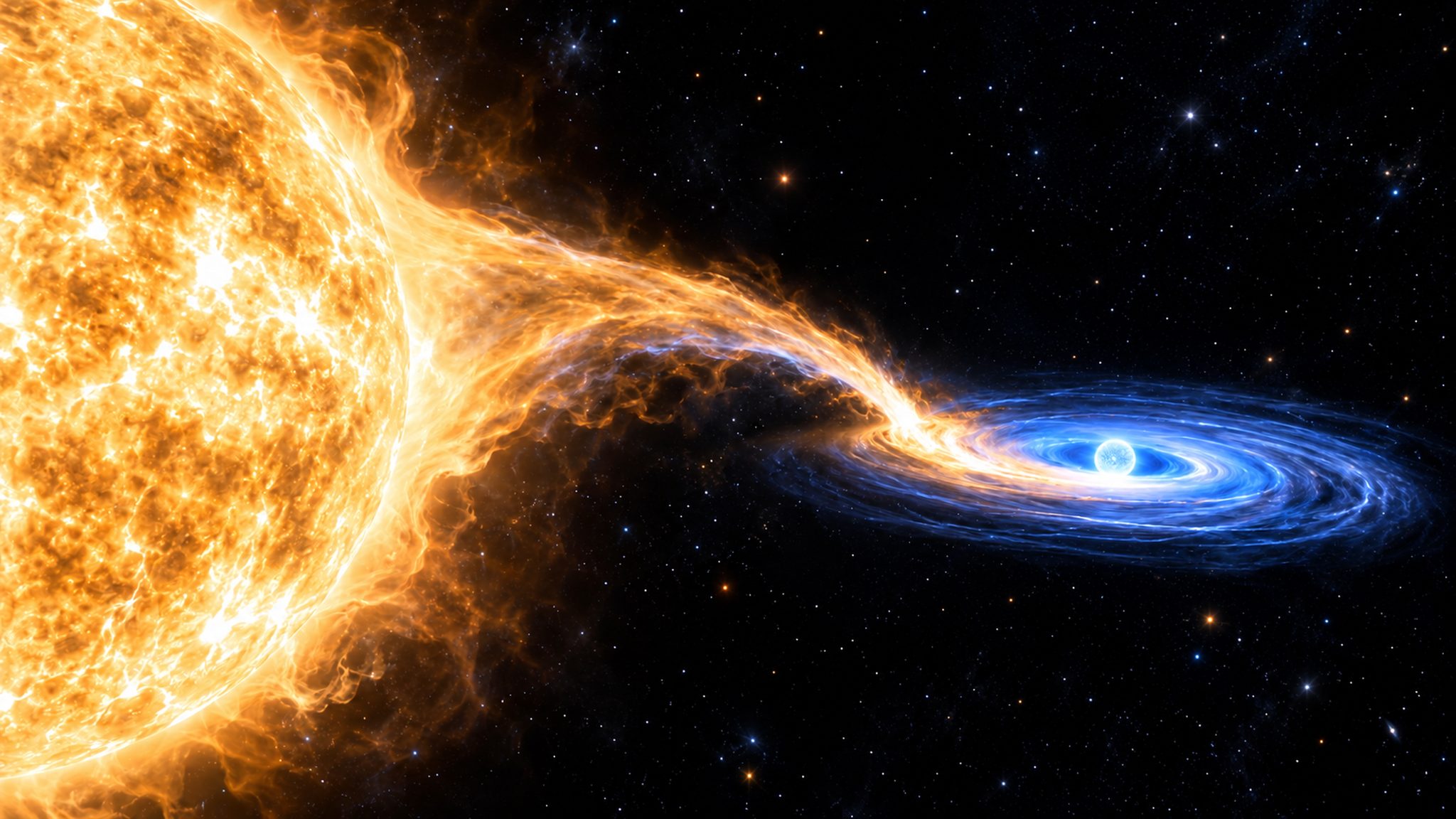
How Do Secondary Emission Lines Reveal the Stream?
The researchers used the relationship between direct and reprocessed radiation across the pulsar’s rotation to infer an otherwise unresolved structure.
- Primary emission comes from the pulsar’s magnetic-pole regions. Some radiation reaches the observer directly; some illuminates surrounding matter, which absorbs and re-emits it, producing secondary radiation that carries information about the illuminated material.
- The RRI team examined four secondary emission lines and their changing intensity with pulsar rotation. Their analysis indicates that the structure producing the varying lines rotates with the pulsar, constraining its location and behaviour.
- In the proposed interpretation, a co-rotating accretion stream periodically obscures the observer’s view of the pulsar. Direct primary emission then decreases, while secondary emission associated with the stream increases during that part of the rotation.
- This linked behaviour matters because timing and spectral changes connect the radiation to a moving structure. The inference uses how signals vary together, rather than simply treating the presence of X-rays as proof of a disk.
- The DST account identifies the stream as the structure channelling material from an accretion disk. Under this interpretation, the stream provides evidence for disk-fed accretion without a directly resolved image of that disk.
Why Does the Accretion Mechanism Matter?
The useful comparison is disk-fed accretion versus direct wind capture, with the finding kept separate from a photograph or discovery of the system.
- In many high-mass X-ray binaries, the compact object captures matter from the companion’s stellar wind. The reported result supports a disk and magnetically guided stream in Centaurus X-3, making that usual comparison scientifically significant.
- A model based on direct wind capture alone can miss radiation arising from disk-associated structures. The researchers argue that future emission models for this system should account for the disk and the relevant reprocessing material.
- The system appears as a point source because of its distance. Researchers reconstruct its internal arrangement from changing signals; an artist’s illustration may explain the proposed geometry, but cannot serve as observational evidence for it.
- The observation is the variation in emission lines; the explanation is a co-rotating stream linked to a disk. Keeping these separate allows alternative models to be evaluated against the same measurements as scientific understanding develops.
- This finding concerns stellar accretion and magnetic channelling, not gravitational-wave detection or a binary black-hole system. The exam-relevant lesson is that spectra and periodic brightness changes can reveal otherwise hidden structures around compact stars.
Way Forward
Test the Proposed Geometry
- Compare disk-and-stream models with measured line variability across the pulsar’s rotation, rather than relying on a single brightness measurement.
- Account for reprocessed emission when modelling the system, and state which physical structures each model requires.
- Use further observations to assess whether the inferred geometry consistently explains both primary and secondary radiation.
Conclusion
- Centaurus X-3 shows how secondary emission lines can connect observable radiation to an inferred accretion structure. The study supports a disk-fed stream without turning an unresolved source into a directly photographed system.
- For UPSC, connect neutron stars, magnetic fields and spectroscopy through the mechanism of matter transfer. Preserve the distinction between measured line variability and the physical interpretation used to explain that variability.
UPSC Practice Questions
Prelims MCQ 1
With reference to Centaurus X-3, consider the following statements:
- Its compact object is a neutron star.
- Secondary radiation can arise when surrounding material absorbs and re-emits primary radiation.
- The reported accretion stream was identified through a directly resolved photograph of its structure.
How many of the above statements are correct?
(a) Only one (b) Only two (c) All three (d) None
Answer: (b) Only two
Explanation:
Statements 1 and 2 are correct. Statement 3 is incorrect: the system appears as a point source, and the stream is inferred from secondary-line variability.
Prelims MCQ 2
Which observation best supports the co-rotating accretion-stream interpretation discussed in the RRI study?
(a) Direct primary emission weakens while stream-associated secondary emission strengthens during part of the rotation. (b) The companion star disappears permanently. (c) Gravitational waves directly map the accretion disk. (d) A resolved photograph shows material entering a black hole.
Answer: (a) Direct primary emission weakens while stream-associated secondary emission strengthens during part of the rotation.
Explanation:
A rotating stream can obscure the direct beam while reprocessing radiation. This provides an explanation for the associated changes in primary and secondary emission.
UPSC Mains Questions
- Explain how the study of secondary emission lines can reveal structures around an unresolved X-ray pulsar. Use Centaurus X-3 as an example.
- Distinguish direct stellar-wind capture from disk-fed accretion in high-mass X-ray binaries. Why does this distinction matter for emission models?
Source: PIB, Department of Science and Technology.
Frequently Asked Questions
What is Centaurus X-3?
Centaurus X-3 is a high-mass X-ray binary containing a rotating, magnetised neutron star and a massive companion. Material transferred towards the neutron star powers its strong X-ray emission.
What did the RRI study infer?
The study examined four secondary emission lines and inferred a structure co-rotating with the pulsar. The researchers identify it as an accretion stream, supporting an interpretation in which a disk feeds the neutron star.
Was the accretion disk directly photographed?
No. The system appears as a point source. The researchers inferred its structure from changes in radiation; illustrations of the disk and stream explain that interpretation rather than presenting a directly resolved observation.
How are primary and secondary radiation different?
Primary radiation originates near the pulsar’s magnetic poles. Secondary radiation results when surrounding material absorbs and re-emits that radiation, allowing its changing properties to reveal information about the intervening or illuminated structures.
Tell Google you want more of this.
Add Anantam IAS as a preferred sourceOne tap, and this site shows up more often in your own Top Stories, AI Overviews and AI Mode. Remove it any time.