Why in News?
The Union Ministry of Environment, Forest and Climate Change (MoEFCC) constituted a three-member team to investigate the death of KNG22, a 19-month-old male cheetah, from firearm pellet injuries outside Madhya Pradesh’s Kuno National Park.
| UPSC Relevance: GS-3 Environment and Biodiversity: Conservation, Protected Areas, Species in News Prelims: Cheetah, Project Cheetah, Keystone species, Kuno National Park |
About the Cheetah:
- World’s fastest land animal; member of the big cat family. Speed: Reaches 80-128 km/h in short, explosive sprints.
- Anatomy: Slender body, long legs, small round head, and flexible spine (all structural adaptations for high-speed locomotion).
- Coat: Distinctive solid black spots on tan fur.
- Facial Markings: Prominent “tear tracks” (black lines from the inner corner of the eyes to the mouth) that absorb glare and aid in daytime hunting.
- Diet: Carnivorous apex/mesopredator. Primary Prey: Small to medium-sized ungulates/antelopes (e.g., Gazelles, Impalas).
- Temporal Niche: Primarily diurnal (hunts during early morning and late afternoon) to minimise direct resource competition and conflict with nocturnal apex predators like lions and leopards.
- Preferred Biomes: Dry grasslands, savannas, diverse scrub forests, and arid/semi-arid open ecosystems where landscape visibility is high.
- Global Distribution:
- African Cheetah: Distributed across Eastern and Southern Africa.
- Asiatic Cheetah: Restricted only to Iran.
Historically, Asiatic Cheetahs were widespread in India (from Punjab to southern Tamil Nadu, Gujarat, Rajasthan to Bengal). The cheetah was declared officially extinct in India in 1952.
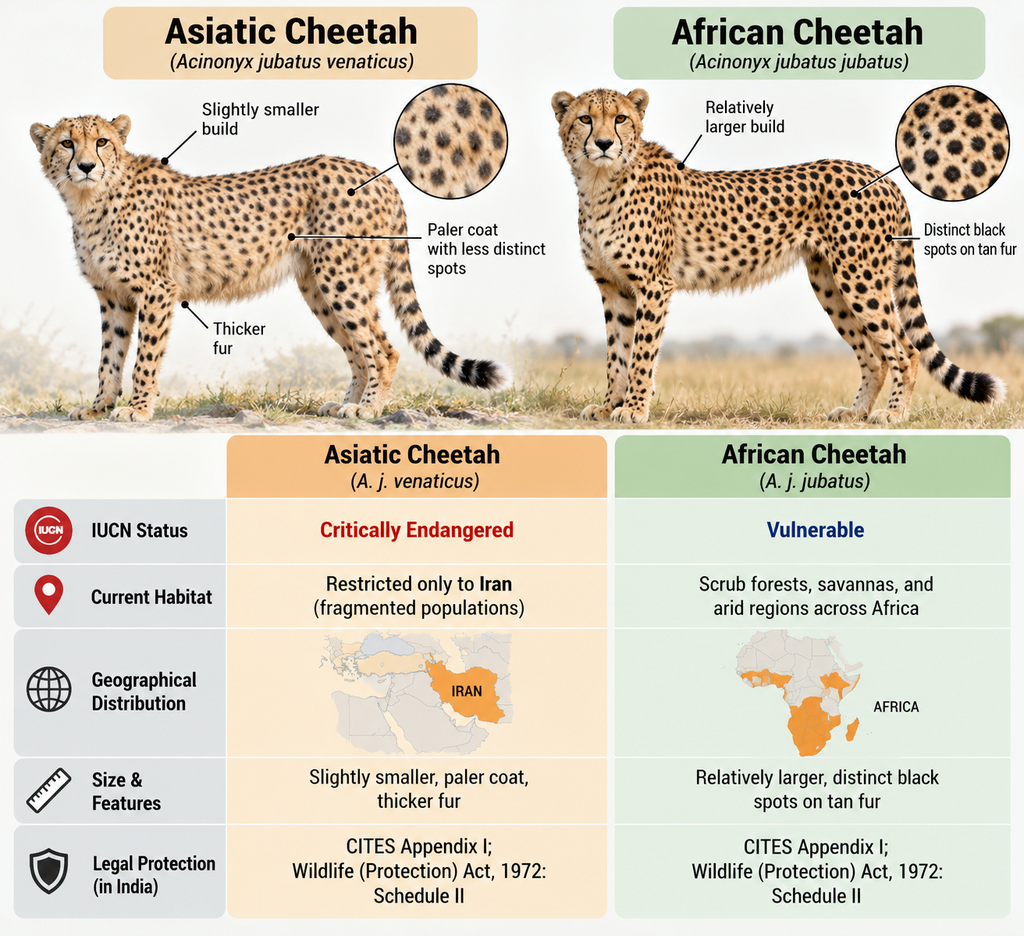
Asiatic Cheetah vs. African Cheetah:
| Parameter | Asiatic Cheetah | African Cheetah |
| IUCN Status | Critically Endangered | Vulnerable |
| Current Habitat | Restricted only to Iran (fragmented populations) | Scrub forests, savannas, and arid regions across Africa |
| Size & Features | Slightly smaller, paler coat, thicker fur | Relatively larger, distinct black spots on tan fur |
| Legal Protection | CITES Appendix I; Wildlife (Protection) Act, 1972: Schedule II | CITES Appendix I; Wildlife (Protection) Act, 1972: Schedule II |
Project Cheetah: Cheetah Reintroduction in India
Project Cheetah is India’s flagship wildlife conservation program launched in 2022 to reintroduce the species after its official extinction in the country in 1952.
(i) Institutional Governance:
- Nodal Agency: National Tiger Conservation Authority (NTCA), a statutory body under the MoEFCC, anchors the project’s strategic implementation and funding.
- Technical Partner: Wildlife Institute of India (WII) coordinates the spatial planning, biological monitoring, and on-ground technical execution.
(ii) Translocation Timeline and Current Population Dynamics:
- Phase I (September 2022): Introduction of 8 adult African cheetahs from Namibia into Kuno National Park (KNP), Madhya Pradesh.
- Phase II (February 2023): Introduction of 12 adult African cheetahs from South Africa into KNP.
- Population Status (Late October 2026): Total cheetah population in India has reached 60 individuals.
After Kuno National Park, the Gandhi Sagar Wildlife Sanctuary in Madhya Pradesh serves as India’s second major home for cheetahs under Project Cheetah.
Cheetah Conservation: Critical Challenges & Vulnerabilities
- Human-Wildlife Conflict: As cheetahs venture outside park boundaries into revenue lands and villages, they face immediate threats from humans due to a lack of awareness (e.g., being mistaken for leopards).
- Technical & Anthropogenic Failures: Past mortalities have been linked to septicaemia (blood poisoning) induced by skin abrasions from tracking radio collars during the monsoon season.
- Infectious Diseases & Starvation: High susceptibility to localised parasites and difficulties adapting to local prey bases have led to unexpected deaths.
- Space Constraints: Kuno National Park faces space limitations for a self-sustaining, multi-generational cheetah population, necessitating alternative sites like Gandhi Sagar.
Cheetah Conservation Fund (CCF): Founded in 1990 and headquartered in Namibia, this premier international non-profit organisation drives global research, habitat restoration, and human-carnivore conflict mitigation strategies.
Way Forward:
- Strengthening Local Eco-Development Committees (EDCs): Intensive community awareness programs are vital to help locals differentiate cheetahs from leopards and mitigate retaliatory killing.
- Capacity Building for State Forest Departments: Enhanced coordination between the NTCA, WCCB, and state special task forces to implement strict anti-poaching protocols.
- Technological Upgrades: Re-evaluating radio collar designs and implementing satellite-based geofencing alerts when animals breach park boundaries.
- Habitat Expansion: Accelerated preparation of alternative landscapes (like Gandhi Sagar and Nauradehi) to reduce overcrowding and territorial infighting at Kuno.
The Kuno incident highlights the need to extend conservation from protected-area management to coordinated protection across the wider landscape.
Prelims Practice MCQ:
Q. With reference to cheetah conservation, consider the following statements:
- The Asiatic cheetah is classified as Critically Endangered by the IUCN.
- The cheetah is listed in Schedule II of the Wildlife (Protection) Act, 1972.
- Gandhi Sagar Wildlife Sanctuary has received cheetahs transferred from Kuno.
Which of the statements given above are correct?
(a) 1 and 2 only
(b) 1 and 3 only
(c) 2 and 3 only
(d) 1, 2 and 3
Answer: (b)
UPSC PYQ 2020:
Q. With reference to Indian elephants, consider the following statements:
1. The leader of an elephant group is a female.
2. The maximum gestation period can be 22 months.
3. An elephant can normally go on calving till the age of 40 years only.
4. Among the States in India, the highest elephant population is in Kerala.
Which of the statements given above is/are correct?
(a) 1 and 2 only
(b) 2 and 4 only
(c) 3 only
(d) 1, 3 and 4 only
Answer: (a)
UPSC PYQ 2019:
Q. Consider the following statements:
1. Asiatic lion is naturally found in India only.
2. Double-humped camel is naturally found in India only.
3. One-horned rhinoceros is naturally found in India only.
Which of the statements given above is/are correct?
(a) 1 only
(b) 2 only
(c) 1 and 3 only
(d) 1, 2 and 3
Answer: (a)
Tell Google you want more of this.
Add Anantam IAS as a preferred sourceOne tap, and this site shows up more often in your own Top Stories, AI Overviews and AI Mode. Remove it any time.