Why in News?
CERN and Mistral announced a statement of intent on 15 October 2026 to develop foundation models for science, initially focused on collider physics.
- The proposed Large Physics Model would be pretrained on billions of simulated proton-proton collisions at the Large Hadron Collider.
- Intended tasks include collision reconstruction, particle identification, unexpected-signal detection and evaluation of future detector designs.
- The announcement establishes an ambition and partnership intent; it does not report a completed model, validated deployment or new particle discovery.
- Scientific AI must handle measurement uncertainty as well as computational scale: a convincing prediction is not automatically a reliable physical result.
- The development connects research infrastructure with reusable AI capabilities, while keeping experimental evidence central to scientific conclusions.
UPSC Relevance
Prelims Relevance
- CERN: European laboratory for particle physics.
- Large Hadron Collider: particle accelerator used for proton-proton collisions.
- Reconstruction: converting detector signals into particles and other analysis objects.
- Foundation model: pretrained model intended to support multiple downstream tasks.
- Simulation-to-data differences: a source of uncertainty requiring validation.
Mains Relevance
GS Paper 3
- Applications and limitations of artificial intelligence in fundamental science.
- Scientific infrastructure, computing capacity and reproducible research.
Essay
- Scientific progress depends on both powerful tools and disciplined doubt.
Background and Context
What Collision Reconstruction Actually Does
A detector records signals; physicists must infer what produced them before testing an explanation of the collision.
- Particle collisions create outgoing particles whose interactions with detector components produce measurable signals. These measurements are the starting material for analysis, rather than a ready-made account of everything that happened inside the collision.
- Reconstruction turns detector signals into particles and other objects used for physics analysis. It connects measurements to an interpretable event, allowing researchers to investigate the physical processes consistent with the recorded evidence.
- CERN describes the existing approach as a chain of specialised algorithms. Each stage contributes to interpreting detector information, so overall performance depends on how these stages work together, not just one isolated calculation.
- Machine learning already contributes to specialised reconstruction tasks. The proposal builds on that experience by exploring learning across the reconstruction chain, rather than introducing artificial intelligence into particle physics for the first time.
- Reconstructed objects remain inferences from measurements, not direct photographs of a collision. Researchers must assess how reconstruction choices affect the physical quantities they study before using those quantities to support a scientific claim.
How Training Differs From Using the Model
The key distinction is between learning from simulated collisions and interpreting detector measurements during scientific analysis.
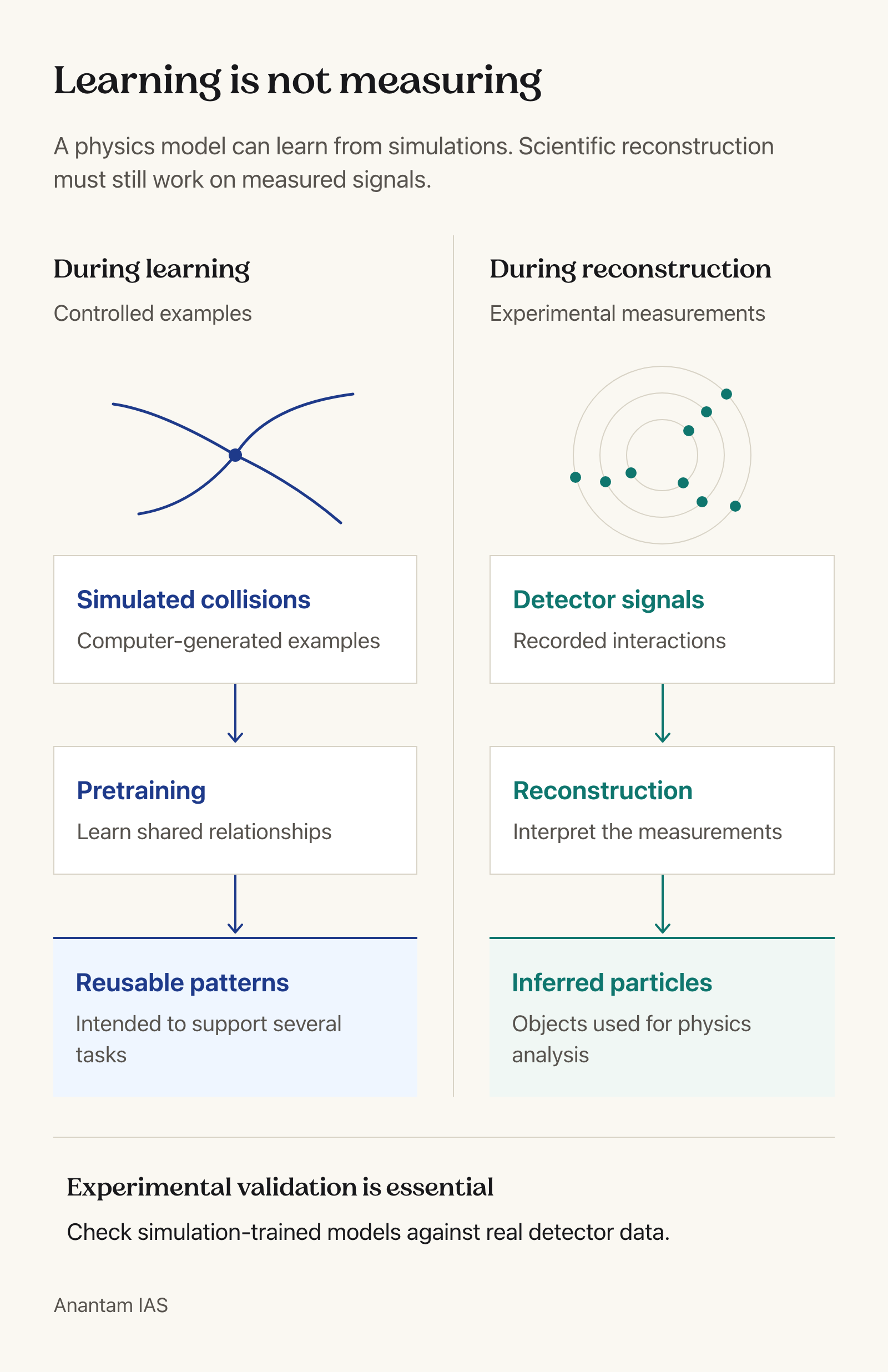
- Simulated collisions are computer-generated examples based on physical and detector models. They provide a controlled learning environment, but their usefulness depends on how well their assumptions represent the experimental conditions being studied.
- During pretraining, the proposed model would learn reusable patterns from many simulated proton-proton collisions. CERN intends this shared foundation to support several scientific tasks, rather than training an entirely separate model for every purpose.
- During inference, a trained model applies what it has learned to an input and produces task-relevant outputs. In reconstruction, the scientific question concerns interpreting detector information, not generating a plausible written answer about physics.
- The central comparison is specialised pipelines versus a shared foundation model. A reusable model could connect related tasks, but the announcement does not establish that it already outperforms established reconstruction methods on experimental data.
- CERN lists unexpected-signal detection and detector-design evaluation among intended applications. These are separate scientific uses of shared learning; the announcement does not specify a final architecture or demonstrate that every intended capability works.
Why Scientific Validation Cannot Be Skipped
The proposal is promising because of its possible reach, but the quality of its scientific conclusions will require evidence.
- Domain shift occurs when the data encountered in use differ from the training examples. Differences between simulated and measured detector responses can affect predictions, making agreement with real experimental data a necessary validation question.
- Uncertainty assessment asks how sensitive a result is to measurement limitations and modelling assumptions. An efficient model remains scientifically useful only if researchers can evaluate whether these limitations change the conclusions drawn from its outputs.
- An unexpected signal is a reason for investigation, not proof of a new particle. Detector effects, modelling weaknesses and known physical processes must be examined before an anomaly can support a discovery claim.
- Independent checks should compare model outputs with established methods and appropriate experimental evidence. Such evaluation helps distinguish better scientific performance from apparent gains that arise because an evaluation resembles the model’s training examples too closely.
- The CERN announcement is a statement of intent, not a performance report. Its training plans and application goals should be read as proposed work, with deployment readiness and scientific benefits still to be demonstrated.
Way Forward
Make Performance Scientifically Auditable
- Evaluate reconstruction accuracy and uncertainty against established methods before using model outputs to support new physics claims.
- Document training assumptions and simulation limitations, so researchers can identify conditions in which outputs need additional scrutiny.
- Test task-specific reliability: successful particle identification does not by itself establish reliable anomaly detection or detector-design evaluation.
Conclusion
- The proposed Large Physics Model illustrates how reusable AI could support scientific analysis across related tasks. Its importance lies in the research approach, while its eventual value depends on demonstrated performance with experimental evidence.
- For an answer on AI in science, connect computational capability with uncertainty, reproducibility and independent validation. A model can help identify a promising question; the scientific method must still establish whether its answer is trustworthy.
UPSC Practice Questions
Prelims MCQ 1
With reference to the proposed CERN Large Physics Model, consider the following statements:
- It is intended to be pretrained on simulated proton-proton collisions.
- Collision reconstruction converts detector signals into objects used for physics analysis.
- An unexpected signal identified by an AI model automatically establishes a new particle discovery.
How many of the above statements are correct?
(a) Only one (b) Only two (c) All three (d) None
Answer: (b) Only two
Explanation:
Statements 1 and 2 are correct. An unexpected signal requires investigation and independent scientific validation; it does not automatically demonstrate a new particle.
Prelims MCQ 2
Why must a collider model trained on simulations be validated against experimental data?
(a) Simulations and detector measurements are necessarily identical (b) The model can eliminate all measurement uncertainty (c) Differences between simulated and real conditions may affect its outputs (d) Pretraining proves every intended downstream task works
Answer: (c) Differences between simulated and real conditions may affect its outputs
Explanation:
Simulation-to-data differences can create domain shift. Experimental validation is needed to evaluate performance and uncertainty under the conditions where the model will be used.
UPSC Mains Questions
- Explain how foundation models could support particle-collision reconstruction. Why does their use strengthen the need for scientific validation? (150 words)
- Discuss the opportunities and limitations of artificial intelligence in fundamental science, with reference to simulation, uncertainty and reproducibility. (250 words)
Source: CERN.
Frequently Asked Questions
What have CERN and Mistral announced?
They have signed a statement of intent for a strategic partnership on foundation models for science. The initial ambition is a Large Physics Model for collider physics; a completed operational model was not announced.
What is collision reconstruction?
Collision reconstruction converts signals recorded by a particle detector into particles and other objects used for physics analysis. It helps researchers infer what happened in a collision from the measurements available.
Will the model be trained on actual collisions?
CERN describes pretraining on simulated proton-proton collisions. Simulated examples are generated using models; experimental detector data remain essential for assessing whether the trained system works reliably in real scientific analysis.
Can an AI anomaly establish a particle discovery?
No. An anomaly is an unexpected result that requires investigation. Researchers must assess detector effects, modelling limitations and known physical explanations before concluding that the evidence supports a new particle.
Is this a chatbot for physics?
The announced ambition is a scientific foundation model supporting tasks such as reconstruction and particle identification. Its purpose concerns collider data analysis, rather than conversational answers, and no final model architecture has been specified.
Tell Google you want more of this.
Add Anantam IAS as a preferred sourceOne tap, and this site shows up more often in your own Top Stories, AI Overviews and AI Mode. Remove it any time.