Why in News?
China’s Law on Promoting Ethnic Unity and Progress came into effect on 1 July 2026. The Hindu reported that the law — passed by the National People’s Congress (NPC) on 12 March 2026 — aims to build a “shared” national identity by strengthening the “community of the Chinese nation“, giving legal backing to Mandarin promotion, ideological education and the ‘Sinicisation‘ of religion.
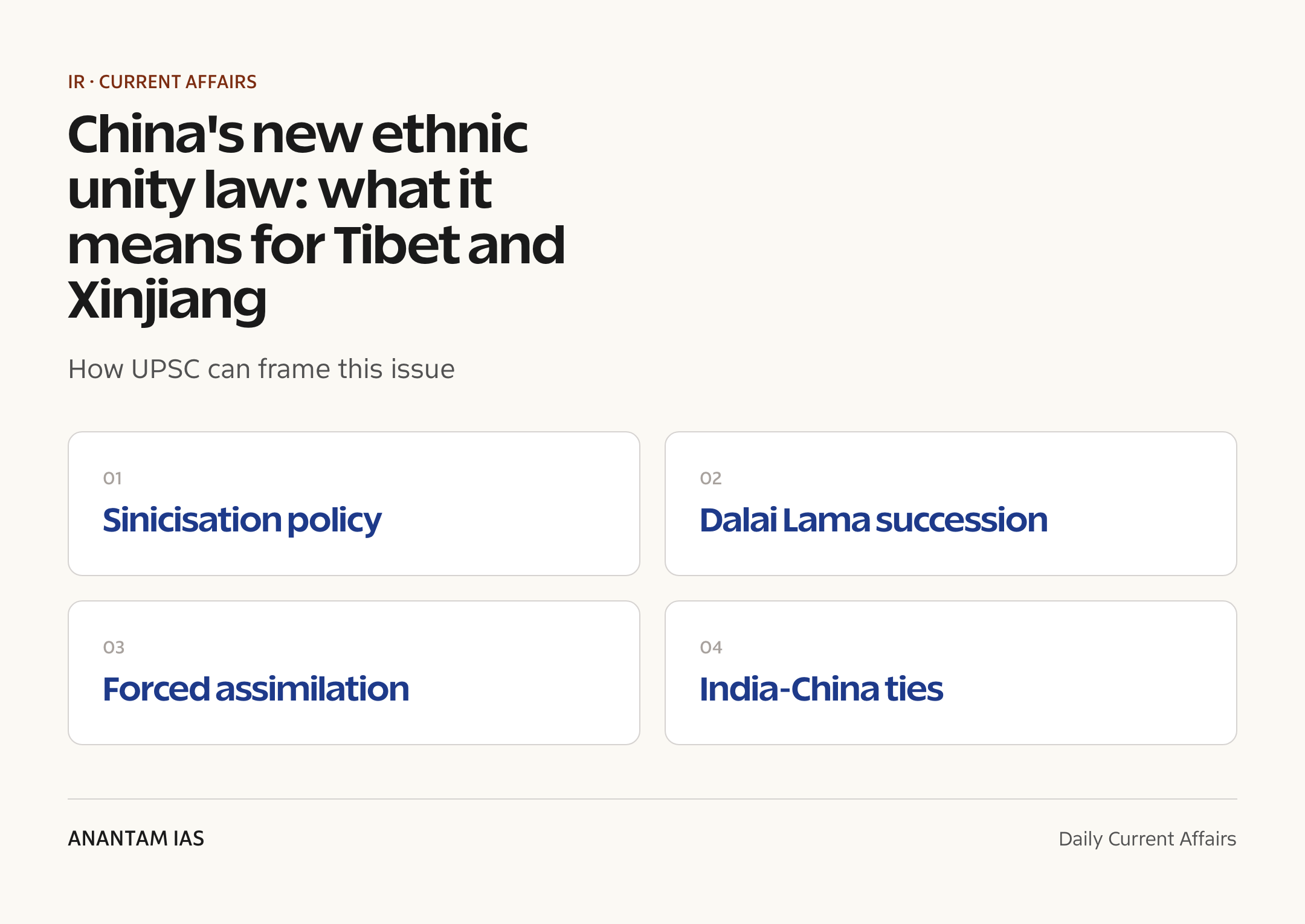
The UN Human Rights Office (OHCHR) warned the law could threaten minority freedoms and lead to forced assimilation — a concern that lands hardest on China’s roughly 7 million Tibetans and 11 million Uyghurs, and feeds directly into the looming Dalai Lama succession question that touches India.
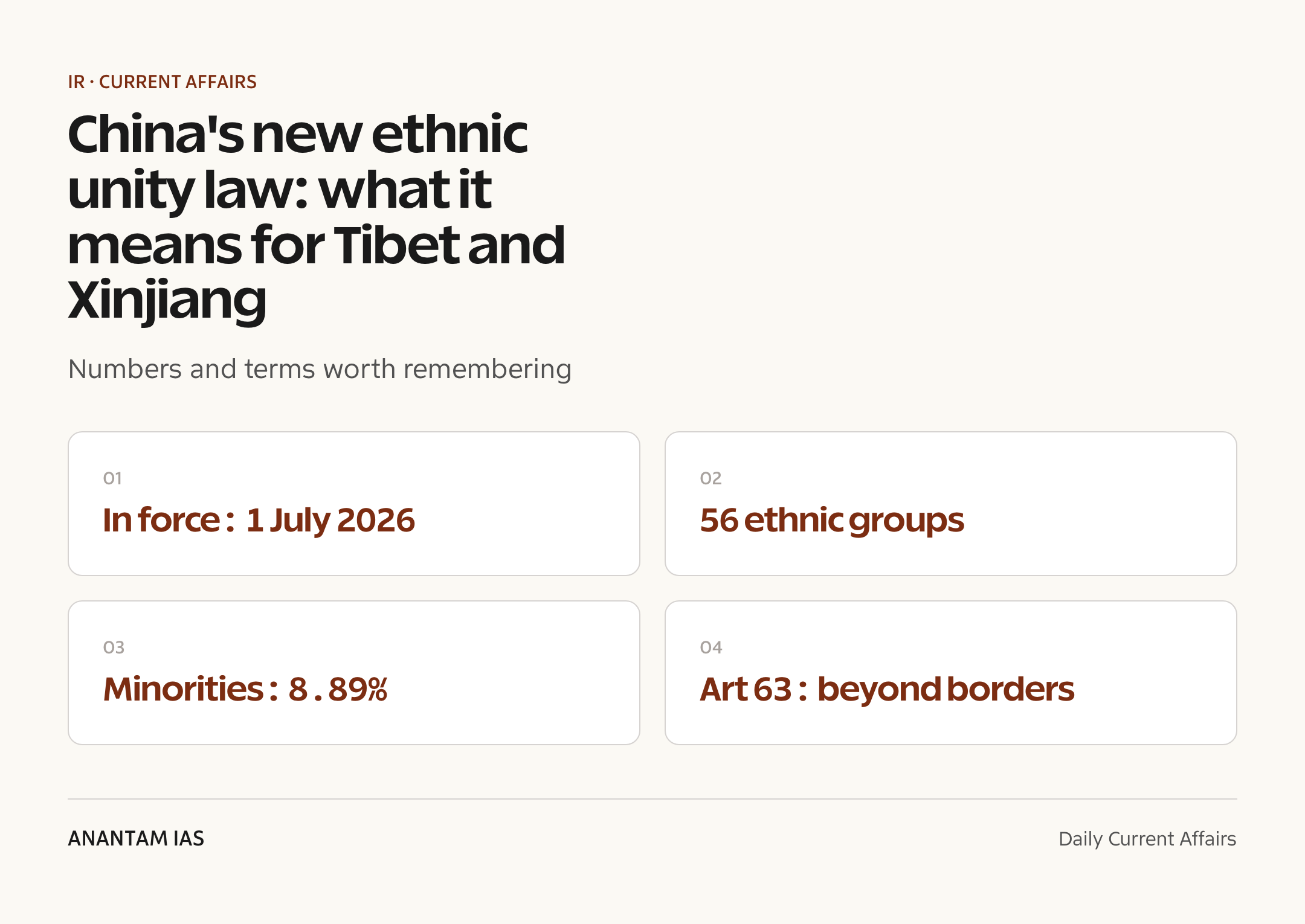
- The bill was introduced by the NPC’s Ethnic Affairs Committee in September 2025, signed on 12 March 2026 and enforced from 1 July 2026 — China’s first nationwide law of its kind on ethnic policy.
- China officially recognises 56 ethnic groups; the majority Han are over 90% of the population, while the 2020 census put ethnic minorities at 125 million-plus, or 8.89% of the total.
- Article 15 mandates Mandarin teaching for all children from before kindergarten through the end of compulsory schooling.
- Article 46 directs religious organisations, schools and places of worship to promote the Sinicisation of religion — aligning religious practice with state law and ideology.
- Article 63 extends liability to organisations and individuals outside China who “undermine national unity” — critics call this a licence for transnational repression.
The development matters in the context of:
- The law codifies a decade-long shift from ethnic autonomy to assimilation that began with the 2014 Central Ethnic Work Conference under Xi Jinping.
- For India, the law sharpens three live files: the Dalai Lama succession, the ~1-lakh-strong Tibetan exile community hosted in India, and the fragile post-2024 normalisation of India-China relations.
- It sits in tension with China’s own Constitution and its Law on Regional Ethnic Autonomy, which promise minorities language rights and limited self-rule.

UPSC Relevance
Prelims Relevance
- Law on Promoting Ethnic Unity and Progress — passed by China’s NPC on 12 March 2026; in force from 1 July 2026.
- China recognises 56 ethnic groups; Han Chinese are over 90% of the population; minorities were 8.89% (125 million+) in the 2020 census.
- Sinicisation of religion — the policy of aligning all religious practice in China with Chinese laws, socialist values and party ideology.
- 2014 Central Ethnic Work Conference — the policy turning point where Xi Jinping pushed “forging the sense of community of the Chinese nation”.
- Article 63 of the law has extraterritorial reach — foreign entities can be held liable for “undermining national unity”.
- Gaden Phodrang Trust (Dharamshala, 2011) — the body the 14th Dalai Lama says has sole authority to identify his reincarnation.
- Golden Urn — the 1793 Qing-era lot-drawing ritual Beijing insists must decide the next Dalai Lama, with central government approval.
- Xinjiang (2015) and Inner Mongolia (2021) had enacted local “ethnic unity” regulations before the national law.
- OHCHR — the UN Human Rights Office, which flagged the law’s forced-assimilation risk.
Mains Relevance
GS Paper 2
- India-China relations: how China’s internal ethnic consolidation in Tibet feeds into the border question, Tawang and the Dalai Lama succession.
- Policies of other states affecting India’s interests and the Indian diaspora/refugee-hosting role — the Tibetan exile community in India.
- Human rights and international institutions: OHCHR scrutiny vs state sovereignty; the limits of UN human-rights machinery against P-5 members.
GS Paper 1
- Salient features of world societies: assimilationist vs multicultural models of managing ethnic diversity — China’s unitary model vs India’s constitutional pluralism.
Essay
- Unity imposed is uniformity: can a nation be built by erasing its diversity?
- India’s ‘unity in diversity’ vs the assimilationist nation-state — two Asian answers to the same question.
Background and Context
From the 2014 conference to a nationwide law
The law is the legal capstone of a decade-long turn in Chinese ethnic policy under Xi Jinping.
- The 2014 Central Ethnic Work Conference marked the shift: from accommodating ethnic difference to “forging the sense of community of the Chinese nation” (zhonghua minzu gongtongti yishi).
- Provinces moved first — Xinjiang (2015) and Inner Mongolia (2021) enacted local “ethnic unity and progress” regulations; the new law scales that template nationwide.
- The bill was introduced by the NPC’s Ethnic Affairs Committee on 8 September 2025, signed on 12 March 2026, and came into force on 1 July 2026.
- Article 1 states its purpose: promote national unity, strengthen the sense of community of the Chinese nation, and advance the “great rejuvenation of the Chinese nation“.
- NPC delegate Lou Qinjian, introducing the proposal, said it is designed to foster “a stronger sense of community among all ethnic groups”.
What the law actually mandates
Three provisions carry most of the weight — language, religion, and an arm that reaches beyond China’s borders.
- Article 15 (language): Mandarin must be taught to all children from before kindergarten through compulsory education and high school; the “national common language” is the basic language of teaching and official work, taking precedence over minority languages.
- Article 46 (religion): religious organisations, schools and places of worship must promote the Sinicisation of religion and strengthen shared Chinese national identity — folding monasteries and mosques into state ideology.
- Article 63 (extraterritorial): any organisation or individual outside China that “undermines national unity” or “creates national division” can be held legally responsible — read by critics as targeting exile groups, including the Tibetan administration in India.
- The law bans acts that “undermine ethnic unity” — terms rights groups call broad and undefined, usable against peaceful expression, activism or cultural practice.
How it rewrites China's older autonomy promise
The new framework sits uneasily on top of China’s own constitutional commitments to minorities.
- China’s Constitution says every ethnicity has “the right to use and develop their own language” and “the right to self-rule”.
- The Law on Regional Ethnic Autonomy (1984) promises limited autonomy — including flexible measures for minority regions to run their economies.
- Five autonomous regions (Tibet, Xinjiang, Inner Mongolia, Ningxia, Guangxi) were built on that accommodation model, loosely inspired by Soviet nationality policy.
- The unity law inverts the hierarchy: national identity above ethnic identity — autonomy provisions survive on paper but are subordinated to “forging one community”.
- Critics see it as the final step of a policy called “second-generation ethnic policy” in Chinese academic debate — replacing group-differentiated rights with a single state-defined identity.
Tibet and the Dalai Lama succession
The law lands just as the succession of the 14th Dalai Lama becomes the central India-China flashpoint on Tibet.
- On 2 July 2025, days before his 90th birthday, the 14th Dalai Lama affirmed the institution will continue and that his Gaden Phodrang Trust (Dharamshala, set up 2011) has sole authority to identify the reincarnation.
- Beijing countered that the next Dalai Lama must be chosen by the Golden Urn lot-drawing ritual — a 1793 Qing-dynasty practice — and approved by the central government.
- The unity law’s Sinicisation-of-religion mandate (Article 46) gives Beijing a fresh statutory hook to control Tibetan Buddhist institutions, monasteries and the reincarnation system.
- Precedent: in 1995 China detained the boy the Dalai Lama recognised as the 11th Panchen Lama and installed its own candidate — a dry run for a contested Dalai Lama succession.
- Article 63’s extraterritorial clause could be aimed at the Central Tibetan Administration and exile bodies operating from Indian soil, since the Tibetan plateau remains the strategic heart of the dispute.
- Mandarin-first schooling threatens the Tibetan language: rights groups have long flagged boarding-school education separating Tibetan children from their linguistic and cultural roots.
Xinjiang and the Uyghurs
For Xinjiang, the law nationalises an approach already tested on the region’s Muslim minorities.
- Xinjiang is home to around 11 million Uyghurs, a Turkic Muslim minority; the region enacted its local ethnic-unity regulation back in 2015.
- Rights groups have documented arbitrary mass detention, surveillance and curbs on religious and cultural practice in Xinjiang — allegations Beijing denies.
- The law legalises the toolkit: Mandarin-medium schooling, mosque oversight, and ideological education now carry national statutory backing instead of regional regulation.
- Amnesty International’s Sarah Brooks said the law “does the opposite” of protecting minorities — it pushes Uyghurs, Tibetans and Mongolians toward “a single, state-defined national identity dominated by Han Chinese culture“, where “unity” means alignment with the Communist Party.
Why India should watch closely
A law about China’s interior is still strategic news for New Delhi on at least four counts.
- Succession stakes: India hosts the Dalai Lama and the Gaden Phodrang Trust; a Beijing-installed rival Dalai Lama would force New Delhi into a choice it has so far avoided — India officially takes no position on matters of faith, even as ministers attended the 90th-birthday celebrations.
- Exile community: India shelters the largest Tibetan exile population and the Central Tibetan Administration in Dharamshala; Article 63’s extraterritorial claim implicitly targets activity on Indian soil.
- Border linkage: Beijing frames Arunachal Pradesh (which it calls “Zangnan”) through the Tibet lens — tighter control over Tibet historically precedes harder positions on the LAC and Tawang.
- Ties under repair: the post-2024 thaw — patrolling disengagement, resumed Kailash Mansarovar Yatra and direct flights — remains hostage to flashpoints like succession; the law adds one more.
- Normative contrast: India’s constitutional model protects minority language and culture (Articles 29-30); China’s law is a live case study in the opposite, assimilationist model — useful for GS and essay answers.
The global pushback
Criticism has come from the UN system, governments and rights groups — Beijing calls it “spreading falsehoods”.
- The UN OHCHR expressed concern the law threatens minority freedoms and could lead to forced assimilation.
- Former UN special rapporteurs, several governments and scholars have criticised the law’s vague prohibitions and its reach into classrooms, worship and homes.
- Rights groups warn the undefined offences — “undermining unity”, “creating division” — chill peaceful expression and cultural practice.
- Beijing rejects the criticism, accusing detractors of spreading falsehoods, and presents the law as a guarantee of equality and shared prosperity among all 56 groups.
Way Forward
For India's policy
- Keep the Dalai Lama succession firmly framed as a religious matter decided by established Tibetan Buddhist convention — consistent, low-temperature messaging that neither provokes nor concedes.
- Quietly strengthen the institutional footing of the Tibetan exile community — education, documentation, cultural preservation — without making it a bilateral irritant.
- Insulate the border normalisation track: keep LAC de-escalation, trade and pilgrimage channels compartmentalised from the succession dispute.
- Invest in Buddhist-circuit diplomacy (Nalanda, Bodh Gaya, the International Buddhist Confederation) — India’s soft-power counter in the contest over Buddhism’s centre of gravity.
For the international system
- Sustained OHCHR and treaty-body scrutiny of implementation — especially boarding schools, language rights and religious controls in Tibet and Xinjiang.
- Democracies need a common line on transnational repression under Article 63-type provisions, protecting diaspora communities within their jurisdictions.
Conclusion
The Law on Promoting Ethnic Unity and Progress converts a decade of assimilationist practice into binding national law. Its real work is definitional: it makes one state-defined Chinese identity the legal norm, and difference — linguistic, religious, cultural — a compliance problem.
For India, the law is not an internal Chinese matter alone. It hard-codes Beijing’s claim over the Dalai Lama’s reincarnation, reaches extraterritorially toward exile institutions on Indian soil, and tightens the Tibet lens through which China views the border. New Delhi’s task is steadiness: protect the sanctity of the succession process, keep ties functional, and let India’s own pluralist model stand as the counter-argument.
UPSC Practice Questions
Prelims MCQ 1
With reference to China’s Law on Promoting Ethnic Unity and Progress (2026), consider the following statements:
- The law came into force on 1 July 2026 after being passed by China’s National People’s Congress.
- It mandates Mandarin-medium teaching for children from before kindergarten through compulsory education.
- The law applies only within the territory of the People’s Republic of China.
How many of the above statements are correct?
(a) Only one (b) Only two (c) All three (d) None
Answer: (b) Only two
Explanation:
Statements 1 and 2 are correct — the NPC passed the law on 12 March 2026 and it took effect on 1 July 2026, with Article 15 mandating Mandarin from pre-kindergarten. Statement 3 is wrong: Article 63 has extraterritorial reach, holding organisations and individuals outside China liable for acts that “undermine national unity”.
Prelims MCQ 2
The ‘Golden Urn’ method, recently in news in the context of the Dalai Lama’s succession, is associated with which of the following?
(a) A Ming-dynasty tribute ritual for recognising Tibetan monasteries (b) A Qing-era lot-drawing ritual that Beijing insists must select senior reincarnate lamas (c) A Tibetan exile convention adopted at Dharamshala in 2011 (d) A UNESCO-listed intangible heritage practice of Inner Mongolia
Answer: (b) A Qing-era lot-drawing ritual that Beijing insists must select senior reincarnate lamas
Explanation:
The Golden Urn dates to 1793 under the Qing dynasty. China maintains that reincarnations of major figures like the Dalai Lama and Panchen Lama must be identified by drawing lots from the urn and approved by the central government — a claim the 14th Dalai Lama rejects, vesting sole authority in his Gaden Phodrang Trust.
UPSC Mains Questions
- China’s new ethnic unity law marks the legal culmination of its shift from ethnic autonomy to assimilation. Examine the implications of this shift for the Tibetan question and for India-China relations. (250 words)
- “The succession of the 14th Dalai Lama is as much a geopolitical question as a religious one.” Discuss India’s stakes and the policy options available to New Delhi. (250 words)
- Compare the assimilationist model of managing ethnic diversity with India’s constitutional model of pluralism. What lessons does the contrast hold for multi-ethnic states? (150 words)
Source: The Hindu (Explained).
Frequently Asked Questions
What is China’s new ethnic unity law?
The Law on Promoting Ethnic Unity and Progress, in force from 1 July 2026, is China’s first nationwide statute on ethnic policy. It aims to forge a single “community of the Chinese nation”, giving legal backing to Mandarin-first schooling, ideological education and the Sinicisation of religion across all 56 recognised ethnic groups.
What does ‘Sinicisation of religion’ mean?
It is China’s policy of aligning every religious practice — Tibetan Buddhism, Islam, Christianity and others — with Chinese laws, socialist values and Communist Party ideology. Article 46 of the new law makes religious bodies, schools and places of worship legally responsible for promoting this alignment.
Why is Article 63 of the law controversial?
Article 63 extends liability beyond China’s borders: any foreign organisation or individual who “undermines national unity” or “creates national division” can be held legally responsible. Critics call this a legal basis for transnational repression aimed at exile groups, including Tibetan institutions based in India.
How does the law affect the Dalai Lama’s succession?
The 14th Dalai Lama says only his Gaden Phodrang Trust in Dharamshala can identify his reincarnation. Beijing insists on the Qing-era Golden Urn ritual plus government approval. The new law’s religious-control provisions strengthen China’s statutory claim over Tibetan Buddhist institutions, setting up a likely contest of rival successors.
Why does this law matter for India?
India hosts the Dalai Lama, the Gaden Phodrang Trust and the largest Tibetan exile community. The law’s extraterritorial clause implicitly reaches Indian soil, the succession dispute could strain the post-2024 thaw in ties, and China views the Arunachal border through the Tibet lens.
Who has criticised the law, and what is China’s response?
The UN Human Rights Office (OHCHR), Amnesty International, former UN special rapporteurs and several governments have warned it enables forced assimilation of Uyghurs, Tibetans and Mongolians. Beijing rejects the criticism as “spreading falsehoods” and presents the law as promoting equality and unity.
Tell Google you want more of this.
Add Anantam IAS as a preferred sourceOne tap, and this site shows up more often in your own Top Stories, AI Overviews and AI Mode. Remove it any time.