Why in News?
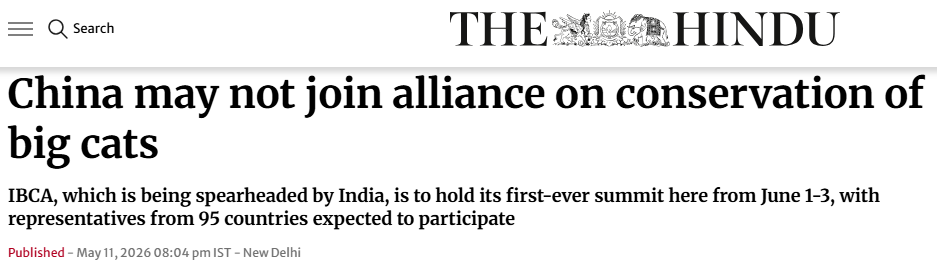
China is unlikely to join the International Big Cat Alliance (IBCA), a major conservation initiative spearheaded by India for the protection of the world’s seven big cat species. The issue has gained attention ahead of the first IBCA summit scheduled from June 1-3, 2026, in India, with participation expected from around 95 countries.
UPSC Relevance
GS-III: Biodiversity conservation and wildlife governance, India’s environmental diplomacy and soft power, Tiger conservation initiatives and global environmental institutions, Species conservation under international frameworks, India’s leadership in global conservation efforts
International Big Cat Alliance (IBCA)
The International Big Cat Alliance is a multilateral initiative launched by India to strengthen global cooperation for the conservation of seven major big cat species:
- Tiger
- Lion
- Leopard
- Snow Leopard
- Cheetah
- Jaguar
- Puma
The alliance aims to facilitate:
- Conservation cooperation among range countries.
- Habitat protection and restoration.
- Research and scientific exchange.
- Capacity building and training.
- Anti-poaching cooperation.
- Technological and ecological innovation.
Unlike some treaty-based environmental institutions, the IBCA does not impose mandatory financial obligations on members.
Background of the Initiative
India announced the IBCA during the commemoration of 50 years of Project Tiger in 2023.
The initiative reflects India’s attempt to:
- Position itself as a global leader in wildlife conservation.
- Build ecological partnerships across Asia, Africa, and Latin America.
- Strengthen South-South cooperation on biodiversity governance.
China’s Position and Concerns
Limited Tiger Population
China currently has:
- A very small population of wild Amur (Siberian) tigers.
- Most of these tigers are confined to northeastern provinces bordering Russia.
Scientific estimates indicate:
- Around 50-70 wild Amur tigers survive in China.
- They form part of a larger transboundary population extending into the Russian Far East.
Functional Extinction of South China Tiger
The South China tiger is regarded as functionally extinct in the wild.
Despite repeated surveys:
- No scientifically confirmed wild populations have been identified in recent decades.
- Habitat fragmentation and hunting historically contributed to the decline.
Strategic and Diplomatic Dimensions
China’s hesitation may also reflect:
- Preference for independent conservation frameworks.
- Geopolitical caution regarding India-led institutions.
- Competing regional leadership aspirations.
Environmental diplomacy increasingly overlaps with strategic influence in international governance structures.
India’s Dominant Role in Tiger Conservation
India currently hosts:
- About 3,167 wild tigers (2022 estimation).
- More than 70% of the global wild tiger population.
- Over 95% of Asia’s wild tigers outside Russia.
The dominant subspecies is the Bengal tiger.
India’s tiger population is spread across:
- Central Indian forests.
- Western Ghats.
- Himalayan landscapes.
- Sundarbans mangroves.
- Northeastern forests.
India’s Conservation Success Story
Project Tiger (1973)
Launched in 1973, Project Tiger became one of the world’s most successful species conservation programmes.
Key Features
- Creation of tiger reserves.
- Habitat conservation.
- Anti-poaching measures.
- Community participation.
- Scientific monitoring using camera traps and GIS tools.
India currently has over 50 tiger reserves.
Legal and Institutional Framework
Wildlife Protection Act, 1972
Provides legal protection to endangered wildlife species.
National Tiger Conservation Authority (NTCA)
Statutory body responsible for tiger conservation and reserve management.
Tiger Conservation Plans
Landscape-based ecological management strategies.
Importance of the IBCA
Global Biodiversity Conservation
Big cats are apex predators and keystone species. Their conservation helps:
- Maintain ecological balance.
- Preserve food chains.
- Protect forests and ecosystems.
Climate and Ecosystem Linkages
Protecting tiger and big cat habitats also safeguards:
- Carbon sinks.
- Water security.
- Biodiversity-rich forests.
This contributes to climate mitigation goals.
India’s Environmental Diplomacy
The IBCA enhances India’s:
- Soft power.
- Leadership in Global South environmental governance.
- Role in biodiversity diplomacy.
It complements initiatives such as:
- International Solar Alliance
- Coalition for Disaster Resilient Infrastructure
Challenges Before the Alliance
Geopolitical Fragmentation
Major powers may hesitate to join initiatives led by rival countries.
Funding Constraints
Long-term conservation requires:
- Stable financial support.
- Technology transfer.
- Capacity building.
Human-Wildlife Conflict
Expansion of protected habitats often intensifies:
- Crop damage.
- Livestock predation.
- Conflict with local communities.
Habitat Fragmentation
Infrastructure expansion and urbanisation continue to threaten wildlife corridors.
India’s Broader Conservation Diplomacy
India is increasingly using environmental cooperation as a tool of diplomacy through:
- Transboundary conservation partnerships.
- International wildlife summits.
- South-South ecological cooperation.
The IBCA demonstrates the growing linkage between ecology, geopolitics, and global governance.
Way Forward
Strengthen Scientific Collaboration
The alliance should promote:
- Joint research programmes.
- Wildlife genetics studies.
- Shared monitoring technologies.
Enhance Transboundary Conservation
Big cat habitats frequently cross national borders. Cooperation is essential for:
- Wildlife corridors.
- Anti-poaching operations.
- Data sharing.
Community-Centric Conservation
Local communities must be integrated through:
- Eco-tourism benefits.
- Compensation mechanisms.
- Sustainable livelihood opportunities.
Sustainable Financing
Dedicated conservation financing mechanisms and international green funds should support habitat restoration and species recovery.
Expand Global Participation
India should continue diplomatic engagement with:
- China.
- Russia.
- African range countries.
- Latin American states.
Broader participation would improve the alliance’s ecological credibility and geopolitical legitimacy.
Conclusion
The International Big Cat Alliance represents an important evolution in global wildlife governance, with India emerging as a leading force in biodiversity diplomacy. China’s possible absence highlights the geopolitical complexities that increasingly shape environmental cooperation.
Nevertheless, the initiative reflects a broader recognition that conserving apex predators is essential not only for biodiversity protection but also for ecological stability, climate resilience, and sustainable development. India’s experience in tiger conservation provides a strong foundation for shaping a more collaborative global conservation architecture.
Practice Questions
Prelims
1. Consider the following species included under the International Big Cat Alliance (IBCA):
- Tiger
- Snow Leopard
- Jaguar
- Black Panther
How many of the above are part of the IBCA framework?
(a) Only one
(b) Only two
(c) Only three
(d) All four
Answer: (c)
2. With reference to Project Tiger, consider the following statements:
- It was launched in 1973.
- The National Tiger Conservation Authority is a statutory body.
- India hosts the largest wild tiger population in the world.
Which of the statements given above are correct?
(a) 1 and 2 only
(b) 2 and 3 only
(c) 1 and 3 only
(d) 1, 2 and 3
Answer: (d)
Mains
- Discuss the significance of the International Big Cat Alliance in the context of biodiversity conservation and India’s environmental diplomacy.
- Examine the challenges associated with transboundary wildlife conservation in the Indo-Pacific and Eurasian regions. How can multilateral cooperation improve big cat conservation efforts?
Tell Google you want more of this.
Add Anantam IAS as a preferred sourceOne tap, and this site shows up more often in your own Top Stories, AI Overviews and AI Mode. Remove it any time.