Why in News?
The Ramsar Convention has announced the inclusion of Sukhna Wetland in Chandigarh and Sauj Jheel in Uttar Pradesh in the List of Wetlands of International Importance. With the addition of Sukhna Wetland and Sauj Jheel, India’s tally of Ramsar Sites has risen to 103.
| UPSC Relevance: GS-3 Environment & Biodiversity: Conservation Prelims: Ramsar Sites, Sukhna Wetland, Sauj Jheel, Ramsar Convention |
Ramsar Convention:
- Ramsar sites are also called Wetlands of International Importance under the Ramsar Convention, an environmental treaty established in 1971.
- Ramsar Convention on Wetlands was adopted in 1971 at Ramsar, Iran, and entered into force in 1975.
- Objective: Conservation and wise use of wetlands through national action and international cooperation.
- Membership: 172 contracting parties. India became a party to the convention on February 1, 1982.
- Wise use: Maintaining a wetland’s ecological character through ecosystem-based approaches within sustainable development. It allows compatible human use while safeguarding ecological functions.
Criteria for Ramsar site qualification:
- A wetland can qualify for Ramsar status if it meets at least one of the nine criteria. These recognise representative or rare wetland types, threatened species, biodiversity and critical life-cycle habitats, among other ecological values. Quantitative criteria include regularly supporting 20,000 or more waterbirds, or 1% of the individuals in a population of a waterbird species or subspecies.
About Sukhna Wetland:
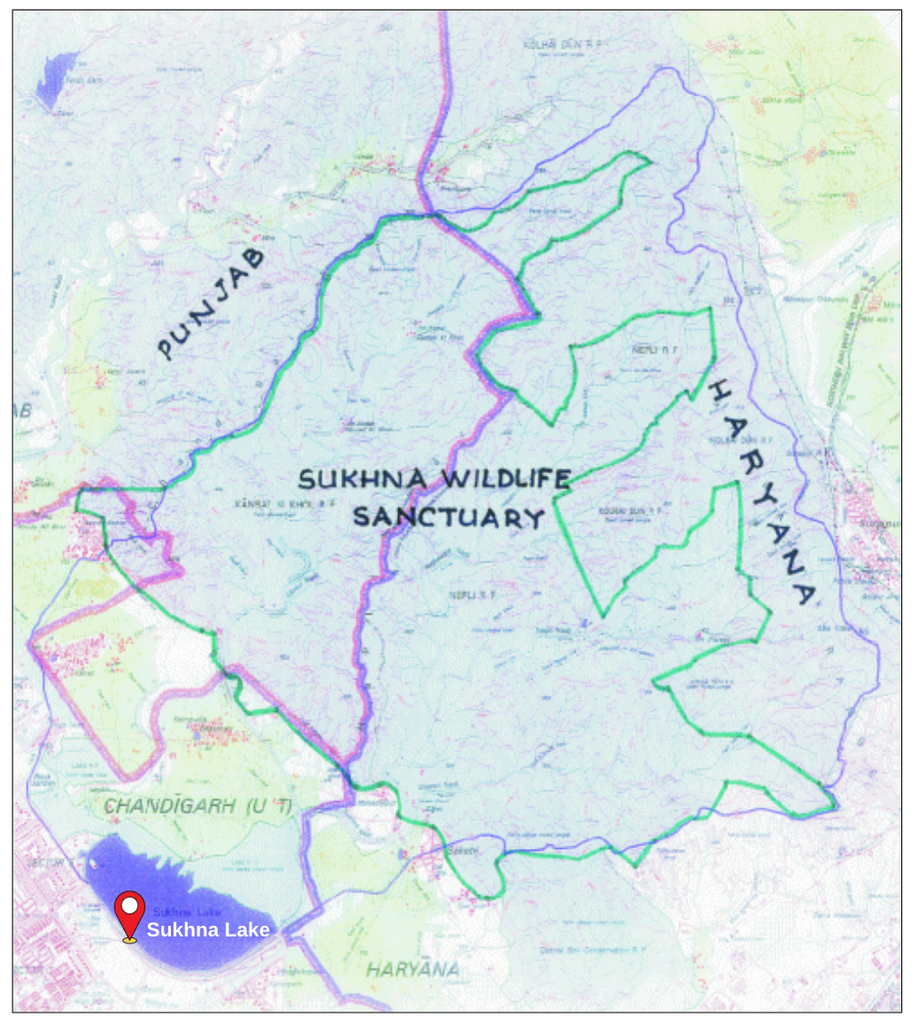
- Located at the foothills of the Outer Himalayas, Sukhna Wetland is a peri-urban reservoir that regulates water and sediment flows from its catchment.
- Sukhna Lake was created in 1958 by constructing an earthen dam across the seasonal Sukhna Choe, which drains the Shivalik hills. The notified wetland area is reported at around 493 to 565 acres, while Sukhna Lake covers around 3 sq km.
- It provides vital habitat and sediment flows from its catchment.
- It provides vital habitats for resident and migratory birds along the Central Asian Flyway, including the vulnerable common pochard (Vulnerable) and the Pallas’s fish eagle (Endangered).
- Its shallow margins support black pond turtles (Endangered).
- The wetland faces challenges from invasive plant species and sediment inflow. Sedimentation from the Shivalik slopes has long threatened the lake’s water-holding capacity.
- Its management plan includes soil and moisture conservation to curb erosion, reduce sediment loads and periodically remove invasive vegetation. The Punjab and Haryana High Court has declared Sukhna Lake a legal entity for purposes of its protection and conservation, while designating Chandigarh’s residents as its guardians.
About Sauj Jheel:
- Sauj Jheel is a shallow lake and wetland located in the Mainpuri district of Uttar Pradesh. Mainpuri has become the first district in India with two Ramsar sites. The other Ramsar site in the Mainpuri district is the Saman Bird Sanctuary.
- Location: Situated near Sauj village, close to Saman and the Saman Bird Sanctuary in Mainpuri district.
- Ecology: A shallow depression surrounded by farmland in the Ganga floodplain. An agricultural runoff canal feeds the lake on its northern side, while another canal discharges excess water toward the Saman Bird Sanctuary.
- Biodiversity: The wetland provides vital habitats for a diverse range of resident and migratory waterbirds, including Black-necked Stork (Near Threatened), Sarus Crane (Vulnerable) and Greater Spotted Eagle (Vulnerable).
Significance: The status is expected to strengthen conservation efforts and promote scientific cooperation and environmental education.
Practice Prelims MCQ:
Q. Consider the following statements regarding the Ramsar Convention on Wetlands:
- It is an intergovernmental treaty that provides the framework for national action and international cooperation for the conservation and wise use of wetlands.
- The designation of a site under the Ramsar Convention automatically brings it under the legal ownership and control of the United Nations.
- The Montreux Record is maintained as part of the Ramsar List to identify wetlands where ecological changes have occurred, are occurring, or are likely to occur as a result of technological developments or pollution.
Which of the statements given above are correct?
(a) 1 and 2 only
(b) 2 and 3 only
(c) 1 and 3 only
(d) 1, 2 and 3
Answer: (c) 1 and 3 only
Explanation:
- Statement 1 is correct: The Ramsar Convention (signed in 1971 in Ramsar, Iran) is an independent intergovernmental treaty focused entirely on the conservation and sustainable “wise use” of wetlands.
- Statement 2 is incorrect: A Ramsar designation does not alter the political or legal sovereignty of the site. The country in which the wetland is located retains full ownership, jurisdiction, and sovereign rights over the territory.
- Statement 3 is correct: The Montreux Record is a register of wetland sites on the List of Wetlands of International Importance where changes in ecological character have occurred, are occurring, or are likely to occur as a result of technological developments, pollution or other human interference.
Tell Google you want more of this.
Add Anantam IAS as a preferred sourceOne tap, and this site shows up more often in your own Top Stories, AI Overviews and AI Mode. Remove it any time.