For the first time, the world’s biggest climate summit met inside the Amazon. COP30 — the thirtieth Conference of the Parties to the UN climate convention — was held in Belem, a humid port city on the edge of the rainforest in northern Brazil, from 10 to 21 November 2025, with talks running into overtime and the final deal gavelled late on 22 November. Brazil chose the venue deliberately: a summit about saving the planet’s forests and slowing warming, staged where the consequences are most visible. The headline that came out of it, though, was about what the meeting could not agree on. After two weeks of negotiation, COP30 closed with a sweeping finance-and-adaptation deal called the “global mutirao” — and no binding roadmap to phase out the fossil fuels that cause the crisis in the first place.
That gap is the whole story of Belem. More than 80 countries, led by the host, pushed for a clear plan to transition away from coal, oil and gas. A bloc of oil-producing nations blocked it, and the final text carried not a single line on a phase-out path. So the summit delivered real money and real machinery — a pledge to triple adaptation finance, a route toward $1.3 trillion a year, a new fund to keep tropical forests standing, and a just-transition mechanism — while leaving the central question of cutting fossil fuels to a set of voluntary roadmaps the Brazilian presidency announced on its own. For UPSC, COP30 is a near-certain current-affairs and GS3 question, because it captures exactly where global climate politics now sits: long on finance and process, short on the one commitment that matters most.
Why It’s in the News
COP30 mattered because it was the first “stocktake” COP after the world formally admitted, at Dubai in 2023, that it was off track for the Paris goals — and the first chance to turn that admission into a phase-out plan. It also landed at a tense moment: the United States, under a second Trump administration, had again pulled out of the Paris Agreement and stayed away from the leadership table, leaving Brazil, the European Union, China and the big developing economies to carry the talks. The drama of the fortnight — a fire that briefly forced an evacuation of the venue, Indigenous protests outside the gates, and the late-night collapse of the phase-out language — kept Belem in headlines worldwide.
For India, the news cut close. New Delhi went to Belem with a sharp, finance-first message and emerged having helped shape an equity-friendly outcome while declining, like several major emitters, to submit a stronger updated climate pledge before the meeting. The summit also pushed forward the Carbon Border Adjustment Mechanism fight — the EU’s plan to tax carbon-heavy imports — that India has been resisting as a trade barrier dressed up as climate policy. So Belem is current affairs that touches India’s economy, its diplomacy and its development model all at once.
What COP and the Phase-Out Debate Are Really About
To read Belem, you need the architecture behind it. COP is the annual decision-making summit of the United Nations Framework Convention on Climate Change, the 1992 treaty under which almost every country agreed to tackle global warming. The landmark agreement under it is the 2015 Paris Agreement, which set the goal of holding the rise in global average temperature to well below 2 degrees Celsius above pre-industrial levels, and ideally to 1.5 degrees. Paris works through Nationally Determined Contributions, or NDCs — the climate action plans each country sets for itself and is meant to ratchet up every five years. There is no global police force; the system runs on pledges, peer pressure and a “global stocktake” every five years to check collective progress.
The phase-out debate is newer and more explosive. For three decades, COP texts never named the actual cause of warming. That changed at COP28 in Dubai in 2023, where, for the first time, nations agreed to “transition away from fossil fuels in energy systems.” It was a historic line — but a soft one, with no dates and no enforcement. Ever since, climate-vulnerable states and ambitious governments have wanted to turn that phrase into a concrete roadmap with timelines. Oil and gas exporters have resisted just as hard, arguing that the convention covers emissions, not specific fuels, and that a forced exit threatens their economies. Belem became the battleground where that argument finally came to a head — and where the blockers won.
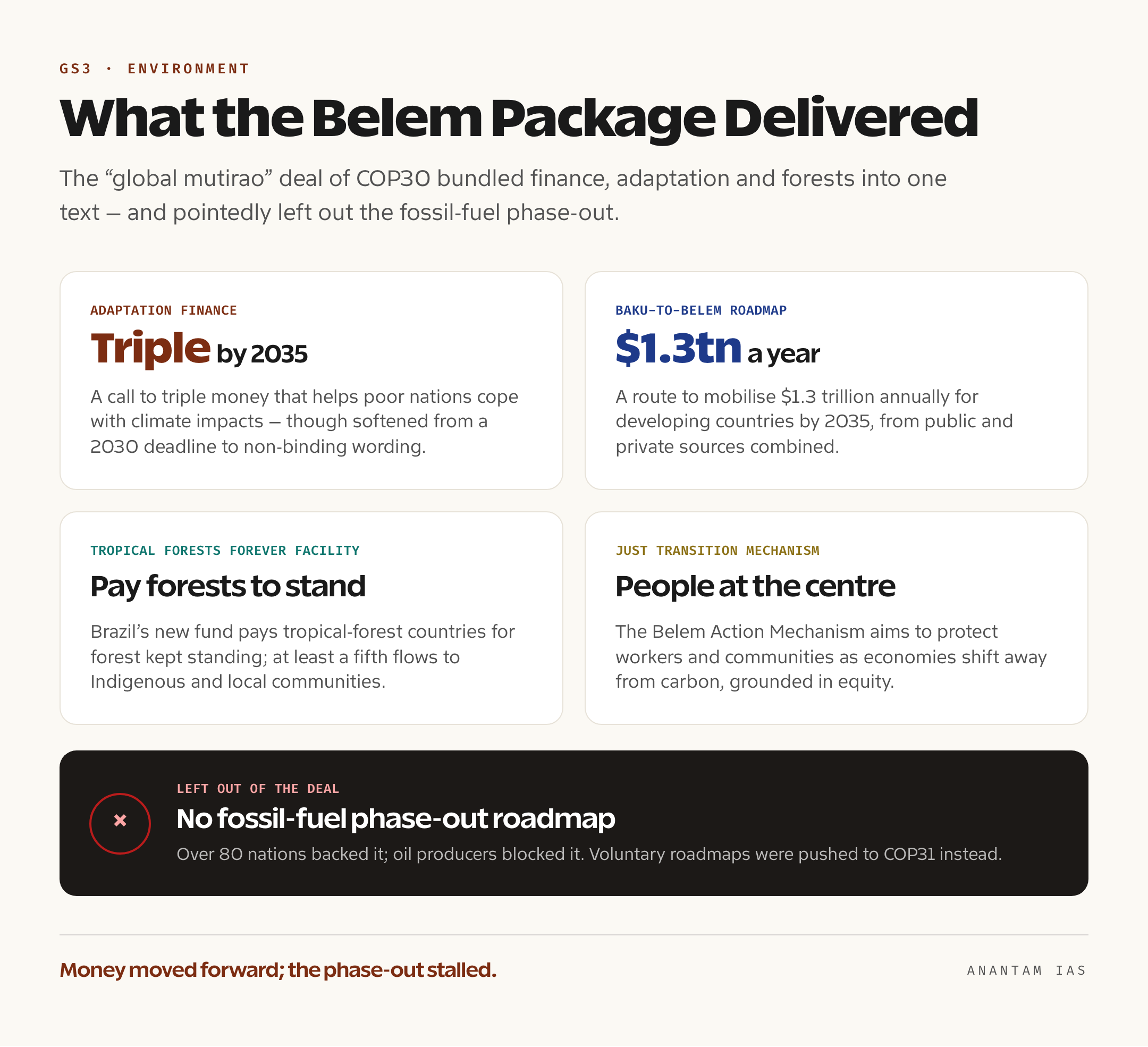

What the Belem Package Delivered
The centrepiece of COP30 is the “global mutirao” decision — and the name itself is worth knowing. Mutirao is a Portuguese word, rooted in the Indigenous Tupi-Guarani language, for a community coming together to get a shared job done. Brazil used it to brand the overarching text that bundled the summit’s “big four” fights — finance, trade, adaptation and ambition on 1.5 degrees — into one consensus deal. The package runs to dozens of decisions, and three of them carry the real weight.
The first is adaptation finance — the money that helps poor countries cope with climate impacts already arriving, like floods, droughts and rising seas, as opposed to mitigation money that cuts emissions. COP30 agreed to call for efforts to triple adaptation finance by 2035 from 2025 levels. It’s a meaningful headline, but the fine print is softer than campaigners wanted: the deadline slipped from 2030 to 2035, the language is hortatory (“calling for efforts”) rather than binding, and the baseline year was dropped from the text, leaving the starting point fuzzy. The second pillar is the Baku-to-Belem Roadmap to 1.3T — a plan, carried over from COP29 in Azerbaijan, to mobilise $1.3 trillion a year for developing countries by 2035 from public and private sources combined. Belem advanced the roadmap and a fresh two-year work programme on the thorny question of how much of that finance developed countries must provide as a legal obligation.
Two more initiatives stand out. Brazil formally launched the Tropical Forests Forever Facility, or TFFF — a first-of-its-kind fund that pays tropical-forest countries for every hectare of forest they keep standing, with results-based payments and at least a fifth of the money flowing directly to Indigenous peoples and local communities. The idea flips the usual logic of conservation funding: instead of paying once for a project that may not last, it pays continuously for forest that stays uncut, so the standing tree becomes worth more alive than felled. It opened with billions of dollars in early pledges and dozens of participating countries, aiming to mobilise far more over time — Brazil’s pitch being that the Amazon, the Congo basin and Southeast Asia’s forests are global carbon sinks the world should pay to protect. And after years of pressure, governments agreed a Just Transition mechanism — sometimes called the Belem Action Mechanism — to make sure the shift away from carbon protects workers and communities rather than abandoning them, grounded in human rights and equity. What Belem did not produce, though, was the one thing the host wanted most. With the phase-out roadmap blocked, the COP30 president, the Brazilian diplomat Andre Correa do Lago, announced that two voluntary roadmaps — one to reverse deforestation, one to transition away from fossil fuels in a “just and planned” way — would be built outside the formal text and carried toward COP31, with a preparatory conference hosted by Colombia and the Netherlands in 2026.
India’s Position and Why It Matters
India walked into Belem with a position it has held, almost word for word, for years — and Belem showed why that consistency is a diplomatic asset. The bedrock is Common But Differentiated Responsibilities and Respective Capabilities, or CBDR-RC: the principle, written into the 1992 convention, that all countries must act on climate but rich nations — which burned most of the carbon now in the atmosphere — must lead and must pay. Speaking through the BASIC group (Brazil, South Africa, India and China) and the Like-Minded Developing Countries, India argued that historical emitters owe the world deep cuts and large-scale finance, and that the global stocktake should not quietly shift the burden onto developing economies still trying to lift people out of poverty.
The sharpest part of India’s message was finance-first. New Delhi’s stance was blunt: nothing moves unless the money does. India pressed for the $1.3 trillion to be delivered as predictable, grant-based public finance under Article 9.1 of the Paris Agreement — the clause that obliges developed countries to provide funds — rather than as loans that deepen developing-country debt. It backed the call to triple adaptation finance and pointed to the gulf between what the UN says developing nations need each year — hundreds of billions of dollars — and the small fraction, roughly a tenth of that, actually flowing. The logic is one of fairness, not charity: a country that contributed little to the carbon already warming the planet should not have to choose between protecting its people from floods and feeding them. India also held firm against trade-as-climate-barrier, joining China and others to challenge the EU’s Carbon Border Adjustment Mechanism — a levy on imports of steel, cement, aluminium and the like based on their carbon content — as a discriminatory measure that punishes developing-country exporters under a green label. On its own targets, India, like several big emitters, had not submitted an updated NDC before the summit, signalling that it will not raise its ambition until the finance it is owed is on the table. India’s existing pledge already aims for net zero by 2070, 50 per cent of electricity capacity from non-fossil sources, and a sharp cut in the emissions intensity of its economy — commitments it has largely been meeting or beating. For UPSC, India’s Belem posture is a clean case study in how a developing power defends equity and economic space inside a multilateral process while still being seen as a constructive player.
Gaps, Criticism and the Road Ahead
The kindest verdict on Belem is that it delivered process where it could not deliver a phase-out. Critics were harsher. The failure to name a fossil-fuel exit, after Dubai had finally said the words, felt to many like backsliding — a summit that “made plans to make more plans.” The adaptation-finance win was real but watered down, with a slipped deadline, no baseline and non-binding wording, and the $1.3 trillion remains a roadmap rather than committed cash. The TFFF, for all its promise, opened well short of the scale tropical forests need, and the just-transition mechanism still has to be turned from a decision into delivery. Above all, the gap between the pledges on paper and the warming already locked in keeps widening: the world is on track to overshoot 1.5 degrees, and Belem’s own “mission to 1.5C” quietly acknowledged as much.
But it’s worth holding two truths together. The UNFCCC process is slow, consensus-bound and easy to mock — yet it is the only forum where nearly 200 countries, rich and poor, sit at one table, and incremental wins like the loss-and-damage fund or the Dubai phrase do compound over time. The road ahead runs through the 2026 conference in Colombia and the Netherlands and on to COP31, where the voluntary phase-out and deforestation roadmaps will be tested against the same wall of oil-producer resistance that stopped them in Belem. For India, the path is to keep pressing for finance and equity while quietly building its own clean-energy and forest record, so that when it does sharpen its NDC it does so on its own terms. The lesson of Belem, in one line, is that the world has learned to fund the response to climate change far faster than it has found the courage to cut the cause.
For Your Mains Answer
This is a high-value topic for GS Paper 3, which covers environment, conservation and climate change, and it spills naturally into GS Paper 2 on international institutions and India’s stand in global groupings. A question can come as “Discuss the outcomes of COP30” or, more sharply, as “Why has the UNFCCC process struggled to agree a fossil-fuel phase-out?” It is also a ready-made Essay example on equity, sustainable development and the limits of multilateralism. The marks go to the candidate who can name the exact outcomes, explain why the phase-out failed, and place India’s position inside the CBDR framework.
How to Build the Answer
Move in a clear chain: what COP30 was (Belem, 10-21 November 2025, the global mutirao) → the headline outcome (finance and adaptation gains, no phase-out roadmap) → the three pillars (triple adaptation finance by 2035, Baku-to-Belem roadmap to $1.3 trillion, TFFF and the just-transition mechanism) → why the phase-out failed (oil-producer resistance, voluntary roadmaps instead) → India’s stance (CBDR-RC, finance-first, anti-CBAM) → a balanced verdict on the UNFCCC process. That arc fits almost any COP30 or climate-governance question.
Common Mistakes to Avoid
Don’t say COP30 “phased out fossil fuels” — it did the opposite, leaving the roadmap out of the text. Don’t confuse adaptation finance (coping with impacts) with mitigation finance (cutting emissions). Don’t treat the $1.3 trillion as committed money; it’s a roadmap to mobilise it by 2035. And don’t frame India as a climate laggard — frame it as defending CBDR-RC and finance-first equity while meeting its own pledges.
A Compact Answer Spine
COP30 = Belem, Brazil, 10-21 Nov 2025, closed 22 Nov → global mutirao deal → triple adaptation finance by 2035 (softened) + Baku-to-Belem roadmap to $1.3 trillion/year + TFFF for forests + just-transition mechanism → NO fossil-fuel phase-out roadmap (blocked by oil producers; 80+ nations wanted it) → voluntary roadmaps to COP31 → India: CBDR-RC, grant-based finance under Article 9.1, anti-CBAM, updated NDC withheld pending finance → verdict: funds the response, dodges the cause.
Diagram or Flowchart Idea
Sketch a simple two-column “delivered vs deferred” box: left column lists adaptation finance, $1.3tn roadmap, TFFF and just transition; right column holds the single empty slot for the fossil-fuel phase-out roadmap. A clean visual of “money moved, phase-out stalled” carries the whole answer at a glance.
A Balanced-Conclusion Line
A line that lands the marks: “Belem proved the world can now finance the response to climate change faster than it can summon the political will to cut its cause — and for India, that makes finance-first equity not obstruction but the price of fair ambition.”
How to Use Data Without Cramming
You need only a handful of anchors: Belem, 10-21 November 2025; triple adaptation finance by 2035; the Baku-to-Belem roadmap to $1.3 trillion a year; over 80 nations backing the phase-out that oil producers blocked; India’s net-zero-by-2070 pledge. Attribute them plainly — “as the global mutirao decision recorded” — rather than scattering figures loose.
FAQ
Where and when was COP30 held, and what was its main outcome? COP30 was held in Belem, Brazil, on the edge of the Amazon, from 10 to 21 November 2025, closing on 22 November after overtime talks. Its main outcome was the “global mutirao” deal — a finance-and-adaptation package that boosted climate money but pointedly left out any binding roadmap to phase out fossil fuels.
Why did COP30 fail to agree a fossil-fuel phase-out? More than 80 countries, led by host Brazil, wanted a clear roadmap to transition away from coal, oil and gas. A bloc of oil-producing nations blocked it, and the final text carried no phase-out language. Instead, the COP30 president announced voluntary roadmaps to be developed outside the formal deal and carried toward COP31.
What is the Tropical Forests Forever Facility? The TFFF is a fund Brazil launched at COP30 that pays tropical-forest countries for keeping forests standing through long-term, results-based payments, with at least a fifth of the money going directly to Indigenous peoples and local communities. It opened with billions in early pledges and aims to mobilise far more.
What was India’s position at COP30? India argued from the principle of Common But Differentiated Responsibilities — that rich, historically high-emitting nations must lead and pay. It pushed for grant-based public finance under Article 9.1, backed tripling adaptation finance, opposed the EU’s Carbon Border Adjustment Mechanism as a trade barrier, and held back a stronger updated NDC until the promised finance materialises.
Practice Questions
Prelims MCQs
- With reference to COP30 of the UNFCCC, consider the following:
(a) It was held in Belem, Brazil, in November 2025
(b) Its central decision was branded the “global mutirao”
(c) It adopted a binding roadmap to phase out fossil fuels
(d) Both
(a) and
(b) are correct
Answer: (d) COP30 met in Belem in November 2025 and produced the global mutirao deal, but it did NOT adopt a fossil-fuel phase-out roadmap. - The “Baku-to-Belem Roadmap to 1.3T” refers to a plan to:
(a) Triple the world’s forest cover by 2035
(b) Mobilise $1.3 trillion a year for developing countries by 2035
(c) Cut global emissions by 1.3 gigatonnes
(d) Build 1.3 trillion units of renewable capacity
Answer: (b) The roadmap, carried from COP29 in Baku to COP30 in Belem, aims to mobilise $1.3 trillion annually for developing nations by 2035 from public and private sources. - The Tropical Forests Forever Facility (TFFF), launched at COP30, is best described as:
(a) A carbon-trading exchange for forest credits
(b) A results-based fund that pays countries to keep tropical forests standing
(c) A ban on timber exports from the Amazon
(d) An IMF lending window for forest nations
Answer: (b) The TFFF makes long-term, results-based payments to tropical-forest countries for verified conservation, with a share reserved for Indigenous and local communities. - The principle of Common But Differentiated Responsibilities and Respective Capabilities (CBDR-RC), central to India’s COP30 stance, originates in which instrument?
(a) The Kyoto Protocol of 1997
(b) The Paris Agreement of 2015
(c) The UN Framework Convention on Climate Change of 1992
(d) The Montreal Protocol of 1987
Answer: (c) CBDR-RC is written into the 1992 UNFCCC and underpins later agreements; it holds that all countries must act but developed nations must lead and finance the effort. - India opposed the EU’s Carbon Border Adjustment Mechanism (CBAM) at COP30 primarily because it:
(a) Raises the price of renewable energy in Europe
(b) Acts as a trade barrier on carbon-intensive exports from developing countries
(c) Requires India to phase out coal by 2030
(d) Funds the loss-and-damage fund directly
Answer: (b) India sees CBAM, a levy on carbon-heavy imports such as steel and cement, as a discriminatory trade barrier disguised as climate policy.
Mains Practice Questions
- Critically examine the outcomes of COP30 at Belem. To what extent does the absence of a fossil-fuel phase-out roadmap undermine the credibility of the UNFCCC process? (15 marks, 250 words)
- “The world has learned to finance the response to climate change faster than it has found the will to cut its cause.” Discuss with reference to the Belem package and the global mutirao decision. (15 marks, 250 words)
- Explain the principle of Common But Differentiated Responsibilities. How did India use it to shape its finance-first position at COP30? (15 marks, 250 words)
- Distinguish between adaptation finance and mitigation finance. Evaluate the significance of COP30’s pledge to triple adaptation finance by 2035 for developing countries. (10 marks, 150 words)
- Trade measures such as the EU’s Carbon Border Adjustment Mechanism are increasingly entangled with climate diplomacy. Analyse India’s objections and the implications for developing-country exports. (15 marks, 250 words)
Tell Google you want more of this.
Add Anantam IAS as a preferred sourceOne tap, and this site shows up more often in your own Top Stories, AI Overviews and AI Mode. Remove it any time.