Why in News?
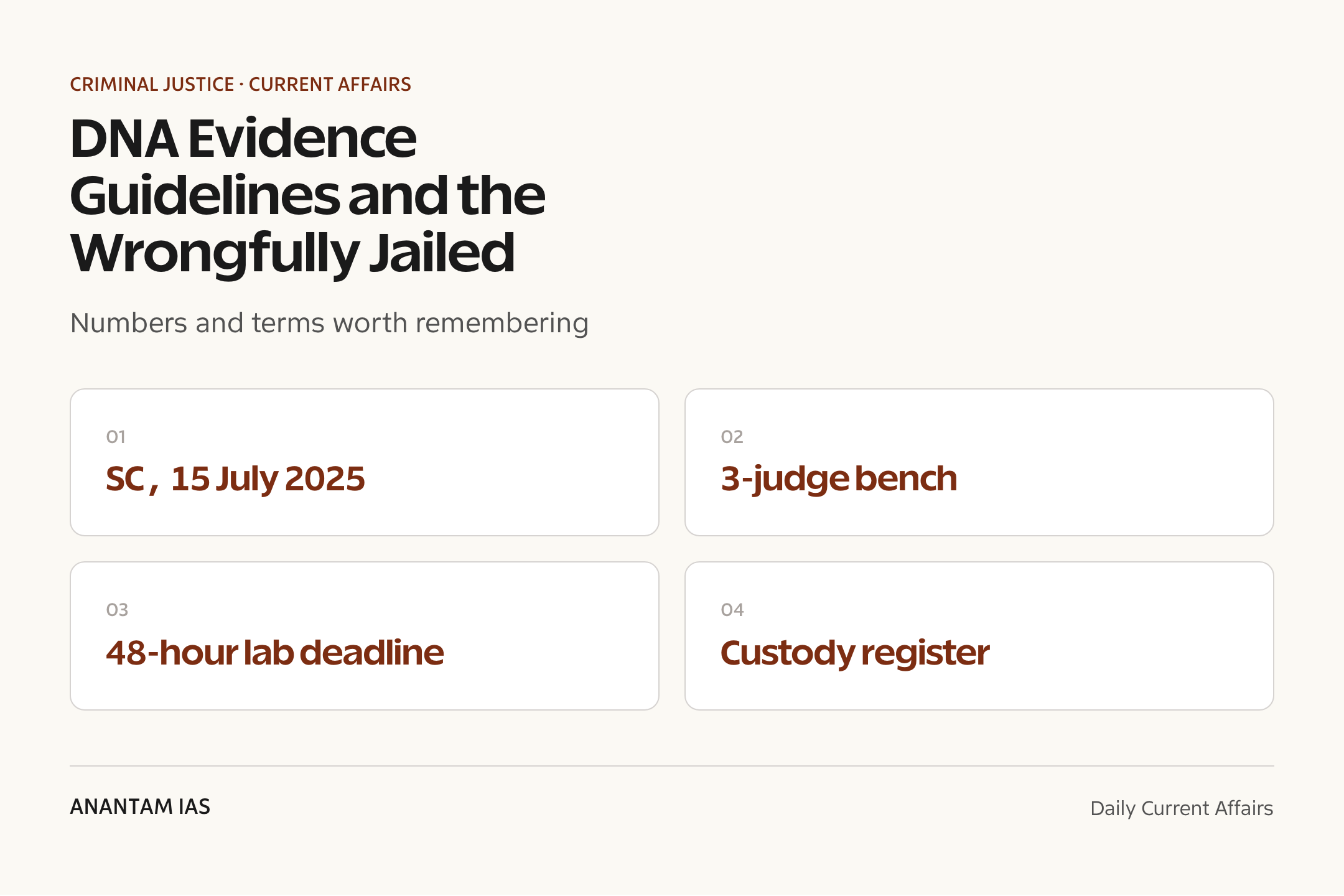
On 15 July 2025 a three-judge bench of the Supreme Court, in Kattavellai alias Devakar v. State of Tamil Nadu, set aside a death sentence and acquitted the convict, holding that chain-of-custody lapses and a faulty investigation had destroyed the prosecution case built on circumstantial and DNA evidence.
Alongside the acquittal, the Court issued nationwide guidelines for the collection, preservation and processing of DNA and forensic evidence, and flagged the absence of any Indian law to compensate persons acquitted after long incarceration, urging Parliament to legislate.
- Bench of Justice Vikram Nath, Justice Sanjay Karol (author) and Justice Sandeep Mehta; citation 2025 SCC OnLine SC 1439.
- The case arose from the May 2011 deaths of two young persons in a Tamil Nadu forest; the convict had been in custody for years before the acquittal.
- Conviction rested entirely on circumstantial evidence with no eyewitnesses; the Court found “the thread of faulty investigation was running throughout the case”.
- Vaginal swabs and a semen sample were sent belatedly to the laboratory, with no record of how or where they were stored — the DNA evidence was rendered useless.
- The Court laid down a mandatory chain-of-custody register and a 48-hour deadline for sending samples to the forensic laboratory.
- It directed every Director General of Police to prepare standardised chain-of-custody forms and circulate them to all districts.
The development matters in the context of:
- Forensic standards and the rights of the wrongfully imprisoned sit at the heart of criminal-justice reform and Article 21 jurisprudence.
- Comes as the new criminal codes push expanded forensic and DNA collection, raising the stakes for reliable handling.
UPSC Relevance
Prelims Relevance
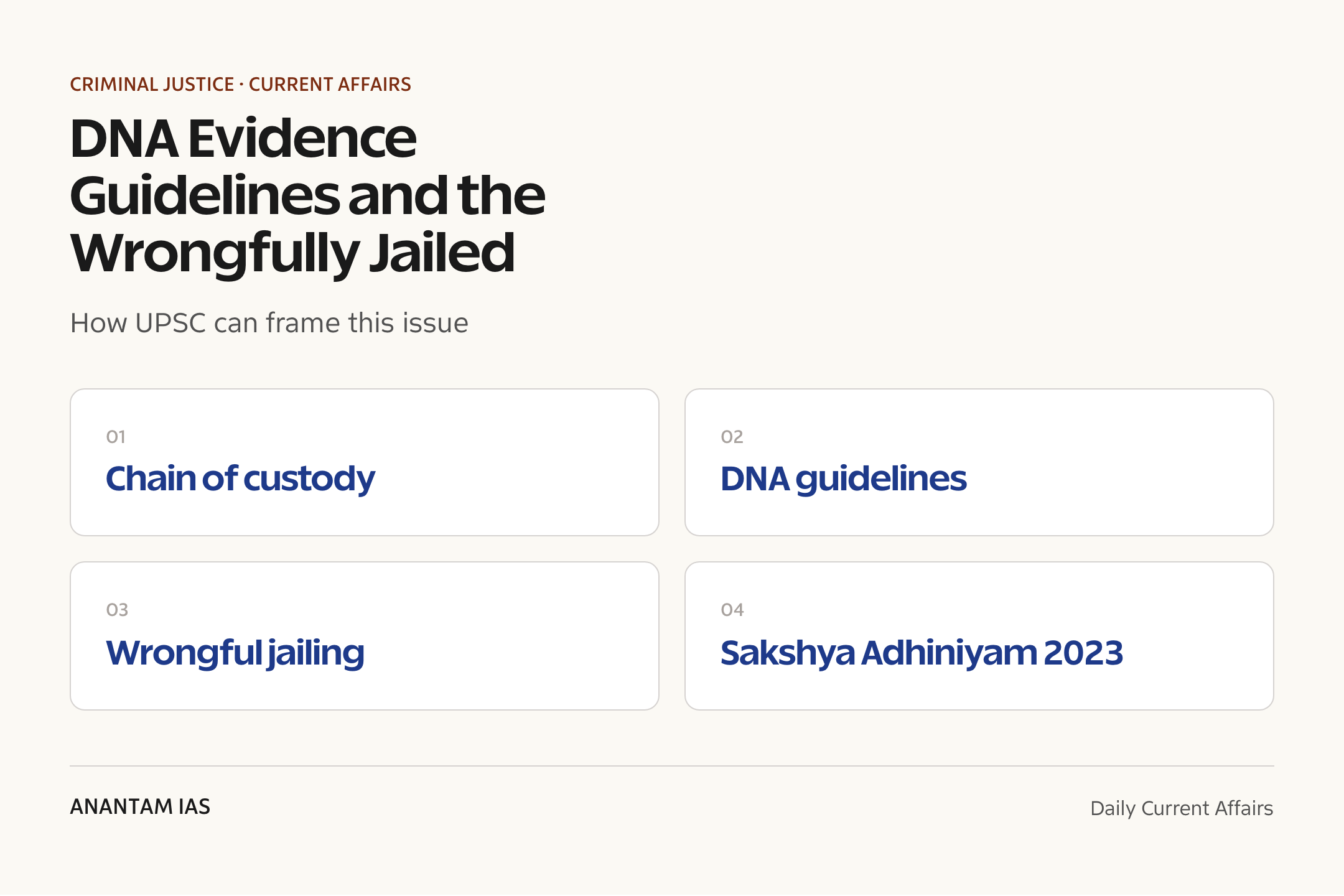
- Kattavellai alias Devakar v. State of Tamil Nadu (2025) — DNA-handling guidelines and the compensation observation.
- Chain of custody — the documented, unbroken record of who handled an exhibit, from collection to court.
- Bharatiya Sakshya Adhiniyam, 2023 — the evidence code (replacing the Indian Evidence Act, 1872 from 1 July 2024) under which forensic and electronic evidence is now tested.
- Section 63 / Section 65B-equivalent rules on electronic records and their authentication.
- Article 21 — life and personal liberty; the basis for fair-trial and wrongful-detention claims.
- DNA Technology (Use and Application) Regulation Bill, 2019 — a lapsed bill that sought to regulate DNA use in justice delivery.
- Directorate of Forensic Science Services (DFSS) and state Forensic Science Laboratories.
- National Forensic Sciences University (NFSU) — institution of national importance for forensic training.
- Concept of circumstantial evidence and the “complete chain of circumstances” rule.
- Author judge in this case — Justice Sanjay Karol.
Mains Relevance
GS Paper 2
- Reforming the criminal-justice system through forensic standards and judicial guidelines in the absence of statute.
- The case for a statutory framework to compensate persons acquitted after prolonged wrongful incarceration.
GS Paper 3
- Strengthening the forensic-science ecosystem — chain of custody, laboratory capacity and DNA regulation — to improve conviction quality.
Essay
- Justice that comes after years behind bars is justice already half-denied.
- A conviction is only as strong as the weakest link in its chain of evidence.
Background and Context
The case and how it collapsed
A double-murder conviction built on circumstantial and forensic evidence unravelled on appeal.
- In May 2011 two young persons were found dead in a Tamil Nadu forest; charges followed in 2013 under provisions of the IPC and the SC/ST Act.
- The trial court imposed the death penalty and the Madras High Court affirmed it, both relying on circumstantial evidence.
- The Supreme Court found there were no eyewitnesses, the star witness was “shaky”, a key witness was never examined, and the confession and arrest were unreliable.
- Crucially, the DNA evidence was sent late and its storage undocumented, so it could not connect the accused to the crime.
- Holding that the conviction had “no legs to stand on”, the Court ordered the convict’s immediate release.
Why chain of custody decides forensic cases
Forensic evidence is only as trustworthy as the record of how it travelled to the courtroom.
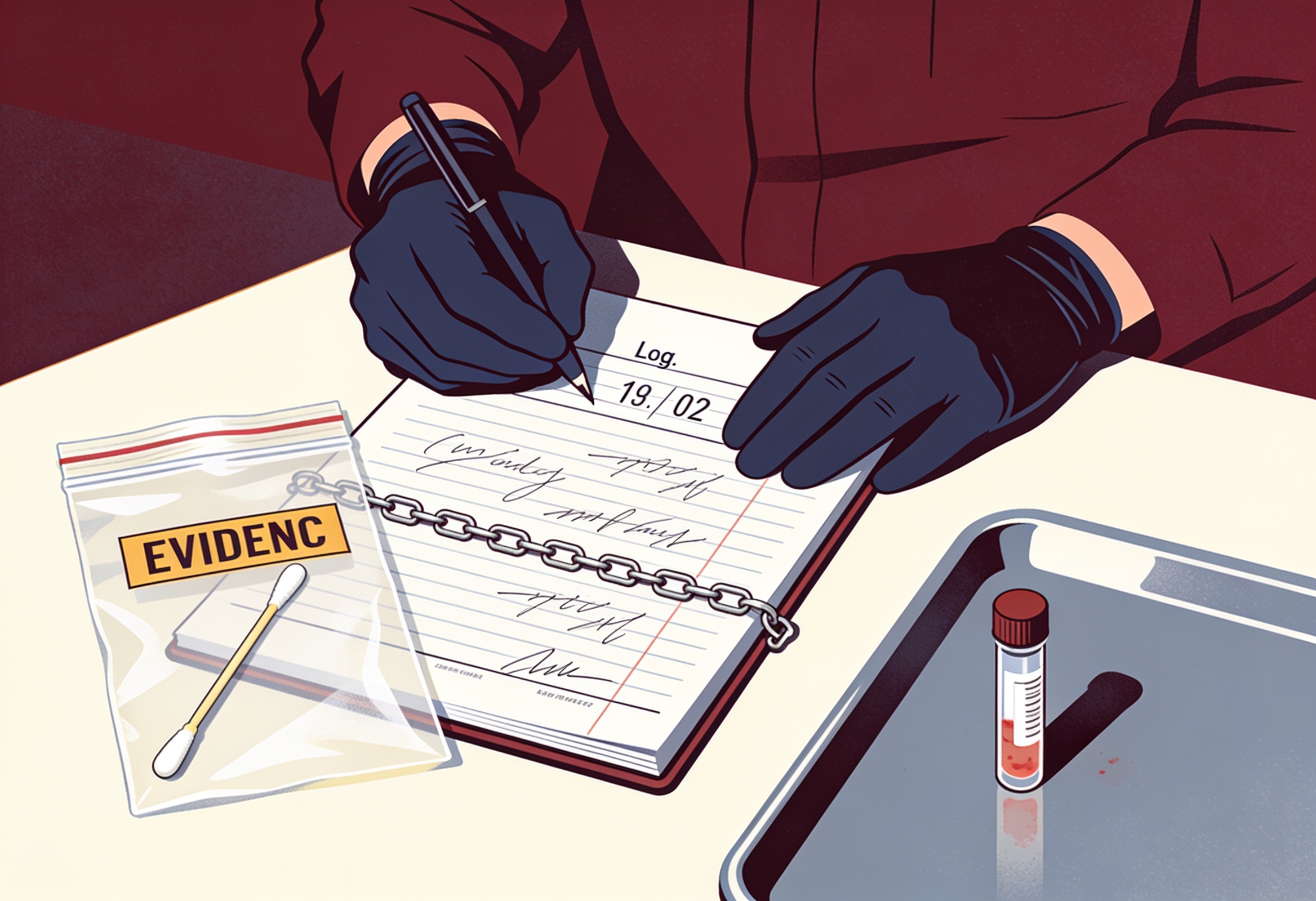
- Chain of custody is the documented, unbroken trail of every person who collected, stored, moved or tested an exhibit.
- A single undocumented gap lets the defence argue the sample was contaminated, swapped or tampered, draining its evidentiary value.
- Here the Court posed the questions the prosecution could not answer — why samples were sent belatedly, where they were stored, and who was responsible for their destruction.
- Even scientifically sound DNA results are worthless if the integrity of the sample cannot be vouched for from collection to verdict.
The nationwide DNA-handling guidelines
The Court framed a binding protocol for handling DNA and forensic evidence across the country.
- Documentation at collection — FIR number and date, the section and statute, investigating officer and police-station details, and a serial number must all be recorded.
- Timeline — the investigating officer must deliver samples to the forensic laboratory not later than 48 hours from collection, with any delay justified in writing in the case diary.
- Storage integrity — no package may be opened, altered or resealed without express authorisation of the trial court, with certification that its sanctity is intact.
- Chain-of-custody register — every movement of the exhibit is logged with counter-signatures at each handover, and the register becomes a mandatory trial-court record.
- State implementation — each Director General of Police must prepare standardised chain-of-custody forms and circulate them with instructions to all districts.
Compensation for the wrongfully jailed
The Court spotlighted a glaring gap — India has no law to compensate those acquitted after years inside.
- The Bench observed that prolonged custody followed by acquittal can violate Article 21, yet there is no statutory route to compensation.
- It noted the convict had spent years in prison on a case that ultimately had “no legs to stand on whatsoever”.
- Stopping short of mandating a remedy, the Court held it is for the legislature to consider and decide on compensation for long incarceration.
- It pointed to its own observations in V. Senthil Balaji v. Enforcement Directorate (2024) on liberty and prolonged detention.
The statutory backdrop — evidence law and DNA regulation
The guidelines land in a system that is shifting to new codes but still lacks a dedicated DNA law.
- The Bharatiya Sakshya Adhiniyam, 2023 replaced the Indian Evidence Act, 1872 from 1 July 2024 and governs how forensic and electronic evidence is now tested.
- The new criminal procedure code expands the use of forensic investigation for serious offences, increasing the volume of samples that need reliable handling.
- India still has no enacted DNA statute — the DNA Technology (Use and Application) Regulation Bill, 2019 lapsed without becoming law.
- Forensic capacity rests with the Directorate of Forensic Science Services, state laboratories and the National Forensic Sciences University, all under strain from rising caseloads.
Why guidelines, not just a verdict
The Court used its appellate power to set a system-wide standard, not merely to free one man.
- Judicial guidelines fill a vacuum until Parliament legislates — a pattern seen earlier in Vishaka and D.K. Basu.
- By making the chain-of-custody register a mandatory court record, the Court created a measurable accountability trigger for investigating officers.
- Standardising forms across states is meant to curb the wide variation in how forensic exhibits are handled in practice.
- The ruling signals that poor forensic process, not just weak forensic science, is a leading cause of failed prosecutions.
Way Forward
Build a statutory floor
- Parliament should consider a compensation law for wrongful and prolonged incarceration, with clear eligibility and a time-bound mechanism.
- Revisit a calibrated DNA regulation framework with privacy safeguards, building on the lapsed 2019 Bill.
Strengthen the forensic chain
- Invest in laboratory capacity, trained handlers and digital chain-of-custody tracking to meet the 48-hour standard.
- Audit and train investigating officers so that documentation, not afterthought, governs every exhibit from the crime scene to the court.
Conclusion
The judgment treats forensic evidence as a process, not a product — a DNA match means nothing if the sample’s journey to court cannot be vouched for. By turning chain of custody into a mandatory, accountable record, the Court raises the floor for criminal investigation across India.
The harder reform is left to Parliament. A man can be freed by a verdict, but the years he lost remain uncompensated. Until a law fills that gap, an acquittal after long incarceration will keep reading as a partial justice rather than a full one.
UPSC Practice Questions
Prelims MCQ 1
With reference to the Supreme Court’s guidelines on handling DNA and forensic evidence (2025), consider the following statements:
- Samples must be delivered to the forensic laboratory not later than 48 hours from collection.
- Every movement of the evidence must be recorded in a chain-of-custody register with counter-signatures.
- A package may be opened or resealed by the investigating officer without the trial court’s authorisation.
How many of the above statements are correct?
(a) Only one (b) Only two (c) All three (d) None
Answer: (b) Only two
Explanation:
Statements 1 and 2 reflect the guidelines. Statement 3 is wrong: no package may be opened, altered or resealed without express authorisation of the trial court.
Prelims MCQ 2
The Bharatiya Sakshya Adhiniyam, 2023 replaced which of the following statutes?
(a) The Code of Criminal Procedure, 1973 (b) The Indian Penal Code, 1860 (c) The Indian Evidence Act, 1872 (d) The Identification of Prisoners Act, 1920
Answer: (c) The Indian Evidence Act, 1872
Explanation:
The Bharatiya Sakshya Adhiniyam, 2023 replaced the Indian Evidence Act, 1872 with effect from 1 July 2024; it governs how forensic and electronic evidence is now tested in court.
UPSC Mains Questions
- In Kattavellai v. State of Tamil Nadu (2025) the Supreme Court issued nationwide guidelines on handling DNA evidence in the absence of a governing statute. Examine how chain-of-custody failures undermine criminal prosecutions and what reforms can strengthen the forensic ecosystem.
- India has no law to compensate persons acquitted after prolonged incarceration. Critically discuss the case for such a statutory framework in light of the right to life and personal liberty under Article 21.
Sources: Supreme Court of India and SCC Online / LiveLaw.
Frequently Asked Questions
What did the Supreme Court rule in July 2025?
In Kattavellai alias Devakar v. State of Tamil Nadu (15 July 2025), a three-judge bench acquitted a death-row convict because chain-of-custody lapses and a faulty investigation had destroyed the case. It also issued nationwide guidelines for handling DNA and forensic evidence and urged Parliament to legislate compensation for wrongful incarceration.
What is chain of custody in forensic evidence?
Chain of custody is the documented, unbroken record of everyone who collected, stored, moved or tested a piece of evidence, from the crime scene to the courtroom. Any undocumented gap lets the defence argue the sample was contaminated, swapped or tampered with, which can render even sound DNA results worthless.
What are the new DNA-handling guidelines?
The Court mandated full documentation at collection, delivery of samples to the laboratory within 48 hours, a bar on opening or resealing packages without trial-court authorisation, a compulsory chain-of-custody register with counter-signatures, and standardised forms prepared by each state’s Director General of Police.
Does India have a law to compensate the wrongfully jailed?
No. The Court flagged that India has no statute to compensate persons acquitted after long incarceration, even though prolonged custody followed by acquittal can violate Article 21. It held that creating such a remedy is for the legislature to decide and urged Parliament to act.
How does the Bharatiya Sakshya Adhiniyam, 2023 relate to this?
The Bharatiya Sakshya Adhiniyam, 2023 replaced the Indian Evidence Act, 1872 from 1 July 2024 and now governs how forensic and electronic evidence is tested. The Court’s chain-of-custody guidelines reinforce the reliability standards that this evidence code expects of forensic exhibits.
Why does this matter for UPSC?
It is a core criminal-justice-reform issue touching forensic standards, the rights of the wrongfully imprisoned and judicial guideline-making. It is relevant to GS-II (polity, governance, social justice) and GS-III (forensic and security infrastructure), and tests awareness of the new Bharatiya Sakshya Adhiniyam, 2023.
Tell Google you want more of this.
Add Anantam IAS as a preferred sourceOne tap, and this site shows up more often in your own Top Stories, AI Overviews and AI Mode. Remove it any time.