
Why in News?
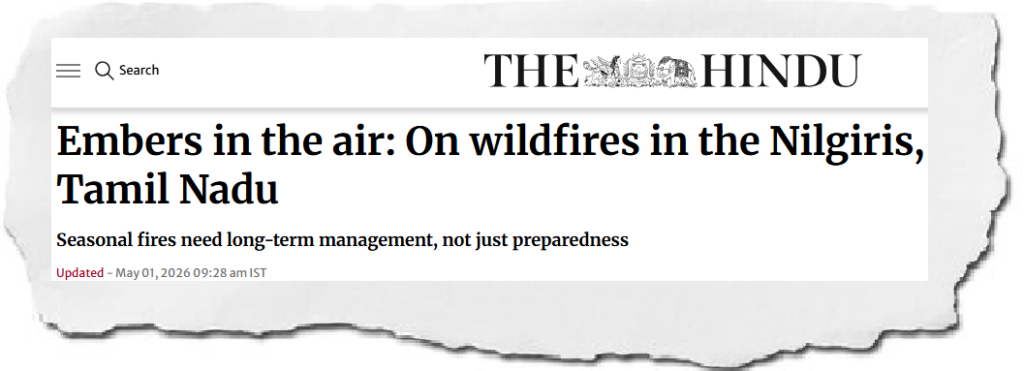
Severe wildfires recently affected the Nilgiris district of Tamil Nadu and adjoining forest regions such as Mudumalai, Coimbatore, and Erode divisions. The fires became intense enough to require assistance from the Indian Air Force for aerial firefighting operations.
UPSC Relevance
GS-III: Environment and Ecology, Disaster Management, Climate Change, Conservation, Biodiversity, Forest Management, Climate Change, Sustainable Development.
Understanding Forest Fires
A forest fire is an uncontrolled fire occurring in forests, grasslands, or other natural ecosystems. Forest fires can occur naturally or due to human activities.
Types of Forest Fires
| Type | Description |
| Surface Fire | Burns dry leaves, grass, and low vegetation on the forest floor |
| Ground Fire | Burns organic matter beneath the soil surface |
| Crown Fire | Spreads through the canopy or treetops and is highly destructive |
The Nilgiris fires largely involved surface fires that spread rapidly under windy and dry conditions.
Why are the Nilgiris Vulnerable to Wildfires?
Seasonal Fire Conditions
The period from February to May is traditionally the fire season in the Nilgiris region due to:
- Dry vegetation
- Reduced soil moisture
- High temperatures
- Strong winds
These conditions create highly combustible landscapes.
Climatic Factors
This year witnessed:
- Early and intense summer heat
- Low humidity
- Strong winds carrying embers across firelines
Such conditions allowed fires to spread faster and burn longer.
Accumulated Biomass and Invasive Species
In areas such as Pykara, accumulated dry biomass and invasive undergrowth intensified the fires.
Invasive species often:
- Increase fuel load
- Reduce soil moisture
- Alter local ecosystem balance
Species such as wattle and eucalyptus plantations in the Nilgiris are frequently associated with increased fire vulnerability.
Difficult Terrain
The Nilgiris consist of:
- Steep slopes
- Dense forests
- Limited road connectivity
This makes firefighting operations difficult and delays movement of personnel and equipment.
Human-Induced Causes
Although climatic conditions worsen fires, many forest fires are linked to human activities.
Traditional Livelihood Practices
Certain local activities contribute unintentionally to fire spread:
- Tribespeople collect dry grass and forest materials for making brooms.
- Herders sometimes burn dry grasslands to stimulate fresh fodder growth.
These practices are often linked to livelihoods and traditional land-use patterns.
Accidental Causes
- Discarded cigarette butts
- Campfires
- Careless tourism activities
can trigger fires during dry seasons.
Controlled Burning Mismanagement
The article notes that one blaze reportedly spread after a controlled burn by Kerala forest officials without proper coordination with Tamil Nadu authorities.
This highlights the need for interstate coordination in ecological management.
Deliberate Fire Setting
Some officials suspected intentional fire-setting linked to local resentment over unresolved issues such as human-wildlife conflict and tiger-related deaths.
Ecological Importance of the Nilgiris
The Nilgiris form part of the Western Ghats, one of the world’s biodiversity hotspots.
Ecological Significance
- Home to endemic flora and fauna
- Important elephant and tiger habitats
- Crucial watershed region
- Regulates regional climate and rainfall patterns
Protected areas in the region include:
- Mudumalai Tiger Reserve
- Mukurthi National Park
- Nilgiri Biosphere Reserve
Impact of Forest Fires
Loss of Biodiversity
Fires destroy:
- Vegetation
- Nesting habitats
- Microorganisms
- Wildlife corridors
Many slow-moving animals and endemic species are particularly vulnerable.
Soil Degradation
Forest fires:
- Reduce soil fertility
- Increase erosion
- Damage microbial activity
This weakens long-term ecosystem recovery.
Air Pollution
Wildfires release:
- Carbon dioxide
- Particulate matter
- Toxic gases
This worsens air quality and contributes to climate change.
Human-Wildlife Conflict
Fires force animals to move closer to human settlements in search of food and water, increasing conflict risks.
Economic and Livelihood Losses
Local communities dependent on forests face:
- Loss of resources
- Reduced grazing areas
- Livelihood insecurity
Tourism in ecologically sensitive regions may also suffer.
Climate Change and Forest Fires
Rising Baseline Risk
Climate change increases:
- Average temperatures
- Frequency of heatwaves
- Dry spells
- Variability in rainfall
These conditions raise the probability and intensity of forest fires.
Climate Variability vs Climate Change
The article importantly highlights that climate variability itself is becoming a major risk factor.
Even without long-term climatic shifts,:
- unusually hot summers,
- delayed rainfall,
- and changing wind patterns
can create extreme fire conditions.
Global Trend
Forest fires are becoming more frequent globally in regions such as:
- California (USA)
- Australia
- Canada
- Mediterranean Europe
India is also increasingly experiencing prolonged fire seasons.
India’s Forest Fire Management Mechanisms
Forest Survey of India (FSI)
FSI provides:
- Real-time fire alerts
- Satellite monitoring
- Fire vulnerability mapping
National Action Plan on Forest Fires (2018)
Objectives include:
- Prevention
- Detection
- Rapid response
- Community participation
Disaster Management Framework
Forest fires are managed through coordination among:
- State forest departments
- National Disaster Response Force (NDRF)
- Indian Air Force (in severe cases)
Community Participation
Local communities are often the first responders during forest fires.
Traditional ecological knowledge plays an important role in:
- Early detection
- Fire containment
- Sustainable forest use
Challenges in Forest Fire Management
Inadequate Infrastructure
Many forest divisions lack:
- Modern firefighting equipment
- Sufficient manpower
- Rapid mobility systems
Weak Interstate Coordination
Forest ecosystems cross administrative boundaries, but coordination among States often remains inadequate.
Livelihood Dependence
Restricting fire-linked activities without providing alternatives may adversely affect tribal and rural communities.
Invasive Species Proliferation
Unchecked spread of invasive vegetation increases fire intensity.
Climate Uncertainty
Traditional fire management strategies are becoming less effective under rapidly changing climatic conditions.
Way Forward
Strengthening Early Warning Systems
- Use of Satellite monitoring, AI-based fire prediction, Weather forecasting, can improve preparedness and response time.
Landscape-Level Fire Management
Forest fire management should move beyond reactive firefighting towards:
- ecosystem restoration,
- fuel management,
- and long-term ecological planning.
Managing Invasive Species
Removal and control of invasive plants can reduce fuel loads and improve ecosystem resilience.
Community-Centric Conservation
Forest-dependent communities should be integrated into:
- planning,
- monitoring,
- and fire prevention strategies.
Alternative livelihood support can reduce risky practices.
Interstate Coordination
States sharing forest ecosystems must establish:
- joint protocols,
- shared communication systems,
- and coordinated controlled-burning practices.
Climate Adaptation Strategies
Forest management policies must integrate climate adaptation measures through:
- ecological restoration,
- water conservation,
- and biodiversity protection.
Improving Firefighting Capacity
Investment is needed in:
- aerial firefighting systems,
- specialised forest fire units,
- modern protective equipment,
- and rapid deployment infrastructure.
Prelims Practice Questions
1. Consider the following statements regarding forest fires in India:
- Surface fires burn dry vegetation on the forest floor.
- Crown fires spread through the canopy of trees.
- Forest fires in India occur only due to natural causes.
Which of the statements given above are correct?
(a) 1 and 2 only
(b) 2 and 3 only
(c) 1 only
(d) 1, 2 and 3
Answer: (a)
2. The Nilgiri Biosphere Reserve is spread across which of the following States?
- Tamil Nadu
- Kerala
- Karnataka
Select the correct answer using the code below:
(a) 1 and 2 only
(b) 2 and 3 only
(c) 1 and 3 only
(d) 1, 2 and 3
Answer: (d)
3. Which of the following factors increase the vulnerability of forests to wildfires?
- Accumulation of dry biomass
- Invasive vegetation
- Prolonged dry conditions
- Strong winds
Select the correct answer using the code below:
(a) 1 and 2 only
(b) 1, 2 and 3 only
(c) 2, 3 and 4 only
(d) 1, 2, 3 and 4
Answer: (d)
Mains Practice Questions
Critically examine the role of climate variability and human activities in intensifying forest fires in ecologically sensitive regions such as the Nilgiris.
Discuss the increasing frequency and intensity of forest fires in India in the context of climate change and ecological degradation.
Examine the challenges in forest fire management in India. Suggest a long-term strategy for building climate-resilient forest ecosystems.
“Forest fire management requires both ecological planning and community participation.” Analyse.
Tell Google you want more of this.
Add Anantam IAS as a preferred sourceOne tap, and this site shows up more often in your own Top Stories, AI Overviews and AI Mode. Remove it any time.