Why in News?
Scientists have identified Tylosaurus rex as a distinct species of giant marine reptile after a detailed re-examination of previously discovered fossils. The newly classified species, which lived about 80 million years ago, rivalled the famous Tyrannosaurus rex in size and predatory dominance, earning the nickname “T. rex of the sea.”
UPSC Relevance
Prelims: Evolution, fossils, geological time scale, extinct reptiles, biodiversity and palaeontology.
Mains:
GS III: Science and Technology, scientific discoveries, evolution of life on Earth, importance of palaeontological research.
Background
The age of dinosaurs was not dominated only by giant land predators. While Tyrannosaurus rex ruled terrestrial ecosystems during the Late Cretaceous Period, the oceans were inhabited by equally formidable marine predators.
Among them were the mosasaurs, a group of giant marine reptiles that evolved from land-dwelling lizards and became apex predators in prehistoric seas. Recent research has identified Tylosaurus rex as a separate species within this group, highlighting the diversity and complexity of marine ecosystems during the Cretaceous era.
Understanding Tylosaurus rex
What is Tylosaurus rex?
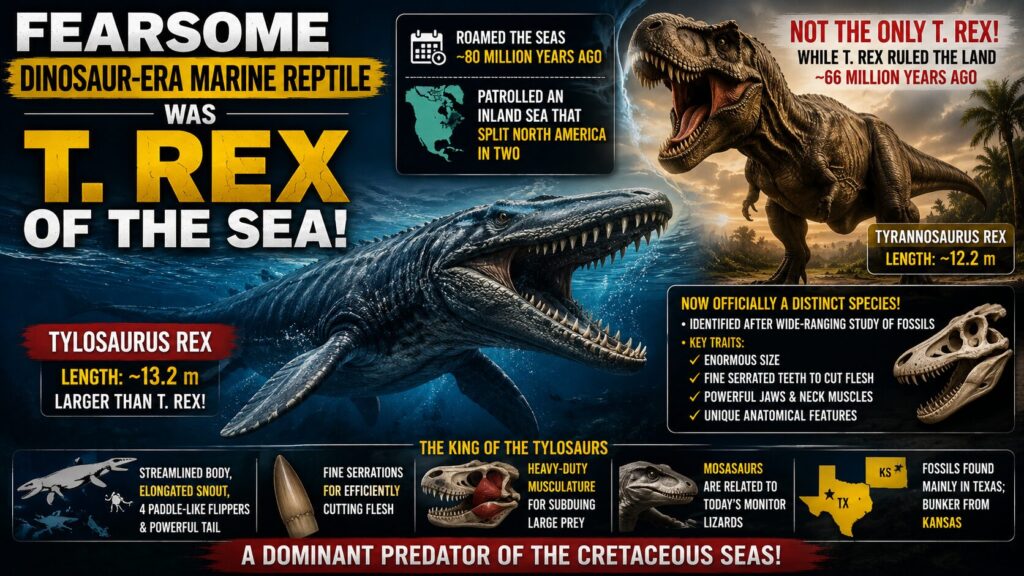
Tylosaurus rex was a giant marine reptile belonging to the mosasaur family. It inhabited the vast inland sea that once divided North America into eastern and western landmasses during the Late Cretaceous Period.
Researchers identified it as a separate species based on several distinctive features, including:
- Extremely large body size.
- Fine serrations along its teeth that enhanced flesh-cutting efficiency.
- Strong jaw and neck musculature suited for capturing large prey.
- Unique anatomical characteristics that distinguished it from other Tylosaurus species.
Physical Characteristics
Tylosaurus rex possessed several adaptations that made it a highly effective marine hunter. It had a streamlined body for rapid swimming, a long snout equipped with powerful teeth, four paddle-like flippers for manoeuvrability, and a muscular tail that generated strong propulsion through water.
The species was among the largest marine predators of its time and occupied the highest level of the marine food chain.
How Large Was It?
Comparison with Tyrannosaurus rex
The largest known specimen of Tyrannosaurus rex, known as “Sue,” measures approximately 12.2 metres in length.
The largest known Tylosaurus rex specimen, nicknamed “Bunker,” measures about 13.2 metres, making it slightly longer than T. rex.
Researchers noted that the skull of Tylosaurus rex alone was approximately 1.7 metres long, illustrating the enormous size of the animal.
Comparison with Modern Marine Predators
According to palaeontologists, Tylosaurus rex would have been nearly twice the length of the largest modern great white sharks.
Its immense size, combined with powerful jaws and specialised teeth, allowed it to dominate ancient marine ecosystems.
Mosasaurs: The Apex Predators of Ancient Oceans
Evolutionary Origins
Mosasaurs evolved from terrestrial lizards and gradually adapted to marine environments. Over millions of years, they developed specialised features such as flippers, streamlined bodies, and powerful tails, enabling them to thrive in oceans across the globe.
They became dominant marine predators during the final 30 million years of the dinosaur era.
Relationship with Modern Reptiles
Although mosasaurs became extinct approximately 66 million years ago, their closest living relatives are believed to be monitor lizards.
Among modern species, the Komodo dragon is considered one of the nearest evolutionary relatives of these giant marine reptiles.
Geological Significance
The Cretaceous Period
The Cretaceous Period lasted from about 145 million to 66 million years ago and represented the final chapter of the age of dinosaurs.
During this period:
- Dinosaurs dominated terrestrial ecosystems.
- Giant marine reptiles controlled oceanic food chains.
- Flowering plants expanded rapidly.
- Continents gradually moved toward their modern positions.
The Western Interior Seaway
Approximately 80 million years ago, a massive inland sea known as the Western Interior Seaway divided North America into two landmasses.
This shallow sea created ideal conditions for diverse marine life, including mosasaurs such as Tylosaurus rex.
Scientific Importance of the Discovery
The identification of Tylosaurus rex as a separate species demonstrates the continuing value of fossil re-examination. Modern analytical techniques allow scientists to identify subtle anatomical differences that may have been overlooked in earlier studies.
The discovery contributes to:
- Better understanding of marine reptile evolution.
- Reconstruction of ancient marine ecosystems.
- Insights into predator-prey relationships during the Cretaceous Period.
- Improved knowledge of biodiversity before the mass extinction event that ended the age of dinosaurs.
Significance for Evolutionary Studies
The discovery highlights how evolution can produce apex predators in different environments.
While Tyrannosaurus rex dominated land ecosystems, Tylosaurus rex evolved independently to occupy a similar ecological role in marine habitats. This illustrates the concept of ecological convergence, where unrelated species develop similar characteristics due to comparable environmental pressures.
Conclusion
The recognition of Tylosaurus rex as a distinct species enriches our understanding of prehistoric marine life and the extraordinary diversity that existed during the age of dinosaurs. As one of the largest and most formidable marine predators ever discovered, it demonstrates that the oceans of the Cretaceous Period were as fiercely contested as the lands ruled by Tyrannosaurus rex. Continued fossil research is likely to reveal even more about the complex ecosystems that existed before one of Earth’s greatest mass extinction events.
Practice Questions
Prelims Question 1 (Inference-Based)
Consider the following statements regarding apex predators during the Cretaceous Period:
- Both terrestrial and marine ecosystems supported highly specialised apex predators.
- The existence of Tylosaurus rex suggests that giant predators evolved only in marine environments.
- Similar ecological roles can evolve independently in different habitats.
Which of the above statements can be inferred from the passage?
(a) 1 and 3 only
(b) 2 only
(c) 1 only
(d) 1, 2 and 3
Answer: (a)
Explanation:
Statement 1 is correct. The passage shows that Tyrannosaurus rex dominated land ecosystems while Tylosaurus rex dominated marine ecosystems.
Statement 2 is incorrect. Giant predators existed in both terrestrial and marine environments.
Statement 3 is correct. The article highlights how T. rex and Tylosaurus rex independently evolved to become apex predators in different ecological settings.
Prelims Question 2
Consider the following statements about mosasaurs:
- They evolved from land-dwelling reptiles.
- They were among the dominant marine predators during the Late Cretaceous.
- They survived the mass extinction event that ended the age of dinosaurs.
Which of the statements given above is/are correct?
(a) 1 and 2 only
(b) 2 and 3 only
(c) 1 and 3 only
(d) 1, 2 and 3
Answer: (a)
Explanation:
Statement 1 is correct. Mosasaurs evolved from terrestrial lizards and adapted to marine environments.
Statement 2 is correct. They occupied the top levels of marine food chains during the Late Cretaceous.
Statement 3 is incorrect. Mosasaurs became extinct during the mass extinction event approximately 66 million years ago.
Mains Questions
- Discuss the evolutionary significance of apex marine reptiles such as Tylosaurus rex in understanding prehistoric ecosystems and biodiversity.
- How does palaeontological research contribute to our understanding of evolution, extinction events, and environmental change on Earth? Examine with suitable examples.
Tell Google you want more of this.
Add Anantam IAS as a preferred sourceOne tap, and this site shows up more often in your own Top Stories, AI Overviews and AI Mode. Remove it any time.