Why in News?
On November 26, the Department of Science and Technology reported that Indian polar gamma-ray detectors identified signatures of the November 11, 2025 solar particle event.
- Researchers at the Indian Institute of Geomagnetism examined observations from Maitri and Ny-Ålesund, in the Antarctic and Arctic regions respectively.
- The study used NaI(Tl) scintillation detectors and compared their signals with neutron-monitor observations and satellite particle data.
- The findings support complementary gamma-ray monitoring of ground-level enhancements, with potential for a wider network of compact instruments.
- Ground measurements help researchers study how energetic solar particles interact with the atmosphere under different geographic and geomagnetic conditions.
- Signal attribution matters because several terrestrial and astronomical sources can change gamma-ray counts.
UPSC Relevance
Prelims Relevance
- GLE means ground-level enhancement associated with sufficiently energetic solar particles.
- Primary protons can produce secondary particles and radiation through atmospheric interactions.
- NaI(Tl) denotes thallium-doped sodium iodide used in scintillation detectors.
- Maitri is in Antarctica, while Ny-Ålesund is in the Arctic region.
Mains Relevance
GS Paper 3
- Scientific monitoring networks and the reliability of space-weather observations.
- Complementary instruments, geographical coverage and evidence-based technology development.
Background and Context
From Solar Protons to Atmospheric Showers
A ground-level enhancement connects an energetic solar event with a measurable change in particles or radiation reaching instruments near the surface.
- Solar energetic particles include protons accelerated during powerful solar activity. The event studied here occurred in November 2025, while the government account of the research appeared in November 2026.
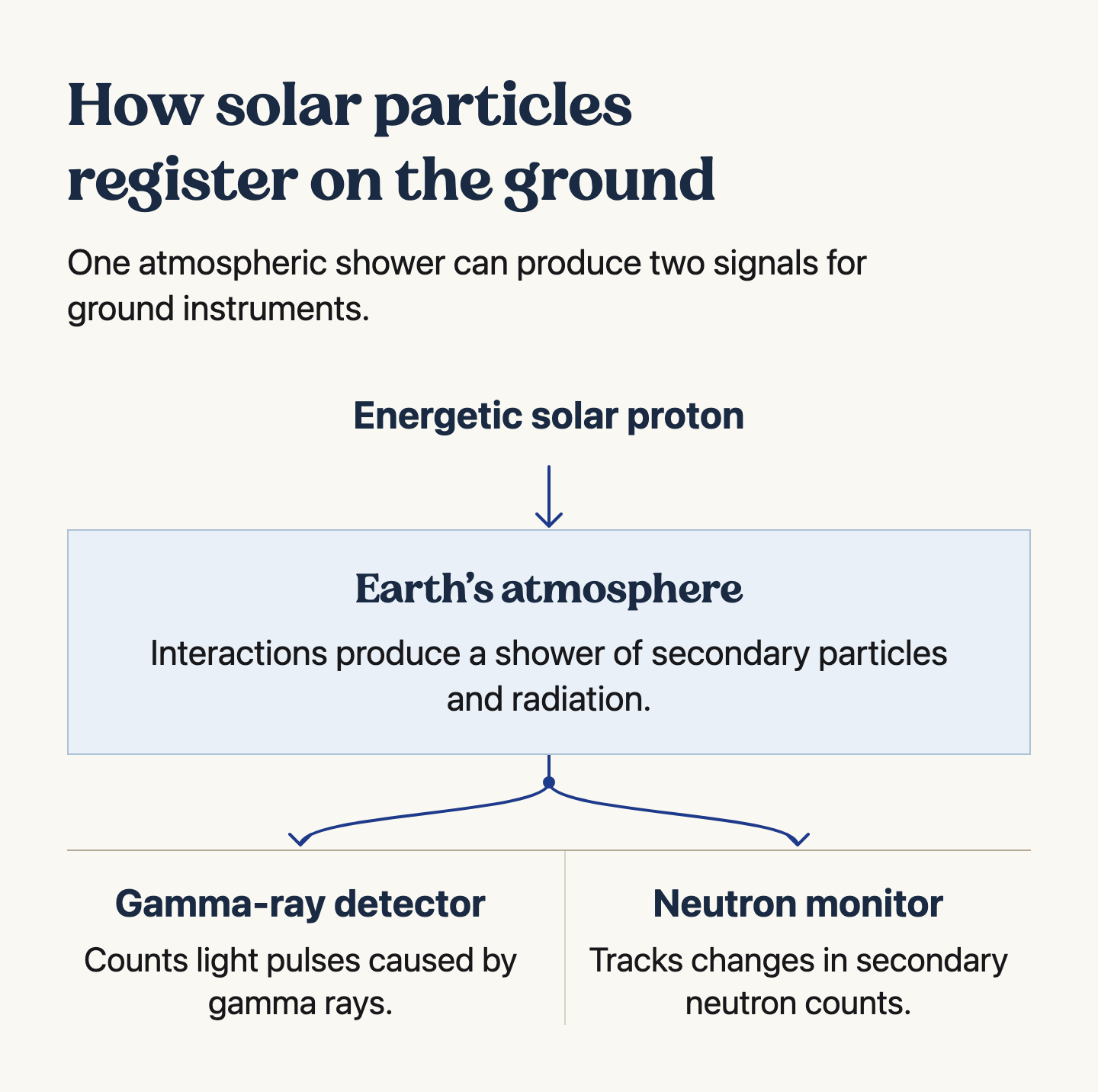
- When sufficiently energetic primary particles enter the atmosphere, they interact with its constituents. These collisions produce a cascade of secondary particles and radiation that can contribute to signals recorded closer to the ground.
- A ground-level enhancement concerns the detectable increase associated with such energetic particles. The atmospheric cascade links the original solar disturbance with the measurements made by instruments at Earth’s surface.
- Polar observations provide useful evidence about particle access under different geomagnetic conditions. Measurements from separated stations help researchers examine how the same event appears at different locations and times.
- The study found a prompt response at Maitri and a more gradual response at Ny-Ålesund. This comparison highlights the value of geographically distributed observations when interpreting the development of a solar particle event.

What the Two Ground Instruments Measure
Gamma-ray detectors and neutron monitors register different components of the atmospheric cascade, allowing researchers to compare independent observations of an event.
- A scintillation detector uses a material that emits light when radiation deposits energy in it. The instrument converts these light signals into measurements that can be analysed as counts over time.
- The Indian stations used thallium-doped sodium iodide, written NaI(Tl). Researchers examined gamma-ray count rates in different energy ranges and compared them with the background recorded before the solar event.
- A neutron monitor tracks changes in secondary neutron intensity near the ground. Its measurements have traditionally provided a major observational basis for identifying and studying ground-level enhancements.
- Agreement between instruments strengthens interpretation when their responses are consistent with the same event. Each sensor supplies a different measurement, so their combined evidence can be more informative than one count series alone.
- The researchers also used GOES particle observations as part of the comparison. Combining ground and satellite records connects measurements at different stages of the particle event and helps assess whether their timing is consistent.
How Researchers Establish the Source
A rise in detector counts requires an explanation supported by comparisons, because gamma radiation has several possible origins beyond energetic solar particles.
- Terrestrial radioactivity contributes to the radiation background. A reliable analysis needs to assess whether an observed increase exceeds ordinary variation and whether the instrument was operating consistently during the relevant period.
- Thunderstorms and lightning-related phenomena can also produce gamma-ray enhancements. Researchers examined such alternatives before connecting the polar signals with the solar particle event and the wider observation network.
- Astronomical sources, including gamma-ray bursts, are another possible explanation for changing counts. The study used the timing and consistency of several observations to support its interpretation of the event.
- Compact gamma-ray instruments could expand the geographical coverage of monitoring networks. Their value depends on reliable operation, suitable site selection and comparison with established instruments over additional events.
- Instrument qualification and space observations involve related demands for dependable measurements. This study shows how ground-based evidence can add another perspective to research on the Sun-Earth environment.
Way Forward
Build Comparable Observations
- Maintain calibration and background records so measurements from different stations and periods can be assessed consistently.
- Expand coverage through carefully selected sites, retaining links with established neutron-monitor and satellite observations.
- Study additional events to assess how the approach performs under varied atmospheric and geomagnetic conditions.
Conclusion
- Atmospheric interactions connect energetic solar protons with the secondary signals measured near the ground. Understanding this chain helps explain what each instrument contributes.
- Complementary measurements and source checks support reliable interpretation. A wider gamma-ray network could improve coverage as its performance is assessed across further events.
UPSC Practice Questions
Prelims MCQ 1
With reference to ground-level enhancements, consider the following statements:
- Energetic solar protons can generate secondary particles through atmospheric interactions.
- Gamma-ray detectors and neutron monitors measure different signals.
- Every increase in gamma-ray counts necessarily originates from the Sun.
How many of the above statements are correct?
(a) Only one (b) Only two (c) All three (d) None
Answer: (b) Only two
Explanation:
The first two statements are correct. Terrestrial radioactivity, atmospheric phenomena and astronomical sources can also affect gamma-ray measurements.
Prelims MCQ 2
Why did researchers compare the polar gamma-ray observations with neutron-monitor and satellite data?
(a) To establish whether several measurements supported the same event (b) To eliminate the need for background measurements (c) To prove that all solar particles reach the ground unchanged (d) To measure only terrestrial radioactivity
Answer: (a) To establish whether several measurements supported the same event
Explanation:
Consistent timing and responses across complementary instruments strengthen the attribution of the observed signals.
UPSC Mains Questions
- Explain how complementary ground and satellite observations improve the study of solar energetic particle events.
- Discuss the importance of background measurements and source attribution when expanding scientific monitoring networks.
Source: Department of Science and Technology via PIB.
Frequently Asked Questions
What is a ground-level enhancement?
It is a measurable increase associated with sufficiently energetic solar particles. Their interactions in the atmosphere produce secondary particles and radiation that can be recorded by instruments near the surface.
What did the Indian polar stations contribute?
Gamma-ray detectors at Maitri and Ny-Ålesund recorded signatures of the November 2025 event. Researchers compared these observations with pre-event backgrounds, neutron-monitor records and satellite particle measurements to assess their origin.
How does a scintillation detector work?
Radiation deposits energy in a scintillating material, producing light. The instrument converts that light into measurable signals. The polar study used thallium-doped sodium iodide detectors to analyse gamma-ray counts.
Why are several kinds of observation needed?
Gamma-ray counts can change for several reasons, including terrestrial and atmospheric activity. Consistent observations from different instruments help researchers assess whether an increase is associated with the same solar event.
Tell Google you want more of this.
Add Anantam IAS as a preferred sourceOne tap, and this site shows up more often in your own Top Stories, AI Overviews and AI Mode. Remove it any time.