Why in News?
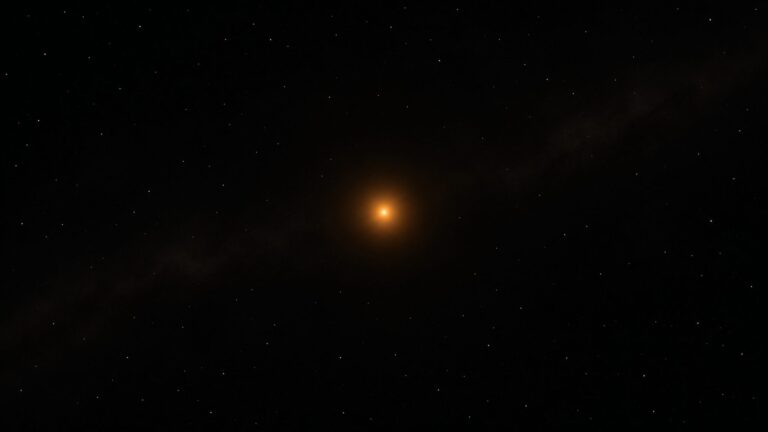
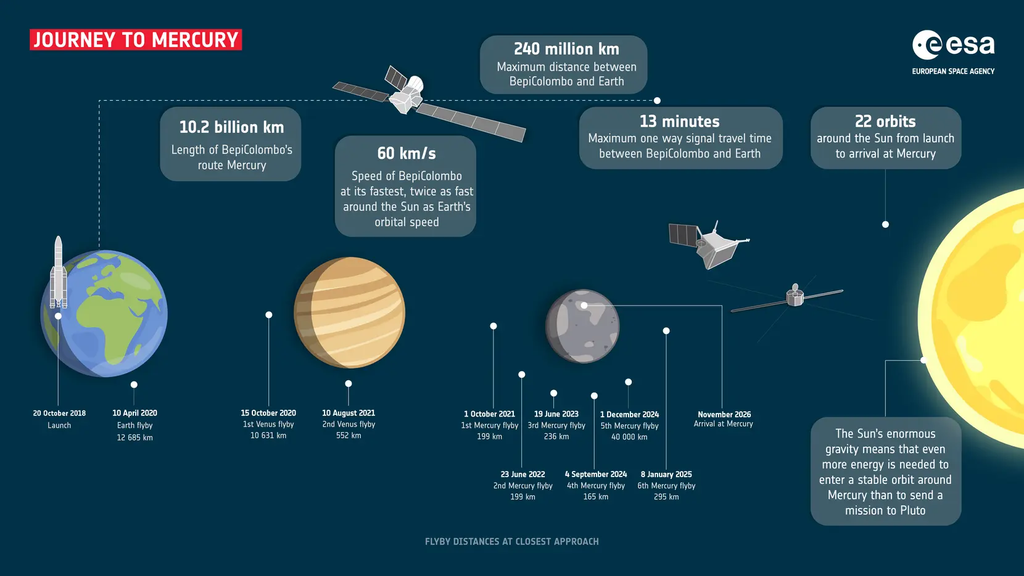
The joint European-Japanese BepiColombo mission entered orbit around Mercury on November 21, 2026, after an approximately eight-year journey. The mission is expected to provide new insights into Mercury’s internal structure, magnetic field, surface composition and polar water ice.
BepiColombo is only the third spacecraft mission to visit Mercury and the second to enter orbit around the planet.
| UPSC Relevance: GS-3 Science and Technology: Space Technology Prelims: BepiColombo mission; Mercury |
BepiColombo: Mission Overview
- Agencies: Joint mission of the European Space Agency (ESA) and Japan Aerospace Exploration Agency (JAXA).
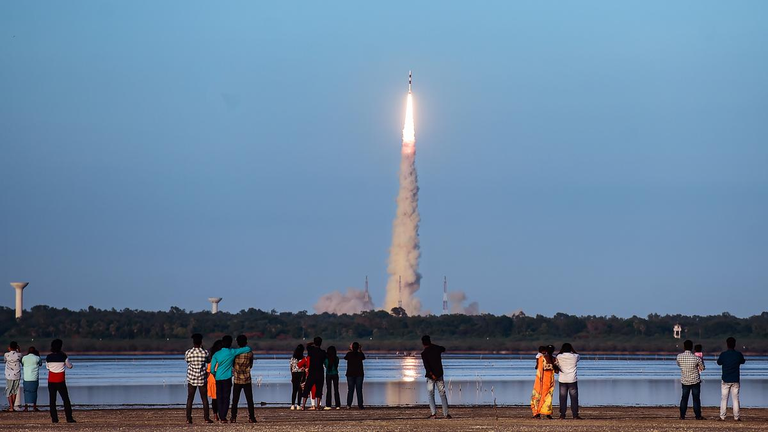
- Launch: 2018, aboard an Ariane 5 rocket from Europe’s Spaceport in Kourou, French Guiana.
- Named after: Italian mathematician and engineer Giuseppe (Bepi) Colombo, who made important contributions to the study of Mercury and planetary orbital mechanics.
- Objective: To study Mercury’s origin, internal structure, geological evolution, magnetic field and interaction with the solar wind.
Twin-orbiter Architecture:
BepiColombo is designed to deploy two specialised scientific orbiters around Mercury, making it the first mission to operate two spacecraft around the planet simultaneously.
1. Mercury Planetary Orbiter (MPO):
- Developed by ESA.
- Carries 11 scientific instruments.
- Will investigate Mercury’s surface, internal structure, composition and geological history.
2. Mercury Magnetospheric Orbiter (MMO/MIO):
- Developed by JAXA.
- Designed to study Mercury’s magnetic field, magnetosphere, plasma environment and interaction with the solar wind.
Additional component: The Mercury Transfer Module (MTM), equipped with solar-electric propulsion, powered and propelled the spacecraft during most of its interplanetary journey. It separated from the spacecraft stack in September 2026.
Upcoming milestones:
- December 2026: Separation of MPO and MIO.
- March 2027: MPO expected to reach its final science orbit.
- April 2027: Commencement of routine scientific operations.
Why is reaching Mercury so difficult?
Mercury is relatively close to Earth in terms of distance, but reaching and entering orbit around it is exceptionally challenging.
- Strong gravitational pull of the Sun: A spacecraft travelling from Earth towards Mercury gains considerable orbital speed due to the Sun’s gravitational attraction. It must shed substantial velocity to be captured by Mercury’s relatively weak gravity. Thus, reaching Mercury requires complex orbital manoeuvres and significant braking rather than simply travelling towards the planet.
- Extreme thermal environment: Mercury receives intense solar radiation because of its proximity to the Sun. Spacecraft systems must withstand extreme temperatures and radiation while maintaining the operating conditions required by sensitive scientific instruments.
The mission used solar-electric propulsion during its cruise phase. Solar panels generated electricity to power ion thrusters, which produced continuous, low-thrust propulsion over extended periods. This helped achieve the substantial velocity changes required for the journey.
BepiColombo used a technique called weak stability capture to enter Mercury’s orbit. It arrived at a relatively low speed, allowing Mercury’s gravity to capture it through a carefully designed orbital manoeuvre. It is the first mission to use this technique for insertion into orbit around a planet.
Major Scientific Objectives and Significance:
- Origin of Mercury’s magnetic field: Mercury is the only planet besides Earth among the inner planets with a global, internally generated magnetic field. Despite its small size, it possesses a disproportionately large iron-rich metallic core. The mission will investigate the origin, structure and dynamics of this magnetic field and its interaction with the solar wind.
- Presence of water ice on a scorching planet: Despite being the closest planet to the Sun, Mercury has evidence of water ice in permanently shadowed polar craters. These regions remain extremely cold because sunlight never reaches them. BepiColombo will investigate the composition, distribution and origin of these polar deposits.
- Mysterious surface features called ‘Hollows’: Hollows are shallow, irregular depressions found across Mercury’s surface. They were identified through observations by NASA’s MESSENGER spacecraft. BepiColombo will investigate their composition and formation mechanisms.
- Understanding Mercury’s internal structure: Mercury has an unusually large metallic core relative to its size. Studying its interior structure will provide clues about planetary differentiation, formation and evolution.
Mercury: Important Facts
- Position: Closest planet to the Sun and the smallest planet in the Solar System.
- Classification: Terrestrial (rocky) planet.
- Diameter: Approximately 4,880 km.
- Orbital period: Approximately 88 Earth days.
- Rotation period: Approximately 59 Earth days.
- Solar day: Approximately 176 Earth days.
- Orbital eccentricity: Highest among the eight planets.
- Atmosphere: Does not possess a substantial atmosphere; instead, it has an extremely thin exosphere.
- Magnetic field: Has a global magnetic field, considerably weaker than Earth’s.
- Temperature: Approximately 430°C during the day and -180°C at night.
- Moons and rings: Neither natural satellites nor planetary rings.
Previous Missions to Mercury:
Only two spacecraft had visited Mercury before BepiColombo.
- Mariner 10 (NASA, 1973): First spacecraft to visit Mercury. Captured close-up images of approximately 45% of the planet’s surface.
- MESSENGER (NASA, 2004): First spacecraft to orbit Mercury (2011-2015). Mapped the planet’s surface and studied its composition, magnetic field and internal structure. Confirmed the presence of water ice in permanently shadowed polar regions.
- BepiColombo (ESA-JAXA, 2018): Third spacecraft mission to visit Mercury. Second mission to orbit Mercury. First mission designed to operate two dedicated scientific orbiters around Mercury simultaneously.
Practice Prelims MCQ:
Q. With reference to Mercury and the BepiColombo mission, consider the following statements:
- Mercury is the only terrestrial planet other than Earth known to possess a global magnetic field.
- Mercury has a substantially thick atmosphere that moderates its extreme surface temperatures.
- BepiColombo is a joint mission of ESA and JAXA comprising two scientific orbiters.
- Mercury completes three rotations on its axis for every two revolutions around the Sun.
Which of the statements given above are correct?
(a) 1 and 2 only
(b) 1, 3 and 4 only
(c) 2, 3 and 4 only
(d) 1, 2, 3 and 4
Answer: (b)
Tell Google you want more of this.
Add Anantam IAS as a preferred sourceOne tap, and this site shows up more often in your own Top Stories, AI Overviews and AI Mode. Remove it any time.