Why in News?
The Hindu reported LUPEX rover testing on November 27, following JAXA’s November 25 presentation on the planned India-Japan lunar polar exploration mission.
- JAXA develops the rover and launch vehicle, while ISRO develops the lander for the joint mission.
- The presentation describes ground development and testing, including mobility, thermal behaviour and sample-handling systems.
- The mission aims to investigate the distribution, form and abundance of lunar water through measurements near the south pole.
- JAXA lists launch as no earlier than 2028, preserving the distinction between a planning window and a confirmed launch date.
- Reliable surface mobility connects a safe landing location with scientifically valuable sampling sites.
- Water-resource assessment requires evidence about location, accessibility and composition before future extraction systems can be planned.
UPSC Relevance
Prelims Relevance
- LUPEX is the Lunar Polar Exploration mission.
- JAXA provides the rover and launch vehicle; ISRO provides the lander.
- Regolith is the loose material covering the lunar surface.
- Permanently shadowed regions receive no direct sunlight and can preserve volatile substances under sufficiently cold conditions.
- In-situ analysis examines material at the exploration site.
Mains Relevance
GS Paper 3
- How ground qualification reduces mission risk.
- Why resource detection and resource usability require different evidence.
GS Paper 2
- Division of technical responsibilities in India-Japan space cooperation.
Background and Context
What Ground Rover Tests Establish
A terrestrial test programme helps engineers evaluate how a rover moves and how its subsystems behave before committing hardware to a mission.
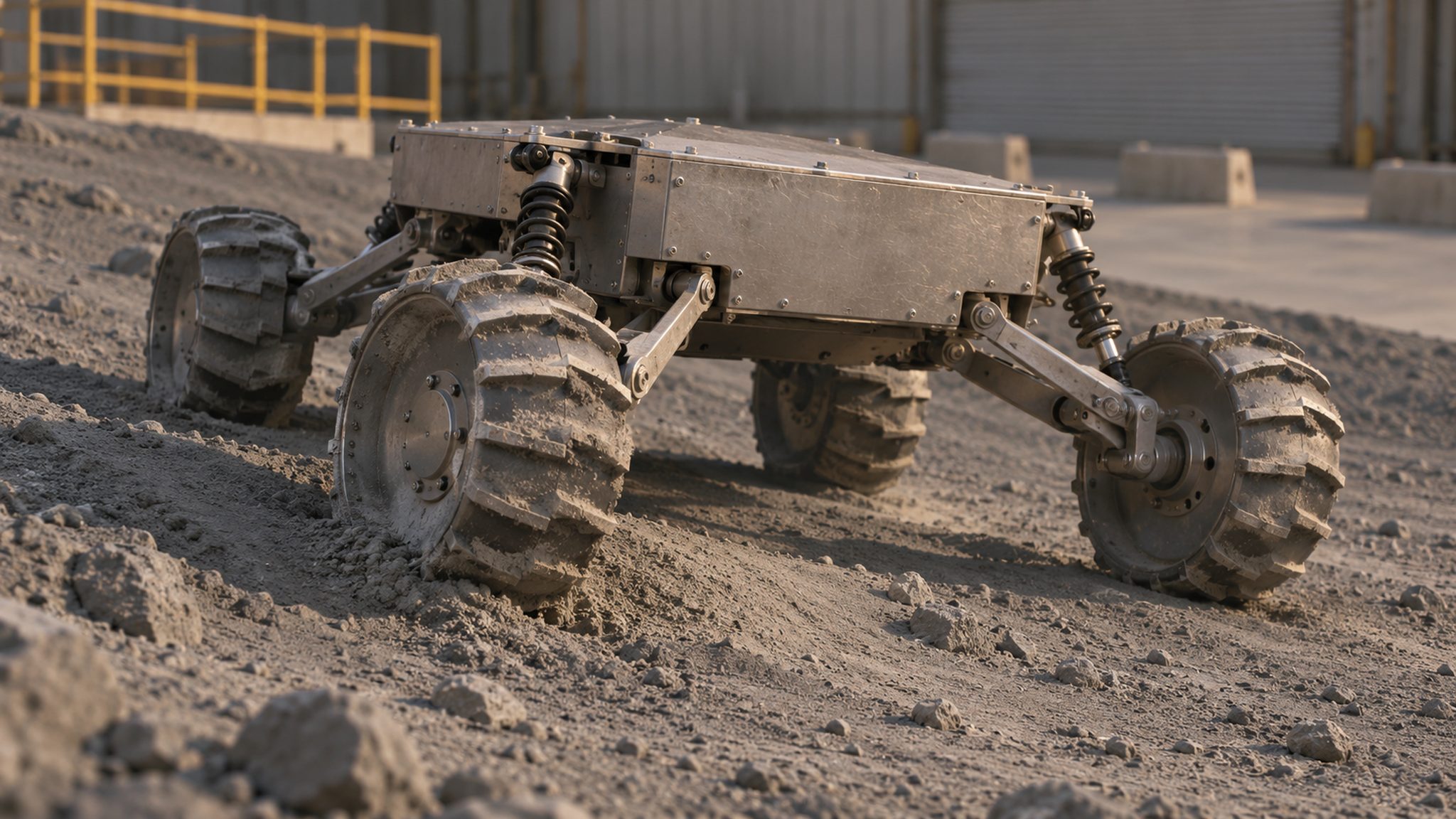
- Mobility tests examine movement over representative terrain, including slopes and loose material. Wheel contact, steering and traction determine whether the vehicle can reach a selected site while maintaining useful control over its motion.
- Ground models allow repeated experiments under controlled conditions. Engineers can compare measured behaviour with predictions, identify weaknesses and revise designs before later tests impose more demanding combinations of environmental and operational stresses.
- Earth testing has limits because lunar gravity, vacuum, temperature and surface conditions differ. A successful drive demonstrates performance within its test conditions, while further qualification is needed to support claims about mission readiness.
- Thermal testing checks how hardware responds to heat flow and cold conditions. JAXA’s presentation describes comparison of measurements with thermal analysis, allowing mathematical models to be updated using observations from physical test hardware.
- The same distinction between assembly and qualification appears in satellite supply chains. Producing a component is one milestone; demonstrating reliable operation under relevant stresses is another part of establishing readiness.
How Mobility Supports Water Measurements
The exploration sequence links route selection, reconnaissance, sampling and analysis so each stage supplies information needed by the next.
- Route planning considers terrain, illumination and observation targets. The rover must move between useful locations while managing energy and opportunities to recharge, making a scientifically attractive target part of a wider operational decision.
- Initial observations help identify where closer examination is worthwhile. Instruments can narrow the choice of drilling locations, reducing the chance that a limited sampling operation is committed before the surrounding site is understood.
- Subsurface sampling extends measurements beyond the exposed surface. The planned drill reaches about 1.5 metres, allowing investigation of material at depth where conditions and volatile abundance may differ from those visible above.
- Sample handling matters because material must move from the collection system to analytical instruments. A drill that penetrates successfully still needs a reliable transfer sequence for the collected material to yield interpretable scientific measurements.
- Water analysis addresses abundance and physical form. Results from selected sites would help researchers understand local deposits, while interpretation must account for the locations sampled and the limits of spatial coverage across the region.
What Water Evidence Can Support
Scientific measurements can guide later exploration decisions, with extraction feasibility requiring additional engineering and resource assessment.
- Presence alone leaves several practical questions open. A deposit’s concentration, depth and accessibility influence the amount of material that would need processing and the effort required to obtain a useful quantity of water.
- Polar illumination creates operational trade-offs. Shadowed terrain can offer conditions favourable to volatile preservation, while access to sunlight supports power generation, so routes and observation plans must account for both scientific and energy requirements.
- Resource use would require collection, processing and storage equipment beyond a measurement mission. JAXA discusses later demonstration concepts separately, helping readers distinguish evidence gathered by exploration from a functioning lunar supply system.
- International interfaces connect the lander, rover and instruments developed by different partners. Shared requirements and compatibility checks support the handover between landing, deployment, movement and observation, with each partner responsible for agreed functions.
- Mission preparation includes a chain of demonstrations with different purposes. The broader discussion of astronaut preparation offers another example of building operational capability through staged training and assessment before a planned space mission.
Way Forward
Report Each Development Stage Precisely
- Link test results to their stated conditions and explain which risks remain for later qualification.
- Keep science objectives, measured results and future resource-use proposals clearly attributed to their respective stages.
- Track joint interfaces and schedules through official updates as the mission progresses.
Conclusion
- LUPEX connects surface engineering and resource science. Movement, sampling and analysis form an operational chain whose reliability determines whether selected lunar locations can produce useful evidence.
- For an answer on space exploration, connect international cooperation with the specific capability it develops, then explain what further evidence would be needed before resource extraction becomes practical.
UPSC Practice Questions
Prelims MCQ 1
With reference to LUPEX, consider the following statements:
- JAXA is responsible for the rover and launch vehicle.
- ISRO is responsible for the lander.
- A ground mobility demonstration establishes that lunar water has been sampled.
How many of the above statements are correct?
(a) Only one (b) Only two (c) All three (d) None
Answer: (b) Only two
Explanation:
The first two statements match JAXA’s division of responsibilities. Ground mobility testing evaluates hardware performance and produces no lunar sample.
Prelims MCQ 2
Why does a rover use preliminary observations before selecting a drilling location?
(a) To remove the need for sample analysis (b) To identify promising sites for closer investigation (c) To guarantee a commercially usable water deposit (d) To replace the lander’s descent system
Answer: (b) To identify promising sites for closer investigation
Explanation:
Reconnaissance provides information for selecting sampling locations. Subsequent collection and analysis are needed to establish properties of the material.
UPSC Mains Questions
- Explain how ground qualification contributes to the scientific success of a lunar rover mission.
- Discuss the evidence needed to move from identifying lunar water to assessing its use as a resource.
Sources: JAXA and The Hindu.
Frequently Asked Questions
What is LUPEX?
LUPEX is a planned joint India-Japan mission to investigate water near the lunar south pole. Its rover will collect observations and samples to study the distribution, form and abundance of water.
Which country provides the rover?
JAXA’s division of responsibilities assigns the rover and launch vehicle to Japan. India is responsible for the lander. Instruments from several international partners will contribute to the scientific investigation.
Did the ground tests find lunar water?
The ground tests assess rover hardware and operational behaviour on Earth. Lunar water measurements remain a mission objective requiring deployment, observations, sample collection and analysis at the selected exploration sites.
Is the launch date fixed?
JAXA’s current overview states no earlier than 2028. This describes a planning window. Subsequent official updates would be needed to establish a specific launch date and confirm progress toward it.
Tell Google you want more of this.
Add Anantam IAS as a preferred sourceOne tap, and this site shows up more often in your own Top Stories, AI Overviews and AI Mode. Remove it any time.