Why in News?
Researchers at the Sudha Gopalakrishnan Brain Centre at the Indian Institute of Technology Madras (IIT-Madras) have released a high-resolution 3D digital atlas of the human brainstem, the small but vital region that links the brain to the spinal cord and controls automatic life-sustaining functions.
Reported by The Hindu in June 2026, the atlas maps the brainstem’s nuclei (clusters of nerve-cell bodies) and tracts (nerve-fibre highways) at near cellular resolution, giving neuroscientists, neurosurgeons and clinicians an open reference for studying disease and planning treatment.
- Built by the Sudha Gopalakrishnan Brain Centre, IIT-Madras’s dedicated whole-brain mapping facility.
- Resolves individual nuclei and fibre tracts of the brainstem in three dimensions, far finer than a standard MRI scan.
- Positioned as a freely usable scientific reference for neurosurgery, neurology and brain-disorder research.
- Adds to India’s growing capacity in indigenous high-resolution brain mapping and digital neuroscience.
The development matters in the context of:
- The brainstem governs breathing, heart rate and consciousness, so even tiny structures matter clinically.
- Surgery near the brainstem is high-risk; a precise atlas can guide safer navigation.
- Open digital brain atlases are now core infrastructure for global neuroscience, much like genome databases are for biology.
UPSC Relevance
Prelims Relevance
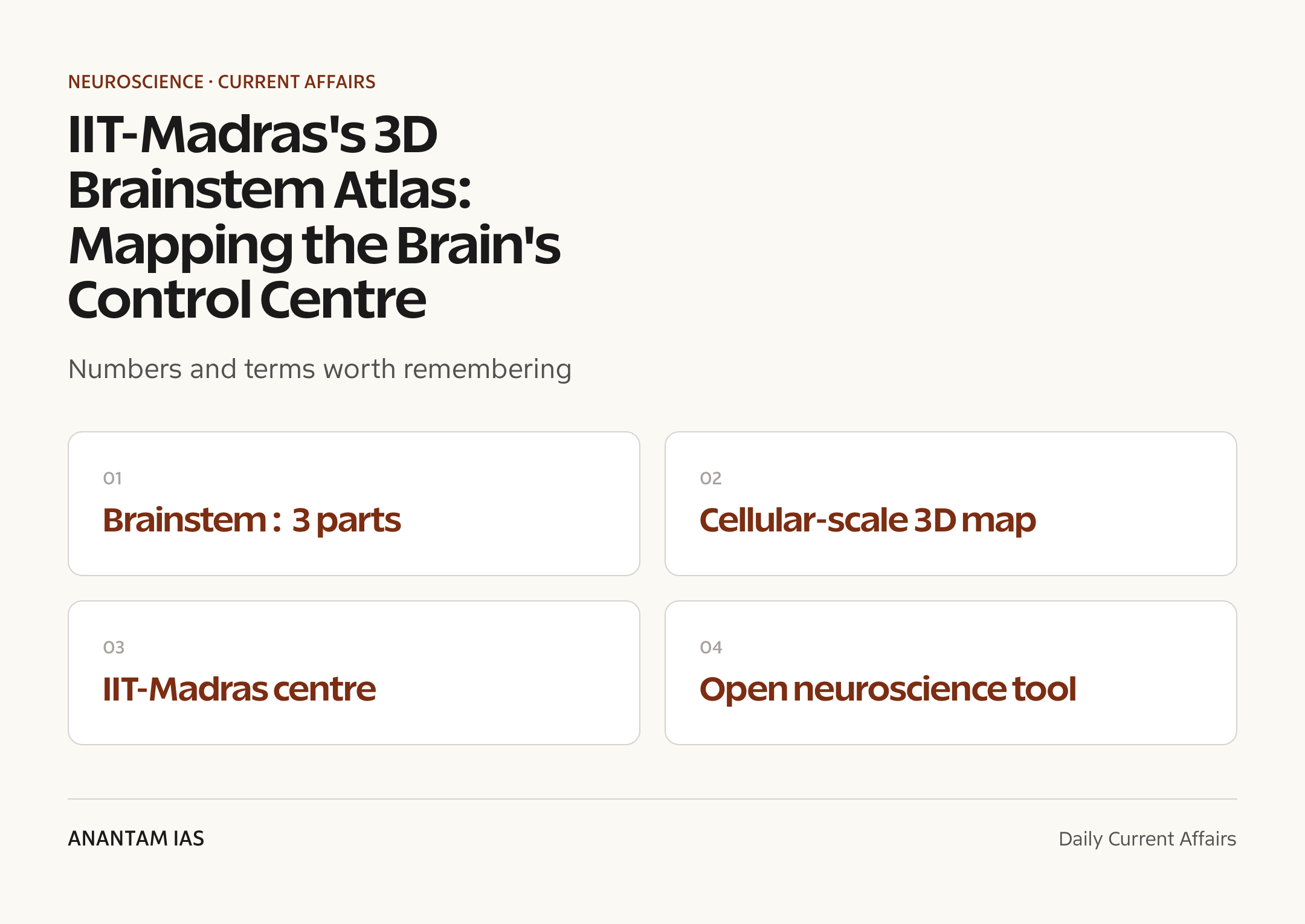
- Brainstem = midbrain + pons + medulla oblongata; connects cerebrum and cerebellum to the spinal cord.
- Medulla oblongata controls breathing, heart rate and blood pressure (the ‘vital centre’).
- Pons relays signals between the cerebrum and cerebellum and aids breathing rhythm.
- Midbrain handles reflexes for vision, hearing and motor control.
- Nuclei are clusters of neuron cell bodies; tracts are bundles of nerve fibres (axons).
- Most of the 12 pairs of cranial nerves emerge from the brainstem.
- The Sudha Gopalakrishnan Brain Centre is housed at IIT-Madras.
- A brain atlas is a 3D reference map of brain structures used across research and clinical care.
Mains Relevance
GS Paper 3
- Indigenous high-end research and self-reliance in science and technology: India building world-class brain-mapping capacity.
- Applications of biotechnology and digital tools in medicine and healthcare; the science-to-clinic pipeline.
GS Paper 2
- Strengthening public healthcare and neurology capacity through better diagnostic and surgical tools.
Essay
- Science as a public good: open knowledge infrastructure and the democratisation of research.
- Mapping the unknown — from the genome to the brain, the quest to understand ourselves.
Background and Context
What the brainstem is and why it matters
The brainstem is small but indispensable, running the body’s automatic systems.
- It has three parts: the midbrain, the pons and the medulla oblongata, stacked between the brain and the spinal cord.
- The medulla houses centres for breathing, heart rate and blood pressure — damage here is life-threatening.
- It is a crossing point for nerve tracts carrying signals up to the brain and down to the body.
- Most cranial nerves, which control the face, eyes, hearing and swallowing, arise here.
- It also regulates sleep, alertness and consciousness through the reticular formation.
What IIT-Madras actually built
The new resource is a digital, three-dimensional map at far finer detail than routine imaging.
- A 3D digital atlas reconstructing the brainstem’s internal architecture in space.
- It resolves individual nuclei and fibre tracts at close to cellular resolution.
- Such detail typically comes from thin physical sectioning and high-power microscopy, then digital stitching — not from a living-patient MRI.
- The output is a navigable reference that scientists worldwide can study and overlay on their own data.
- It builds on the centre’s broader effort to map the whole human brain at high resolution.
The Sudha Gopalakrishnan Brain Centre
IIT-Madras runs a dedicated facility built specifically for whole-brain mapping.
- The Sudha Gopalakrishnan Brain Centre focuses on high-throughput, high-resolution digital reconstruction of human brain tissue.
- It develops imaging pipelines that turn physical brain sections into searchable 3D digital models.
- It is an example of an indigenous, India-led platform in a field long dominated by a few foreign laboratories.
- Work like this strengthens India’s footprint in global neuroscience and data-driven biology.
Why a brain atlas is useful
Detailed maps turn the brain into shared, reusable scientific infrastructure.
- Neurosurgery: a precise map helps surgeons plan routes around fragile structures, lowering risk.
- Disease research: comparing healthy and diseased brains can reveal where disorders begin.
- Education: students and clinicians get an interactive reference instead of flat textbook diagrams.
- Standardisation: a common atlas lets labs around the world compare results in the same coordinate space.
- It complements brain-imaging methods such as MRI and fMRI, and frontier neurotech like the brain-computer interface, by adding microscopic structural detail.
Links to AI and the wider brain-mapping push
High-resolution brain data sits at the intersection of biology and computing.
- Reconstructing a brain at cellular scale generates huge datasets that need artificial intelligence and machine learning to align, label and analyse, echoing India’s wider push for indigenous AI under efforts like sovereign AI and BharatGen.
- Detailed wiring maps can also inform brain-inspired computing such as neuromorphic computing, which models chips on the structure of neurons.
- Globally, large efforts such as the Human Connectome Project have shown the value of open brain-mapping data.
- Indian efforts add to this commons while building domestic expertise in imaging, computing and clinical translation.
What to be careful about
A reference atlas is a powerful tool, not an instant cure, and a few caveats apply.
- An atlas from donated tissue is a detailed reference; it does not by itself diagnose or treat a living patient.
- Translating such maps into routine clinical practice takes validation, training and regulatory steps.
- Sustained funding, tissue donation and skilled staff are needed to keep mapping the rest of the brain.
- Open, well-documented data and ethics in handling human brain tissue remain essential.
Way Forward
From reference to clinic
- Validate the atlas against clinical cases so it can guide neurosurgical planning.
- Integrate it with hospital imaging so surgeons can overlay it on a patient’s scans.
Scale and openness
- Extend high-resolution mapping to the whole brain, not just the brainstem.
- Keep the data open and interoperable so Indian and global labs can build on it.
Sustain investment in imaging hardware, AI pipelines and trained neuroscientists, and encourage brain-tissue donation through clear, ethical frameworks so India can keep building world-class brain-mapping infrastructure.
Conclusion
The brainstem runs the body’s most basic life-support systems, yet its small, densely packed structures have been hard to study in fine detail. A 3D atlas that resolves its nuclei and tracts turns this region into a shared, navigable reference for surgeons and scientists alike.
By building this map at home, IIT-Madras’s Sudha Gopalakrishnan Brain Centre shows India can lead in frontier neuroscience. The next test is turning open scientific maps into safer surgery, sharper diagnoses and stronger homegrown research capacity.
UPSC Practice Questions
Prelims MCQ 1
With reference to the human brainstem, consider the following statements:
- It is composed of the midbrain, the pons and the medulla oblongata.
- The medulla oblongata contains centres that control breathing and heart rate.
- It connects the cerebrum and cerebellum to the spinal cord.
How many of the above statements are correct?
(a) Only one (b) Only two (c) All three (d) None
Answer: (c) All three
Explanation:
The brainstem comprises the midbrain, pons and medulla. The medulla holds the vital centres for breathing, heart rate and blood pressure, and the brainstem links the cerebrum and cerebellum to the spinal cord. All three statements are correct.
Prelims MCQ 2
The high-resolution 3D atlas of the human brainstem reported in 2026 was released by which institution?
(a) The Sudha Gopalakrishnan Brain Centre at IIT-Madras (b) The National Institute of Mental Health and Neurosciences (c) The Indian Institute of Science, Bengaluru (d) The All India Institute of Medical Sciences, New Delhi
Answer: (a) The Sudha Gopalakrishnan Brain Centre at IIT-Madras
Explanation:
The atlas was produced by the Sudha Gopalakrishnan Brain Centre, the whole-brain mapping facility at IIT-Madras, as reported in June 2026.
UPSC Mains Questions
- High-resolution brain atlases are emerging as critical scientific infrastructure. Discuss how indigenous brain-mapping efforts can strengthen India’s capacity in neuroscience, medicine and digital research. (250 words)
- Examine the role of advanced imaging and artificial intelligence in modern brain research, and the challenges in translating such basic science into clinical benefit in India. (150 words)
Sources: The Hindu and Sudha Gopalakrishnan Brain Centre, IIT-Madras.
Frequently Asked Questions
What is the brainstem?
The brainstem is the lower part of the brain that connects the cerebrum and cerebellum to the spinal cord. It has three sections — the midbrain, pons and medulla oblongata — and controls automatic functions such as breathing, heart rate, blood pressure, swallowing and alertness, making it essential for survival.
What did IIT-Madras release?
Researchers at IIT-Madras’s Sudha Gopalakrishnan Brain Centre released a high-resolution 3D digital atlas of the human brainstem. It maps the region’s nuclei and nerve-fibre tracts in three dimensions at close to cellular resolution, giving scientists, neurosurgeons and clinicians a detailed open reference for research and treatment.
Why is a brain atlas important?
A brain atlas is a standard 3D map of brain structures. It helps neurosurgeons plan safer operations, lets researchers compare healthy and diseased brains in the same coordinate space, supports teaching, and gives laboratories worldwide a common reference, much like a genome database does for biology.
How is this different from an MRI scan?
An MRI scans a living patient but cannot show individual cell clusters. This atlas, built from detailed sectioning and microscopy of donated tissue, resolves nuclei and tracts at far finer, near-cellular detail. The two are complementary: MRI for patients, the atlas as a high-resolution reference.
What is the Sudha Gopalakrishnan Brain Centre?
It is a dedicated brain-mapping facility at IIT-Madras that reconstructs human brain tissue into high-resolution 3D digital models. It is an example of indigenous Indian capacity in neuroscience, developing imaging and computing pipelines to map the brain in fine detail.
How does artificial intelligence relate to this?
Mapping a brain at cellular scale produces enormous datasets that need artificial intelligence and machine learning to align, label and interpret. Detailed wiring maps can also inform brain-inspired computing, linking neuroscience with advances in AI and data science.
Tell Google you want more of this.
Add Anantam IAS as a preferred sourceOne tap, and this site shows up more often in your own Top Stories, AI Overviews and AI Mode. Remove it any time.