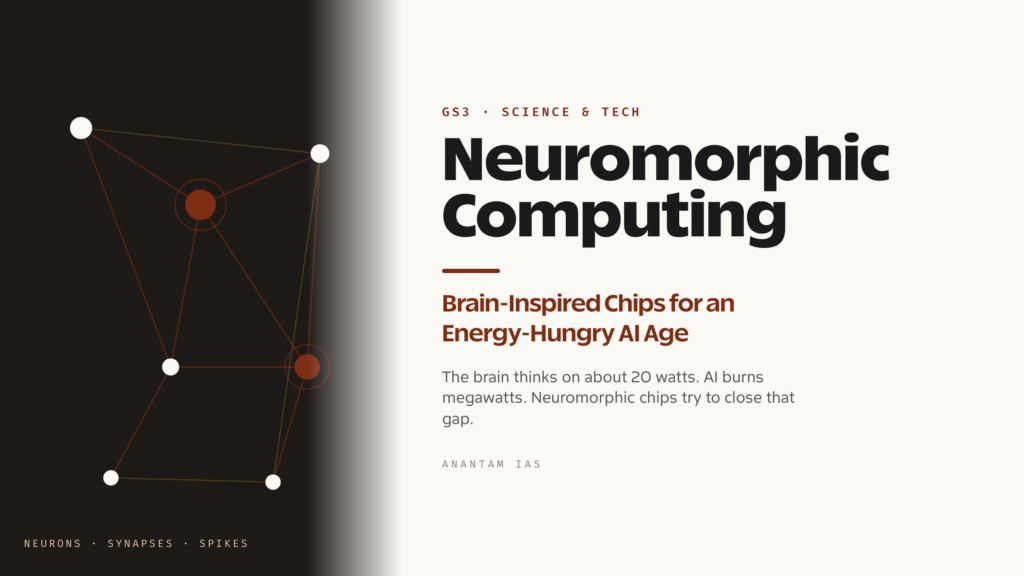
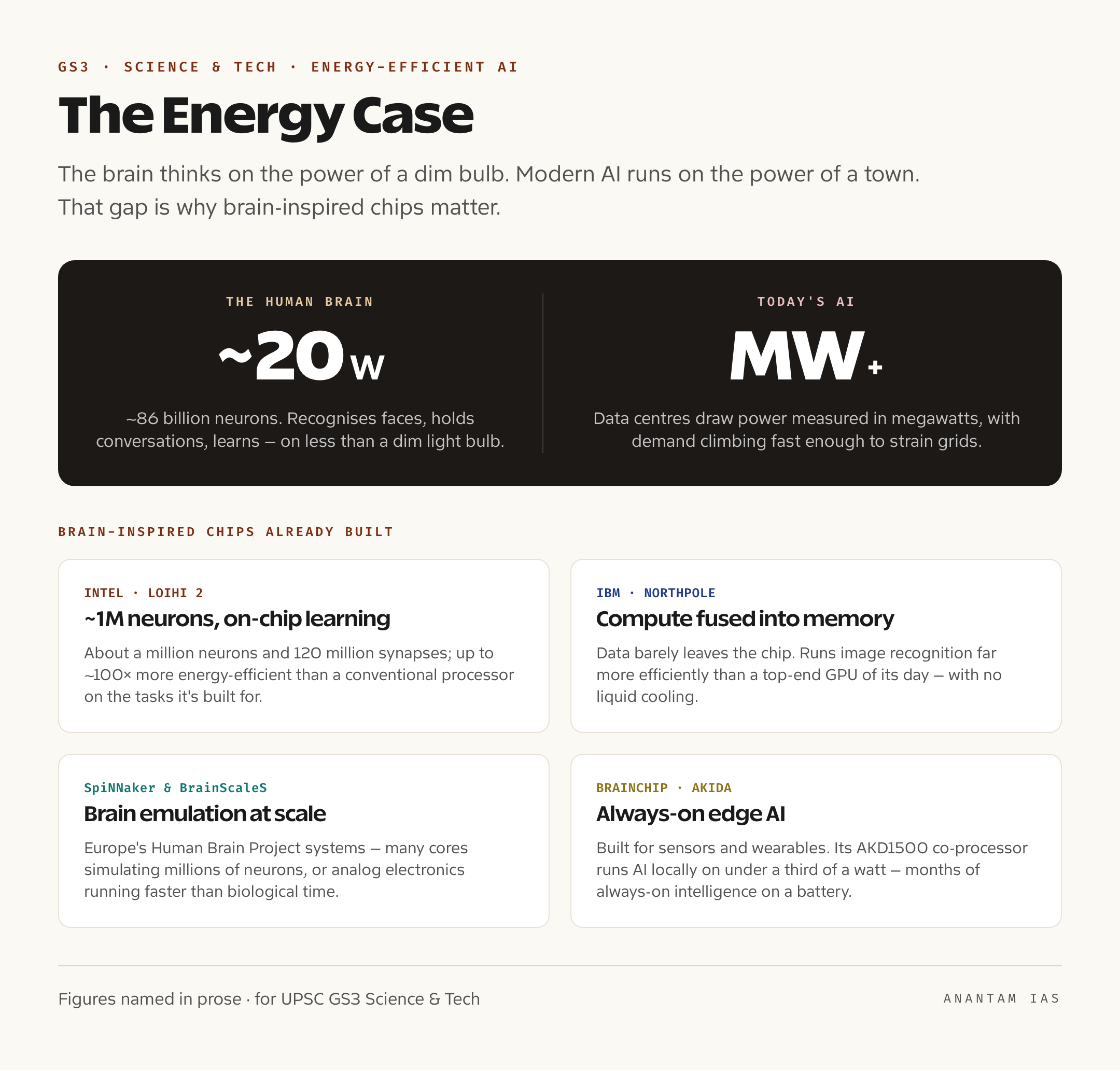
There’s a number that should bother anyone watching artificial intelligence eat the world’s electricity: the human brain, which can recognise a face, hold a conversation and learn a new skill, runs on about 20 watts — less than a dim light bulb. The data centres training and running today’s AI models, by contrast, draw power measured in megawatts, and their appetite is climbing fast enough to strain national grids. Somewhere in that gap — between a three-pound organ sipping 20 watts and a server hall guzzling a small town’s worth of power — sits the case for neuromorphic computing: the attempt to build chips that work the way the brain works, so that machine intelligence might one day cost a fraction of what it does now.
And the timing makes this more than a curiosity. As AI spreads from the cloud into phones, cars, factory sensors and wearables, the old approach of shipping everything to a giant data centre starts to break down — too slow, too power-hungry, too dependent on a connection. For a country like India, racing to build its own AI and semiconductor base while staring at a power-constrained future, a technology that promises intelligence at a sliver of the energy is not a luxury. It is exactly the kind of leap that rewards a UPSC aspirant who can explain, in plain language, why the way a computer is built matters as much as how fast it runs.
What Neuromorphic Computing Is and the Bottleneck It Escapes
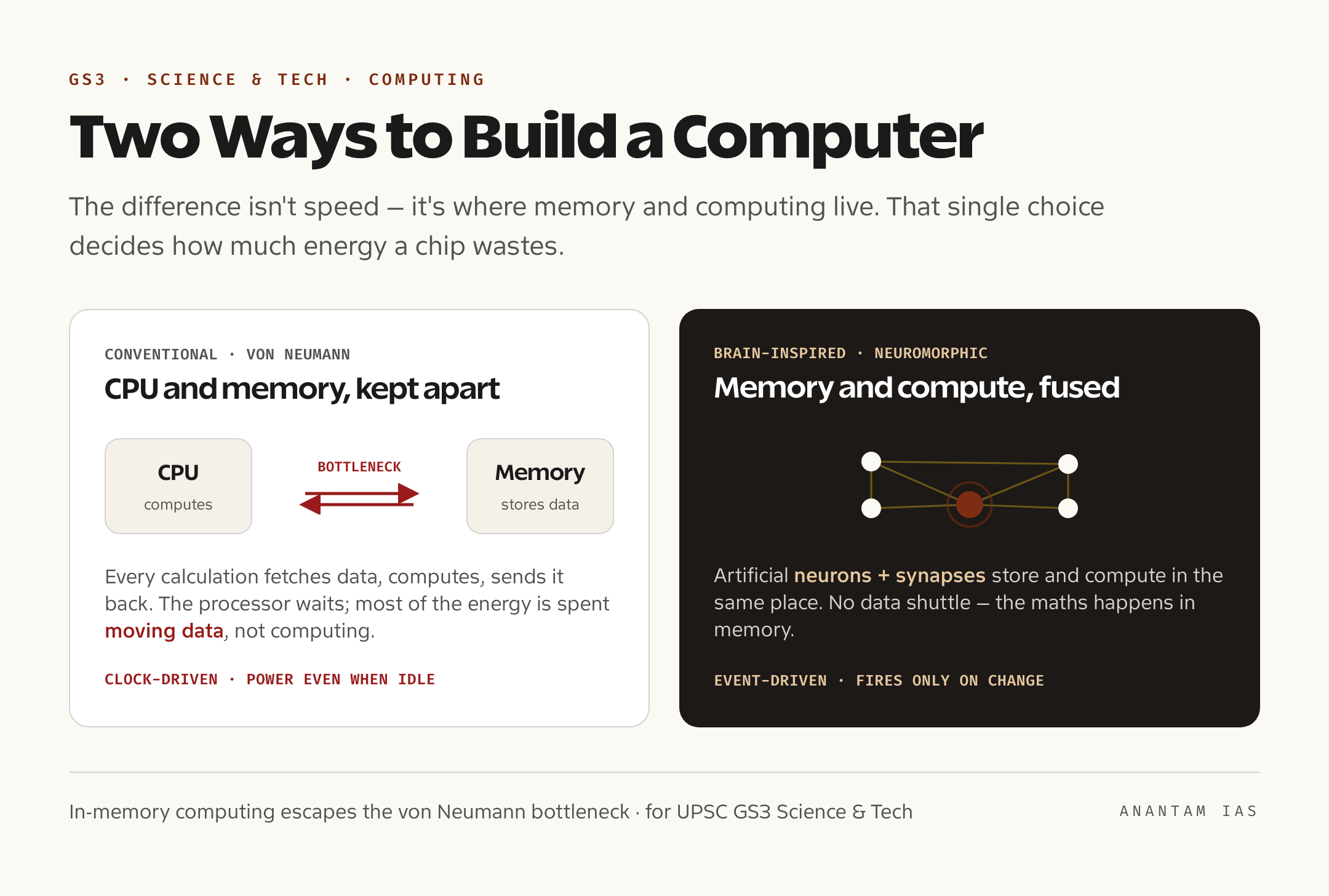
Start with the machine you already know. Almost every computer on Earth — your laptop, your phone, the servers behind every app — is built on the von Neumann architecture, named after the mathematician John von Neumann who set it out in the 1940s. Its defining feature is a clean separation: the processor (the CPU) does the thinking, and a separate block of memory holds the data, with a channel running between them. Every calculation means fetching data from memory, computing on it in the processor, and sending the result back. That design has carried computing for eighty years. But it has a built-in choke point, and engineers gave it a name: the von Neumann bottleneck. The processor often sits idle, waiting for data to crawl back and forth across that channel, and a huge share of a chip’s energy is spent not on computing at all but on simply moving data between memory and processor.
Neuromorphic computing — the word means “in the form of the nervous system” — throws out that separation. Instead of a CPU on one side and memory on the other, it builds hardware out of artificial neurons and synapses, the same two units the brain uses. In the brain, a neuron is a tiny processor and the synapses connecting it to other neurons both store information (as the strength of each connection) and do the computing (by passing or blocking signals). Memory and processing are the same physical thing, sitting in the same place. Neuromorphic chips copy this: they fuse storage and computation so that data barely has to move at all. This is often called in-memory or near-memory computing, and it is the single idea that lets these chips dodge the bottleneck that defines every ordinary machine.
The pay-off is not just speed but a completely different way of handling information. A normal processor marches to a clock, doing work on every tick whether or not anything has changed. A neuromorphic chip is event-driven: its artificial neurons stay quiet and burn almost no power until they receive enough input to “fire” — to send out a brief pulse called a spike. Nothing happening means nothing computing, and nothing computing means almost no energy spent. That is precisely how a brain saves power, and copying it is what makes neuromorphic hardware so frugal on the sparse, bursty, real-world data — a camera’s view of a quiet street, a microphone in a silent room — that conventional AI chips churn through wastefully.
How the Chips Work: Spikes, Synapses and Memristors
So how do you actually build a neuron in silicon? The core trick is to stop sending data as steady streams of numbers and start sending it as spikes — short electrical pulses, like the ones real neurons fire. This is the world of the spiking neural network, or SNN, the software-and-hardware model at the heart of neuromorphic computing. In an SNN, information is carried not just by how strong a signal is but by when and how often the spikes arrive — timing itself becomes data, exactly as it is in living brains. Because a neuron only acts when spikes push it past a threshold, the system naturally ignores everything that isn’t worth reacting to. An ordinary AI model processes every pixel of every frame; a spiking system can process only the pixels that changed, which on most real-world inputs is a tiny fraction.
The artificial synapses are where the cleverest hardware lives, and this is where a device called the memristor comes in. A memristor — short for “memory resistor” — is a tiny component that changes its electrical resistance depending on the current that has flowed through it, and crucially, it remembers that resistance even when the power is switched off. That makes it a near-perfect stand-in for a biological synapse: the resistance value is the “weight” of the connection, it both stores that weight and computes with it when a signal passes through, and it holds the value without constant power. Build a dense grid of memristors — a crossbar array — and you have a fabric that can perform the heavy mathematics of AI, the multiply-and-add operations, directly inside memory, in a single physical step rather than thousands of separate fetches and calculations. Other neuromorphic systems lean more on conventional transistors arranged to behave like neurons, but the principle is the same: keep memory and compute married, and let the hardware physics do the maths.
Put the spikes and the synapses together and you get the neuromorphic recipe in three lines: store and compute in the same place to kill the bottleneck, communicate in event-driven spikes so nothing wastes energy idling, and let the connection strengths sit in non-volatile devices so the chip can even learn — rewire itself — on the fly. None of this makes the chip a general-purpose replacement for your laptop. It makes it spectacularly good at one family of jobs: pattern recognition on streaming, sensory, real-world data, at a power budget the von Neumann world can only dream of.
The Chips Already Built: Loihi, NorthPole, SpiNNaker and Akida
This is not a paper idea. Working neuromorphic chips already exist, and naming a few precisely will lift any answer. Intel’s research chip, Loihi 2, packs around a million artificial neurons and 120 million synapses onto a single piece of silicon, supports on-chip learning so it can adapt in real time, and on the kinds of sparse, event-based tasks it is built for has shown energy efficiency on the order of a hundred times better than a conventional processor, with far lower latency. IBM has pushed the in-memory idea hard with its NorthPole chip, unveiled in 2023, which fuses compute and memory so tightly that data barely leaves the silicon at all — IBM reported it running image-recognition far more efficiently than a top-end graphics processor of its day, and without the liquid cooling those AI chips need. These are the marquee names: Intel Loihi for adaptive, learning-capable spiking, IBM TrueNorth and its successor NorthPole for in-memory efficiency.
Then there are the systems built to mimic the brain at scale. SpiNNaker — the “Spiking Neural Network Architecture”, developed at the University of Manchester and continued as SpiNNaker 2 in Dresden — wires together huge numbers of small cores to simulate millions of neurons in real time, a tool for both AI and for neuroscientists studying how brains actually compute. Its cousin, the BrainScaleS system in Heidelberg, takes a different route: instead of digitally simulating neurons, it uses analog electronics whose physics behave like neurons, running far faster than biological time. Together SpiNNaker and BrainScaleS grew out of Europe’s decade-long Human Brain Project, and they show the research split clearly — some labs chase faithful brain emulation, others chase efficient AI.
The most commercially aggressive corner is edge AI, and here the standout is BrainChip’s Akida family. Akida is designed to be dropped into small devices — sensors, cameras, hearables — and run AI locally on milliwatts of power. In late 2025 BrainChip unveiled its AKD1500 co-processor, which it pitched at hundreds of billions of operations per second while drawing under a third of a watt, the sort of figure that lets a battery-powered gadget run always-on intelligence for months. The market is still small in absolute terms — worth only a few hundred million dollars in 2025 by conservative estimates — but it is forecast to grow many times over within a decade, precisely because the energy logic is so compelling as AI moves out of the data centre.
Why It Matters: Edge AI, Robotics and an Energy Reckoning
The reason to care, beyond the engineering elegance, is the collision course between AI’s hunger and the planet’s power supply. Training and running large AI models already consumes electricity on the scale of small countries, and projections show data-centre demand rising steeply as AI use spreads. You cannot simply keep building bigger, hotter, thirstier chips forever — the grid, the cooling and the carbon all push back. Neuromorphic computing is one of the few approaches that attacks the problem at its root, in the architecture itself, rather than just shaving a few percent off existing designs. If a task that takes a data-centre GPU a hundred joules can be done by a brain-inspired chip in one, that is not an incremental saving; it changes what is affordable and where AI can live.
That “where” is the second big reason: the edge. Most AI today runs in the cloud, which means your device sends data to a distant server and waits for an answer — fine for a chatbot, useless for a self-driving car deciding whether to brake, or a pacemaker spotting an irregular heartbeat. Edge AI means doing the thinking on the device itself, instantly and privately, without a network round-trip. But devices have tiny batteries and no room for a furnace of a chip. Neuromorphic hardware, sipping milliwatts and waking only when something happens, is almost tailor-made for always-on edge intelligence: a security camera that only computes when motion appears, a hearing aid that filters speech in real time, a drone that navigates on its own power budget. Its event-driven nature also suits robotics and sensory processing, where a machine must react continuously to a messy, unpredictable stream of sight, sound and touch.
There are real obstacles, and an honest answer must name them. The hardware has run ahead of the software — programming a spiking chip is nothing like writing ordinary code, the tools and algorithms are immature, and the deep-learning ecosystem that powers mainstream AI does not transfer cleanly. There are no agreed benchmarks, so comparing one neuromorphic chip against another, or against a GPU, is genuinely hard. Manufacturing dense, reliable memristor arrays at scale is still a frontier problem. And neuromorphic chips are specialists, not all-rounders, so they will complement conventional processors rather than replace them. The field is roughly where conventional AI hardware sat before the deep-learning boom — promising, proven in the lab, and waiting for the software and the killer applications to catch up.
The India Angle: IISc, the Memristor Bet and Energy-Frugal AI
For India, neuromorphic computing lines up almost suspiciously well with the country’s needs and its strengths. The headline achievement comes from the Indian Institute of Science in Bengaluru, where a team led by Sreetosh Goswami at the Centre for Nano Science and Engineering built a molecular memristor — a device based on a thin metal-organic film — capable of storing and processing information across more than 16,000 distinct resistance states, rather than the mere two (0 and 1) of an ordinary digital bit. Published in the journal Nature in 2023, the work drew global attention precisely because so many states packed into one tiny device means enormous information density and the prospect of doing brain-like analog computation with a fraction of the energy and steps a digital machine needs. The team has since integrated a 64-by-64 array of these devices with a standard silicon processor and, with support from the Ministry of Electronics and Information Technology, plans to scale toward larger arrays and a full system-on-chip aimed at energy-efficient edge AI.
The work is spread across the ecosystem, which is what makes it look like a genuine national capability rather than one lab’s lucky shot. Groups at IIT Bombay, IIT Delhi and IIT Madras work on the device physics and the hard problem of wiring memristors together reliably at scale, while IISc pushes on engineering better memristor materials from the ground up. This sits inside a wider policy push: the India Semiconductor Mission’s drive to build domestic chip-making, the IndiaAI Mission’s investment in AI compute, and a research community that has long punched above its weight in physics and materials science. Neuromorphic devices are a place where India can aim for genuine intellectual-property leadership rather than catching up — the underlying breakthroughs are still being made in university labs, not locked inside a handful of foreign giants. You can read more about the hardware base in the India Semiconductor Mission and about the parallel deep-tech race in quantum computing and the National Quantum Mission.
And there is a strategic logic underneath the science. India will deploy AI across a vast population using a power grid that is still stretched, in a climate where every extra megawatt of cooling is a cost. A technology that delivers intelligence at the energy budget of the brain — rather than the energy budget of a server farm — is not just clever; it is a fit for a country that has to do more with less power. If India can pair home-grown memristor research with its semiconductor and AI missions, neuromorphic computing offers a rare chance to lead a frontier from the front, building energy-frugal AI for a power-constrained world that the rest of the planet will eventually need too.
For Your Mains Answer
This is a high-value topic for GS Paper 3, which covers science and technology, developments and applications, and indigenisation of technology. Questions on emerging technologies, the future of computing, energy-efficient AI, India’s semiconductor and AI ambitions, or the sustainability costs of digital growth can all draw on this material. It also feeds the Essay paper on themes of technology, sustainability and self-reliance. The skill examiners reward here is conceptual clarity: show that you understand why the architecture matters, not just that brain-inspired chips exist, and always anchor the abstract idea with one or two precise examples and figures.
How to Build the Answer
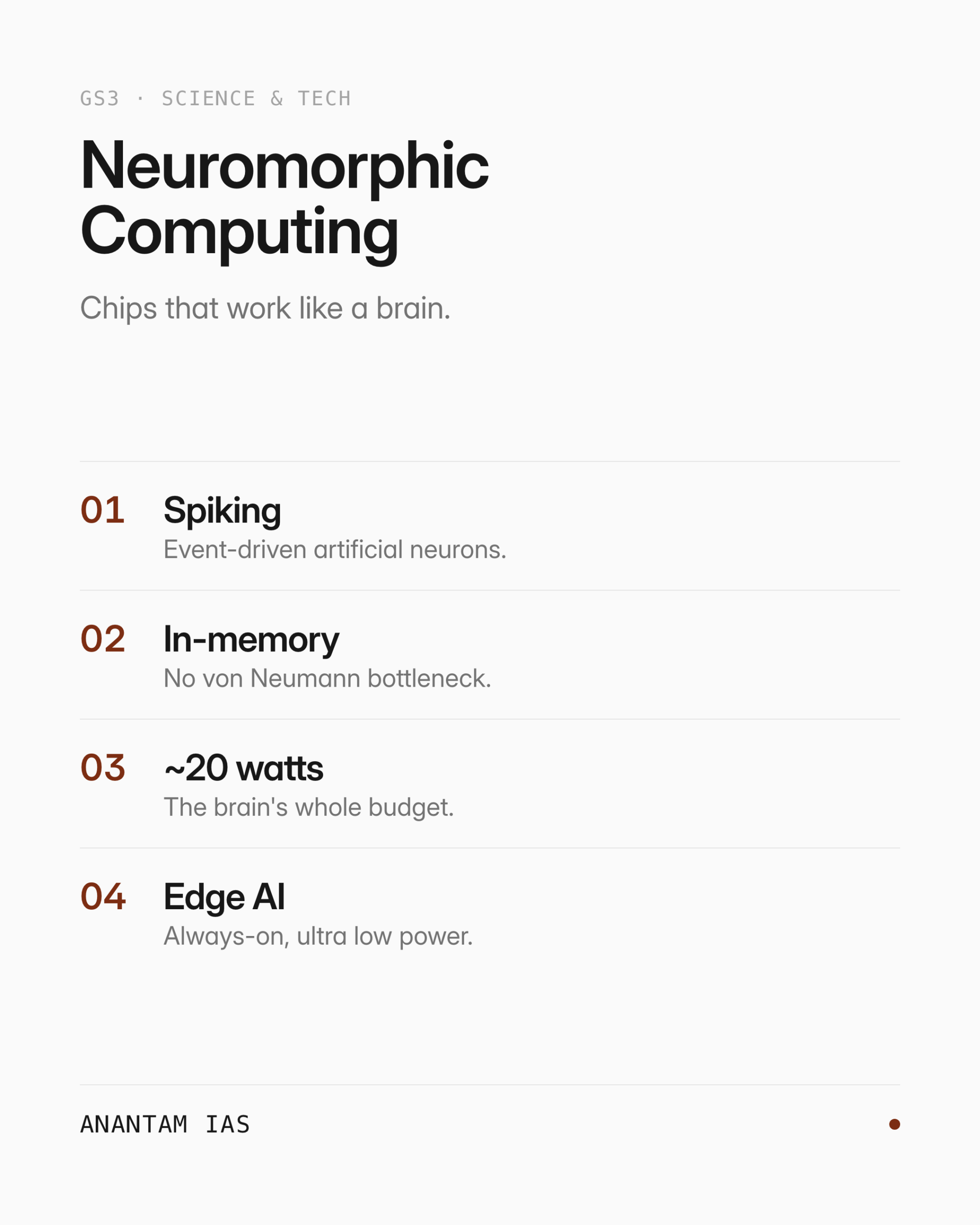
Open with the problem, not the gadget — the brain runs on about 20 watts while AI’s power demand is soaring, and that gap is the reason this field exists. Then move in a clean chain: the von Neumann bottleneck (separate CPU and memory waste energy moving data) → the neuromorphic fix (fuse memory and compute using artificial neurons and synapses) → how it works (spiking, event-driven, memristors) → who has built it (Loihi, NorthPole, SpiNNaker, Akida) → why it matters (edge AI, robotics, energy) → the India angle (the IISc memristor, the IITs, the semiconductor and AI missions) → an honest note on challenges. Close with a judgement. That arc — problem, fix, mechanism, examples, significance, India, limits — fits almost any question on the topic.
Common Mistakes to Avoid
Don’t describe neuromorphic chips as just “faster computers” — the point is a different architecture, not more speed. Don’t confuse them with quantum computers; the two are unrelated frontiers. Don’t claim they will replace ordinary CPUs — they are specialist accelerators that complement them. Don’t forget the software gap and the lack of benchmarks; an answer that only sells the upside reads as a brochure. And don’t drop the energy framing — the 20-watt brain versus power-hungry AI is the hook that makes the whole topic matter.
A Compact Answer Spine
The brain computes on ~20 W; AI burns megawatts → cause is the von Neumann bottleneck (separate CPU + memory; energy wasted moving data) → neuromorphic fix: artificial neurons + synapses fuse memory and compute (in-memory computing) → mechanism: spiking neural networks (event-driven, compute only on change) + memristors (store + compute the connection weight, non-volatile) → real chips: Intel Loihi 2 (~1M neurons, on-chip learning), IBM NorthPole (in-memory), SpiNNaker/BrainScaleS (brain emulation), BrainChip Akida (sub-watt edge) → uses: always-on edge AI, robotics, sensory processing → India: IISc molecular memristor (16,000+ states, Nature 2023, MeitY-backed scaling), IITs on device scaling, tied to the Semiconductor and IndiaAI missions → challenges: immature software, no benchmarks, scaling, specialist not universal → verdict: a promising structural answer to AI’s energy problem and a genuine chance for Indian leadership.
Diagram or Flowchart Idea
Draw two side-by-side boxes. On the left, the von Neumann machine: a “CPU” box and a “Memory” box with a thin arrow between them labelled “bottleneck — data shuttles back and forth.” On the right, the neuromorphic design: a grid of dots labelled “neurons + synapses (memory + compute together)” with spike pulses between them. A small caption — “~20 W brain vs megawatt AI” — ties it to the energy point. This single contrast communicates the whole concept faster than a paragraph.
A Balanced-Conclusion Line
A line that lands the marks: “Neuromorphic computing will not replace the conventional computer, but by building intelligence the way nature does — in spikes, in-memory, and on a few watts — it offers a rare structural answer to AI’s energy problem, and India’s memristor research gives it a credible seat at this frontier rather than a place in the queue.”
How to Use Data Without Cramming
You need only a handful of anchors, not a datasheet: the brain at ~20 watts (the hook), Intel Loihi 2 at about a million neurons and 120 million synapses, IBM NorthPole as the in-memory example, and IISc’s molecular memristor storing 16,000-plus states (Nature, 2023). Attribute them plainly — “as IBM reported,” “in work published in Nature by an IISc team” — rather than scattering numbers loosely. Four well-placed facts make the answer authoritative; a flood of them makes it noise.
Frequently Asked Questions
What is neuromorphic computing in simple terms?
It is the design of computer chips that work the way the brain works. Instead of a separate processor and memory, a neuromorphic chip is built from artificial neurons and synapses that store and process information in the same place, and it communicates in short electrical pulses called spikes, computing only when something happens. The aim is to do AI-style pattern recognition at a tiny fraction of the energy a conventional chip uses.
How is it different from a normal computer and from quantum computing?
A normal computer uses the von Neumann design — a CPU and a separate memory, with data shuttling between them, which wastes time and energy (the “von Neumann bottleneck”). Neuromorphic chips fuse memory and compute to escape that. They are not the same as quantum computers, which use quantum physics (qubits) for an entirely different class of problems. Neuromorphic computing is about energy-efficient, brain-like processing; quantum computing is about solving certain problems classical machines find intractable.
What is a memristor and why does it matter?
A memristor, or “memory resistor,” is a tiny device whose electrical resistance changes with the current that has passed through it, and which keeps that value even when switched off. That makes it an excellent artificial synapse — it stores a connection’s strength and computes with it in one place, without constant power. Dense grids of memristors can perform AI’s core mathematics directly inside memory, which is why they are central to neuromorphic hardware. An IISc team’s molecular memristor, storing over 16,000 states, is a notable Indian contribution.
Where does India stand in neuromorphic computing?
India has genuine strength in the underlying science. A team at the Indian Institute of Science in Bengaluru built a molecular memristor capable of more than 16,000 distinct states, published in Nature in 2023, and is scaling it toward an energy-efficient edge-AI system-on-chip with Ministry of Electronics and Information Technology support. Groups at IIT Bombay, IIT Delhi and IIT Madras work on related device physics. This research dovetails with the India Semiconductor Mission and the IndiaAI Mission, giving India a credible chance to lead rather than follow on this frontier.
Practice Questions
Prelims MCQs
- With reference to neuromorphic computing, consider the following statements:
1. It separates the processor and memory more strictly than conventional computers to improve speed.
2. It is inspired by the structure of the brain, using artificial neurons and synapses.
Which of the statements is/are correct?
(a) 1 only
(b) 2 only
(c) Both 1 and 2
(d) Neither 1 nor 2
Answer: (b) Neuromorphic computing fuses memory and compute (the opposite of stricter separation) and is modelled on the brain’s neurons and synapses. - The “von Neumann bottleneck” in conventional computing refers to which of the following?
(a) The limit on how small transistors can be made
(b) The energy and delay caused by data moving between a separate processor and memory
(c) The heat generated by quantum processors
(d) The maximum number of qubits a chip can hold
Answer: (b) It is the choke point created by shuttling data back and forth between the separated CPU and memory. - A “spiking neural network,” as used in neuromorphic systems, is best described as one that
(a) processes every data point continuously on a fixed clock cycle
(b) carries information through discrete pulses, computing only when neurons fire
(c) relies entirely on quantum entanglement
(d) stores data only in the cloud
Answer: (b) Spiking neural networks are event-driven, transmitting information in spikes and computing only when input crosses a threshold. - A memristor is most accurately described as a device that
(a) generates electricity from heat
(b) changes and retains its electrical resistance based on past current flow
(c) cools processors without liquid
(d) converts light into spikes
Answer: (b) A memristor (“memory resistor”) changes resistance with current history and remembers it without power, making it a strong artificial synapse. - Consider the following neuromorphic or brain-inspired computing platforms:
1. Intel Loihi 2. IBM NorthPole 3. SpiNNaker. Which of these are associated with neuromorphic or brain-inspired computing?
(a) 1 and 2 only
(b) 2 and 3 only
(c) 1 and 3 only
(d) 1, 2 and 3
Answer: (d) Intel Loihi, IBM NorthPole and SpiNNaker are all neuromorphic or brain-inspired computing platforms.
Mains Practice Questions
- Explain the concept of neuromorphic computing and discuss how it differs from the conventional von Neumann architecture. Why is this difference significant for the future of energy-efficient artificial intelligence? (15 marks, 250 words)
- “The future of computing may be less about making chips faster and more about making them work like the brain.” Critically examine this statement in the context of neuromorphic computing and its applications. (15 marks, 250 words)
- Discuss the role of memristors and spiking neural networks in brain-inspired computing. How do they help overcome the limitations of traditional computer architecture? (10 marks, 150 words)
- Assess India’s position in neuromorphic computing research, with reference to recent work at the Indian Institute of Science and the IITs, and explain how it connects to India’s broader semiconductor and AI ambitions. (15 marks, 250 words)
- Energy consumption is emerging as a major constraint on the growth of artificial intelligence. Examine how neuromorphic computing and edge AI could address this challenge, and outline the obstacles that remain. (15 marks, 250 words)
Tell Google you want more of this.
Add Anantam IAS as a preferred sourceOne tap, and this site shows up more often in your own Top Stories, AI Overviews and AI Mode. Remove it any time.