A Brain-Computer Interface, abbreviated BCI, is a system that lets the brain communicate directly with an external device, bypassing the muscles and peripheral nerves that normally carry out the brain’s commands. A paralysed person can move a robotic arm by thinking. A locked-in patient can spell words on a screen. A blind person, in a research demonstration, can perceive a crude pattern of light directly stimulated into the visual cortex. The brain talks to the computer; the computer talks back to the brain. Sometimes both at once.
For most of the field’s history, BCIs were an academic curiosity. The first paper describing electrical activity recorded from a human scalp came from Hans Berger in 1929. The first BCI to give a paralysed patient cursor control on a screen came in the early 2000s, from the BrainGate consortium at Brown University. The technology stayed niche, expensive, and slow until the late 2010s, when investment from companies like Neuralink, Synchron, Paradromics, and Blackrock Neurotech accelerated the engineering side. The first FDA-approved human implant of Neuralink’s Telepathy device went in during 2024. India’s first Brain-Computer Interface clinical demonstration at IIT Madras and NIMHANS dates from 2023.
For UPSC GS-III, BCIs sit at a fast-moving intersection of biotechnology, neuroscience, AI, ethics, and disability policy. The technology has crossed from research laboratory to early-stage clinical product within the last few years, and the regulatory and ethical frameworks are catching up in real time. This article walks through what a BCI is, the three architectural classes, the major global and Indian projects, the medical applications, the looming consumer applications, the ethics framework, and the regulatory questions India is starting to grapple with.
Quick Facts on Brain-Computer Interfaces
A BCI is a system that records neural activity, decodes it using algorithms, and uses the decoded signal to control an external device. The reverse direction, where the system writes information back into the brain by stimulating neurons, is also part of the BCI definition and is often what distinguishes a full BCI from a passive read-only neural interface.
The terms BCI, BMI (Brain-Machine Interface), and neural interface are largely interchangeable. Some literature uses BCI for systems where the device is a computer screen or cursor and BMI for systems that drive a physical machine like a robotic arm, but the distinction is not consistent. Neural interface is sometimes used as a broader umbrella term that includes peripheral nerve stimulators and deep brain stimulators alongside cortical BCIs.
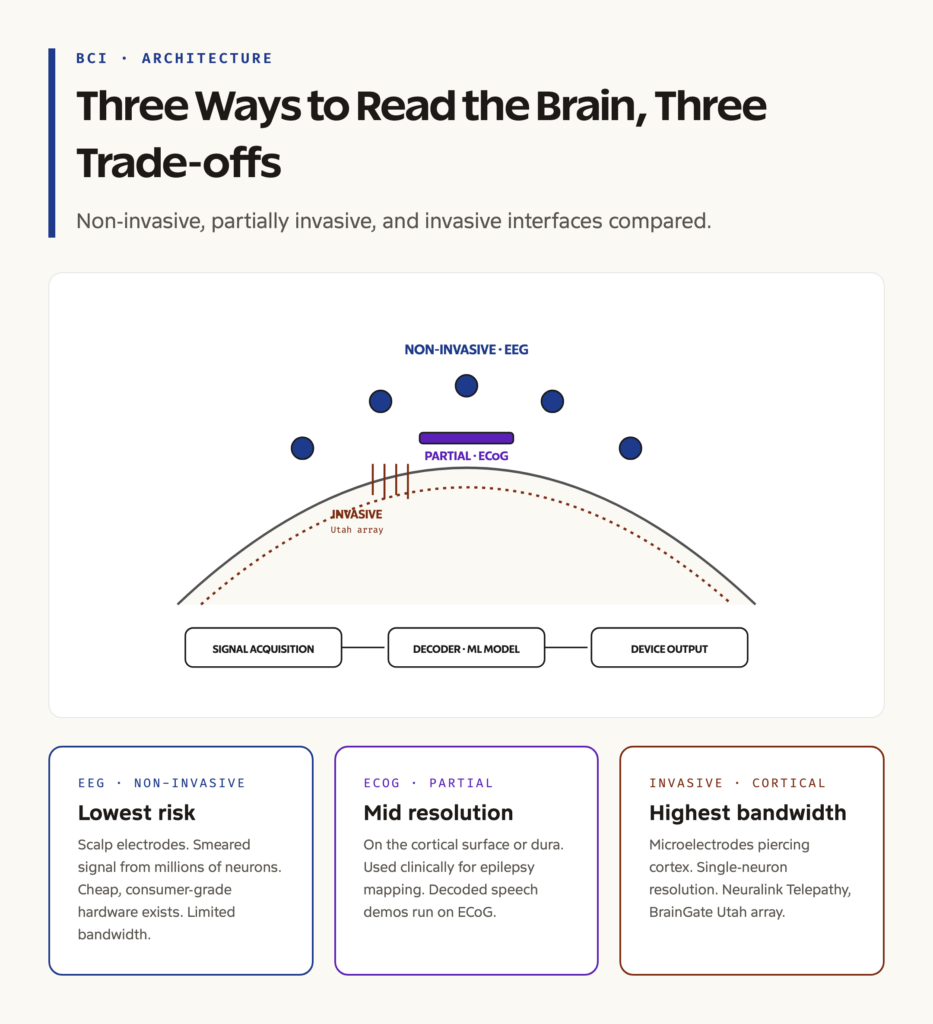
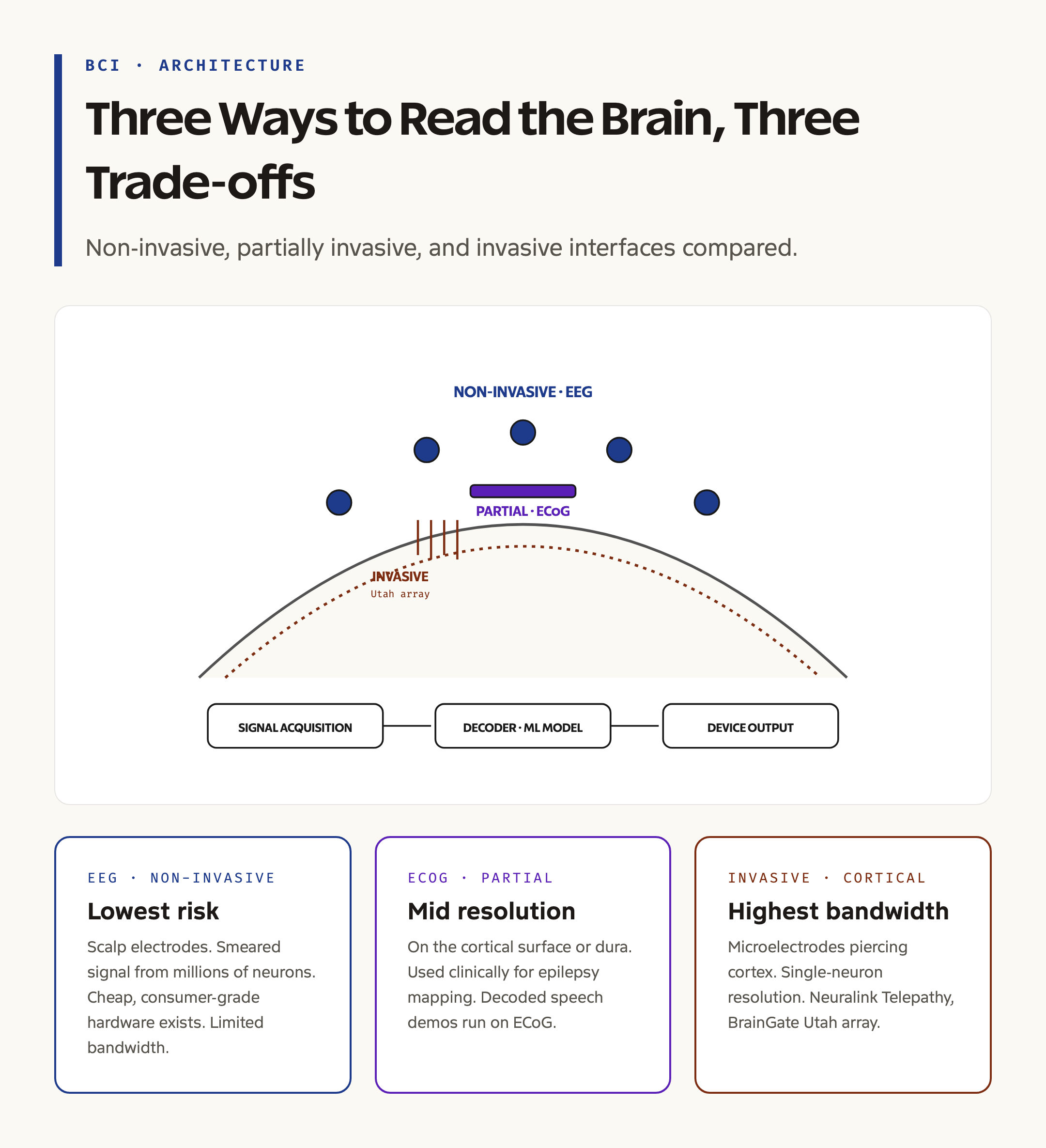
The three architectural classes are non-invasive, invasive, and partially invasive. Non-invasive BCIs sit outside the skull and read scalp electrical signals, typically EEG. Invasive BCIs are implanted inside the brain itself, with electrode arrays in or near the cortex. Partially invasive BCIs sit on the surface of the brain or on the dura mater but do not penetrate cortical tissue, with ECoG (electrocorticography) being the most common technique. Each class trades off signal resolution against surgical risk.
Non-Invasive BCIs: EEG and Beyond
Electroencephalography, abbreviated EEG, is the oldest and most accessible BCI modality. Electrodes placed on the scalp pick up the summed electrical activity of millions of neurons in the underlying cortex. The signal is fuzzy compared to direct cortical recording, but the technique is non-invasive, low-cost, and available at clinical and consumer-grade scales.
EEG-based BCIs can decode a few categories of intent: yes-or-no responses, attention to one of several stimuli, and slow cursor movements. Consumer-grade EEG headsets from Emotiv, OpenBCI, and Neurosity have brought entry-level BCI hardware to under a thousand US dollars. Clinical EEG-BCI systems, used for patients with locked-in syndrome and amyotrophic lateral sclerosis, allow simple communication at speeds of a few characters per minute.
Functional near-infrared spectroscopy (fNIRS), magnetoencephalography (MEG), and functional magnetic resonance imaging (fMRI) are alternative non-invasive modalities. fNIRS is portable and uses light absorption changes in the cortex to infer activity. MEG and fMRI offer better localisation but require expensive, room-sized equipment that limits their BCI use to research settings.
The ceiling for non-invasive BCIs is the bandwidth of the signal. Scalp electrical activity smears the contributions of millions of neurons together. To decode complex intents like specific speech sounds or finely controlled limb movement, the signal-to-noise ratio is too low.
Invasive BCIs: Neuralink, BrainGate, and Utah Arrays
Invasive BCIs penetrate the skull and place electrodes directly into the cortical tissue. Each electrode tip records the action potentials of a small number of nearby neurons. With enough electrodes, the system can decode complex intent at high resolution and high speed.
The Utah Array, developed at the University of Utah in the 1990s, is a 100-electrode silicon-based microelectrode array that pierces the cortex to a depth of about 1.5 millimetres. It is the workhorse of academic invasive BCI research. The BrainGate consortium, anchored at Brown University, has used Utah arrays in human subjects since 2004, demonstrating cursor control, robotic arm control, communication speeds approaching natural typing speeds, and recently, decoded internal speech.
Neuralink, founded by Elon Musk in 2016, builds a higher-density flexible-thread electrode array implanted by a robotic surgical system. The 2024 implant in a paralysed human subject, Noland Arbaugh, was the first FDA-approved Neuralink human trial. By 2026, Neuralink has implanted multiple subjects and reports cursor control speeds and accuracy comparable to or better than BrainGate’s Utah array results. Synchron, a competitor, places electrodes inside a blood vessel that runs over the motor cortex, avoiding open-brain surgery, and has run human trials in the US and Australia.
The trade-off is risk. Open-brain surgery carries infection, bleeding, and seizure risks. Implanted electrodes scar the surrounding tissue over time, gradually degrading the signal. The body’s foreign-body response to implanted electrodes is one of the central engineering challenges in invasive BCI design, and the move to flexible polymer-coated threads, ultrathin biocompatible electrodes, and biodegradable materials is the current direction of research.
Partially Invasive BCIs: ECoG and Surface Arrays
Electrocorticography, abbreviated ECoG, places electrodes on the surface of the brain or on the dura mater rather than penetrating into cortical tissue. The signal resolution is intermediate between EEG and intracortical recordings, and the surgical risk is lower than for full invasive systems because the electrodes do not pierce neurons.
ECoG is widely used clinically for epilepsy monitoring, where surgeons need to identify the cortical region generating seizures before resecting it. The same patients have, with consent, participated in BCI research, allowing decoded speech, motor commands, and even reconstructed mental imagery from short ECoG recordings. The 2023 demonstration at the University of California San Francisco, where a paralysed woman’s attempted speech was decoded into a synthetic voice and animated avatar in near-real time, used ECoG arrays.
The strategic appeal of ECoG is that it offers most of the bandwidth of intracortical BCIs without the long-term risks of penetrating electrodes. The trade-off is that the surgery is still significant, requiring a craniotomy, and the spatial resolution is coarser than what intracortical electrodes provide.
Medical Applications
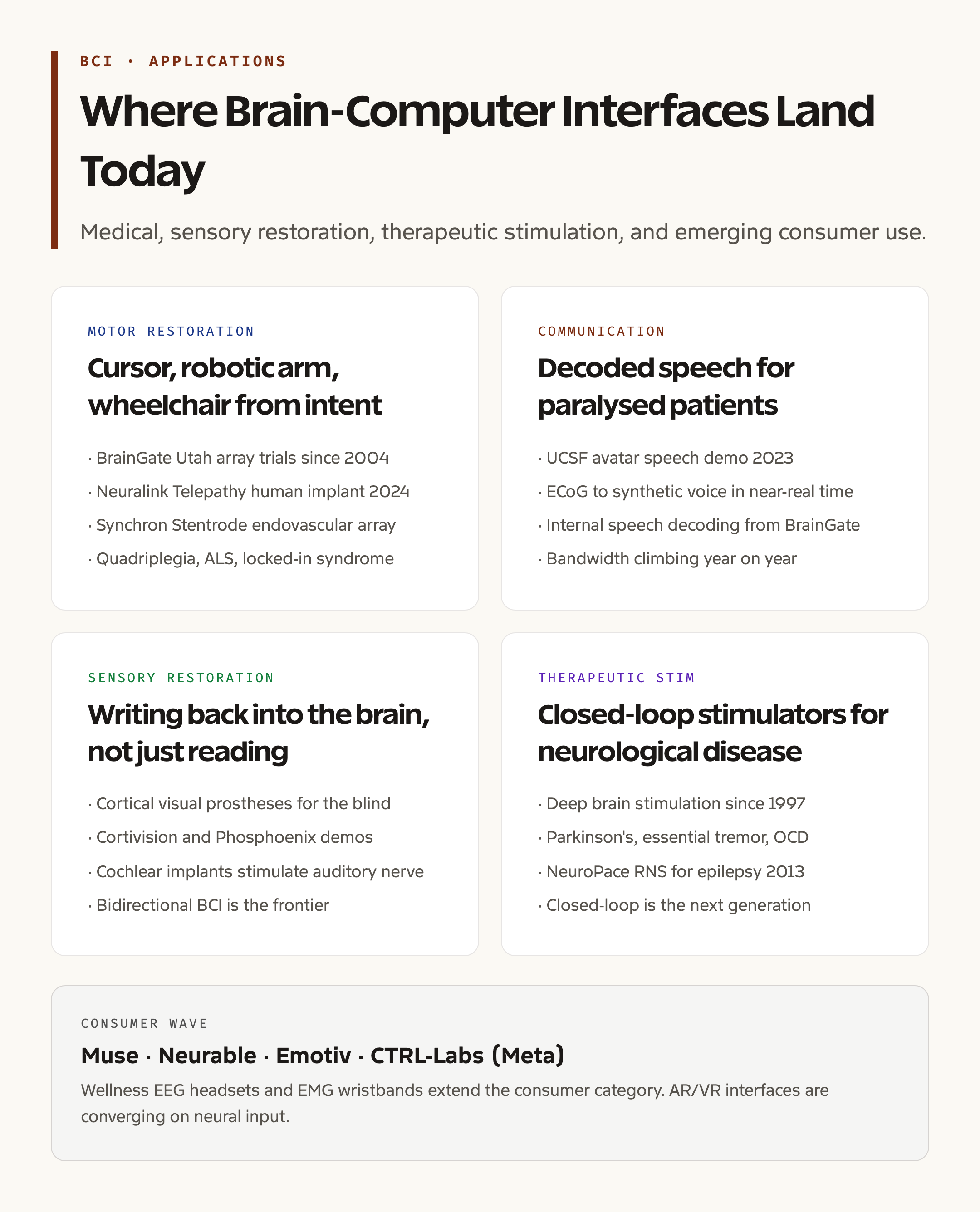
The first wave of BCI clinical applications centred on motor restoration. Quadriplegic and locked-in patients have been able to control a cursor on a screen, type messages, drive a powered wheelchair, and operate a robotic arm using BCI signals. The BrainGate trials, the Synchron Stentrode trials, and the Neuralink Telepathy trials all target this population in their initial indications.
A second area is communication restoration. Patients with severe motor impairment but intact cognition can use BCI-decoded speech intent to drive a synthetic voice. The 2023 UCSF demonstration mentioned above is one example. The bandwidth of decoded speech has grown rapidly, from a few words per minute in the early 2010s to dozens of words per minute in the latest experiments.
Sensory restoration is the writing-back direction. Cochlear implants are not usually classed as BCIs because they stimulate the auditory nerve rather than the cortex, but cortical visual prostheses that stimulate the visual cortex directly are an active area of research. The Spanish company Cortivision and the Dutch start-up Phosphoenix have demonstrated rudimentary visual percepts in blind subjects.
Therapeutic stimulation has its own established class of devices. Deep brain stimulators, FDA-approved since 1997, treat Parkinson’s disease, essential tremor, and obsessive-compulsive disorder. Closed-loop stimulators, which read cortical activity and stimulate only when needed, are the next generation. Neuropace’s RNS device, approved in 2013, is a closed-loop implant for medication-resistant epilepsy and is the closest thing to a fully bidirectional BCI in routine clinical use.
Consumer and Cognitive Applications
Beyond medicine, BCIs are starting to appear in consumer wellness, gaming, and accessibility products. Consumer EEG headsets are sold for meditation feedback, focus training, and sleep tracking. Companies like Muse, Neurable, and Emotiv have built businesses on this segment, though clinical claims for cognitive enhancement remain weak.
The augmented-reality interface category is the longer-term consumer prize. Apple Vision Pro and Meta Quest already use eye and hand tracking, but full neural input that lets a user control an interface by intention rather than gesture is the obvious next step. CTRL-Labs, acquired by Meta in 2019, builds a wrist-worn EMG (electromyographic) device that picks up the motor signals to the hand muscles before the muscles act, allowing finger-level interface control. Strictly this is a peripheral nerve interface rather than a BCI, but the consumer category is converging.
Cognitive enhancement, including memory augmentation and learning acceleration, is the most speculative end of the field. DARPA’s Restoring Active Memory programme demonstrated memory augmentation using closed-loop hippocampal stimulation in 2018. Whether this scales to broad consumer use is unclear, and the ethical concerns around modifying memory are substantial.
India’s BCI Research Stack
India’s BCI research is concentrated at a handful of institutions. IIT Madras’s Centre for Computational Brain Research and the Department of Applied Mechanics have worked on EEG-based and ECoG-based BCIs since the early 2010s. NIMHANS Bengaluru runs clinical neurological research and has partnered with IIT Madras on BCI applications for paralysis and epilepsy. The Indian Institute of Science Bengaluru runs research on neural decoding and brain-machine interfaces in primates. AIIMS Delhi has a small neural engineering programme. IIT Bombay and IIT Kharagpur have EEG-BCI research groups.
The first publicly reported Indian BCI clinical demonstration was at IIT Madras and NIMHANS in 2023, using an EEG-based system to enable a paralysed patient to operate a cursor and communicate via a screen interface. India does not yet have a domestically developed invasive BCI in human trials. The Department of Science and Technology and the Department of Biotechnology have funded BCI research grants, and the Bio-E3 Policy of 2024 names neurotechnology as one of the priority areas, but a flagship national BCI mission has not yet been launched.
The Indian regulatory framework for BCIs is the same as for other implantable medical devices, regulated under the Medical Devices Rules 2017 and the New Drugs and Clinical Trials Rules 2019, both administered by CDSCO. There is no BCI-specific regulation, and questions of neural data privacy, informed consent for cognitive monitoring, and equitable access have not yet been addressed in Indian law.
Ethics: The Neurorights Framework
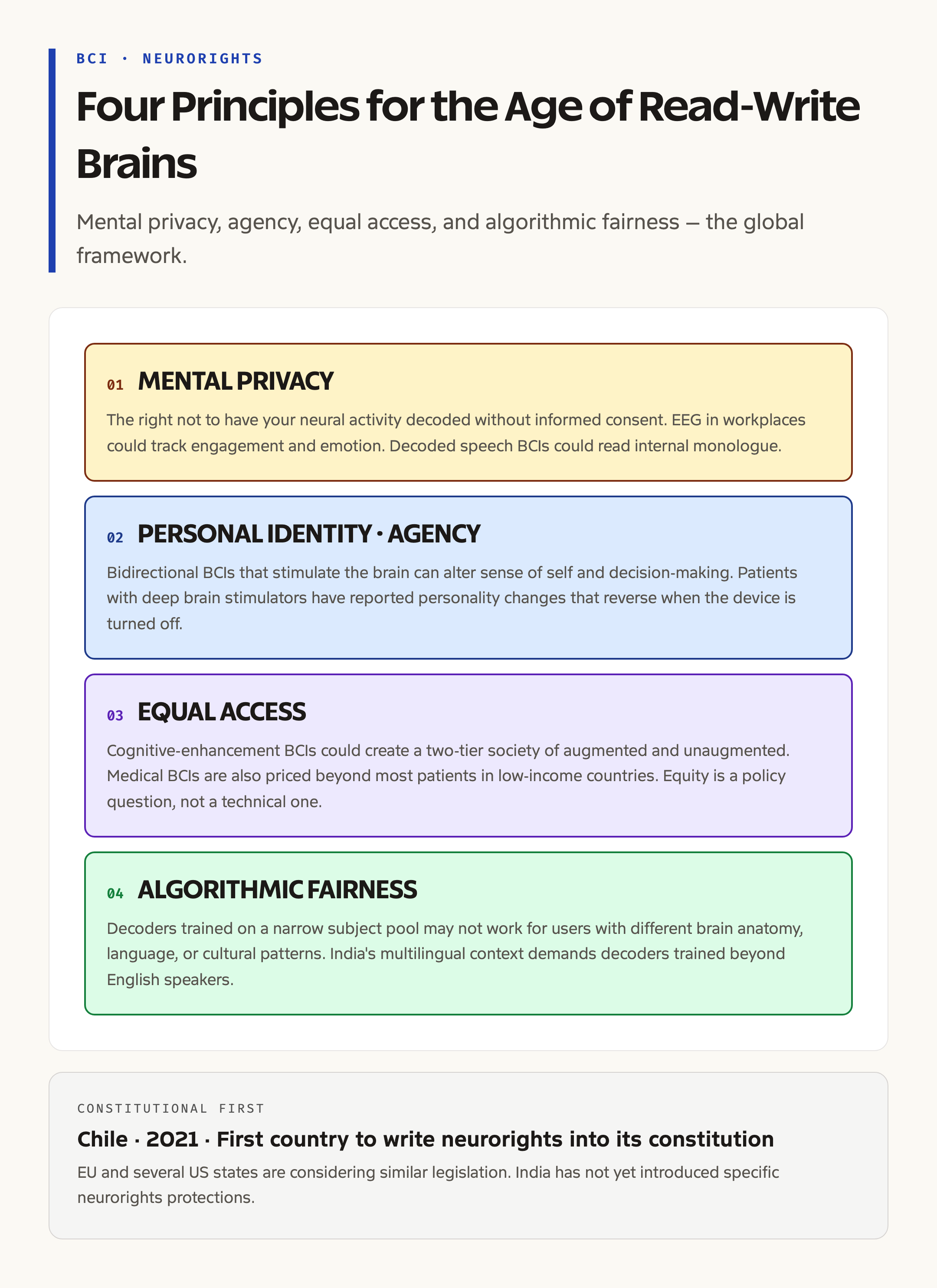
The ethical issues raised by BCIs are not new in kind but are sharper in degree. Four principles have emerged in international discussions, most notably in the 2017 paper by Rafael Yuste’s Columbia group and the subsequent NeuroRights Initiative, and they are now folded into international policy debates.
Mental privacy is the right not to have one’s neural activity decoded without consent. EEG headsets in workplace or educational settings could in principle track engagement, fatigue, and emotional state. Decoded speech BCIs could in principle read internal monologue. The line between voluntary and involuntary disclosure of mental state matters more when the disclosure is automatic.
Personal identity and agency cover the concern that bidirectional BCIs, particularly those that stimulate the brain, could alter the subject’s sense of self or their experience of their own decisions. Patients with deep brain stimulators have reported personality changes that are reversed when the stimulator is turned off, raising questions about who is making the decision when the device is on.
Equal access addresses the risk that cognitive-enhancement BCIs, if effective, would create a two-tier society of the augmented and the unaugmented. The same concern applies to medical access, where high-cost BCIs may be available only to wealthy patients in wealthy countries, leaving others with severe disabilities without comparable options.
Algorithmic fairness covers the bias built into the decoding models. A speech-decoding BCI trained on a small number of subjects may not work well for users with different brain anatomy, language, or cultural patterns of thought. India, with its multilingual population, would have particular interest in seeing decoders trained across linguistic diversity rather than only on English speakers.
Chile became the first country to write neurorights into its constitution in 2021. The European Union and several US states are considering similar legislation. India has not yet introduced specific neurorights protections.
What to Watch Going Forward
Three trends will shape the BCI field through the rest of the decade. The first is the scale-up of invasive BCI clinical trials. Neuralink, Synchron, Paradromics, and Precision Neuroscience are all running concurrent human trials, and the cumulative evidence base will grow rapidly. The second is the convergence with foundation AI models. Decoders trained on transformer architectures and self-supervised learning are extracting more from less neural data than the older shallow networks managed, and the bandwidth of BCI communication is climbing fast. The third is the regulatory and ethical response. The 2026 World Health Organization technical guidance on neurotechnology, expected mid-decade, will set a global baseline that India will have to position against.
For UPSC, the testable elements are the three architectural classes (non-invasive, invasive, partially invasive), the major global projects (Neuralink, BrainGate, Synchron, Neuropace), the Indian institutions (IIT Madras, NIMHANS, IISc), and the four neurorights principles (mental privacy, agency, equal access, algorithmic fairness). Connections to broader policy are also relevant, for example through India’s stem cells and gene therapy ecosystem, both of which intersect with neural engineering through cell-replacement and genetic-based neural therapies.
Frequently Asked Questions
What is a Brain-Computer Interface in simple terms?
A BCI is a system that records electrical activity from the brain, decodes the patterns using algorithms, and uses the decoded signal to control an external device or to write information back into the brain. A paralysed person using a BCI can control a cursor or robotic arm by thinking, without using their muscles.
What is the difference between invasive, non-invasive, and partially invasive BCIs?
Non-invasive BCIs sit outside the skull and use scalp electrodes (EEG) or other surface methods. Invasive BCIs are implanted into the cortical tissue itself, with electrode arrays inside the brain. Partially invasive BCIs sit on the surface of the brain or on the dura, using techniques like ECoG. Invasive BCIs have the highest signal resolution and the highest surgical risk; non-invasive BCIs are the safest and the lowest resolution.
What is Neuralink?
Neuralink is a US company founded in 2016 that builds a high-density flexible-thread brain implant. The 2024 FDA-approved human trial implanted the Telepathy device in a paralysed subject, who used it to control a cursor on a screen. By 2026 multiple subjects have been implanted with the device.
Where does India stand in BCI research?
India’s BCI research is concentrated at IIT Madras, NIMHANS, IISc Bengaluru, AIIMS Delhi, and a handful of other IITs. The first publicly reported Indian BCI clinical demonstration was at IIT Madras and NIMHANS in 2023, using an EEG-based system. India does not yet have a domestically developed invasive BCI in human trials.
What are neurorights?
Neurorights are the proposed legal protections for mental privacy, personal identity and agency, equal access to neurotechnology, and algorithmic fairness in neural decoding. Chile became the first country to write neurorights into its constitution in 2021. The framework was articulated by Rafael Yuste’s group at Columbia University and is now part of global policy debates on neurotechnology regulation.
Tell Google you want more of this.
Add Anantam IAS as a preferred sourceOne tap, and this site shows up more often in your own Top Stories, AI Overviews and AI Mode. Remove it any time.