Why in News?
A study published in The Lancet Public Health has estimated country-specific levels of antibiotic need using the WHO AWaRe framework. For India, it identifies a mismatch between the amount and mix of antibiotics used: overall consumption and Watch use exceed the modelled requirement, while Access and Reserve use falls below it.
The finding matters because antimicrobial resistance (AMR) isn’t only a problem of excessive consumption. Patients can face inappropriate exposure to broad-spectrum drugs at one end and inadequate access to the correct first-line or last-resort treatment at the other. Sound policy must address both errors together.
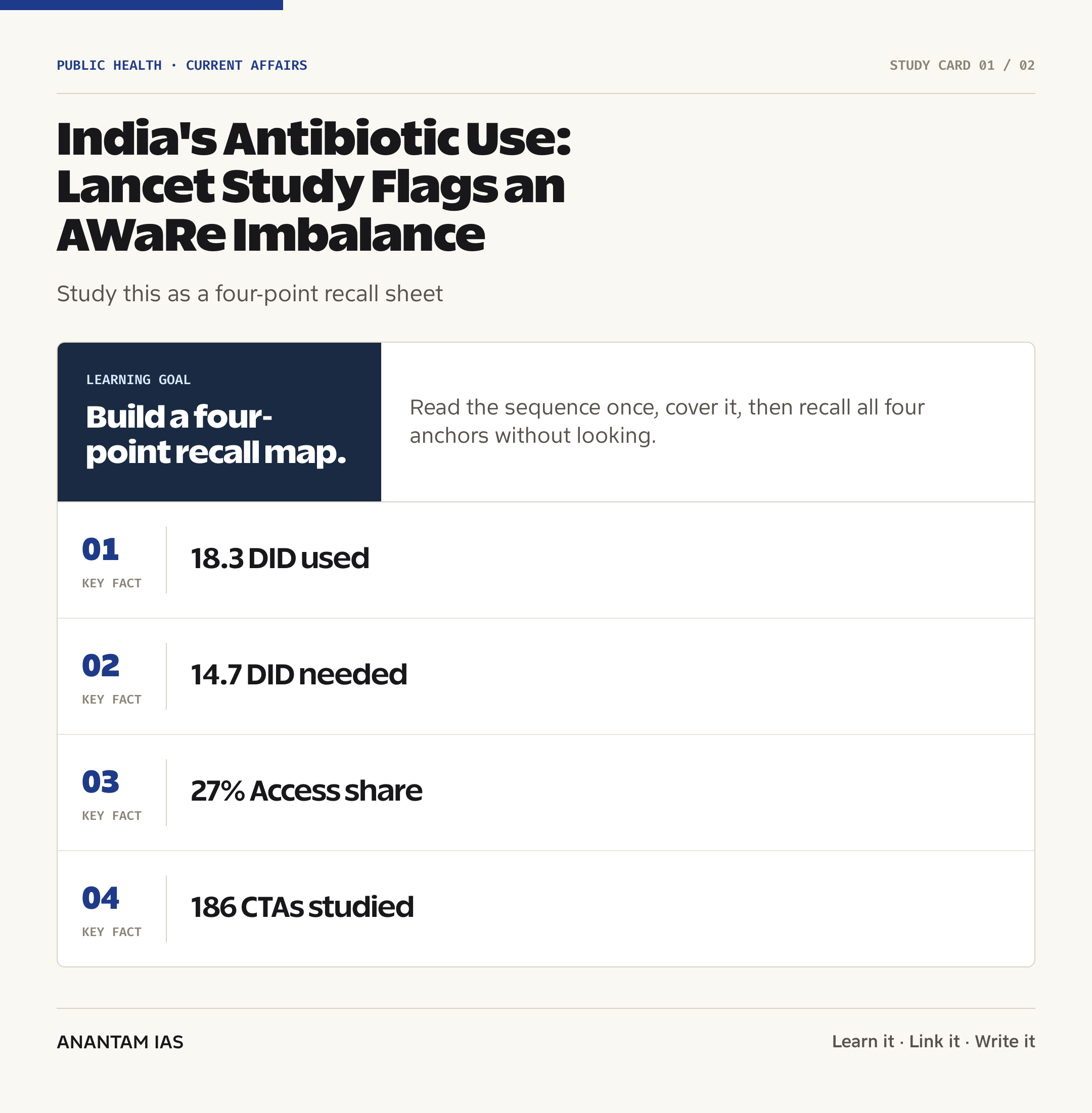
- India’s estimated optimal total was 14.7 defined daily doses per 1,000 inhabitants per day, compared with reported actual use of 18.3.
- Estimated optimal Access use was 7.8 DID, while actual use was 4.5 DID.
- Estimated optimal Watch use was 6.0 DID, while actual use was 9.3 DID.
- Estimated optimal Reserve use was 0.99 DID, while actual use was 0.19 DID.
- Only 27% of India’s reported antibiotic use came from the Access group, against a modelled requirement of 52.3%.
The development matters in the context of:
- The study reframes antibiotic stewardship as choosing the right drug, dose and duration, not merely cutting aggregate use.
- India’s high infectious-disease and resistance burden can create a legitimate need for some Watch and Reserve antibiotics, so blunt volume caps may harm access.
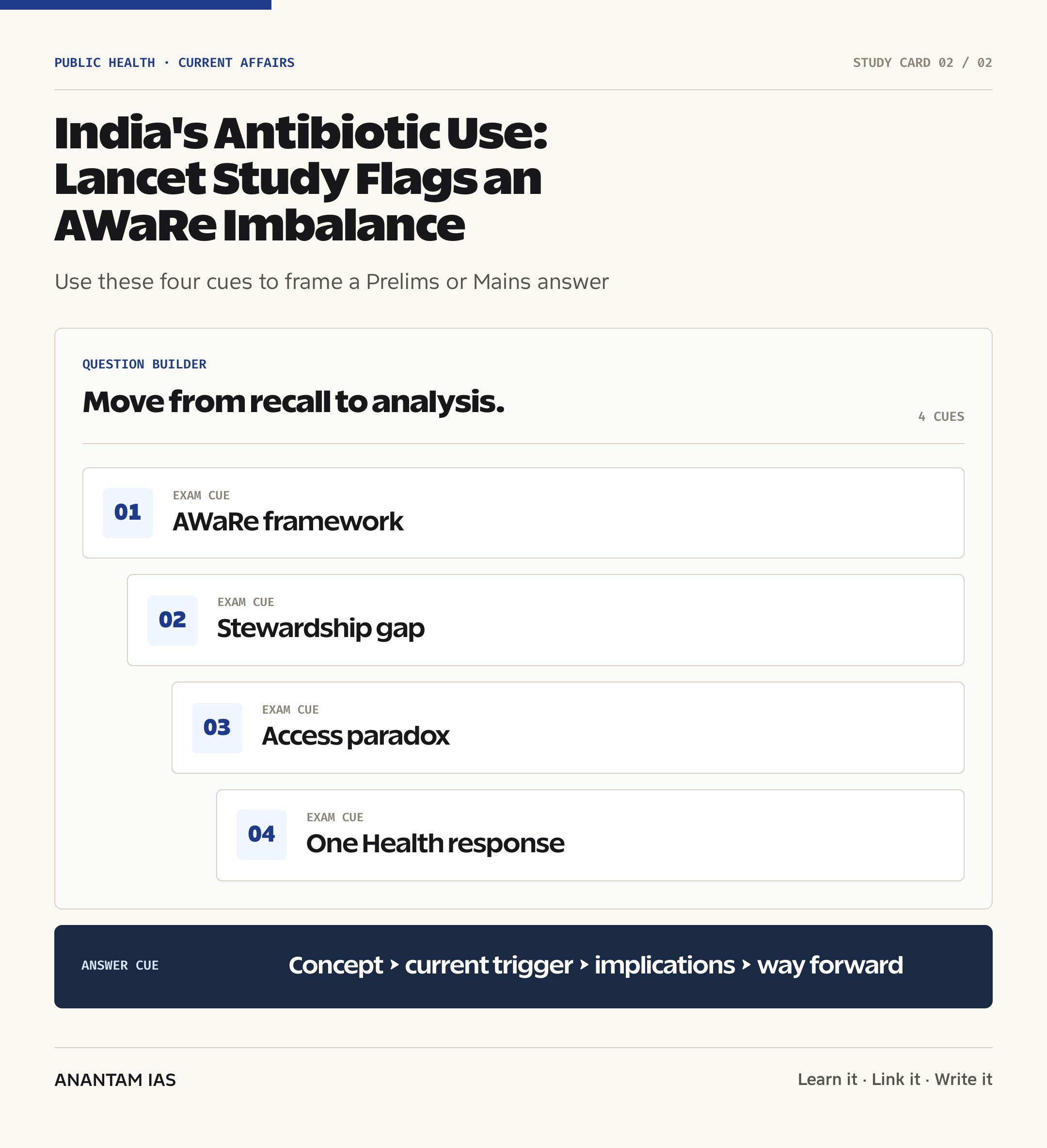
- The findings connect public health, medicine regulation, diagnostics, hospital governance and the One Health approach.
UPSC Relevance
Prelims Relevance
- The AWaRe classification was introduced by WHO in 2017 and is updated through its essential-medicines process.
- Access antibiotics are generally preferred first- or second-choice treatments for common bacterial infections and have lower resistance potential than Watch drugs.
- Watch antibiotics have higher resistance potential and should be priority targets for stewardship and monitoring.
- Reserve antibiotics are last-resort options for confirmed or suspected multidrug-resistant infections; they must remain accessible under tight controls.
- A defined daily dose (DDD) is WHO’s standard technical unit for drug-consumption measurement; it isn’t an individual patient’s prescribed dose.
- DID expresses defined daily doses per 1,000 inhabitants per day and permits population-level comparison.
- The UN General Assembly’s 2030 target calls for at least 70% of global human antibiotic consumption to come from the Access group.
- The Global Antimicrobial Resistance and Use Surveillance System (GLASS) supports standardized reporting of resistance and antimicrobial use.
- India’s NAP-AMR 2.0 covers 2025-29 and uses a One Health, multi-sector response.
Mains Relevance
GS Paper 2
- Public-health governance challenges in aligning prescribing, diagnostics, drug access and hospital stewardship with evidence-based treatment guidelines.
- The state’s role in securing equitable access to effective antibiotics while regulating irrational prescriptions, non-prescription sales and poor-quality medicines.
GS Paper 3
- AMR as a One Health risk linking human medicine, livestock, aquaculture, food systems, pharmaceutical effluent and environmental transmission.
- Use of surveillance, microbiology, rapid diagnostics and digital prescribing data to conserve the effectiveness of existing antibiotics.
Essay
- The right to health requires both restraint against unnecessary medicine and reliable access to essential medicine.
- A common resource can be exhausted through individually rational choices: antibiotic effectiveness as a form of shared biological infrastructure.
Background and Context
What the Lancet study measured
The study developed the first global framework for estimating an appropriate AWaRe mix from health need rather than treating low consumption or high consumption as inherently good or bad.
- Researchers covered 186 countries, territories and areas, representing about 99.8% of the world’s population, and modelled need for the 2019 reference year.
- Countries were grouped by comparable infection burden, resistance patterns, health-care access and socioeconomic conditions.
- Within each peer group, places combining relatively low antibiotic use with low infection-related mortality helped form a benchmark frontier.
- The model estimated Watch need from infections for which WHO guidance recommends Watch drugs, and Reserve need from resistance burdens that make last-resort treatment relevant.
- Access need was estimated as the residual requirement after accounting for Watch and Reserve need. This produces a policy benchmark, not a prescription for an individual patient.
- Across all 186 settings, the study estimated about 43 billion antibiotic treatment days were needed in 2019. About 77% of optimal global use would be Access drugs, close to the UN target.
- Among settings with observed-use data, 72% used more antibiotics overall than their estimated optimum and 99% used more Watch antibiotics. At the same time, 42% used fewer Access and 52% fewer Reserve drugs than estimated, showing why excess and scarcity must be measured together.
Reading India's numbers correctly
India’s totals show a compositional problem: patients may be exposed to the wrong class even where genuine infection-related need remains high.
- At 18.3 DID, observed overall use was about 24% above the study’s modelled 14.7 DID requirement. The comparison signals potential excess but doesn’t prove that every prescription above the benchmark was inappropriate.
- Observed Watch use of 9.3 DID was around 55% above the estimated 6.0 DID need. Common Watch agents in India include ceftriaxone, azithromycin, ciprofloxacin and piperacillin-tazobactam.
- Observed Access use of 4.5 DID was about 42% below estimated need of 7.8 DID. This may reflect substitution of broad-spectrum treatment where a narrower first-line option would work, alongside access failures for some patients.
- Observed Reserve use of 0.19 DID was far below estimated need of 0.99 DID. Low Reserve use isn’t automatically success if patients with documented resistant infections cannot obtain the drug that can still work.
- The reported AWaRe components don’t sum to total use because actual consumption also includes antibiotics categorized as not recommended or not classified. That residual is itself a stewardship concern.
- India’s estimated optimal Access share was 52.3%, below the global 70% goal. The difference reflects country-specific disease and resistance needs, but India’s actual 27% share still falls well short of both reference points.
The AWaRe framework
The WHO AWaRe system translates stewardship into a practical hierarchy for procurement, prescribing and monitoring.
- Access drugs should be widely available, affordable and quality-assured because they cover many common infections with generally lower resistance-selection potential.
- Watch drugs remain clinically necessary for defined syndromes and resistance patterns, but their higher resistance potential makes them key targets for prior authorization, review and consumption audits.
- Reserve doesn’t mean unavailable. It means protected access for highly specific cases, backed by culture results or a strong suspicion of multidrug resistance and specialist oversight where feasible.
- WHO also identifies some antibiotic combinations as not recommended when evidence-based indications or high-quality guideline support are lacking.
- AWaRe classification describes stewardship priority, not an absolute ladder of drug strength. A Watch antibiotic can be the correct first choice for a particular infection under the AWaRe antibiotic book.
- The 2030 70% Access target is a population-level monitoring goal and shouldn’t replace diagnosis or local treatment guidelines.
What Indian hospital evidence shows
The global model is consistent with earlier Indian facility-level evidence of heavy empirical and broad-spectrum use.
- The NCDC multicentric point-prevalence survey for 2021-22 covered 20 tertiary hospitals across 15 states and two Union Territories.
- Nearly three in four hospitalized patients surveyed were receiving an antibiotic: 57% of prescriptions were Watch, 38% Access and 2% Reserve.
- Only 6% of prescriptions were based on microbiological evidence, indicating that most treatment began without culture confirmation.
- About 55% of prescriptions were for prophylaxis rather than treatment, opening room to tighten surgical prophylaxis duration and perioperative protocols.
- Duplicate coverage was recorded for gram-negative and anaerobic organisms, which can add toxicity and cost without improving outcomes when combinations aren’t clinically justified.
- Point-prevalence data offer a one-time facility snapshot and are not identical to national consumption estimates. Their value lies in revealing prescribing-process weaknesses that aggregate sales data cannot show.
- High use of injectable drugs also deserves review because route of administration affects staffing, infection risks and cost. The survey reported 86.5% of antibiotics were administered intravenously, while antibiotic exposure varied widely across hospitals, cautioning against a single national remedy for every facility.
Why misuse and poor access coexist
India’s antibiotic problem is shaped by fragmented care, uneven laboratory capacity and incentives across both public and private markets.
- Empirical prescribing is sometimes necessary before test results arrive, especially in sepsis, but weak diagnostic access can turn an emergency exception into routine broad-spectrum use.
- Non-prescription sale, patient demand, incomplete medical histories and pressure for a rapid cure can encourage antibiotic use for viral or self-limiting illness.
- Small hospitals may lack microbiologists, antibiograms and stewardship teams, while delayed referrals can push clinicians toward broader drugs as defensive treatment.
- At the same time, price, supply-chain gaps and registration constraints can keep some Reserve agents and diagnostics beyond the reach of patients who genuinely need them.
- Poor infection prevention, limited vaccination, unsafe water and sanitation, and health-care-associated infections increase the underlying demand for antibiotics.
- Use of medically important antimicrobials in animals and release of resistant organisms or active residues into the environment connect clinical stewardship to the wider AMR challenge.
Policy architecture and governance
India has moved from a general AMR strategy toward a newer implementation framework, but outcome measurement must reach prescriptions, laboratories and supply chains.
- The Union Health Ministry launched National Action Plan on AMR 2.0 for 2025-29, retaining a multi-sector One Health approach.
- Its implementation priorities include awareness and training, laboratory capacity, surveillance, infection control and optimized antimicrobial use.
- The NCDC National AMR Surveillance Network and ICMR’s surveillance and stewardship work can connect resistance profiles with prescribing decisions and national procurement.
- Hospitals need local antibiograms, which summarize susceptibility patterns of bacteria isolated in that facility, because resistance varies across places and patient populations.
- Regulation under prescription-only schedules must be paired with affordable clinical care. Enforcement without access may shift patients to informal or delayed treatment rather than produce rational use.
- The study’s benchmark can support national and state dashboards, but it should be triangulated with GLASS-compatible consumption data, cultures, outcomes and facility audits.
Limits of the benchmark
The estimates are a powerful planning tool, but they are modelled counterfactuals rather than direct clinical judgments on each prescription.
- The analysis uses a 2019 reference year; subsequent resistance trends, health-system shocks and changing guidelines can alter both need and actual consumption.
- Cross-country sales and consumption datasets differ in coverage of public, private, hospital and community sectors, which affects comparability.
- A defined daily dose is a standardized measurement unit and may differ from doses prescribed to children, patients with renal impairment or people with severe infections.
- Peer-group benchmarking assumes that countries with relatively low use and low infection mortality offer an attainable reference, but unmeasured differences can remain.
- National averages can hide unequal access: an urban hospital may overuse Watch drugs while a rural district lacks an effective Access antibiotic for the same syndrome.
- Policy should track clinical outcomes and resistance alongside volume. A lower DID isn’t a success if treatable bacterial infections go untreated or mortality rises.
Way Forward
Make diagnosis drive treatment
- Expand affordable culture and susceptibility testing, rapid diagnostics and sample-transport networks, with clear rules for de-escalating empirical therapy after results arrive.
- Use facility-specific antibiograms and standard treatment guidelines in prescribing software, order forms and pharmacy review.
Institutionalize stewardship
- Require major hospitals to maintain multidisciplinary antimicrobial stewardship programmes with audit, feedback, dose review and stop dates.
- Measure the Access share, Watch DID, Reserve appropriateness and not-recommended combinations without rewarding indiscriminate cuts.
Protect access and quality
- Align essential-medicines procurement with syndrome burden so Access drugs don’t stock out and protected Reserve medicines reach eligible patients quickly.
- Strengthen prescription-only enforcement, pharmacovigilance and quality testing while expanding affordable consultation so regulation doesn’t deepen treatment exclusion.
Reduce the need for antibiotics
- Invest in vaccination, WASH, infection prevention and control, hospital hygiene and safe food systems to prevent infections before antibiotics are needed.
- Implement One Health surveillance across humans, animals, food and the environment, including controls on pharmaceutical effluent and inappropriate farm use.
Conclusion
The Lancet study’s clearest lesson is that more access and less misuse aren’t competing goals. India needs fewer unnecessary Watch prescriptions, more reliable first-line Access treatment and guarded but timely Reserve access for patients with resistant infections.
An AWaRe target becomes useful only when it changes bedside decisions. Diagnostics, local resistance data, stewardship teams, procurement and infection prevention must work as one system, with patient outcomes checked alongside consumption ratios.
India’s NAP-AMR 2.0 provides the policy frame. The next test is measurable execution across public hospitals, private clinics, pharmacies, laboratories, farms and wastewater systems.
UPSC Practice Questions
Prelims MCQ 1
With reference to the WHO AWaRe classification of antibiotics, consider the following statements:
- Access antibiotics are generally first- or second-choice options for common infections and have lower resistance potential than Watch antibiotics.
- Watch antibiotics must never be prescribed as first-choice therapy for any clinical syndrome.
- Reserve antibiotics should remain accessible for selected multidrug-resistant infections under strict stewardship.
How many of the above statements are correct?
(a) Only one (b) Only two (c) All three (d) None
Answer: (b) Only two
Explanation:
Statements 1 and 3 are correct. Watch antibiotics have higher resistance potential and need close monitoring, but WHO guidance can recommend a Watch drug for a defined syndrome. AWaRe isn’t an absolute ban on first-choice Watch use.
Prelims MCQ 2
Which one of the following best explains a defined daily dose (DDD) in antibiotic-use surveillance?
(a) The exact dose prescribed to every adult patient (b) The maximum legally permitted daily dose (c) A standardized technical unit used to compare drug consumption (d) The minimum dose that prevents antimicrobial resistance
Answer: (c) A standardized technical unit used to compare drug consumption
Explanation:
DDD is a standardized WHO measurement unit for the assumed average maintenance dose of a medicine for its main indication in adults. It supports population comparisons but isn’t necessarily the dose prescribed to an individual.
UPSC Mains Questions
- India’s antibiotic challenge combines excessive broad-spectrum use with inadequate access to appropriate first-line and last-resort drugs. Examine this paradox through the AWaRe framework, and suggest health-system reforms that can improve stewardship without denying effective treatment.
- Antimicrobial resistance is a governance problem extending beyond hospitals and prescriptions. Discuss the roles of surveillance, diagnostics, infection prevention, pharmaceutical regulation and One Health coordination in implementing India’s National Action Plan on AMR 2.0.
Sources: The Lancet Public Health and The Indian Express.
Frequently Asked Questions
What is the WHO AWaRe classification?
WHO groups antibiotics into Access, Watch and Reserve categories to guide stewardship. Access drugs are preferred for many common infections; Watch drugs have higher resistance potential and need closer monitoring; Reserve drugs are protected last-resort options for selected resistant infections. The system supports procurement, prescribing audits and population-level consumption targets.
What did the Lancet study find for India?
The study estimated India’s optimal total use at 14.7 DID, compared with actual use of 18.3 DID. Actual Access use was below estimated need, Watch use was above it and Reserve use was below it. This points to both unnecessary broad-spectrum exposure and gaps in access to appropriate treatment.
Does low Reserve antibiotic use mean good stewardship?
Not by itself. Reserve antibiotics should be tightly protected, but they must be available when a patient has a documented or strongly suspected multidrug-resistant infection. Very low use can reflect successful prevention and stewardship, or it can reflect delayed diagnosis, unaffordability, stock-outs and lack of access to effective treatment.
What does DID measure?
DID means defined daily doses per 1,000 inhabitants per day. It is a standardized population-level measure used to compare drug consumption across time and places. It doesn’t equal the prescribed dose for every patient, and it must be interpreted alongside age, disease burden, resistance, sector coverage and clinical outcomes.
What is the global Access antibiotic target?
At the 2024 UN high-level meeting on AMR, member states endorsed a target that at least 70% of global human antibiotic use should come from the WHO Access group by 2030. Country context still matters because infection and resistance burdens differ, so the target informs monitoring rather than individual prescriptions.
How can India reduce Watch antibiotic overuse?
India can expand microbiology and rapid diagnostics, use local antibiograms, enforce standard treatment guidelines, audit prescriptions and review empirical therapy when test results arrive. Reliable supplies of Access drugs, tighter control of unsupported combinations, better infection prevention and affordable clinical care are also needed so patients aren’t pushed toward irrational self-medication.
Tell Google you want more of this.
Add Anantam IAS as a preferred sourceOne tap, and this site shows up more often in your own Top Stories, AI Overviews and AI Mode. Remove it any time.